Austerity: The Cost Paid by Those Who Did Not Borrow
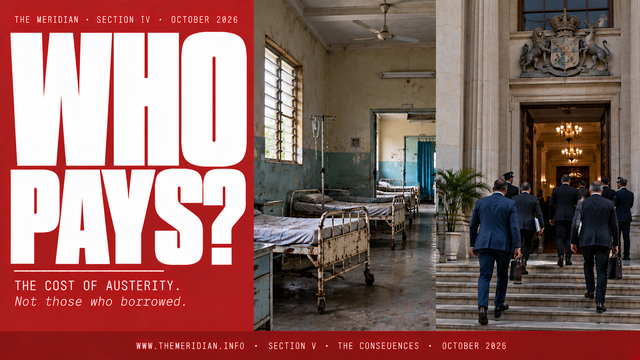
Austerity is presented as a necessary correction. It is not applied to those who borrowed. It is applied to those who use the services the borrowing financed. The nurse who did not take out the sovereign bond pays for the adjustment. Here is the mechanism, the evidence across five documented cases, and the IMF's own admission that the costs may outweigh the benefits.
The logic of austerity is presented as arithmetic: the government has spent more than it earned, and the gap must be closed. What this framing conceals is a distributional question that the arithmetic does not answer: who closes the gap? The government that overspent does not bear the cost. The institution that required the adjustment does not bear the cost. The creditors who lent the money receive their interest payments as a first claim on government revenue before the adjustment even begins. The cost falls on the users of public services -- healthcare, education, social protection, public pensions -- who are disproportionately people who did not borrow the money, did not negotiate the programme, and have no mechanism to contest the terms.
This is not a moral abstraction. It is a documented mechanism operating across every case in this edition where sovereign debt has required adjustment. In Greece it took the form of pension cuts that removed 40 to 50% of retirement income from people who had contributed to those pensions across working lifetimes. In Zambia it took the form of health and education spending reductions in a country where those budgets were already among the lowest in the region relative to need. In Ghana it took the form of losses imposed on domestic pension funds -- on the retirement savings of workers -- as a condition of IMF support. In Pakistan it means that over 50% of the federal budget goes to debt service before a rupee reaches a school or a hospital. The adjustment always falls somewhere. It falls on the same people.
The mechanism is structural. Austerity requires a government to reduce its deficit. The government's options are to raise revenue, reduce spending, or some combination. Revenue increases are politically contested and take time to generate yield. Spending reduction is faster and more controllable. The categories of spending most amenable to rapid reduction are those without a hard contractual claim: healthcare budgets, education budgets, social protection payments, public sector wages and pensions. These are also the categories that disproportionately serve lower-income populations. The distributional consequence of the mechanism is not an accident. It is the product of which fiscal levers are available and which constituencies can resist their use.
Greece between 2010 and 2018 is the most thoroughly documented austerity case in recent history, precisely because its adjustment occurred within the European Union's statistical and institutional framework, generating data that is unusually complete. Pensions were cut by 40 to 50% in some categories. Hospital budgets were reduced to levels that produced documented medicine shortages: Médecins Sans Frontières, an organisation whose mandate is disaster and conflict medicine, operated programmes in Greece to provide healthcare to Greek citizens who could not access it through the public system. GDP fell by approximately 25% over the adjustment period. Youth unemployment reached approximately 60%. (Source: European Commission / IMF Troika programme documents; MSF Greece; World Bank / Eurostat)
The people who experienced these outcomes were not those who had borrowed. Greece's sovereign debt had been accumulated by a succession of governments and had financed public expenditure that included genuine public services as well as genuine inefficiencies and corruption. The pensioner whose income was cut by 45% had contributed to the pension system across a working life. The young person who could not find work at 60% youth unemployment had not negotiated the sovereign bond terms. The patient who could not access medicine had not designed the fiscal deficit. The adjustment requirement was externally set and was the same for all Greek citizens regardless of their role in producing the conditions that required it.
In Pakistan, the fiscal arithmetic of debt service leaves approximately 1.2% of GDP for health spending, one of the lowest ratios in the world for a country of Pakistan's size and complexity. This is not a policy choice in any meaningful sense. It is the residual after debt service obligations are met. A government that spends over 50% of its federal budget on debt service before allocating anything to healthcare, education, or infrastructure is not making a deliberate health policy decision. It is implementing the unavoidable consequence of a debt structure that it inherited, accumulated under external constraint, and cannot exit without IMF support that itself requires continued fiscal consolidation. (Source: IMF / Pakistan Ministry of Finance 2025; WHO 2025)
Ghana's 2023 domestic debt restructuring imposed losses on the pension funds of Ghanaian workers. These pension funds held Ghanaian government bonds because Ghanaian financial regulation required them to hold a proportion of their assets in domestic government securities. The government subsequently restructured those securities -- reduced their value -- as a condition of the IMF programme. The workers whose retirement savings were in those funds lost a portion of those savings. They had not chosen to lend to the government. They had complied with a regulatory requirement. The loss fell on them because they were the domestic creditors available to bear it. (Source: IMF Ghana Extended Credit Facility 2023)
"The IMF's own researchers wrote in 2016 that fiscal consolidation increases inequality and that the costs may outweigh the benefits in some cases. The institution continued to require fiscal consolidation as a programme condition. The gap between what it knows and what it requires is the space in which the cost falls."
In June 2016, three IMF Research Department economists, Jonathan Ostry, Prakash Loungani, and Davide Furceri, published a paper in the IMF's Finance and Development journal under the title "Neoliberalism: Oversold?" The paper argued that fiscal consolidation -- austerity -- increases income inequality, and that the costs of austerity in terms of reduced output and increased inequality may in some cases outweigh the benefits in terms of reduced debt. The paper was published by the IMF's own research department in the IMF's own publication. (Source: Ostry, Loungani, Furceri, Finance and Development, IMF, June 2016)
The paper did not change IMF programme design in any systematic way. The programmes that followed it continued to require spending reductions and revenue increases as conditions of disbursement. The quarterly reviews continued to monitor compliance. The 2023 Ghana programme, the 2023 Sri Lanka programme, the 2024 Kenya programme, and the ongoing Pakistan programme all required fiscal consolidation as a central condition. The gap between what the IMF's own research acknowledges about austerity's costs and what the IMF's programme operations require of debtor governments is the space in which the costs documented in this article are generated.
1. Debt service is senior. Interest payments on sovereign debt are a first claim on government revenue. They are paid before anything else is funded. The fiscal space available for public services is whatever remains after debt service. In Pakistan, that is less than half the budget. In Kenya, it is less than two thirds. The people who use public services bear the consequence of the senior claim held by creditors they did not choose.
2. Public services are the available fiscal lever. A government under adjustment pressure cannot easily reduce defence spending in an insecure region, cannot default on debt service without triggering the crisis it is trying to avoid, and cannot raise taxes faster than the economy generates taxable income. The fastest and most controllable fiscal lever is public service spending. Public service spending is disproportionately consumed by lower-income populations. The distributional consequence is structural, not incidental.
3. The people who pay cannot exit the system. A wealthy household can substitute private healthcare for a deteriorating public system, private schooling for an underfunded state school, and private pension provision for a reduced public pension. A low-income household cannot. The cost of austerity falls fully on those who depend on the public services being cut, and the people who depend most fully on those services are those with the least capacity to absorb the loss.
The fiscal adjustment that austerity produces is real and in many cases necessary: governments that spend more than they earn for extended periods accumulate debt that eventually becomes unsustainable. The argument in this article is not that fiscal adjustment is never required. It is that the distribution of the cost of that adjustment is not determined by arithmetic. It is determined by power: by who holds the senior claim, who can exit the public system, who can resist the specific measures proposed, and who cannot.
The pensioner in Greece whose income was cut by 45% had no senior claim. The Ghanaian worker whose pension fund was restructured had no IMF vote. The Pakistani child born in a hospital that cannot afford medicines has no mechanism to contest the debt service priority that consumed the health budget before she arrived.
The $348 trillion in global debt will be adjusted. Some of it is already being adjusted. The question that no debt architecture currently answers is not whether the adjustment is necessary but whether the cost of it must always fall on the same people: those who did not borrow, who did not negotiate, who have no voice in the institution that requires the adjustment, and who have no exit from the services that the adjustment cuts.
Add comment
Comments