Billions Borrowed, Promises Recycled, Pipes Leaking and Now Two Water Tanks to Save the Nation
Nearly six decades of independence. Financing from every major development institution on earth. Election after election promising water around the clock. And in 2026, the government's solution is a Rs 15,000 subsidy for two tanks and a pump.
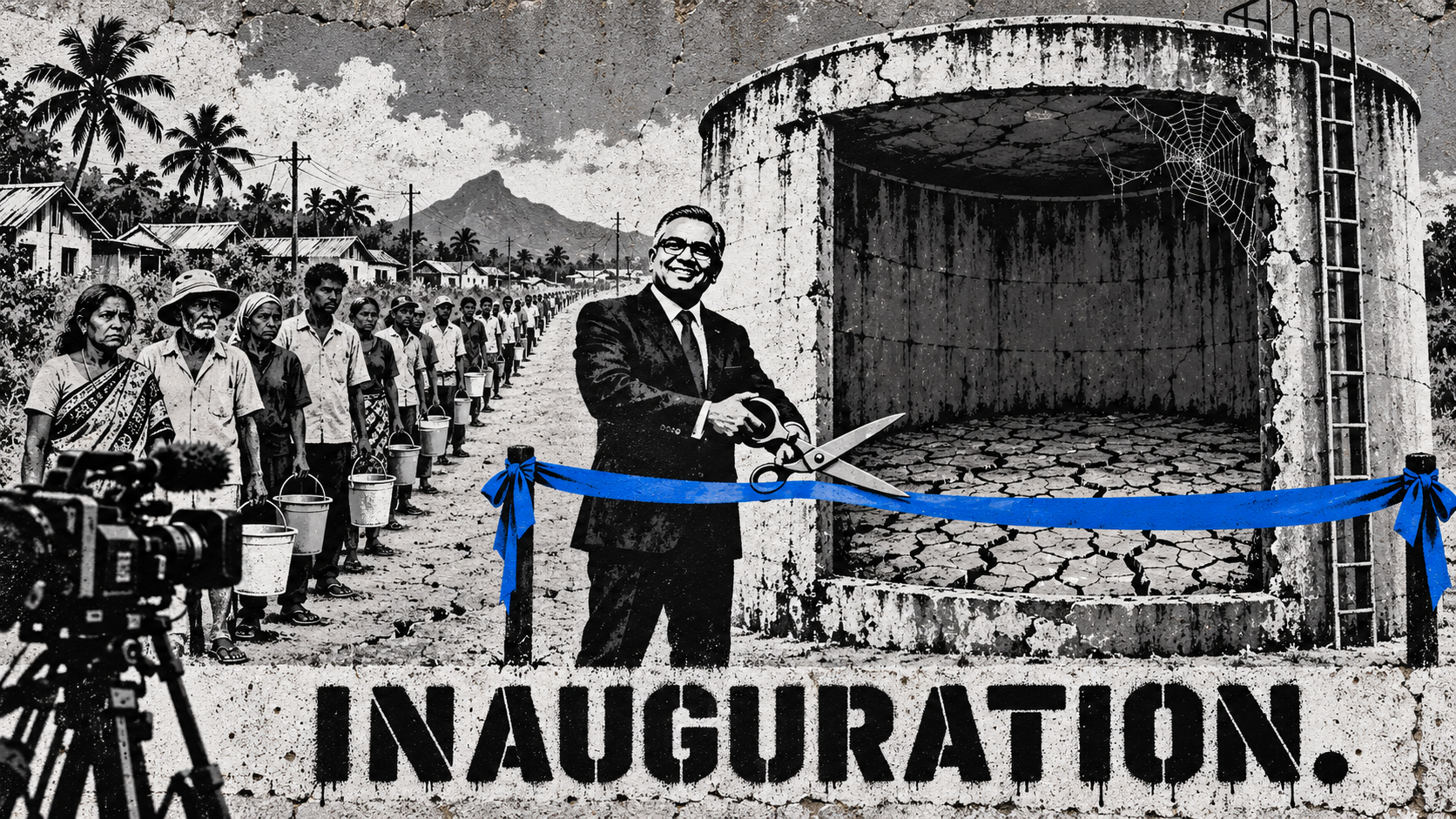
The remarkable Republic of Mauritius. A country surrounded by water. A country blessed with rainfall, rivers, reservoirs, and natural resources. A country that has attracted foreign financing worth billions of rupees to develop and improve its water infrastructure. And yet, in 2026, thousands of households continue to organise their daily lives around the possibility that water might eventually arrive.
Elsewhere in the world, people check the weather forecast before leaving home. In Mauritius, people check the CWA timetable before deciding whether they can take a shower. It is your responsibility to listen to any announcement made by the CWA, regardless of whether you are allowed to listen to the radio at work or use your mobile phone for any announcements. However, should you need to pay your CWA bills, you will be hassled through emails, SMS, and constant reminders through MyT Money.
And when water arrives unexpectedly, it should be celebrated as a national event. Because reliable water supply has apparently become one of the country's most ambitious long-term aspirations. But the real scandal is not simply that water remains unreliable. It is the extraordinary history of money, promises, planning, political declarations and unfinished business stretching back almost to independence.
1968: Independence, Hope and the Beginning of a Very Long Wait
Mauritius gained independence on 12 March 1968 under Sir Seewoosagur Ramgoolam. The country inherited enormous developmental challenges. Roads, housing, healthcare, education, and public utilities all required investment. International financial aid became an important part of national development. World Bank historical records confirm substantial British development aid in the early independence years, alongside smaller contributions from France, the United States, and international institutions.
However, the available historical accounts do not separately establish how much of that early assistance was specifically spent on water distribution. That distinction matters. Because the purpose of this investigation is not to invent billions where the records do not support them. It is to establish what was financed, by whom, under which government, and what happened afterwards. And the documented water infrastructure story becomes particularly interesting during the following decade.
1978: The First Great Discovery — Mauritius Has Leaking Pipes
On 8 June 1978, under the government of Sir Seewoosagur Ramgoolam, the African Development Bank approved 4 million Units of Account for the Port Louis water supply project. The overall project cost was recorded as 28.3 million Units of Account. Its objectives included reducing interruptions to water supply, repairing leakage problems and improving distribution.
Yes. In 1978, international lenders were already being asked to help Mauritius address leaking pipes and unreliable water supply. Nearly half a century later, those same problems continue to dominate national discussion. Some countries preserve historical monuments. Mauritius appears determined to preserve historical infrastructure problems. And what better way to honour the past than to ensure that future generations experience precisely the same inconveniences?
The 1980s: More Financing, More Planning, More Consultants
During the early 1980s, Mauritius benefited from French cooperation on water resource planning. Japanese technical cooperation followed, with JICA engineering studies during the late 1980s and early 1990s addressing Port Louis water supply, dams, pipelines, and treatment infrastructure. The World Bank's own completion report for a historical water supply project records an estimated project cost of US$18.22 million and a final cost of approximately US$17.62 million. The Bank Group financed approximately 69.2 per cent of the final cost, with a government loan to the CWA of approximately US$5.42 million. The Bank loan was fully disbursed by 8 November 1989.
This is particularly significant. Unlike a political announcement about money that might eventually be spent, the World Bank completion report records an actual completed financing operation. And yet, as the years passed, the same national problems persisted. Different decades. Different governments. Different lenders. But a remarkably familiar conversation. There is insufficient water. The pipes are ageing. More investment is required. And, naturally, another plan must be prepared.
“One might reasonably wonder whether Mauritius has produced more studies about water than some countries have produced water.”
1989 to 2000: From Master Plans to More Master Plans
By 1989, the African Development Fund had approved approximately 911,841 Units of Account for wastewater master planning in Mauritius and Rodrigues. This was during Sir Anerood Jugnauth's premiership. French development cooperation also supported treatment capacity improvements, while Japanese technical studies continued into the early 1990s. Then, under Navin Ramgoolam's government, Japan provided a ¥4.538 billion loan in 1998 for environmental sewerage and sanitation.
These projects were not all concerned with household drinking water. Some dealt with wastewater, sanitation and the protection of water resources. But they form part of the wider history of international financing of Mauritius's water sector. The remarkable feature is not that successive governments did nothing. Projects were undertaken. Facilities were built. Studies were commissioned. The remarkable feature is that the underlying problems proved so extraordinarily resistant to political promises.
2002: Europe Arrives with €20 Million to Help Stop the Leaks
On 20 December 2002, during the premiership of Sir Anerood Jugnauth, the European Investment Bank signed a €20 million financing agreement for the CWA Reduction of Non-Revenue Water project. This was not a vague proposal. It was specifically concerned with reducing water losses and improving the distribution network. Twenty million euros. More than two decades ago. For reducing water losses. The Mauritian government's own 2002/03 capital budget also recorded allocations for upgrading district water distribution, including Rs 20 million for the eastern district system and Rs 55 million for the Mare aux Vacoas water supply programme.
One might have expected the early 2000s to mark a decisive turning point. Unfortunately, a World Bank diagnostic published in 2016 later described the EIB-supported technical assistance programme as having achieved limited performance improvements. And the country continued to experience intermittent water supply. So, there it was. An international loan. Foreign expertise. Technical assistance. And years later, a national water system still struggling with the very problems the financing was intended to address. Perhaps the water was simply not informed that improvements had been financed.
2006 and 2007: More Millions for the Wider Water Sector
During Navin Ramgoolam's administration, the OPEC Fund for International Development provided a US$4 million loan in 2006 for the Pailles Guibies sewerage project. In June 2007, the African Development Bank approved a further US$20.75 million loan for the Plaines Wilhems sewerage programme. The wider programme involved the European Union, European Investment Bank, China and Mauritian government financing. Its total estimated cost was approximately US$200.27 million.
These figures must not be confused with money spent repairing drinking water pipes. Sewerage and sanitation are important public services, but they are not the same as delivering reliable drinking water to household taps. That distinction is particularly important when governments announce large infrastructure budgets. A citizen without water cannot take a shower using the total estimated cost of a sewerage project. No matter how impressive the amount sounds.
2012: China Finances Bagatelle Dam
On 1 March 2012, under Navin Ramgoolam's government, China Eximbank committed RMB 580 million, a concessional loan, for the Bagatelle Dam project. The dam was intended to strengthen water availability for Port Louis, parts of Plaines Wilhems and western regions of Mauritius. Construction was completed in June 2017, under Pravind Jugnauth's government. AidData records that the Chinese loan was fully disbursed by October 2017.
This is a particularly interesting example of how political credit works. One administration negotiates financing. Another administration completes the project. And the population is expected to decide which politicians deserve the applause. Meanwhile, the dam is supposed to serve the public, not a political party. The relevant question is whether the investment improved water availability and whether the distribution network could deliver that water reliably. Because storing water in a dam and delivering it to a kitchen tap are two very different achievements.
2014: The Promise of Water, Twenty-Four Hours a Day
Then came the 2014 general election. The Alliance Lepep presented its programme under the title: “Gouverner pour le Peuple avec le Peuple.” And among its commitments was an extraordinarily attractive promise. Water distribution throughout Mauritius, twenty-four hours a day, every day, by the end of the government's mandate. A wonderful promise. A necessary promise. A promise that would have transformed the daily lives of thousands of Mauritians. But by the end of the mandate, universal uninterrupted water supply had not been achieved.
Perhaps the manifesto should have carried a small disclaimer. Twenty-four hours a day, subject to availability, infrastructure conditions, reservoir levels, and future political announcements. Or simply that twenty-four no longer means twenty-four hours a day. Still, the political slogan was magnificent. And the public continued waiting, and they kept “Viré Mam.”
2019: The Same Promise, Freshly Recycled
In 2019, the Alliance Morisien returned with another electoral manifesto. And what did it promise? Continued efforts towards water distribution 24 hours a day, seven days a week, across Mauritius. More pipe replacement. More reservoirs. Better treatment infrastructure. Improved water resource management. In other words, much of what had already been promised five years earlier was simply and intelligently repeated.
There is something almost environmentally admirable about this. Mauritius may struggle with water conservation. But political promises are certainly recycled. The pipes may be ageing. The roads may be deteriorating. The reservoirs may be running low. But the promises remain as fresh as ever.
2023: France and Saudi Arabia Open Their Chequebooks
In December 2023, under Pravind Jugnauth's government, the French Development Agency provided a financing package of €202 million. That included a €200 million public policy loan and €2 million in grant support for technical aid. The programme was intended to strengthen water sector management, improve access to drinking water and support institutional reforms in Mauritius and Rodrigues. The French agency itself acknowledged that more than half the drinking water produced was being lost within the distribution system and that investment had fallen behind over several decades.
One may want to read that carefully. After decades of international aid, the country still had a distribution system in which more than half the treated water was being lost or otherwise not accounted for. And in September 2023, Saudi Arabia signed a US$70 million loan agreement for the Rivière des Anguilles Dam, intended to strengthen water security in the south. An important project. An expensive project. And another opportunity to prove that financing is not the same thing as delivery.
2024: The National Audit Office Reveals the Uncomfortable Numbers
Budgeted: Rs 6.917 billion
Actually disbursed: Rs 2.730 billion
Disbursement rate: 39.5 per cent
Undisbursed: more than Rs 4.1 billion in planned expenditure
That is not evidence that Rs 4.1 billion was stolen. But it is evidence of a serious gap between financial planning and implementation. Where did the money go? Mauritius has become exceptionally good at announcing what it intends to spend. It has been rather less convincing at showing that all those intentions have been translated into completed infrastructure.
The World Bank's diagnostic also recorded approximately Rs 619.4 million in identifiable pipe renewal expenditure and Rs 1.769 billion in network expansion expenditure between 2006 and 2015. Substantial sums were spent on distribution infrastructure long before the present crisis. So why does the problem continue? Because money alone does not repair pipes. Proper procurement does. Competent engineering does. Effective supervision does. Maintenance does. And accountability certainly helps.
2024: A New Government, a New Slogan, an Old Problem
Then came the 2024 general election. The Alliance du Changement campaigned with the message: “Nou pei se nou priorite.” Our country is our priority. The alliance criticised the outgoing government's record, including its failure to deliver reliable water around the clock. It promised change, better infrastructure, stronger management, and improved public services. And, once again, water was presented as a national priority.
The irony was almost irresistible. The previous government had promised reliable water. The incoming government criticised it for failing to deliver. And now, nearly two years later, households are being encouraged to install more water tanks. A change of government does not automatically produce a change in water pressure. A new minister does not automatically repair an old pipe. And a new slogan does not magically fill a reservoir.
2025: India Provides Yet Another Major Pipeline Credit Facility
In March 2025, under Navin Ramgoolam's government, a government-backed Indian credit facility was formalised for the CWA's pipe replacement programme. The State Bank of India records a credit line of ₹487.60 crore, widely reported as approximately US$58 million or Rs 2.6 billion at the time. The programme was intended to replace approximately 100 kilometres of ageing pipes, with some Mauritian announcements referring to a wider scope of around 114 kilometres.
Reporting at the time indicated that the financing arrangement had already been under discussion in October 2024, shortly before the previous government lost office. Another project crossing political administrations. Another opportunity for competing claims of credit. And another reason to separate who started a project from who signed, implemented, and completed it. By February 2026, the State Bank of India's project documentation was still recording procurement-related developments. The agreement is real. The financing is identifiable. But the public needs evidence of completed work. Not merely the announcement of another loan.
2026: The Miracle of the Two Water Tanks
And now, comes the grand finale. After nearly six decades of independence. After financing from international development banks. After loans from China. After aid from Japan. After European financing. After French loans and grants. After Saudi development financing. After Indian credit facilities. After decades of water infrastructure projects. After election after election promising reliable supply. The latest highly visible solution is two water tanks and a pump. Extraordinary.
On 9 October 2026, the government extended its water tank and pump grant scheme to households without existing storage tanks. The announced support provides approximately Rs 10,000 for two tanks, Rs 4,000 for a pump and Rs 1,000 for fittings. A possible Rs 15,000 public subsidy per eligible household. Providing water storage to households facing irregular supply is not inherently a bad policy. For many families, particularly vulnerable households, it may be extremely useful. But it is not a permanent solution to defective national infrastructure. A tank stores water. A pump moves water. Neither creates water. And when the CWA cannot provide sufficient pressure or supply, two empty tanks remain two empty tanks. A rather expensive monument to a service that has failed to arrive.
The Boreholes, the Tanks and the Business of Public Generosity
The present minister, Patrick Assirvaden, has spoken about emergency measures involving boreholes and additional water sources. The government has announced the planned use of nine boreholes to reinforce supply to the Mare aux Vacoas distribution area. According to his recent radio remarks, the minister also discussed acquiring access to boreholes from certain private owners. Readers are entitled to ask about the exact terms. Were the boreholes purchased? Leased? Provided voluntarily? Was compensation paid? Who negotiated the arrangements? And where are the relevant agreements?
10,000 households: Rs 150 million
25,000 households: Rs 375 million
50,000 households: Rs 750 million
100,000 households: Rs 1.5 billion
These are illustrations, not official forecasts of actual spending. But if eligibility is expanded regardless of income, households with considerable financial means may also benefit from public assistance. Why should a wealthy household receive the same subsidy as a pensioner struggling to purchase basic necessities? And then comes another interesting question. Who manufactures the tanks? Who imports the pumps? Who supplies the fittings? Who receives the sales revenue? Are any participating suppliers commercially connected to individuals involved in the relevant decisions? The difference between legitimate business and questionable preferential treatment is transparency, competition, and the absence of undisclosed conflicts of interest. Perhaps the government should publish a complete supplier register. Then the public would not have to guess who benefits.
The CWA Board: Qualifications, Responsibility and Accountability
Who is responsible for overseeing an institution that has struggled with persistent water losses and intermittent supply for decades? The Central Water Authority has a board, senior management, technical departments and political oversight. Surely the public is entitled to expect expertise in engineering, infrastructure management, finance, procurement and public administration. Yet the most important issue is not simply whether a board member has an impressive title. It is whether the collective leadership has the necessary competence to deliver results.
How many members have substantial experience managing water distribution systems? How many have overseen successful infrastructure renewal programmes? How many understand the operational consequences of non-revenue water? And what performance targets have been imposed upon them? Political appointment does not automatically confer technical expertise. Nor does it automatically prove incompetence. But responsibility for public utilities should involve more than attending meetings, making announcements and explaining shortages. If the institution repeatedly struggles to deliver its essential service, leadership must answer for the outcomes. Not merely celebrate the announcements.
The Pipe Repair That Requires Another Pipe Repair
A pipe bursts. Water begins escaping. A resident complains. A reference number is issued. The resident waits. Another complaint is made. Another explanation is offered. Perhaps there are no contractors available. Perhaps the work has been scheduled. Perhaps another department must intervene. Eventually, the repair team arrives. The road is excavated. The pipe is repaired. The road is left in a worse condition than before. Eventually, asphalt is applied. And for a glorious 48 hours, everything appears normal.
Then the damp patch returns. A little seepage. A small puddle. And before long, the same familiar stream appears. The repair has apparently developed a sequel. And naturally, the sequel requires another contractor, another excavation, and another expenditure. This is the extraordinary circular economy of Mauritian water infrastructure. The same problem can potentially generate multiple repairs. The same road can be excavated repeatedly. And the same taxpayer can finance the consequences. The public is entitled to ask whether repairs are pressure tested, inspected and subject to warranties. Because when a contractor's work fails shortly after completion, accountability should not evaporate along with the water.
The Industrial Tank and the Thirsty Neighbours
In certain residential areas, complaints have been raised about commercial operations allegedly storing substantial quantities of water while nearby households struggle with irregular supply. Questions have also been raised about whether some operations possess the appropriate permits. Those concerns require proper investigation rather than assumptions of illegality. But the underlying question remains legitimate. How can a commercial operation apparently secure enough water to replenish an enormous industrial tank while neighbouring families struggle to obtain sufficient water for ordinary domestic needs?
Are the water sources the same? Are private tankers involved? Are commercial permits and water abstraction permissions in order? And is there an appropriate system for protecting essential domestic supply during shortages? These questions deserve answers. Because access to water should not depend on commercial influence, personal connections or the ability to create political embarrassment. And yet some residents have reportedly felt compelled to make considerable public noise before their complaints receive attention. A functioning public service should respond to legitimate complaints without requiring intervention from a politician. A minister should not have to become the country's most senior plumber.
The Real Cost: How Much Reached the People?
After all the financing, loans, grants, and political announcements, one question matters more than any other. How much money actually improved the water supply of households that were previously receiving little or no reliable water? The evidence does not yet provide a complete lifetime figure. But it does provide enough information to justify serious scrutiny. The National Audit Office recorded Rs 2.730 billion disbursed through the government pipe replacement programme between 2010 and June 2024, against Rs 6.917 billion budgeted.
Yet no consolidated public account has been established showing precisely how many previously underserved households gained continuous water supply from each of these investments. And that is a serious accountability gap. It is not enough to say that billions were borrowed. It is not enough to say that kilometres of pipes were replaced. It is not enough to say that reservoirs were constructed. The ultimate measurement is whether households receive reliable water. Because citizens cannot wash their hands with a financing agreement. They cannot prepare meals with a ministerial statement. And they certainly cannot bathe using a photograph of a newly inaugurated reservoir.
The Great Electoral Water Recycling Programme
In 2014, the Alliance Lepep promised water around the clock by the end of its mandate. In 2019, the Alliance Morisien again promised continued efforts towards water around the clock. In 2024, the Alliance du Changement criticised the previous government's failure and promised improvements. And in 2026, the government is extending a scheme to help households store water because the supply remains unreliable. Different governments. Different slogans. Different manifestos. Different ministers. Yet the same basic problem.
“Perhaps Mauritius should stop referring to these as electoral promises. Perhaps they should be classified as political heirlooms. Passed from one government to another. Carefully polished before each election. Displayed proudly during campaigns. And returned to storage afterwards.”
The Final Drop of Water
Mauritius has achieved remarkable progress since independence. It has developed its economy, expanded education, strengthened its international relationships, and attracted substantial investment. Yet one of the most basic responsibilities of government remains unresolved for many households. Reliable water. Not a luxury. Not an electoral favour. Not a gift from a minister. A basic public service.
After nearly sixty years of independence, decades of foreign aid, repeated loans and countless promises, the population deserves more than another announcement. It deserves a transparent account of what was borrowed, what was spent, what was built and what actually improved. It deserves properly repaired pipes. It deserves competent oversight. It deserves fair distribution. It deserves roads that are not repeatedly destroyed by defective repairs. It deserves emergency assistance that does not become a permanent substitute for functioning infrastructure. And above all, it deserves accountability from every government that has presided over the problem. Because the true measure of success is not how many water tanks are distributed. It is how many households no longer need them.
The next time a politician announces another billion rupees for water infrastructure, readers should ask what happened to the previous billions. The next time a minister promises a permanent solution, readers should ask for a deadline and measurable results. And the next time a political party promises water twenty-four hours a day, perhaps the electorate should ask whether the promise comes with a warranty. After all, the people of Mauritius have already financed the infrastructure. They have financed the repairs. They are financing the loans. And now they may be financing the tanks.
The politicians have had decades to perfect their promises. Surely the people deserve the same dedication towards perfecting the water supply. Because in Mauritius, the promises flow freely. The loans continue arriving. The political speeches never seem to run dry. Unfortunately, the same cannot always be said of the water. And perhaps that is the greatest irony of all. After nearly sixty years of independence, the most ambitious dream of many Mauritian households is not a luxury home, an expensive car or an overseas holiday. It is something considerably simpler. To open a tap and find water. Not tomorrow. Not after the next election. Not after another loan. Not after another press conference. Today.
“Because the people do not need another political performance. They need a shower. And preferably one that does not require an appointment with the Minister of Energy and Public Utilities.”
— Jim Browning, The Meridian, October 2026
All financial figures cited in this article are drawn from publicly available records including World Bank completion reports, African Development Bank project documentation, AidData, National Audit Office reports, and official government budget allocations. The Meridian welcomes responses from the Central Water Authority, the Ministry of Energy and Public Utilities, and the Office of the Prime Minister.
© The Meridian 2026 / © Jim Browning 2026. All rights reserved.This article is part of The Meridian Live News series, published alongside the October 2026 edition: “$348 Trillion in Debt. Who Do We Owe It To. And Who Will Pay.” Primary sources: African Development Bank project records; World Bank completion reports and 2016 diagnostic; AidData; National Audit Office Report 2024; JICA technical cooperation records; European Investment Bank financing documentation; French Development Agency (AFD) press releases December 2023; State Bank of India credit line documentation; Government of Mauritius capital budget allocations 2002/03; Alliance Lepep electoral manifesto 2014; Alliance Morisien electoral manifesto 2019; Alliance du Changement electoral manifesto 2024. The Meridian is an independent publication.
Add comment
Comments