The Climate Exposure
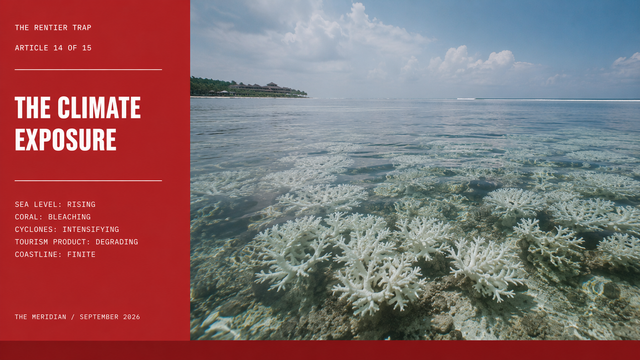
In March 2025, 80 per cent of corals in Mauritian waters were bleached, according to Pierre Edgard Daniel Marie, Director of the Mauritius Oceanography Institute. In April 2024, NOAA confirmed Mauritius within the fourth global coral bleaching event. Sea surface temperatures around Mauritius have risen 0.16 degrees Celsius per decade since 2003, surpassing the bleaching threshold of 27.5 degrees. Sea levels rose at 3.8 millimetres per year between 1987 and 2014. This is not a future projection. This is the present condition of the natural infrastructure on which the Mauritian tourism model is built. The Meridian Intelligence Desk examines the physical exposure of an economic model whose primary asset is already being degraded.
The Mauritius tourism model, documented in Article 8 of this edition, is built on three natural assets: the lagoon, the reef, and the beach. The lagoon is defined by the reef that creates it. The beach is maintained by the sediment and coastal protection that the reef provides. The reef is alive. Alive reefs are temperature-sensitive. Sea surface temperatures around Mauritius have been rising since the instrumental record began, and the scientific documentation of what that rise is doing to the reef that defines the tourism product is precise, current, and publicly available from the institutions responsible for monitoring it. This article presents that documentation in the same analytical register as every other article in this edition: primary sources, named institutions, verified figures. The climate exposure of the Mauritian economic model is not a matter of future risk assessment. It is a present reality measurable in the percentage of bleached corals in Mauritian waters in March 2025.
On 15 April 2024, the United States National Oceanic and Atmospheric Administration, in partnership with the International Coral Reef Initiative, confirmed that the world was in the midst of its fourth global coral bleaching event, the most extensive on record. NOAA's official press release confirmed widespread bleaching across the Indian Ocean basin including, specifically named, Mauritius, Tanzania, Kenya, the Seychelles, Tromelin, Mayotte, and off the western coast of Indonesia. From 1 January 2023 to 30 September 2025, bleaching-level heat stress had impacted approximately 84.4 per cent of the world's coral reef area and mass coral bleaching had been documented in at least 83 countries and territories, according to NOAA Coral Reef Watch's status update of September 2025.
Mauritius is home to approximately 250 species of coral, according to documentation cited in Mongabay's October 2025 investigation into Mauritius coral restoration. In March 2025, ocean heat waves bleached 80 per cent of corals in Mauritian waters, according to Pierre Edgard Daniel Marie, Director of the Mauritius Oceanography Institute, the primary national scientific body responsible for marine monitoring. This figure was stated directly by the MOI Director to Mongabay in October 2025. It is an institutional statement from the director of the competent Mauritian scientific authority, not an estimate or a model projection. Eighty per cent of the coral in Mauritian waters was bleached in a single season.
The scientific context for this event is documented in research published in Sea Technology magazine in October 2025, drawing on the peer-reviewed literature on Mauritius reef systems. Since 2003, sea surface temperatures around Mauritius have risen by 0.16 degrees Celsius per decade, a rate that has surpassed the bleaching threshold of 27.5 degrees Celsius and reduced the thermal margin available to coral before bleaching is triggered. Even small temperature anomalies of 1 degree Celsius or more cause mass bleaching events in Mauritian waters. The historical record of bleaching events in Mauritius, documented in the same scientific literature, shows events in 1998, 2006, 2016, and 2024. The frequency has increased from approximately one event per decade to approximately one every eight years. The trend is in the direction of more frequent, not less frequent, events.
Sea levels around Mauritius rose at an average rate of 3.8 millimetres per year between 1987 and 2014, according to peer-reviewed research cited in the Sea Technology October 2025 analysis of climate change impacts on Mauritian reefs. Over the 27-year measurement period, this represents a cumulative rise of approximately 10.3 centimetres. The IPCC Sixth Assessment Report, published in 2021 and 2022, projects that under intermediate emissions scenarios (SSP2-4.5), global mean sea level will rise by approximately 0.32 to 0.62 metres by 2100 relative to the 1995-2014 baseline. Small island developing states in the Indian Ocean are projected to experience sea level rises consistent with or exceeding the global mean, as the regional sea level response in the Indian Ocean has been above the global average in recent decades.
The coastal infrastructure of Mauritius, the resort complexes, the hotel room stock, the beach infrastructure, the marinas, and the coastal road network, was built at elevations calibrated to current sea levels, not to projected mid-century sea levels. The 85 per cent of Mauritius hotel rooms that are in the premium and luxury category, as documented by the AXYS Hospitality Industry Report 2026 cited in Article 8, are disproportionately located on the coastline precisely because proximity to the beach is the primary luxury tourism asset. This is the intersection of the economic model and the physical exposure: the highest-value segment of the tourism infrastructure is located in the zone most exposed to the sea level rise that the scientific record documents.
The relationship between reef health and tourism revenue is not theoretical. The Mauritius tourism product is sold on the basis of its marine environment: the snorkelling, the diving, the glass-bottom boat tours, the visual appeal of the turquoise lagoon defined by the living reef at its outer edge. Tourist operators, travel agents, and destination marketing agencies position Mauritius as a premium Indian Ocean destination on the strength of its natural environment. That natural environment is experiencing the documented degradation this article describes. Eighty per cent of corals bleached in a single season is not a minor aesthetic concern. It is the removal of the biological foundation of the product that premium tourists are paying, at EUR 121 per day on average according to the AXYS 2026 data, to experience.
Ocean acidification compounds the bleaching risk. Peer-reviewed research monitoring declining pH levels at sites including Bel Ombre, Bambous Virieux, and Trou aux Biches, documented in the Sea Technology analysis, indicates that the capacity of Mauritius reef systems to calcify and rebuild after bleaching events is being chemically reduced simultaneously with the thermal stress that triggers the events. The reef that bleaches under the 2024 event cannot recover as effectively under acidifying ocean chemistry as the reef that bleached in 1998 could under earlier chemical conditions. Each bleaching event is more damaging in its long-term consequences than the last, even when the intensity of the thermal stress is comparable, because the chemical environment in which recovery must occur has deteriorated.
The coral bleaching is not a future risk to be assessed. It is a present condition to be documented. Eighty per cent of Mauritius corals were bleached in March 2025. The reef defines the lagoon. The lagoon defines the tourism product. The tourism product generates 20 per cent of GDP. The chain is direct.
The IPCC Sixth Assessment Report projects that while the total global frequency of tropical cyclones may remain stable or decline slightly under climate change scenarios, the proportion of cyclones reaching Category 4 and 5 intensity is projected to increase. The physical mechanism is straightforward: warmer sea surface temperatures provide more energy to developing cyclones, intensifying the strongest storms even if the overall count does not increase. For Mauritius, located in the South Indian Ocean cyclone basin, this projection means that the storms that do reach the island will be more intense on average than the historical record. The tourism infrastructure built to the engineering standards of the 1980s, 1990s, and 2000s was not designed for the cyclone intensity projections of the 2040s, 2050s, and 2060s.
The economic consequence is concentrated in the same coastal strip that faces the sea level rise risk and that holds the majority of the premium hotel stock. A Category 4 or 5 cyclone making direct landfall on the north or west coast of Mauritius, where the highest concentration of IRS and luxury resort infrastructure is located, would produce insurance claims, reconstruction costs, and revenue interruption losses whose scale has not been systematically assessed in any publicly available Mauritius government document. The climate exposure of the tourism model is physical, concentrated, and documented by the scientific institutions responsible for monitoring it. The absence of a comprehensive climate risk assessment for the tourism infrastructure in the published record of the Mauritian government is itself a structural observation.
1. Coral bleaching: present, documented, accelerating. 80% of Mauritius corals bleached in March 2025, confirmed by the MOI Director. NOAA confirmed Mauritius within the 4th global bleaching event in April 2024. SSTs have risen 0.16°C per decade since 2003, surpassing the bleaching threshold. Bleaching events previously occurred approximately once per decade. The 1998, 2006, 2016, and 2024 sequence shows a compression of the interval. Ocean acidification is simultaneously reducing reef recovery capacity. The reef that defines the tourism product is being degraded by a process that is accelerating.
2. Sea level rise: measured at 3.8mm per year (1987-2014), projected to accelerate. The cumulative effect over the measurement period is approximately 10.3 centimetres. IPCC AR6 projects further rises of 0.32-0.62 metres by 2100 under intermediate emissions scenarios. The premium hotel stock is concentrated on the coastline. The infrastructure was built to current sea levels. The coastal zone that generates 20 per cent of GDP will be under increasing inundation and erosion pressure throughout the productive life of the infrastructure within it.
3. Cyclone intensity: rising proportion of Category 4-5 events projected by IPCC AR6. The Indian Ocean cyclone basin will produce a higher proportion of intense storms as sea surface temperatures rise. The coastal infrastructure was not engineered to the cyclone intensity projected for mid-century. The insurance and reconstruction cost of a major cyclone direct landfall on the hotel strip has not been systematically assessed in publicly available government documentation.
4. Structural observation: no comprehensive government climate risk assessment for tourism infrastructure. The physical exposure documented in this article is available from NOAA, the Mauritius Oceanography Institute, and the IPCC. It has not been assembled into a comprehensive climate risk assessment for the tourism sector in any publicly available Mauritian government document. Addressing the physical risk requires first acknowledging its scale. The data to do so is public and primary.
The Rentier Trap analysis documented across this edition identifies the structural vulnerabilities of the Mauritian economic model: the fiscal trajectory, the offshore erosion, the tourism ceiling, the monetary bind, the land displacement, the diaspora gap. Each of these is a structural economic condition. The climate exposure is different in kind. It is a physical condition. The reef does not respond to fiscal reform. The sea level does not respond to monetary policy. The cyclone does not respect the engineering standards of a 1990s resort construction.
The 80 per cent of Mauritius corals bleached in March 2025 is the intersection of the physical exposure and the economic model. The tourism product is the reef. The reef is bleaching. If the bleaching frequency continues to increase, and the scientific record indicates that it will under any realistic emissions scenario, the tourism product will be materially degraded within the productive lifespan of the infrastructure that has been built to deliver it. The IRS and PDS villas documented in Article 11 are coastal assets. The premium hotel rooms documented in Article 8 are coastal assets. The marine tourism activities that justify the EUR 121 daily spend are reef-dependent activities.
The climate exposure of the Mauritian economic model is not a future scenario. It is a present and documented condition whose trajectory is established by the instrumental record. The reef bleaching is not a modelled projection. It is an institutional statement from the Director of the Mauritius Oceanography Institute about what happened to 80 per cent of the corals in Mauritian waters in March 2025. The model has not accounted for this. It will need to.
Add comment
Comments