The Room India Must Chair: BRICS New Delhi, the West Asia Fracture, and the Question of Indian Strategic Weight
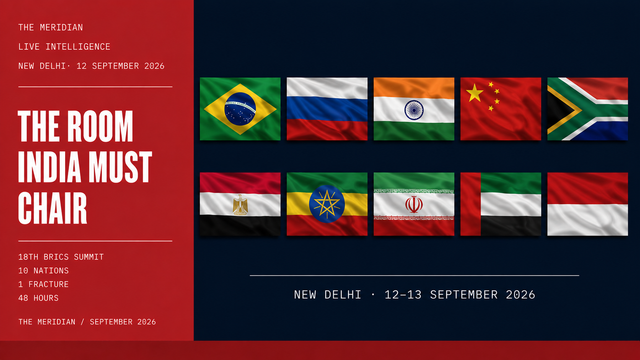
The 18th BRICS Summit opens in New Delhi on 12 September 2026. The foreign ministers' meeting has already ended without a joint communique, a first under India's chairmanship, after Iran and the UAE failed to reach consensus on the West Asia conflict. Both are attending the leaders' summit. Iran launched missile strikes on the UAE in February 2026. Chinese President Xi Jinping is expected for his first India visit in nearly seven years. Russian President Vladimir Putin is confirmed. India has committed to halting Russian oil purchases in its trade deal with Washington. The question facing New Delhi is no longer whether it can balance. It is whether balance, at this moment, is still sufficient.
The 18th BRICS Summit, which India hosts under the theme "Building for Resilience, Innovation, Cooperation and Sustainability," opens in New Delhi on 12 September 2026 as the culmination of India's year-long BRICS chairmanship. The summit brings together leaders of what is now an eleven-member grouping whose expansion has given BRICS a broader presence across Asia, Africa, the Middle East, and Latin America and has simultaneously made it more internally fractured than at any point in its history. The foreign ministers' preparatory meeting, held in New Delhi earlier in India's chairship, ended without a joint communique. India was forced to issue a chair's statement in its place, noting only that members held differing views on the Middle East situation. It was the first time the grouping had failed to produce a consensus document under India's watch. The leaders arrive on 12 September to the same unresolved fracture.
The assembly India is convening in New Delhi is without recent precedent in its internal contradictions. Iran is a BRICS member. The United Arab Emirates is a BRICS member. In February 2026, following coordinated US-Israeli strikes on Iranian nuclear facilities, Iran launched a multiday series of missile and drone strikes on the UAE and other Gulf states. The two countries are now sharing a table chaired by India, which simultaneously maintains strategic ties with Iran through Chabahar port and the International North-South Transport Corridor, deepening economic and security partnerships with the UAE, an active relationship with Israel including Prime Minister Modi's address to the Israeli Knesset on 25 February 2026 during the war itself, and a February 2026 trade deal with Washington in which India committed to halt Russian oil purchases. Russian President Vladimir Putin is confirmed for the summit. Chinese President Xi Jinping is expected, in what would be his first India visit since the Mamallapuram informal summit of 2019 and his first since the Galwan Valley clash of June 2020, the deadliest India-China border confrontation in decades.
India's foreign minister has argued that the Global South represents approximately 85 per cent of the world's population and close to 40 per cent of global GDP. The 18th BRICS Summit is India's most visible platform for that argument. It is also the platform on which the argument is most directly tested by the inability of the grouping's own members to agree on the fundamental question of who was responsible for the conflict that has destabilised the region its newest members inhabit.
The collapse of the BRICS foreign ministers' communique was not a procedural failure. It was a substantive one, and it reflects the fundamental challenge of a grouping that has expanded in geographic reach without developing the institutional architecture to manage the conflicts among its own members. Iran's Foreign Minister Abbas Araghchi used the New Delhi ministerial visit to push for a larger BRICS condemnation of the US and Israel. The UAE, which was struck by Iranian missiles in February 2026, opposed language that could undermine its ties with Washington and Tel Aviv. India, as chair, sought to avoid taking sides. The result was a chair's statement that noted differing views, reaffirmed commitment to cooperation across the grouping's pillars, and called separately for a Gaza ceasefire, humanitarian access, and adherence to international humanitarian law. The West Asia war itself, its attribution, and the responsibility for its escalation were not addressed by consensus. They could not be.
Iran's position at the foreign ministers' meeting was not only defensive. Araghchi used the New Delhi platform to signal something more forward-leaning: that India could play a greater role in bringing peace to the region given its standing with all sides. When pressed on Iran's view of India's simultaneously deepening ties with the UAE, historically a difficult relationship for Tehran, Araghchi's response was notably restrained. India's relations with other countries, he stated, were New Delhi's own decision to make. The restraint is itself a signal. Tehran needs the Chabahar route. It needs the INSTC. It needs India to remain, at minimum, non-hostile. The restraint is the price of that need.
Xi Jinping's expected attendance at the BRICS leaders' summit would mark his first visit to India in nearly seven years and his first since the Galwan Valley clash of June 2020, in which 20 Indian soldiers and four Chinese soldiers were killed in the deadliest India-China border confrontation in decades. The gap of seven years reflects the depth of the rupture that Galwan produced. The LAC, the Line of Actual Control that defines the disputed border, remains the central unresolved issue in the relationship. Border stability continues to be a key priority that both sides have cited as a precondition before any major diplomatic breakthrough.
The warming trajectory was visible at the recent SCO summit, where Modi and Xi were both present and where, according to reports, a bilateral sit-down was considered likely if not formally confirmed. Both leaders exchanged condolences over flooding and landslides on the Tibet-Nepal border that killed more than 900 people. The Tianjin SCO meeting, where Modi also held bilaterals with Putin, produced the image that went around the world: three leaders who have managed, through two years of active regional conflict and sustained Western pressure on Russia, to maintain the institutional architecture of their respective relationships with each other. The BRICS leaders' summit in New Delhi is the continuation of that architecture on Indian soil. Xi arriving with a delegation reportedly twice the size of his 2019 contingent, more than 400 officials, is not an accident of logistics. It is a signal of the scale of engagement Beijing intends to demonstrate.
India's westward strategic outreach was built on three infrastructure pillars, each of which the 2026 Iran war has disrupted to varying degrees. Chabahar port in Iran, India's primary route to Afghanistan and Central Asia and the central piece of its INSTC engagement, was directly affected by the conflict and by the tightening of sanctions pressure that followed the US-Israeli strikes. The landlocked Central Asian states have been pushed back towards reliance on Pakistani routes or Chinese Belt and Road infrastructure, undermining the strategic logic that justified India's Chabahar investment. The India-Middle East-Europe Economic Corridor, unveiled at the G20 New Delhi summit in 2023 as India's flagship alternative to the BRI, depends on Arab-Israeli normalisation and a stable Middle East. The war shattered both assumptions. IMEC is effectively frozen.
The three infrastructure pillars Chabahar, INSTC, IMEC were intended to integrate India more deeply with Central Asia, the Persian Gulf, and Europe while reducing dependence on Chinese-controlled routes. All three are now disrupted. The strategic logic that built them has not changed. The regional conditions that would allow them to function have. This is the structural context within which India is hosting the 18th BRICS Summit: a moment when its own westward strategic architecture has been damaged by a conflict among the members it is convening.
Iran's Foreign Minister told reporters in New Delhi that India could play a greater role in bringing peace to the region given its standing with all sides. The question is whether India's standing is sufficient to produce outcomes, or whether it is sufficient only to produce invitations to meetings that end without joint statements.
The underlying question that the 18th BRICS Summit poses is not about the grouping's communique. It is about India's strategic doctrine. For several decades, India has pursued what analysts describe as calibrated multi-alignment: maintaining parallel, non-exclusive relationships with Iran, the Gulf monarchies, Israel, and the United States, without formally aligning with any of them. The doctrine has served India well in conditions of moderate regional instability. It has enabled New Delhi to secure energy supplies from multiple sources, protect its large diaspora, expand trade, and open new strategic partnerships simultaneously.
The 2026 Iran war represents a qualitative change in the conditions under which multi-alignment must operate. The US-Israel-Iran confrontation has forced every regional actor to clarify its position in ways that moderate instability did not require. India's response to the US-Israeli strikes on Iranian nuclear facilities was cautious and diplomatic. Modi's address to the Israeli Knesset on 25 February 2026, during the war itself, was widely noted. India's "humanitarian window" for discounted Iranian LPG shipments, securing 500,000 tonnes to avert fertiliser shortages while maintaining 5 per cent of its energy basket from Iran without inviting penalties, reflects the structural pragmatism that multi-alignment at its most functional produces.
But a new regional architecture is forming around India regardless of its preferences. A Saudi-Turkey-Pakistan defence pact is emerging. The US is reassessing its Middle East commitments as it concentrates strategic resources on the Indo-Pacific and the China challenge. Regional powers are no longer waiting for Washington's lead. The I2U2 grouping (India, Israel, UAE, United States) and the broader concept of an Indo-Abrahamic architecture represent an emerging alternative framework that places India at the centre of a Middle Eastern security arrangement that does not require Iranian participation. The tension between that framework and India's Chabahar and INSTC dependence on Iranian cooperation is not resolvable by neutrality alone.
Modi-Xi: First formal India-China bilateral at this level since Galwan. The LAC situation remains the central agenda item. A joint statement on border management would be the most significant diplomatic output of the summit. The size of Xi's delegation signals intent. Whether that intent extends to concrete LAC commitments is the question that determines whether Tianjin warmth translates into New Delhi substance.
Modi-Putin: India committed in February 2026 to halt Russian oil purchases in its US trade deal. Putin is coming to New Delhi anyway. The relationship, described by Modi as "steadfast like the pole star," is being managed in full public view of Washington. The bilateral will be watched for signals on whether India's defence procurement relationship with Russia, historically its largest, continues to evolve under the trade deal's constraints.
Modi-Pezeshkian: Iran needs Chabahar. India needs Chabahar. The war has complicated the terms. Araghchi's restrained response to India-UAE ties in New Delhi signals that Tehran is not prepared to force a choice. The bilateral will test whether Iran's need for India gives India leverage to shape Iranian diplomatic behaviour within BRICS toward language that allows a joint statement.
The joint statement question: India issued a chair's statement at the foreign ministers' meeting. Issuing a chair's statement again at the leaders' summit would be a significant diplomatic setback for India's BRICS presidency and its claim to lead the Global South. The 48 hours of leader-level negotiations on 12-13 September will determine whether India can broker language that Iran and the UAE can both accept, or whether the fracture that produced the first failed communique produces the second.
India is not merely hosting a summit. It is hosting a test of its own strategic doctrine at the moment that doctrine is under the most structural pressure it has ever faced. The grouping India chairs contains a country that launched missiles at another member earlier this year. The bilateral it is most anticipated to produce involves a neighbour with whom India fought a lethal border skirmish six years ago. The confirmed attendee India most needs to manage diplomatically is a leader whose country India has committed to stop buying oil from in a trade deal with a third party.
The framing that India's Foreign Minister has offered, that the Global South represents 85 per cent of the world's population and 40 per cent of global GDP and that India speaks for it, is a claim that New Delhi has been building toward for years. The 18th BRICS Summit is the most prominent stage on which that claim has ever been tested. Failing to produce a joint statement at the leaders' level, in a room India has convened and chaired all year, would not disprove the claim. But it would complicate it in ways that a chair's statement cannot paper over.
Iran's Foreign Minister told New Delhi's press corps that India could play a greater role in bringing peace to the region. The question is not whether India has the relationships to play that role. It demonstrably does. The question is whether holding simultaneous, non-exclusive relationships with every party to a conflict is the same thing as the strategic weight that the moment actually requires. The next 48 hours will begin to answer it.
Add comment
Comments