Trump, Xi, Musk, Jensen Huang, and $50 Billion Worth of Banned Chips
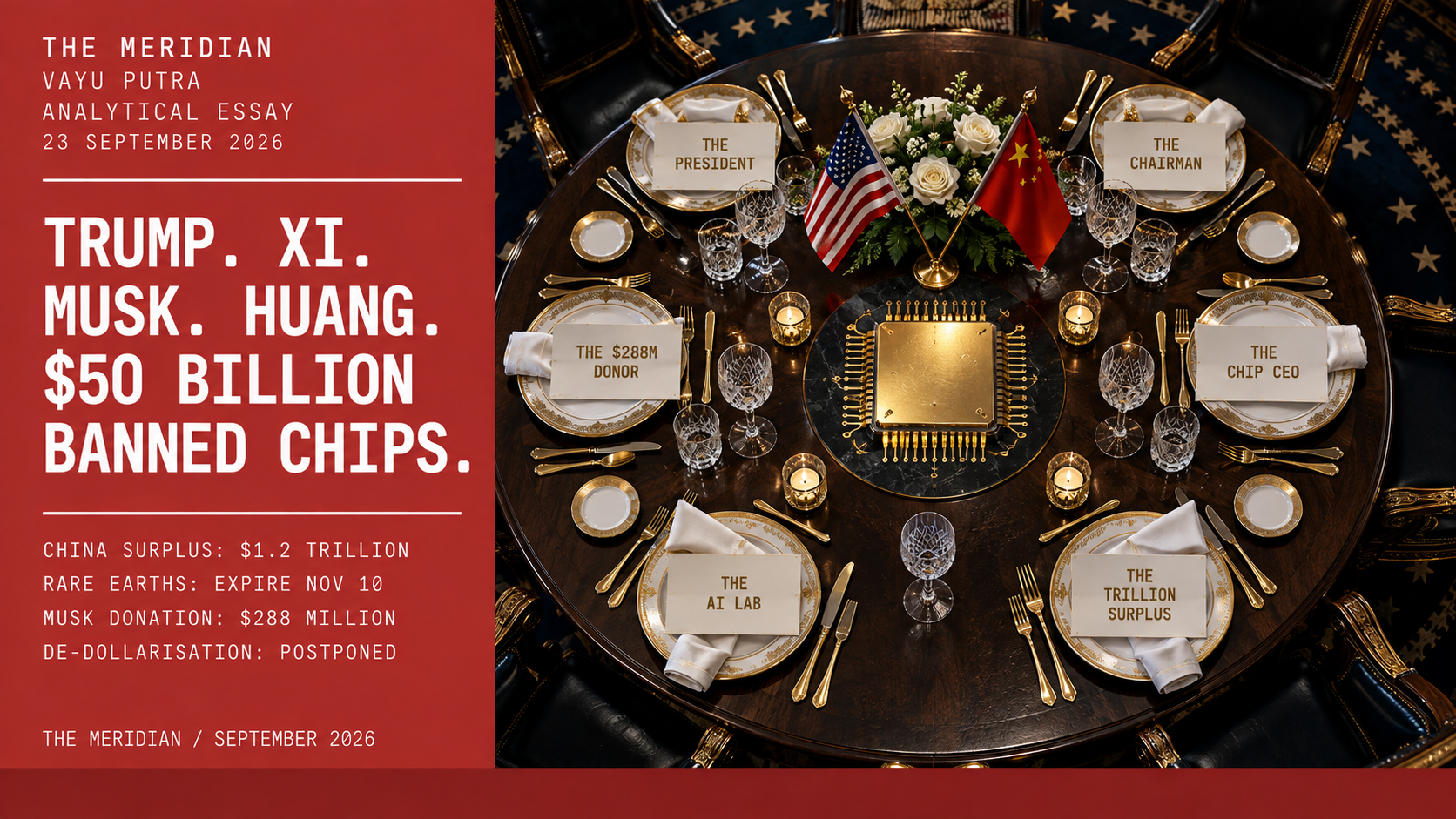
On Thursday 24 September 2026, Donald Trump hosts Xi Jinping at a White House state dinner. The guest list includes the man who spent $288 million to elect the host, the CEO whose company has $50 billion in annual revenue excluded from its own financial guidance because of chip export bans that the host loosened after lobbying, and the leaders of every major American AI company whose future depends on the rare earth minerals that the guest controls and whose export suspension expires in six weeks. I want to explain what that room actually represents, because the mainstream coverage is describing a diplomatic summit. What I see is something more precise: the moment when geopolitical competition, commercial interest, and political investment converge at a single dinner table, and the entire world economy sits in the chairs that were not offered a place.
Ten days ago, Xi Jinping sat in New Delhi as a member of BRICS, a bloc whose New Delhi Declaration criticised unilateral tariffs and coercive economic measures. Today, he is landing at Joint Base Andrews, Washington DC, where Donald Trump is personally greeting him on the tarmac, a gesture described by protocol observers as rare for an American president. Xi will sleep at Blair House, the official guest residence across from the White House. Tomorrow he will stand in the Rose Garden for a military review. Thursday he will hold a bilateral meeting with Trump and then attend a state dinner. The gap between the New Delhi Declaration and the Washington arrival ceremony is ten days and the entire distance between what BRICS says and what its most powerful member does.
I want to start with the clearest fact on the guest list. Elon Musk donated $288 million to elect Donald Trump in the 2024 election cycle, according to the Washington Post's final Federal Election Commission analysis. This makes him the largest individual political donor in American history, larger than any donor since at least 2010. The bulk, approximately $238.5 million, went through America PAC, the super political action committee Musk founded specifically for this purpose. In return, Musk became co-head of the Department of Government Efficiency, the advisory body that has reshaped American federal spending with a mandate from the president he funded.
This is not corruption in the legal sense. Super PAC donations of this scale are permitted under American campaign finance law. What it is, in the plainest political economy terms, is a transaction: capital deployed to secure access to the room where decisions are made. Musk is now in that room on Thursday, sitting at the same table as Xi Jinping, whose country manufactures the Teslas Musk sells globally, supplies the titanium and critical components SpaceX uses, and represents the largest potential market for his xAI artificial intelligence venture. The $288 million was not philanthropy. It was the entrance fee to the room where the terms of his China business relationships are discussed at the highest possible level.
Jensen Huang's position at Thursday's dinner is even more specific in its commercial implications. Nvidia's own financial guidance excludes approximately $50 billion in annual China data centre revenue because of the uncertainty created by US chip export controls. That is not a projection. It is a gap in the company's own stated forward guidance, an absence visible in the accounts of the world's most valuable semiconductor company, caused by a policy decision made in Washington that Huang has spent two years lobbying against.
The timeline of that lobbying is documented. After the Biden administration's October 2022 controls banned Nvidia's most advanced chips from China, Huang spent the following two years arguing publicly and privately that the bans were counterproductive. His argument was straightforward: if Nvidia cannot sell to China, China will build its own chips. He was right. Huawei's AI chip division is now generating approximately $12 billion in annual revenue and growing. Huang told Fox Business in May 2026 that China already has "all the chips they need" and that Huawei is "flourishing in our absence." He accompanied Trump on Air Force One to China for the May 2026 state visit, sitting alongside Elon Musk and the US Ambassador as they landed in Beijing. Trump, asked afterwards whether Huang understood where the administration stood on export controls, said: "Smart man. He knows."
After the lobbying campaign, the Trump administration lifted some restrictions in July 2025, clearing approximately ten Chinese firms including Alibaba, Tencent, and ByteDance to purchase Nvidia's H200 chips, subject to a 15% government fee on those sales. China's regulators then blocked most H200 imports anyway. Huang declined a Senate Banking Committee invitation to testify on these matters in June 2026. He is at Thursday's dinner where Trump and Xi may finalise the terms under which those chips can flow. The $50 billion gap in Nvidia's guidance is the specific commercial question sitting in the seat next to Jensen Huang at the White House table.
Trump, asked whether Jensen Huang understood where the administration stood on export controls, said: "Smart man. He knows." Huang is now at the same table as Xi Jinping, whose country represents the $50 billion market those export controls have blocked.
Xi Jinping is not arriving in Washington from a position of vulnerability. He is arriving with the most powerful commercial leverage any head of state has brought to a bilateral meeting in recent memory. China's 2025 trade surplus reached $1.189 trillion, the first time any country in history has recorded a trillion-dollar annual trade surplus. In the first eight months of 2026 alone, the surplus reached $806 billion, putting the full year on track to surpass the 2025 record. Exports to the United States surged 34.4% in August 2026, lifting China's monthly surplus with America to more than $29 billion, the widest gap since Trump returned to office.
This surplus is not built on cheap textiles any more. Exports of semiconductors almost doubled in value in 2026. High-technology product exports grew 40.7%. China is now the world's leading supplier of AI-related hardware, electric vehicle components, battery technology, and solar panels. The economy Xi is representing at this summit is not the manufacturing cost centre of the 1990s. It is the world's leading exporter of the technology that powers the energy transition, the AI revolution, and the electrification of transport. Every American company in that dinner room depends on Chinese supply chains, Chinese manufacturing capacity, or Chinese market access at some level. Xi knows this. He has spent the week making sure they know it too.
The most specific lever Xi is carrying into Washington expires on 10 November 2026. China's suspension of rare-earth export controls, which has allowed American companies to continue accessing the materials essential to AI chip manufacturing, electric vehicle motors, military equipment, and renewable energy technology, runs out in six weeks. Rare earths are not rare in geological terms. They are rare in processed, accessible form because China controls approximately 85% of global rare earth processing capacity. Every Nvidia chip that Jensen Huang sells, every Tesla that Elon Musk manufactures, every F-35 that the US Department of Defence operates, contains rare earth elements processed in China.
The November 10 expiry is not an accident of timing. It is a negotiating instrument, and it arrives at this summit with six weeks on the clock. If Trump and Xi reach a broader trade accommodation at this summit, the suspension will almost certainly be extended. If they do not, the suspension lapses, and every American technology company in that dinner room faces an immediate supply chain crisis. The CEOs at Thursday's dinner are not attending as observers of a diplomatic conversation. They are, in the most direct sense, the subject matter of the negotiation taking place around them.
I need to name something that the Western coverage of this summit has largely chosen not to examine directly. Ten days ago, Xi Jinping sat in New Delhi as part of a bloc whose communique criticised unilateral tariffs. The New Delhi Declaration, the formal output of the 18th BRICS Summit, expressed concern over the escalation of coercive economic measures and called for a rules-based multilateral trading system. The specific tariffs it was criticising were largely American. Trump's tariffs on Indian goods, on Chinese goods, on the products of developing economies that BRICS claims to represent.
Ten days later, Xi is in Washington to negotiate directly with the man who imposed those tariffs, to extend the trade truce that governs the terms under which China's $1.2 trillion export machine continues to operate, and to discuss the chip sales and rare earth flows that determine whether American AI companies maintain their technological edge over the Chinese alternatives that BRICS was implicitly defending.
I wrote in September that BRICS is a fable, that its members owe their debt in dollars, receive their remittances through Western financial infrastructure, and meet once a year to discuss replacing the system they depend on. The Washington summit is the proof of concept delivered in ten days. The de-dollarisation communique and the Washington state visit are not contradictory positions held by different people. They are the same position held by the same man, addressed to different audiences. BRICS is the speech. Washington is the reality.
I want to name the other guests at Thursday's dinner because each of them represents a specific commercial thread in the same negotiation. Jeff Bezos runs Amazon Web Services, the world's largest cloud computing provider, whose data centre hardware supply chains run through Chinese manufacturers and whose rare earth dependencies are as acute as Nvidia's. Sundar Pichai runs Alphabet, whose Google AI division is competing directly with Chinese AI models for global market share and whose DeepMind research unit needs compute at a scale that makes energy costs a strategic variable. Sam Altman runs OpenAI, whose GPT models run on Nvidia chips and whose compute costs make the price of those chips and the energy to run them the central variable in the company's commercial model. Tim Cook runs Apple, which manufactures the majority of its products in China and which has spent years trying to diversify that supply chain without finding a replacement at the quality and scale that China provides.
Every CEO at that table has a direct, documented, commercially material interest in the outcome of the Trump-Xi bilateral meeting taking place in the same building on the same day. This is not improper in a legal sense. CEOs meeting with heads of state is a normal part of modern trade diplomacy. What I am noting, as an economist watching from the Global South, is the structural reality that this dinner represents: the rules of the global economy are being negotiated in a room whose guest list was shaped by political donations, commercial lobbying, and supply chain dependency, and the countries and populations most affected by those rules are not in the room, were not invited to the room, and have no mechanism to influence what happens in the room.
The countries most affected by the outcomes of Thursday's dinner are not attending it.
The chip export controls being negotiated at this dinner determine whether Chinese AI development accelerates or slows. If Chinese AI accelerates, it automates jobs in Global South call centres, data processing operations, and back-office financial services before those countries have built the welfare architecture to absorb the displaced workers. If it slows, the same jobs are automated by American AI on the same timeline. The Global South is not choosing between these outcomes. It is receiving whichever outcome the dinner produces.
The rare earth controls being negotiated at this dinner determine which countries receive Chinese investment in rare earth processing, on what terms, and at what environmental and labour cost. The rare earth mines are mostly in Africa, Australia, and Central Asia. The processing happens in China. The decision about access to that processing is made in Washington. The communities living near the mines were not consulted.
The trade surplus of $1.2 trillion that China carries into this room was built partly by displacing manufacturing in developing economies. When China's high-technology exports surge 40.7%, some of that surge is taking market share from Indian, Vietnamese, and Mexican manufacturers who were developing their own export capacity. The terms under which that competition continues are being discussed on Thursday. The competitors are not in the room.
The Centre for Strategic and International Studies published its analysis of the Washington summit two hours before Xi's arrival was confirmed. It is worth quoting the conclusion precisely because it names what the dinner will not resolve: "The Trump-Xi summit revealed how little progress has been made on the most consequential dimensions of US-China competition: AI, cyber operations, export controls, and digital sovereignty. While trade dominated headlines, deeper technological tensions remain unresolved."
This matters for the analytical framework I have been building in The Meridian throughout September. The summit will produce an agricultural purchase pledge, a trade truce extension announcement, and photographs of Trump and Xi shaking hands in the Rose Garden. It will not resolve the AI chip export control question, because the US national security establishment and the technology industry have directly opposing interests and neither has won the internal argument. It will not resolve the digital sovereignty question, because the Pontes system the ECB switched on this week, the mBridge platform China is building, and the stablecoin framework the US is constructing through legislation are three parallel responses to the same strategic question, and a bilateral summit cannot reconcile three competing answers. It will not resolve the Taiwan arms sale question, because the $14 billion package is a domestic political constraint on the American side that Xi cannot publicly accept and Trump cannot publicly abandon.
What the summit will do is extend the current period of managed competition for another cycle, maintain the trade flows that both economies depend on, and allow the CEOs at Thursday's dinner to continue building businesses in the uncertain space between two systems that are simultaneously interdependent and adversarial. For Jensen Huang, that means another quarter of uncertainty about the $50 billion. For Elon Musk, it means another quarter of manufacturing in China while publicly positioning himself as a defender of American interests. For Xi, it means another extension of the trade truce while Huawei continues to build the domestic chip alternative that makes China less dependent on the truce he is extending.
I write about the global economy from the Global South because the Global South is where the consequences of these decisions land most heavily and are least represented in the rooms where the decisions are made. The Washington summit is the most visible example of that structural absence available in the September 2026 news cycle. The rules being discussed at Thursday's dinner, about which chips can move, which trade flows continue, which rare earths remain accessible, which AI companies can operate in which markets, will shape the economic trajectory of countries whose populations vastly outnumber the populations of the two countries hosting the dinner, and whose governments were not invited to participate in the discussion.
The $288 million that Musk spent to be in that room is the most honest accounting of what access to this level of rule-making costs. The $50 billion that Huang is seeking to recover from that room is the most honest accounting of what commercial interest is at stake in that rule-making. The $1.2 trillion that Xi is carrying into that room is the most honest accounting of the leverage that determines whose preferences the rule-making serves.
For the Global South, watching from outside the room, the lesson of this dinner is the same lesson that the BRICS summit in New Delhi taught ten days ago: the rules of the world economy are made by the people in the room, and being in the room costs either $288 million, a $1.2 trillion trade surplus, or $50 billion in banned chips. The countries that have none of these are not in the room. They are living with the rules the room produces.
Add comment
Comments