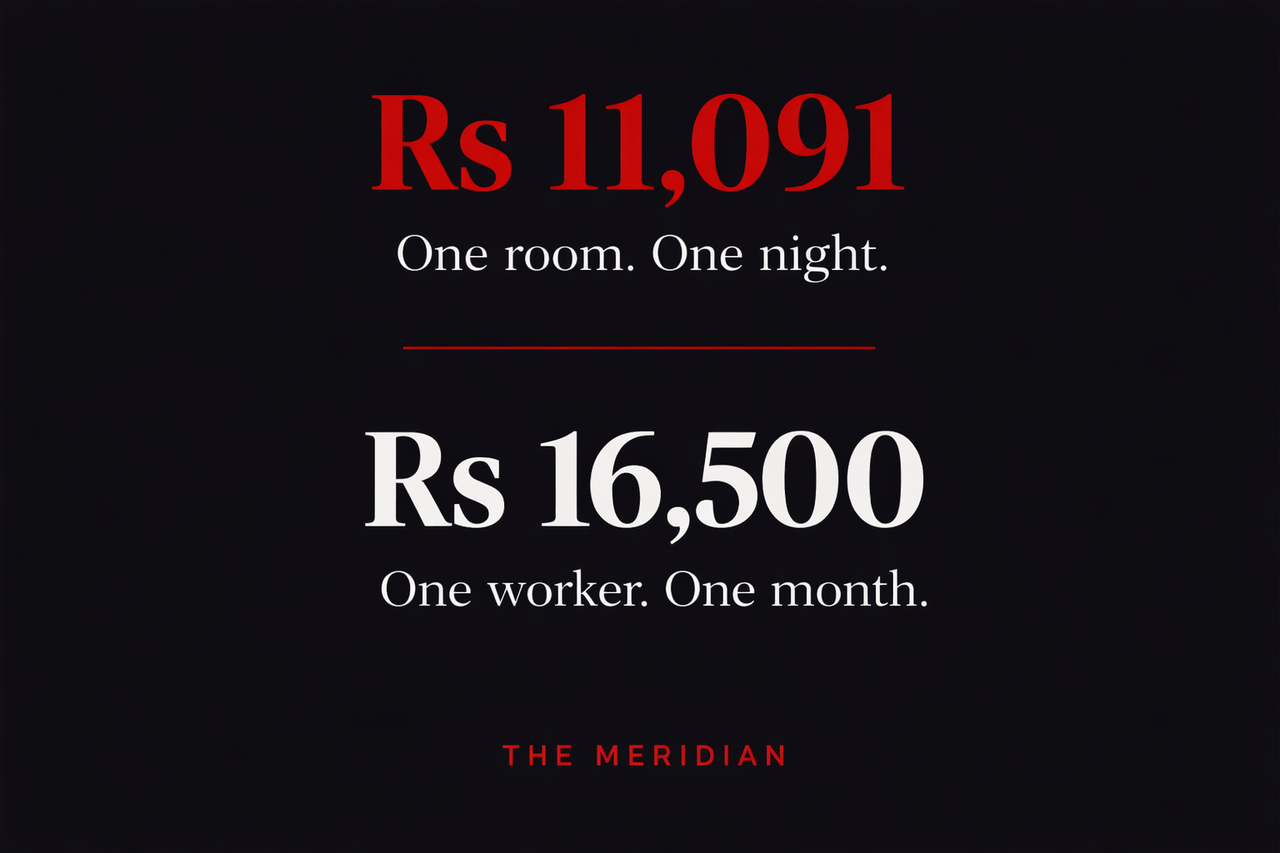
There is a number that Mauritian journalism has never published. Not because it is secret. It is in the audited financial reports of a publicly rated company, crosschecked against a government gazette. The number is this: in the financial year 2023 to 2024, the average nightly room rate across Beachcomber's eight beachfront resorts, four five-star and four four-star, was Rs 11,091. The statutory national minimum wage that an employer is legally required to pay a full-time worker is Rs 16,500 per month. One room. One night. Sixty-seven per cent of one worker's monthly wage. Twenty working days of labour to afford a single night in the hotel where that worker cleans rooms, serves food, and maintains the grounds.
This is not an injustice that emerged accidentally from market forces. It is the arithmetic of a political architecture built over fifty years and maintained by the deliberate alignment of currency policy, energy dependency, wage legislation, and state subsidy. Each element of this architecture has been reported on separately and superficially by Mauritian media. None of it has ever been connected into the mechanism it actually constitutes. This article connects it.
Fourteen countries in West and Central Africa use the CFA franc. Their currencies are pegged to the euro, the peg is backed by French Treasury deposits, and the mechanism is explicit, named, and extensively debated in the academic literature on post-colonial monetary subordination. The mechanism is visible because it is formal. What Mauritius operates is less visible because it is informal. But the economic function is structurally identical.
Mauritius runs a managed float, not a fixed exchange rate. The Bank of Mauritius does not publish a target rate. It intervenes in the foreign exchange market selectively, and the official position is that the exchange rate is determined by market forces. This is technically accurate. It is also structurally misleading, because the market forces in question are not random. They are the direct consequence of a political choice to keep 90.9 per cent of primary energy import-dependent on foreign currency, which ensures a permanent structural demand for US dollars and a permanent structural pressure on the rupee to weaken.
When the rupee weakens, something happens in both directions simultaneously. On one side, Mauritian exports, primarily tourism and offshore financial services, become cheaper in foreign currency terms. A European tourist finds Mauritius more affordable. A hotel owner selling rooms in euros or dollars receives more rupees for every euro earned when converting revenues. On the other side, the Mauritian worker paid in rupees finds that every imported good, every litre of fuel, every tin of food, costs more in rupees. The weak rupee is a transfer mechanism. It moves purchasing power from workers paid in rupees to capital owners earning in hard currency. It does this silently, through the exchange rate, without legislation, without announcement, and without any Mauritian newspaper headline.
The weak rupee is not a market accident. It is a transfer mechanism that moves purchasing power from workers paid in rupees to capital owners earning in hard currency. It operates silently, through the exchange rate, without legislation and without any headline.
The fossil fuel dependency sustains this mechanism. Mauritius imports 90.9 per cent of its primary energy, 61.1 per cent from petroleum products and 29.8 per cent from imported coal, as recorded in Statistics Mauritius Energy and Water Statistics 2024. Every month, the State Trading Corporation and the Central Electricity Board must purchase millions of US dollars on the local foreign exchange market to pay international fuel suppliers. This structural dollar demand depresses the rupee continuously. If Mauritius built a sovereign solar grid and reduced that structural demand, the rupee would face less downward pressure. Hotel revenues in rupee terms would fall relative to current levels. Hotel profit margins in rupee terms would compress. The mechanism that transfers purchasing power from workers to capital owners would weaken. This is why the solar transition has not happened. The political class that governs Mauritius is the same class that benefits from the mechanism the fossil fuel dependency sustains.
The CFA franc zone keeps fourteen African economies in monetary subordination to France through an explicit mechanism: the peg is formal, the guarantee is contractual, and the loss of monetary sovereignty is documented. Critics of the CFA argue, correctly, that it keeps member states from devaluing to restore competitiveness and traps workers in low-wage equilibria that serve French capital.
Mauritius achieves the same distributional outcome through a different architecture. There is no explicit peg. There is no French Treasury guarantee. But the structural energy import dependency creates a permanent downward pressure on the rupee that functions identically to a managed weak-currency policy. Export capital earns in hard currency and converts into rupees at favourable rates. Workers earn in rupees and buy imported goods at unfavourable rates.
The critical difference: the CFA mechanism is visible and debated. The Mauritian mechanism is invisible and unreported. Invisibility is not the same as absence. The distributional consequences are the same. Only the accountability is different.
The Beachcomber group did not arrive in the tourism sector as an external investor. New Mauritius Hotels Limited, which operates the Beachcomber portfolio, traces its origins to the Franco-Mauritian elite that owned the sugar estates before and after independence. When sugar became uncompetitive, the estates were not dismantled. They were converted. The beachfront land that once grew cane now accommodates the resorts. The same families, the same land, a different product. This is the colonial succession in its most literal form: not dispossession reversed, but dispossession extended into a new extractive model.
The hotel industry in Mauritius rests on three structural advantages that it did not build and did not earn. The first is the land, former estate land sold or leased at prices set before the tourism boom it subsequently created. The second is the labour, a workforce educated at public expense, kept at minimum wage by statutory design, and topped up to survival level by taxpayer-funded transfers the hotel industry does not contribute to proportionately. The third is the currency, kept weak by fossil fuel import dependency that the hotel industry actively resists disrupting because a stronger rupee would compress its foreign-currency profit margins.
The arithmetic published above is therefore not a coincidence of market pricing. It is the measurable output of a system designed to produce it. The room costs Rs 11,091 per night because the market for luxury tourism in a weak-rupee destination generates that rate. The worker earns Rs 16,500 per month because the statutory wage floor was set at a level that keeps the labour cost of running the hotel internationally competitive. The ratio between these two figures, 67 per cent of a monthly wage for one night, is not an accident. It is the gap between what the market charges for the product and what the political system allows the producer to be paid for making it.
The CSG Income Allowance is presented in official communications as a government support mechanism to protect low-income workers. That characterisation is not false. But it is incomplete in a way that changes the entire political meaning of the instrument.
The statutory minimum wage of Rs 16,500 is what an employer is legally required to pay. The government acknowledges, through the existence of the allowance itself, that Rs 16,500 is insufficient for a worker to maintain an adequate standard of living. It therefore adds a taxpayer-funded supplement of Rs 2,000 to Rs 3,500 per month, bringing total worker income to Rs 18,500 to Rs 20,000. This supplement is paid by the state, not the employer. The hotel industry, which employs a substantial workforce at or near the minimum wage floor, receives from this arrangement a benefit that is never described as a subsidy but functions precisely as one: the taxpayer pays part of its wage bill.
The political economy of this arrangement is extraordinary in its clarity once named. The hotel earns Rs 11,091 per room per night. It pays its lowest-grade workers Rs 16,500 per month. The state tops that up with Rs 2,000 to Rs 3,500 of public money because the wage is insufficient. The hotel's margin is protected. The worker receives survival-level income. The public finances absorb the difference. And the IMF, auditing the public finances, identifies the transfer programmes as unsustainable expenditure to be reduced as part of fiscal consolidation. The prescription would cut the state supplement that makes a structurally insufficient wage sufficient. The hotel's statutory obligation of Rs 16,500 would remain unchanged. The worker would absorb the cut.
Layer one: The rupee is kept structurally weak by fossil fuel import dependency. Hotel revenues in foreign currency convert to more rupees. The hotel margin expands in rupee terms. The worker's rupee wage buys fewer imported goods. Transfer: from worker's purchasing power to hotel's profit margin, administered by the exchange rate.
Layer two: The statutory minimum wage is set at a level below survival. The state adds a taxpayer-funded CSG Income Allowance to bridge the gap. The hotel does not pay this supplement. The public finances do. Transfer: from general taxpayers to hotel operating margin, administered as a welfare programme.
Layer three: The hotel industry occupies beachfront land converted from former sugar estates at prices that preceded the tourism value the industry subsequently created. The land appreciates. The FDI data shows 73 per cent of all foreign direct investment flows into real estate. The capital gain accrues to the estate succession. Transfer: from public land value creation to private capital accumulation, administered as property rights.
Layer four: The IMF, auditing the fiscal position, identifies the state transfers as unsustainable. It prescribes their reduction. If implemented, the CSG allowance is cut. The hotel's obligation is unchanged. The worker absorbs the loss of the supplement that made the insufficient wage survivable. Transfer: from worker income to fiscal consolidation target, administered as structural adjustment.
The point of absorption in every layer is the same person. The minimum-wage worker who cleans the room, serves the breakfast, and maintains the pool. They absorb the weak rupee. They absorb the insufficient statutory wage. They absorb the withdrawal of the state supplement. They absorb the IMF prescription. The hotel absorbs nothing. It is the beneficiary of each layer, not the subject of any adjustment.
The International Monetary Fund is not wrong about Mauritius. Its Article IV Consultations correctly identify that general government gross debt at 86.5 per cent of GDP, as confirmed by the National Audit Office Annual Report for the financial year ended 30 June 2025, is at dangerous levels for a small island developing state. It is correct that the Basic Retirement Pension trajectory is unsustainable given the approaching demographic cliff. It is correct that untargeted transfers create fiscal risk. The IMF's analysis is technically sound. What it cannot do, and what its mandate explicitly prohibits, is name the political architecture that produced the fiscal imbalance it is measuring.
Article IV Section 3(b) of the IMF's Articles of Agreement directs the Fund to respect member states' rights to choose their own economic policies. The decision to remain 90.9 per cent fossil fuel dependent rather than building a sovereign solar grid is a political decision. The decision to set the minimum wage below survival level and supplement it with public funds is a political decision. The decision to allow 73 per cent of foreign direct investment to flow into real estate rather than productive manufacturing is a political decision. The Fund can identify the fiscal consequences of these decisions. It cannot, by its own governing rules, recommend that the government make different political choices.
The result is a recurring structural absurdity. The IMF identifies fiscal stress. It prescribes consolidation. The government partly complies, partly defers, and borrows more to manage the political cost of compliance. The underlying political architecture that produced the fiscal stress is untouched. The same conditions generate the same imbalance. The IMF returns four years later with the same diagnosis and the same prescription. This is not IMF failure. It is the collision between an institution designed to address fiscal arithmetic and a problem that is fundamentally political. The Fund is the right auditor for the wrong question.
The IMF's Articles of Agreement, specifically Article IV Section 3(b), instruct the Fund to respect member states' domestic policy choices. This is not a technicality. It is the political foundation of the Fund's legitimacy as a multilateral institution. If the IMF prescribed solar energy investment instead of pension reform, it would be crossing from fiscal advice into political prescription, a line it cannot cross without undermining its relationships with every member government simultaneously.
The Fund can say: your debt is too high, your transfers are unsustainable, your fiscal position requires consolidation. It cannot say: your debt is too high because you chose fossil fuels over solar energy, your transfers are unsustainable because your minimum wage was deliberately set below survival level to subsidise hotel margins, and your fiscal consolidation will fail unless you change the political architecture that produced the imbalance.
Why it matters for Mauritius: The government can point to IMF consultations as external validation of its fiscal management while implementing none of the structural changes the fiscal position actually requires. The IMF validates the arithmetic. The political architecture continues. The debt compounds. This cycle has been running since at least 2015 when IMF Working Paper 15/126 first formally identified the pension trajectory as unsustainable.
Sir Anerood Jugnauth's bagasse cogeneration policy of the 1980s was, in structural terms, the most intelligent energy policy Mauritius has ever produced, and not because it was environmentally visionary. It was intelligent because it understood the political economy of the oligarchy and designed around it rather than against it. The state could not simply order the sugar estates to stop burning fossil fuels. The estates controlled the Independent Power Producer contracts. They controlled land. They controlled political financing. A frontal assault on their energy interests was not available to any government that needed their acquiescence to function.
SAJ's insight was to give the oligarchy a new revenue stream that happened to serve the national interest. The estates already had the waste product, bagasse. They already had the land and the infrastructure proximity to the grid. The government created IPP contracts that made burning bagasse more profitable than burning nothing, and in doing so converted the oligarchy's self-interest into a national energy benefit. The estates were not reformed. They were incentivised. The result was a genuine, world-leading renewable energy policy that reduced fossil fuel dependency without requiring the elite to sacrifice anything. Their margin improved. The country's energy sovereignty improved simultaneously. This is the only template that has ever worked in Mauritius, and it has not been repeated in forty years.
The solar transition requires the same political architecture. The hotel estates now own the precise assets required for large-scale solar deployment: extensive land, often on elevated terrain with optimal solar exposure, existing grid connections, and capital reserves from decades of tourism revenue. A government that offered the hotel industry IPP contracts for solar farms on estate land, at rates that matched or exceeded current fossil fuel generation costs, would be doing exactly what SAJ did with bagasse. Converting elite self-interest into national energy sovereignty. The hotel industry's FX revenue would partially offset the rupee's structural weakness. A stronger rupee would raise the USD cost of Mauritian tourism slightly, which a premium positioning strategy absorbs. The state's energy import bill would fall. The structural dollar demand that depresses the rupee would ease. The mechanism would begin to weaken.
This policy has not been proposed because the governments that could implement it are funded by the same industry whose IPP coal and oil revenues it would displace. The Navin Ramgoolam administrations chose instead the architecture of the patch: the CSG allowance on wages, the STC price stabilisation on fuel, the MIC bailout on private sector fragility. Each patch requires public debt. Each debt compounds. The structure beneath every patch remains intact and continues generating the conditions that make the next patch necessary. This is not incompetence. It is a rational response to the incentives created by a political system in which the oligarchy's financial support is indispensable to the cost of winning elections.
SAJ could not order the estates to abandon fossil fuels. So he gave them a reason to prefer something better. That is the only model that has ever worked in Mauritius, and it has not been used since.
The arithmetic in this article is not hidden. The Beachcomber Average Daily Rate is in a credit rating agency's published rationale for a publicly listed company. The minimum wage figure is in a government gazette. The energy import dependency is in a Statistics Mauritius publication. The IMF working paper on pension reform has been publicly available since 2015. The Bank of Mauritius publishes monthly foreign exchange data. None of this required a source with a concealed identity, a leaked document, or access to classified government files. It required reading the public record and connecting what the public record says.
Mauritian journalism has operated for decades in two modes that together ensure the mechanism is never named. The first mode is taboo. The ownership structures of the hotel industry, the genealogy of the Franco-Mauritian estate succession, the relationship between hotel industry financing and political party funding, the wage architecture and who designed it: these are subjects that Mauritian media outlets consistently decline to pursue with the rigour they deserve. The taboo is not enforced by law. It is enforced by the proximity of advertisers to editorial decisions, by the social networks that connect media owners to the elite they might otherwise investigate, and by a culture in which naming the structural beneficiary of an inequality is treated as more inflammatory than describing the inequality itself.
The second mode is sensation. When a political crisis erupts, when a government falls, when a coalition fractures, when a scandal breaks, Mauritian journalism pours its full attention into the drama of the event without ever asking what structural condition produced it. The Berenger resignation in 2026 was covered as a political drama. The question that would have given the drama meaning, why does every Ramgoolam-Berenger alliance fracture in the same way, in the same fiscal conditions, producing the same result, was not asked. The 1999 Kaya riots were covered as a social crisis. The structural economic exclusion of the Creole community from the wealth generated by the tourism and offshore sectors was not mapped. The 2022 inflation surge was covered as a cost of living crisis. The fossil fuel dependency that transmitted the global shock directly into the household was not named.
The consequence is an electorate that understands the symptoms of its condition with great emotional precision and the causes with almost none. Each election, the electorate replaces one coalition with another, each promising relief from conditions that neither has ever addressed structurally. The journalism that should provide the connective tissue between the symptom and the cause instead provides the amplification of the symptom and the personalisation of the blame. The mechanism continues. The players rotate. The audience, informed only of the drama and not of the script, believes it is watching something new.
The room costs what the worker earns in a month. This is not a metaphor for inequality. It is a measured ratio produced by a functioning system. The weak rupee makes the room cheaper for the tourist and the wage worth less for the worker simultaneously. The minimum wage is set below survival and supplemented with public money so the hotel's statutory obligation remains internationally competitive. The taxpayer funds the supplement. The IMF audits the fiscal position and recommends cutting the supplement. The hotel's margin is never the subject of adjustment. The worker absorbs every layer of the architecture.
This system was not built by accident and it will not be dismantled by sentiment. The only precedent for breaking it is SAJ's bagasse policy: find the instrument that makes the oligarchy's self-interest and the national interest temporarily identical, create it in legislation, and move before the political window closes. The solar grid is that instrument. Hotel estate land, existing grid connections, IPP contracts priced to match fossil fuel revenues: the template exists. The political will to use it has not existed in any government since 1982. Until it does, the rupee will continue to do the work that politics cannot admit to, transferring purchasing power from the person who cleans the room to the person who owns it, silently, through the exchange rate, one working day at a time.
Mauritian journalism owes the public a reckoning with why it chose not to show them this for fifty years. The arithmetic was always available. The connection was never made. The mechanism ran undisturbed, covered by taboo from one direction and sensation from the other, while the country accumulated the debt of every structural decision that was never taken and every reform that was replaced with a patch.