Who Controls What Mauritius Eats: The Small Number of Distributors Between the Port and Your Plate, and the Price You Pay for Having No Alternative
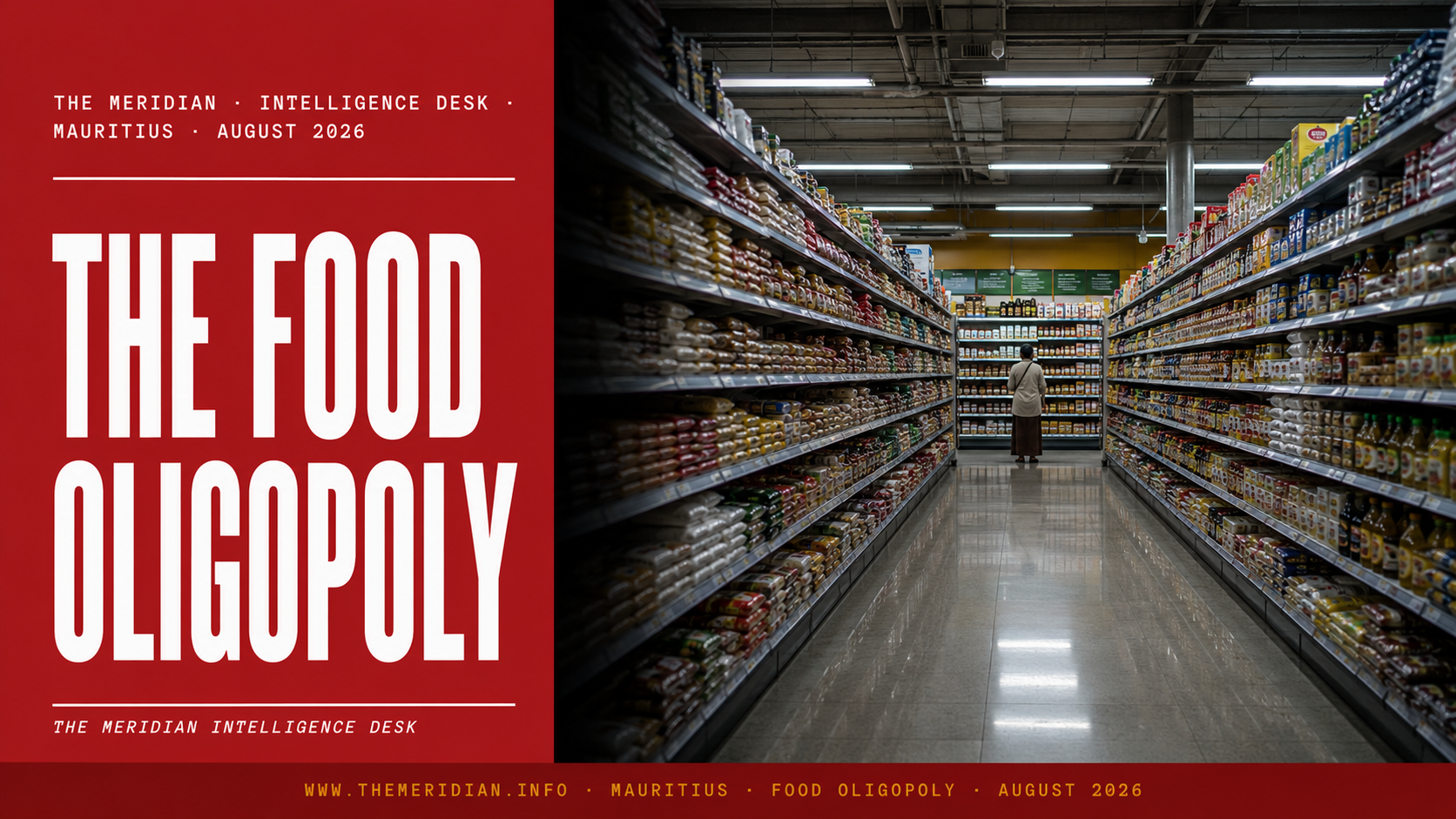
Mauritius has an overall food self-sufficiency ratio of approximately 25 per cent. The remaining 75 per cent arrives through the port. In 2024, agricultural imports accounted for $1.6 billion, representing 24.4 per cent of total Mauritian imports. Once that food clears the port, it enters a distribution architecture dominated by a small number of large conglomerates whose origins predate independence, whose reach extends from the warehouse to the supermarket shelf, and over whom the Competition Commission of Mauritius has no power to impose fines for abuse of a dominant position. The contradiction this article examines is not that the food is imported. It is that the chain between the port and the plate is controlled by so few, on terms set by so few, and corrected by no one with the institutional authority to require otherwise.
Begin with a specific fact from the United States Commercial Service Country Commercial Guide for Mauritius, published in 2024. Mauritius is a net food importer with an overall self-sufficiency ratio of approximately 25 per cent. France was the leading source of Mauritian agricultural imports with a market share of 11 per cent, followed by South Africa at 10 per cent, India at 8 per cent, Australia at 6 per cent, New Zealand at 5 per cent, and Spain at 5 per cent. Mauritius imported rice, meat and fish, fruits, pulses, milk and dairy products, fresh and frozen vegetables, coffee, tea, spices, cereals, oil, beverages, wheat, and food preparations. Six source countries supply more than 45 per cent of all agricultural imports. The food arrives on ships. It clears customs. It enters a distribution system. And then it reaches you. The question this article asks is what happens between the port and your plate, who controls that journey, and what the evidence shows about the cost of that control.
The observable contradiction is this. Mauritius describes itself as a market economy with competitive private enterprise. The BTI 2026 report on Mauritius notes that private enterprise is generally able to operate freely in Mauritius and that the government has pursued a policy of economic liberalisation for several decades. The OECD Investment Policy Review for Mauritius 2024 observes that lobbying from the private sector is so influential that it can prevail over the legislative process.
Yet when a Mauritian household goes to the supermarket to buy yoghurt, they are buying from a brand owned or distributed by one of a small number of conglomerates. When they buy frozen chicken, they are buying from a producer that also imports, distributes, and in some cases retails the product. When they buy dairy products, beverages, imported processed food, or household staples, they are buying goods whose passage from the port to the shelf has been managed by an architecture of exclusive distribution agreements, vertically integrated supply chains, and conglomerate ownership structures that the Competition Commission of Mauritius has been explicitly designed without the authority to challenge.
This is the structural condition the article examines. Not that the conglomerates are corrupt — the evidence does not establish that. Not that the food is poor quality — the evidence does not establish that either. But that a market economy in which the distribution of 75 per cent of the food supply passes through a small number of hands, where those hands also own the warehouses, the distribution fleets, the wholesale cash-and-carry operations, and in some cases the retail outlets, and where the regulatory body charged with protecting competition explicitly lacks the power to fine anyone for abusing a dominant position, is not a market in the sense that the theory of competitive markets requires.
The first constraint is historical. The conglomerates that dominate Mauritian food distribution did not acquire their market position through anti-competitive conduct in the legal sense. They acquired it through colonial-era mercantile accumulation, post-independence diversification, and the structural advantages that accrue to any business that was present and capitalised when an island economy was developing its import infrastructure. IBL, founded in 1830 as Blyth Brothers and Ireland Fraser, predates the Mauritian state by 138 years. Its position in food distribution is not the product of market manipulation. It is the product of institutional continuity across two centuries of commercial activity in a market too small to easily accommodate a well-capitalised new entrant.
Innodis was founded in 1973 as Mauritius Farms Ltd, a family-run poultry business, and grew through exclusive supply agreements with global food majors including Nestlé, Lactalis, Bel, Barilla, and Kimberly-Clark. It now services more than 5,700 outlets nationwide — hypermarkets, supermarkets, corner shops, food chains, and hotels — with an annual group revenue of over Rs 6 billion. The exclusive distribution agreement is the key structural instrument. When a global food major grants exclusive Mauritian distribution rights to a single local distributor, it concentrates market power in that distributor not through monopoly legislation but through contractual arrangement. A competing Mauritian distributor cannot carry Nestlé products if Nestlé has granted exclusive rights to Innodis. The market concentration is produced by a private contractual instrument, not by a legal monopoly, and it is therefore not directly challengeable under competition law even where competition law exists.
The second constraint is regulatory. The BTI 2026 report states precisely: the Competition Commission cannot impose fines for abuse of a monopoly, does not receive mandatory notification of mergers, and lacks authority over state-owned enterprises. This regulatory design means that if a food distributor uses its dominant market position to price above what a competitive market would permit, there is no institutional mechanism with the authority to investigate, establish the fact, and impose a meaningful sanction. The Competition Commission can investigate. It can recommend. It cannot fine.
A market in which 75 per cent of food arrives through a small number of hands, where exclusive distribution agreements concentrate brand access in single players, and where the regulatory body explicitly cannot fine anyone for abusing a dominant position, is not a market in the sense that economic theory requires. It is a managed distribution system with competitive aesthetics.
The Competition Commission of Mauritius was established under the Competition Act 2007. Its stated purpose was to prevent anti-competitive practices, promote competitive markets, and protect consumer welfare. The correction it was designed to address was real: a small island economy in which the same conglomerates that built their position under colonial and early post-independence conditions continued to dominate market after market without structural accountability.
The correction failed at the point of institutional design. A competition authority that cannot impose fines is not a competition authority in the operational sense — it is an advisory body. The decision to establish the Commission without fine-imposing powers was not an accident of drafting. It was a legislative choice made in a Parliament where the business interests that would be subject to those fines have, by the BTI 2026's own account, lobbying influence capable of prevailing over the legislative process. The correction was designed to address the appearance of the problem without addressing the structure that produced it.
The July 2025 merger of ENL and Rogers to form NewENLRogers illustrates the consequence of this design choice. The merger combined two of Mauritius's largest diversified conglomerates, with combined interests spanning real estate, logistics, food distribution, financial services, and hospitality, into a single listed entity. The Competition Commission did not receive mandatory notification of this merger because mandatory merger notification is not required under Mauritian competition law. The institutional mechanism that would assess whether the combination of two major distribution players creates conditions inimical to competitive pricing of food and consumer goods was not triggered because it does not exist.
The evidence suggests three things. First, that food inflation in Mauritius reached 7.6 per cent year on year in April 2026, according to OECD data, driven primarily by price increases in food and non-alcoholic beverages. The OECD describes Mauritius as an open economy significantly exposed to external price shocks — which is true. But an open economy in which 75 per cent of food arrives through a concentrated distribution architecture is not exposed to external price shocks in the same way a competitive market is. In a competitive market, falling global prices produce competitive pressure on distributors to pass reductions on to consumers. In a concentrated distribution architecture, the relationship between global price movements and retail price movements depends on the pricing decisions of the distributors — decisions made without competitive constraint from below and without regulatory constraint from above.
Second, that the self-sufficiency ratio of 25 per cent, combined with the exclusive distribution agreement architecture, produces a structural condition in which Mauritian consumers cannot meaningfully substitute. If the price of Nestlé products distributed by Innodis increases, the consumer cannot choose to buy from a competing Nestlé distributor — there is none. They can choose a different brand. But in multiple food categories, the number of brands available at the Mauritian retail level is itself constrained by the concentration of distribution rights in a small number of players. The substitution mechanism that competitive theory relies on to discipline pricing is limited not by consumer preference but by market architecture.
Third, and most consequentially for the broader extraction economy argument this edition is making, the food distribution architecture is not separable from the wider conglomerate structure of the Mauritian economy. IBL, Innodis, and NewENLRogers are not food distribution companies that also do other things. They are diversified conglomerates in which food distribution is one cluster among several, cross-subsidised by and cross-subsidising the others. A conglomerate that owns retail outlets, distribution infrastructure, warehousing, and exclusive brand rights across multiple food categories does not price its food distribution operations in isolation. It prices them in the context of the total conglomerate return. The food distribution margin contributes to a return that also includes the real estate, the logistics, the hospitality, and the financial services. The consumer paying food prices in a Mauritius supermarket is not paying the price that a competitive food distribution market would produce. They are paying a component of a conglomerate pricing strategy whose optimisation logic is not visible to them and not accountable to any regulatory body with enforcement power.
The OECD Investment Policy Review for Mauritius 2024 made a finding that should be read alongside the BTI 2026's Competition Commission assessment. Lobbying from the private sector is so influential that it can prevail over the legislative process.
These two findings together describe a specific institutional condition. The regulatory body designed to protect competition cannot impose fines on those who abuse dominant market positions. The private sector interests that benefit from this regulatory design have sufficient lobbying influence to prevail over the legislative process that would be required to change it. The condition that produces the problem is the condition that prevents the correction.
This is the elastic political cycle applied to food distribution. The reform that would address the structural concentration of Mauritius's food supply chain requires legislative action. The legislative action requires political will to resist the interests of the conglomerates that benefit from the status quo. Those conglomerates have the lobbying power to prevent that political will from translating into legislative action. The cycle continues. The food prices rise. The Competition Commission recommends. Nobody is fined.
The food distribution oligopoly in Mauritius is not a conspiracy. It is a structure. It was built over two centuries of commercial activity by firms that are today publicly listed, professionally managed, and operating entirely within the law. The evidence does not establish that they have acted unlawfully. It establishes that the law has been designed in a way that makes unlawful conduct in food distribution practically impossible to sanction even where it occurs.
The correction — the Competition Commission — was designed without fine-imposing powers in a legislative process that the OECD independently assessed as subject to private sector lobbying sufficient to prevail over the legislative outcome. The merger that combined two of Mauritius's largest conglomerates in July 2025 was not notified to the Competition Commission because mandatory notification does not exist. Food inflation reached 7.6 per cent in April 2026 in an economy where the distribution of 75 per cent of the food supply is concentrated in a small number of hands with exclusive brand rights and no meaningful competitive constraint.
The question the evidence raises is not whether the Mauritian food distribution system is corrupt. It is whether it is competitive. And the answer the evidence provides — through the self-sufficiency ratio, the exclusive distribution architecture, the Competition Commission's regulatory design, the OECD's lobbying assessment, and the food inflation rate — is that it is not competitive in the sense that the theory of markets requires to produce prices in the consumer's interest rather than the distributor's.
Add comment
Comments