The CFA Franc: How Fourteen African Nations Have Conducted Their Monetary Policy in Paris Since 1945
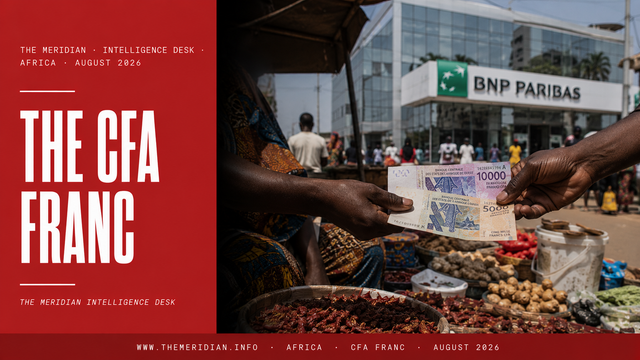
As of July 2026, three West African nations — Mali, Burkina Faso, and Niger — have expelled French troops, torn up military agreements, left ECOWAS, and created a confederal investment and development bank to prepare the ground for a currency of their own, provisionally called the sira. They are still using the CFA franc, pegged to the euro at the unchanged rate of 655.957 francs to one euro, the same rate that has prevailed since the 1994 devaluation. The name of the currency changed in 2020 from Colonies Françaises d'Afrique franc to the ECO. The peg to the euro did not change. The French guarantee of unlimited convertibility did not change. The monetary sovereignty these fourteen nations do not possess did not change. The contradiction this article examines is not that the CFA franc exists. It is that after eighty years of accumulating evidence about what it costs, it still does.
Begin with the date: 26 December 1945. The Bretton Woods conference has ended. The International Monetary Fund has been created. France, among the Allied victors, establishes the franc des Colonies Françaises d'Afrique — the CFA franc — at a rate pegged to the French franc. The stated purpose is monetary stability for the colonies. The mechanism requires that fifty per cent of the foreign exchange reserves of the member central banks be deposited in an operations account at the French Treasury. France guarantees unlimited convertibility of the CFA franc into French francs, and subsequently into euros. In exchange for that guarantee, France appoints representatives to the monetary governance bodies of the member central banks. The arrangement is presented as mutual benefit: stability for Africa, influence for France. The colonies become independent. The arrangement continues. The name changes in 2020. The rate, the peg, the convertibility guarantee, and the structural relationship between African monetary policy and a European institution remain. What this article examines is what eighty years of that stability actually produced, at what cost, and for whom.
The observable contradiction is stated precisely by the evidence of 2026. Since 2024, the juntas of Mali, Burkina Faso, and Niger, now bound together as the Alliance of Sahel States, have made exit from the franc zone explicit policy. They have torn up military agreements with France, expelled French troops, left ECOWAS, and in December 2025 created a confederal investment and development bank to prepare the ground for a currency of their own, provisionally called the sira. As of 2026, the three states still use the West African CFA franc, still pegged to the euro at the unchanged rate of 655.957. The gap between the political declaration and the economic reality is the most precise evidence of what the CFA franc's architecture actually costs to exit: it is so embedded in the trade, credit, and banking infrastructure of the member states that governments prepared to expel French troops and leave the regional economic bloc cannot, in practice, leave the monetary arrangement those troops were there to support.
The contradiction at the heart of the CFA franc is not between stability and sovereignty in the abstract. It is between the specific form of stability the arrangement delivers and the specific cost at which that stability is purchased. The fixed peg of the West African CFA franc to the euro has contributed to sustained low inflation rates across WAEMU member states. Average annual inflation in WAEMU has remained below 3 per cent for much of the post-1994 period. By the second quarter of 2025, WAEMU inflation had fallen to 0.6 per cent. This is the evidence the arrangement's defenders cite. It is accurate. The question the evidence also requires is: what monetary policy options does 0.6 per cent inflation purchased through an external peg and an external convertibility guarantee preclude? And who bears the cost of those foregone options?
The first constraint is the convertibility guarantee itself. The CFA franc is convertible into euros without restriction because France guarantees that conversion. That guarantee is the arrangement's primary economic value: it means that any holder of CFA francs can exchange them for euros at the fixed rate, without the queue, the discount, and the uncertainty that characterise convertibility in most African currency markets. For traders importing goods priced in euros, this is a material benefit. For manufacturers needing to import capital equipment, it is a structural advantage. For the banking system that intermediates between the real economy and the foreign exchange market, it is a source of institutional stability that is extremely difficult to replicate from a standing start.
The constraint this guarantee creates is monetary policy autonomy. A currency pegged to the euro at a fixed rate cannot be devalued to improve export competitiveness. It cannot be depreciated to make imports more expensive and domestic production more attractive. It cannot be used as an instrument of counter-cyclical policy when a commodity price shock reduces export revenues and the economy needs monetary stimulus. The WAEMU member states are commodity exporters — cocoa, cotton, gold, oil, uranium. When global commodity prices fall, their export revenues fall. Their currencies cannot fall with them to cushion the shock. The adjustment burden falls entirely on wages, employment, and fiscal policy — the tools that impose the cost of external shocks directly on the population.
The 1994 devaluation is the most precise evidence of what this constraint produces when it reaches its limit. The CFA franc had been overvalued against the French franc for a decade, making exports from member states uncompetitive and imports cheap. The correction, when it came, was imposed overnight by Paris in consultation with the IMF: a 50 per cent devaluation on 12 January 1994. The purchasing power of every CFA franc holder was cut in half in a single night. The stability the peg had delivered was not permanent — it was deferred. When it broke, it broke entirely at once, at a moment chosen in Paris, without democratic mandate from the populations who bore the cost.
Political sovereignty without monetary sovereignty is nothing but a tragic illusion. The sanctions imposed on Mali in 2022 froze Malian assets at the BCEAO and proved the regional banking system can be remotely disconnected to suffocate a government deemed too sovereignist. This was not a theoretical vulnerability. It happened.
The 2019 reform — the agreement between France and WAEMU announced jointly by Presidents Ouattara and Macron in Abidjan — was the most significant structural change to the CFA franc arrangement since independence. The reform ended the obligation to deposit half of the foreign exchange reserves of the BCEAO with the French Treasury, giving the BCEAO the freedom to place its foreign exchange reserves elsewhere. French representatives were removed from the board of the BCEAO. The currency's name was to change from CFA franc to ECO in West Africa. These were the announced corrections. With the FCFA Reform, the main features of the FCFA were maintained — the free convertibility guaranteed by France and the pegging to the euro. France retained the right to appoint an independent member to the Monetary Policy Committee to monitor reserves, and stated that a French representative would be reintroduced if reserve levels fell too low.
The reform addressed the most symbolically loaded element of the arrangement — the reserve deposit requirement that sent African foreign exchange to the French Treasury — without altering the economic architecture that produces the arrangement's costs. The peg to the euro was maintained. The convertibility guarantee was maintained. The French veto on reserve levels below a threshold was maintained in modified form. Critics called the ECO "CFA franc with a new name." Target dates have been missed repeatedly. The latest ECOWAS target is now July 2027. The correction corrected the optics of the arrangement without correcting the structure.
The most dramatic challenge came not from diplomatic reform but from military coups. Niger's junta leader stated: "Currency is a sign of sovereignty. The AES member states are engaged in the process of recovering their full sovereignty. It is no longer acceptable for our states to be France's cash cow." The governments of Mali, Burkina Faso, and Niger declared exit from the CFA franc as explicit policy. They have not exited. The sanctions imposed by ECOWAS and UEMOA on Mali on 9 January 2022, including the closure of borders and the freezing of Malian assets at the BCEAO, proved a terrible truth: the regional banking system can be remotely disconnected to suffocate a government deemed too sovereignist. Political sovereignty without monetary sovereignty is nothing but a tragic illusion. From that moment on, leaving the CFA became a matter of national security. And yet they have not left. The correction attempted by military means faces the same constraint that diplomatic reform has not solved: there is no viable exit path that does not impose severe short-term costs on the populations already bearing the costs of the arrangement.
The evidence suggests three conclusions that the CFA franc debate rarely holds simultaneously. First, the stability argument is real. WAEMU inflation at 0.6 per cent in Q2 2025, compared with double-digit inflation in non-CFA West African economies during the same period, is not a minor achievement. In economies where the poor hold their savings in cash, low inflation is a form of wealth protection for the most vulnerable. The argument that the CFA franc has delivered no benefits is not supported by the evidence. The argument that its benefits have been distributed equally is also not supported by the evidence.
Second, the cost argument is equally real. Monetary policy autonomy is not an abstraction. It is the capacity to adjust interest rates, manage exchange rates, and use monetary instruments to respond to economic conditions specific to the domestic economy. The WAEMU member states share a monetary policy set by a central bank whose mandate covers eight economies with significantly different economic structures, commodity profiles, and fiscal positions. The interest rate that is appropriate for Côte d'Ivoire's growing services sector is not necessarily appropriate for Niger's uranium-dependent economy. The exchange rate that supports Senegalese tourism is not necessarily the exchange rate that makes Malian agricultural exports competitive. Monetary union across heterogeneous economies imposes adjustment costs that fall disproportionately on the weaker members — a finding that the eurozone's own history has demonstrated with considerable force.
Third, and most consequentially for the extraction economy argument this edition is making: the CFA franc's architecture is not separable from the commodity chain extraction it has facilitated. The fourteen member states are primary commodity exporters. Their commodities are priced in dollars and euros on global markets. Their imports — manufactured goods, capital equipment, medicines, refined petroleum — are also priced in dollars and euros. A currency pegged to the euro at a rate set in Paris, without the capacity to adjust that peg when terms of trade deteriorate, means that when global commodity prices fall, the adjustment falls on domestic wages, employment, and government services rather than on the exchange rate. The commodity chain extracts the value. The monetary architecture ensures that when the extraction produces a downturn, the population — not the currency — absorbs the shock.
On 9 January 2022, ECOWAS and UEMOA imposed sanctions on Mali following the military junta's postponement of elections. The sanctions included closure of borders and, critically, the freezing of Malian assets held at the BCEAO — the regional central bank that holds the monetary reserves of all eight WAEMU member states.
The freeze was not imposed by France. It was imposed by the regional institutions of which Mali was a member. But those institutions operate under a monetary architecture whose ultimate guarantee is French. The freezing of a member state's central bank assets by regional institutions is the practical demonstration of what monetary sovereignty means when you do not have it: your reserves can be frozen by a decision made by your neighbours, in an institution whose architecture was designed by your former colonial power, without your consent.
This is not an argument for the Malian junta's political choices. It is evidence about what the absence of monetary sovereignty costs when a government — elected or otherwise — takes decisions that the monetary architecture's guarantor considers unacceptable. The BCEAO is not the Banque de France. But the lesson the 2022 freeze taught the Sahel governments is that the distance between the two is smaller than independence promised.
The CFA franc is not a conspiracy. It is a structure. It was built in 1945 by an imperial power to maintain monetary control over its colonial territories, survived decolonisation by offering something those territories genuinely needed — convertibility and stability — and has persisted because the cost of exiting it is higher than the cost of remaining, for every government that has seriously calculated both.
The 2020 reform removed the most visible colonial feature — the reserve deposit at the French Treasury — while preserving the economic architecture that produces the arrangement's costs: the fixed peg, the French convertibility guarantee, and the absence of independent monetary policy for fourteen economies whose development trajectories diverge significantly from each other and from the eurozone to which they are anchored. The reform corrected the symbol without correcting the structure.
The three Sahel governments that declared exit in 2024 and 2025 are still using the CFA franc in July 2026. The confederal bank they created to prepare for the sira has not yet issued a currency. The rate is 655.957. It has been 655.957 since 1994. The extraction economy that this edition has been documenting across six articles has, in the CFA franc zone, a monetary architecture specifically designed to ensure that the value commodity exports generate cannot be captured through exchange rate adjustment, currency policy, or monetary sovereignty by the economies that produce them. That is the CFA franc. That is what sixty years of monetary stability actually cost.
Add comment
Comments