Ethiopia: The War That Did Not End — How the Tigray Conflict Restructured a Country and What the Evidence Shows About Its Aftermath
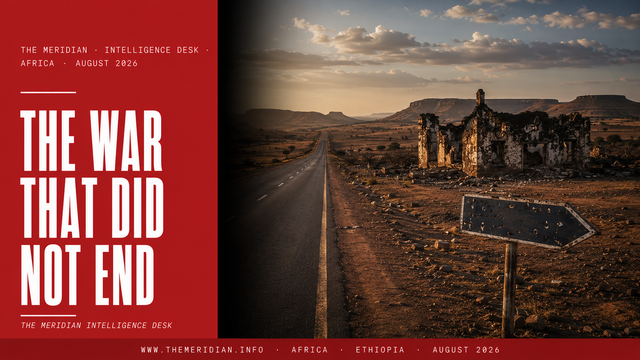
The Pretoria Agreement was signed on 2 November 2022. It ended the declared war between the Ethiopian federal government and the Tigray People's Liberation Front. More than three years later, the core substance of the agreement remains unimplemented. About 900,000 internally displaced persons remain in Tigray, with the vast majority having been displaced for more than three years. Starvation remains the leading cause of death across all age groups. Western Tigray, constitutionally part of the Tigray region, remains under Amhara administration in violation of the agreement. Food aid has declined by over 50 per cent. Starvation deaths were documented at Hitsats IDP camp in December 2025. The TPLF — the agreement's signatory — has been banned from future elections. The war did not end. It changed form.
The scale of the Tigray war is contested in its upper range and documented beyond dispute in its lower range. Estimates of direct and indirect deaths from the Tigray conflict, including those caused by conflict-induced famine, range from 300,000 to 600,000 lives lost. A peer-reviewed study by researchers from the University of London calculated over 102,000 excess deaths in Tigray from November 2020 to mid-2022, of which 72 per cent are from violence and the rest from lack of healthcare and famine. A Ghent University study estimated between 162,000 and 378,000 total deaths in the same period, with an average estimate of 518,000 civilian victims. The Uppsala Conflict Data Program recorded over 100,000 battle-related fatalities in 2022 alone. These are the numbers that the international community processed, debated, and ultimately did not act upon in a manner commensurate with their scale. The Pretoria Agreement was then signed. The world moved on. The evidence shows what was left.
The observable contradiction is stated precisely by the Rift Valley Institute's March 2026 assessment: the Cessation of Hostilities Agreement was intended to create a pathway toward several interconnected outcomes: the withdrawal of non-federal forces from Tigray, restoration of basic services and humanitarian access, resolution of contested territories, a verified process for the return of internally displaced Tigrayans, and Tigray's reintegration into Ethiopia's federal order. More than three years later, the core substance of the agreement remains unimplemented.
The non-implementation is not ambiguous. It is documented in real time by multiple credible sources. Western Tigray, which is constitutionally recognised as an integral part of the region, remains under extraconstitutional control by Amhara regional authorities. Eritrean troops — who were not party to the Pretoria Agreement and are not mentioned in it — continue to operate in some Tigrayan border areas and were reportedly present in western Tigray as late as January 2023. Food aid to Tigray declined by over 50 per cent. About 900,000 internally displaced persons remain in Tigray, the vast majority displaced for more than three years. Starvation remains the leading cause of death across all age groups. Between November 2022 and August 2023, over 300 IDPs died at Hitsats IDP camp. In December 2025, reports emerged of starvation deaths among Tigrayan IDPs at Hitsats camp, originally built for Eritrean refugees and now a makeshift home to thousands of Tigrayans ethnically cleansed from Western Tigray by Amhara forces.
The first constraint is the Pretoria Agreement's structural incompleteness. The agreement did not resolve core disputes, such as the final status of Western Tigray, but rather postponed them to be worked out via dialogue. In effect, it froze front lines and transitioned the conflict into a post-war phase fraught with implementation challenges. A peace agreement that defers its most contested provisions to future dialogue is not a resolution. It is a ceasefire with administrative architecture attached. The deferred questions — Western Tigray's political status, the return of displaced Tigrayans, the disarmament and reintegration of the Tigray Defense Forces, and accountability for war crimes — were the questions most likely to produce renewed conflict if left unresolved. Leaving them unresolved was the price of getting an agreement signed. The evidence shows what the deferred questions cost when they remain deferred for three years.
The second constraint is Eritrea. The Pretoria Agreement does not explicitly mention Eritrea, nor were Eritrean representatives present at the negotiations. This omission raised international concern that Eritrean troops would continue operations within Ethiopia despite the agreement between the Ethiopian government and TPLF. Eritrea is an independent state that entered Ethiopian territory to fight alongside Ethiopian federal and Amhara forces against the TPLF. The agreement that ended the war between Ethiopia and the TPLF did not require Eritrea to do anything. Eritrea did not sign. Eritrean forces have continued to operate in Tigray. Eritrea is reportedly supporting dissident factions of the TPLF, potentially undermining Ethiopia's ambitions for sea access — itself a source of regional tension as Ethiopia seeks an outlet to the Red Sea. The external party whose forces inflicted some of the most documented atrocities of the war is not party to the agreement that ended it.
The third constraint is the progressive dismantling of Tigrayan political standing within Ethiopia's federal system. The National Election Board of Ethiopia banned the TPLF from participating in future elections. The TPLF is the signatory to the Pretoria Agreement. Banning the signatory from future democratic participation while simultaneously failing to implement the agreement's provisions is a political move whose constitutional implications are significant. The House of Federation's decision reflects a broader federal pattern of dispossessing Tigrayan territory and impeding Tigrayan political representation. The international accountability mechanism — the UN Human Rights Experts on Ethiopia (ICHREE) — was not renewed in October 2023, effectively closing the primary independent international body with a mandate to document violations of the agreement.
The war ended on paper on 2 November 2022. Three and a half years later: 900,000 IDPs. Western Tigray under unconstitutional Amhara control. Starvation deaths at a camp in December 2025. Food aid down 50 per cent. The TPLF banned from elections. The accountability mechanism closed. The war did not end. The declared combat did.
The Pretoria Agreement was a correction to an immediate problem: a war that had produced casualties in the range of 300,000 to 600,000, displaced millions, and created a humanitarian emergency that the UN had described as one of the worst in the world. The African Union mediation that produced the agreement was a genuine diplomatic achievement — it brought the Ethiopian federal government and the TPLF to the same table after two years of total war and produced a signed text. This should be stated plainly: the agreement stopped the mass killing. Whatever its implementation failures, it ended the phase of the conflict in which hundreds of thousands of people were dying.
The correction's failure is not in what the agreement stopped. It is in what the agreement assumed would happen after signing. It assumed that the federal government would implement the provisions requiring it to withdraw non-federal forces from Tigray, restore services, and permit IDP return. The International Crisis Group has acknowledged that the parties failed over several years both to implement the agreement and to establish a framework for Tigray's reintegration into Ethiopia's federation. The correction assumed goodwill and institutional follow-through that the evidence shows was not forthcoming on the provisions most disadvantageous to the federal government's territorial and political interests in Tigray.
The September 2025 warning from Tigray's Interim Administration President Tadesse Worede of a "visible cloud of war" is the correction's most precise failure indicator. President Tadesse stressed that his administration "is working diligently to avoid war for any reason" and that "there will be no war started by the Tigray side." The leader of a region that signed a peace agreement three years earlier, warning against renewed war while simultaneously assuring that his side will not start it, is describing a situation in which the peace agreement's correction has not held.
The evidence suggests that the Tigray conflict belongs in this edition's examination of the extraction economy not because it is primarily an economic story — it is primarily a humanitarian and political one — but because it illustrates, with greater clarity than any commodity chain, the structural relationship between state capacity, institutional capture, and the ability of correction mechanisms to function.
The Tigray war began as a political conflict between a centralising federal executive under Abiy Ahmed and a regional party — the TPLF — that had dominated Ethiopian federal politics for thirty years and resisted the centralisation. The war that resulted was conducted with methods — the use of starvation as a weapon, the blocking of humanitarian aid, the systematic targeting of civilian infrastructure, the deployment of Eritrean forces whose atrocities are documented — that the International Commission of Human Rights Experts on Ethiopia described in its reports before its mandate was closed in 2023. Eritrean troops committed rape and sexual violence against women in occupied areas. Despite the 2022 cessation of hostilities agreement, Tigrayans continued to be forcibly displaced from Western Tigray.
The correction mechanism — the Pretoria Agreement, the ICHREE, the African Union monitoring framework — has not delivered accountability. The war in Tigray ended with formal commitments to accountability, but these have yet to produce publicly available accounts of the harms caused by the conflict. No individual has been prosecuted. No reparation mechanism has been established. No truth commission has been created. The ICHREE that was documenting violations was not renewed. The federal government that is required under the agreement to implement its provisions is the same government whose forces, alongside Eritrean allies, conducted the operations the ICHREE was documenting.
Hitsats camp was originally built for Eritrean refugees. It became a makeshift home to thousands of Tigrayan civilians ethnically cleansed from Western Tigray by Amhara forces. Humanitarian assistance to Hitsats was woefully inadequate. In December 2025, reports emerged of starvation deaths among Tigrayan IDPs at the camp.
This is three years and one month after the Pretoria Agreement was signed. The agreement promised humanitarian access and IDP return. Starvation remains the leading cause of death across all age groups in Tigray. The healthcare system is near collapse, with over 90 per cent of facilities damaged and two-thirds non-functional. On 5 March 2026, Tigray's Health Bureau warned of imminent total health system collapse.
A peace agreement that is followed three years later by starvation deaths in IDP camps and a warning of total health system collapse is not a peace agreement that is being implemented. It is a ceasefire whose provisions have been selectively honoured by the party with the power to determine what is honoured. The people dying at Hitsats in December 2025 are the evidence of what selective implementation costs.
The Tigray war is the largest armed conflict in Africa of the twenty-first century by casualty estimates. It is also the conflict that the international community most comprehensively failed to prevent, to stop while it was underway, to hold accountable when it paused, and to enforce when the agreement designed to resolve it was signed and then systematically not implemented.
The failure is not mysterious. It follows a documented pattern. The tensions now surfacing are rooted in the unresolved aftermath of the Pretoria Agreement. Much of the international response has focused on containing immediate instability, but far less attention has been paid to the deeper reality that the peace process itself remains fundamentally incomplete. That distinction matters because the present moment did not emerge from a settled post-war order suddenly falling apart. It emerged from a peace arrangement whose central political questions were deferred. Over time, deferred questions become new crises. The evidence of July 2026 confirms that the deferral has produced exactly that.
The war in Tigray belongs in The Meridian's August 2026 edition because it is the extraction economy operating at its most total: the extraction of sovereignty, of territorial rights, of political representation, of humanitarian access, and of accountability from a population whose capacity to resist the extraction was destroyed by the same war that the extraction sustained. The Pretoria Agreement promised correction. The evidence shows correction has not arrived. The 900,000 IDPs at Hitsats and elsewhere are waiting.
Add comment
Comments