The Mineral Corridor: How the Congo's Cobalt Powers the World's Electric Vehicles and Leaves Its Miners in Poverty
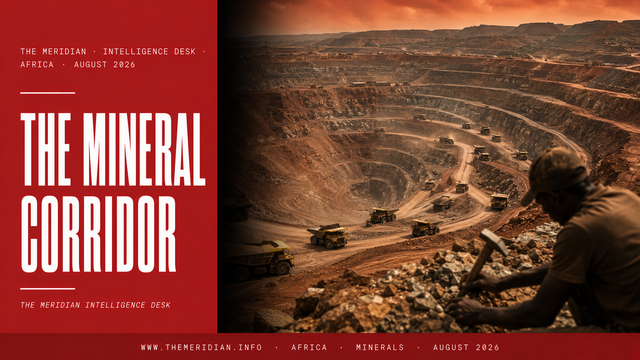
The DRC produced 230,000 metric tonnes of cobalt in 2025 — approximately 84 per cent of global supply. Lithium-ion batteries consumed approximately 77 per cent of global cobalt demand in 2024, with electric vehicle battery production accounting for about 60 per cent of total cobalt consumption. The clean energy transition — the replacement of internal combustion engines with electric vehicles, the deployment of grid-scale battery storage — depends structurally on Congolese cobalt. The DRC's GDP per capita was $555 in 2024. An estimated 69 per cent of the population lives below the national poverty line. The majority of Congolese artisanal cobalt miners earn less than the DRC national minimum wage of $5 per day. The world's clean energy future is being built on Congolese ground. The Congolese people are not among its beneficiaries.
In February 2025, the DRC government imposed a ban on all cobalt exports. The announcement sent immediate reverberations through global electric vehicle supply chains. Automotive manufacturers, battery producers, and technology companies that had spent the previous decade building supply chains dependent on Congolese cobalt found themselves facing the prospect of a supply disruption from a source that has no viable substitute at scale. The DRC — which dominates global cobalt production and holds 71 per cent of proven reserves — decided to halt all exports of the mineral essential to artificial intelligence, weaponry, and electric vehicles. The ban lasted until October 2025 — eight months during which Congolese cobalt continued to be mined and stored inside the country. The ban demonstrated, with greater precision than any policy paper could, the structural reality of the mineral corridor: the DRC has leverage that it has rarely been able to exercise, and when it exercises it, the entire global clean energy supply chain notices. What the ban also demonstrated was the limit of that leverage: the cobalt was still being mined by the same companies, stored in the same country, and the DRC's GDP per capita remained $555.
The observable contradiction is stated in two numbers that should not coexist. In 2022, copper and cobalt were exported from the DRC for a combined total of $25 billion — equal to over a third of the Congo's GDP that year. In the same year, the World Bank found that around 74.6 per cent of the DRC's population lives on less than $2.15 a day. A country that exports minerals worth a third of its GDP in a single year, in which the overwhelming majority of the population lives in extreme poverty, is not experiencing a development paradox. It is experiencing the extraction economy in its most undisguised form: the minerals leave, the revenue does not follow the minerals into the population that produced them, and the poverty persists alongside the extraction because the two are structurally connected rather than contradictory.
The DRC has been the top producer of cobalt since 2003 and is likely to remain a crucial supplier to the cobalt market for the foreseeable future. CMOC and Glencore together account for about 70 per cent of cobalt exports from the DRC. These two companies — one Chinese, one Swiss — dominate the extraction of a resource that belongs, in law, to the Congolese state. CMOC produced 61,073 tonnes of cobalt in the first half of 2025 alone, a 13 per cent increase year on year, targeting between 100,000 and 120,000 tonnes for the full year. Glencore raised its annual production forecast for 2025 to at least 42,000 tonnes. The production continues because cobalt is a byproduct: 99 per cent of global cobalt output is a byproduct of copper or nickel mining. As long as copper prices remain between $8,000 and $10,000 per tonne — as they have throughout 2025 — cobalt continues to be produced as a consequence of copper extraction, regardless of the cobalt price.
The first constraint is the structure of ownership in large-scale mining. The mines that produce the overwhelming majority of Congolese cobalt are owned or operated by multinational companies — principally CMOC (Chinese) and Glencore (Swiss-British), with Jinchuan Group, ERG, and others holding significant stakes. These companies hold mining concessions granted by the Congolese state, pay royalties and taxes to the government, and employ Congolese workers. The revenues they generate accrue primarily to their shareholders — who are located in China, Switzerland, the United Kingdom, and the global institutional investment community — not to the Congolese population in whose ground the cobalt sits. The state collects royalties. The royalties are a fraction of the export value. Cobalt contributed approximately 9 per cent of GDP on average from 2013 to 2018. A sector contributing 9 per cent of GDP while generating export revenues equivalent to a third of GDP is a sector in which the capture of value by the producing state is severely constrained relative to what the resource generates.
The second constraint is the artisanal mining sector's structural vulnerability. The OECD estimates there are more than 200,000 artisanal miners — creuseurs — who extract cobalt using hand tools, often in hazardous conditions, alongside large-scale industrial operations. The majority earn less than the DRC national minimum wage of $5 per day. Over the past decade, Glencore encouraged artisanal miners to work on its leased concessions to increase cobalt production. During this period, the price paid to miners collapsed from $40 a pound to $13.50 a pound. The artisanal miner is the most price-exposed and least legally protected participant in the cobalt supply chain. When cobalt prices spike — as they did in 2022, when the metal reached $82,000 per tonne — the artisanal miner's income improves modestly. When prices fall — as they did to $21,550 per tonne in early 2025 — the artisanal miner absorbs the full downside. The industrial miner adjusts production volumes. The artisanal miner cannot.
The third constraint is geopolitical. The EU has signed strategic partnership roadmaps with the DRC and three other African mineral nations — Zambia, Namibia, and Rwanda — as part of its Global Gateway strategy to secure access to critical minerals and reduce dependence on Chinese-controlled supply chains. The United States signed a minerals agreement with the DRC in September 2025. The DRC finds itself the object of competitive geopolitical attention from the EU, the United States, and China — each seeking to secure supply chains for the clean energy transition that their domestic industrial policies require. This attention gives the DRC a form of leverage it has not historically possessed. The February 2025 export ban was, in part, an exercise of that leverage — a demonstration that the DRC government under President Tshisekedi was willing to use the country's resource position as a negotiating instrument. The constraint is that the leverage exists at the level of the state, while the poverty exists at the level of the household. The geopolitical competition for Congolese minerals does not automatically translate into improved incomes for Congolese miners.
The DRC holds $24 trillion in untapped mineral wealth according to UNEP. Its GDP per capita is $555. Its cobalt exports generate $25 billion in a single year. 69 per cent of its population lives below the national poverty line. These numbers do not describe a country that lacks resources. They describe a country whose resources leave without the value following them.
The DRC has attempted multiple corrections to the extraction architecture. The 2022 Mining Code revision increased royalty rates on cobalt and other strategic minerals, directing a greater share of export revenue to the state. The creation of ARECOMS — the Strategic Mineral Substances Market Regulation and Control Authority — in 2025 established a government body with the mandate to manage the strategic reserve allocation under the new cobalt export quota system. The Entreprise Générale du Cobalt, created in 2019 as a state-owned entity with exclusive purchasing rights for artisanal cobalt, was designed to formalise and improve conditions in the artisanal sector. These institutional corrections are genuine attempts to capture more value from the mineral corridor within the DRC rather than allowing it to flow exclusively to multinational shareholders.
The February 2025 export ban is the most dramatic correction the DRC has attempted. Zimbabwe banned exports of unprocessed lithium ore in December 2022. Namibia implemented a ban on lithium in June 2023. Malawi announced a ban on all raw mineral exports in October 2025, arguing that local processing could generate up to $500 million annually. The DRC's cobalt ban fits within a broader African pattern of using export restrictions to force processing investment within the country — the argument being that if raw cobalt cannot be exported, international companies will be compelled to build processing facilities in the DRC, retaining the refining margin domestically. The production continued during the ban because cobalt was being stored inside the country, with lifting expected no earlier than September 2025. The ban demonstrated leverage. Whether it will produce processing investment is a question the evidence has not yet answered.
The evidence suggests that the mineral corridor's extraction architecture has three features that distinguish it from the agricultural commodity chains this edition has examined in cocoa, coffee, and sugar, and that make structural reform simultaneously more urgent and more difficult. First, the mineral is non-renewable. Coffee trees can be replanted. Sugar cane regrows annually. The UNEP estimates the DRC has untapped mineral reserves worth $24 trillion. But what is extracted is gone. The cobalt that leaves the DRC in 2025 will not regenerate. The question of who captures its value is therefore a question about a finite endowment, not a recurring agricultural income. Every tonne of cobalt that leaves the DRC at a price that does not adequately compensate the Congolese state and the Congolese population is a permanent transfer of non-renewable wealth.
Second, the clean energy transition creates a demand structure that is qualitatively different from the demand for cocoa or coffee. The International Energy Agency reports that EV battery production accounted for about 60 per cent of total cobalt consumption in 2024. As EV adoption accelerates — driven by European and American climate policy mandates — cobalt demand will grow. The DRC's 84 per cent share of global production gives it a structural market position that Ghana and Ivory Coast do not possess in cocoa. The DRC is not one of many producers. It is the producer. This concentration of supply in a single country gives the Congolese state a negotiating position — demonstrated by the export ban — that agricultural commodity producers cannot match.
Third, the political economy of the correction is complicated by the DRC's internal conflict. Violence in eastern DRC has caused over seven million internally displaced people as of June 2024 and is exacerbating the challenges facing the country, with adverse impact on poor household livelihoods. The minerals of eastern DRC — not just cobalt and copper, but coltan, gold, and tin — have financed armed groups for decades. The connection between mineral extraction and conflict is not incidental. It is structural: the revenue from mineral sales finances the weapons that perpetuate the instability that prevents the state from building the governance capacity that would allow it to capture more value from its own resources. The extraction economy and the conflict economy are the same economy, operating at different levels of the same system.
The electric vehicle is the symbol of the clean energy transition. Its lithium-ion battery contains cobalt. Electric vehicle battery production accounts for approximately 60 per cent of total global cobalt consumption. The clean energy transition — the policy programme that Europe and North America have committed to as their primary mechanism for reducing carbon emissions — is structurally dependent on Congolese cobalt.
Approximately 40,000 children are engaged in artisanal cobalt mining in the DRC, according to UNICEF estimates. The majority of artisanal miners earn less than $5 per day — the DRC national minimum wage. The US Department of Labour added lithium-ion batteries to its list of goods produced by child labour in October 2022.
The clean energy transition that Europe and North America present as a moral and environmental imperative is being physically built by Congolese children earning less than $5 a day, in mines where, as one artisanal miner quoted by The Conversation stated: "We miners die a lot." The contradiction between the green credential of the electric vehicle and the condition of the person who mined the battery's cobalt is not a supply chain problem to be solved by certification. It is the extraction economy operating at the foundation of the clean economy. It will not be corrected by a sustainability label.
The mineral corridor of the DRC is the extraction economy in its most undisguised form. No preferential trade agreement obscures the relationship. No commodity futures market adds a layer of abstraction between the mine and the miner. The cobalt comes out of the ground. It is loaded onto trucks owned by CMOC or Glencore. It leaves the country. The DRC's GDP per capita is $555.
The February 2025 export ban demonstrated that the DRC government under Tshisekedi is willing to use the country's resource position as a negotiating instrument. The cobalt stayed in the country for eight months. The supply chains noticed. The negotiations happened. The ban was lifted in October 2025. The miners' wages did not change. The poverty rate did not change. The geopolitical attention generated by the ban produced memoranda of understanding with the EU and a minerals agreement with the United States. Whether those agreements produce processing investment that retains more value within the DRC, or whether they produce preferential supply commitments at prices set in Brussels and Washington, is the question that the evidence will answer over the next decade.
The mineral corridor is not a past injustice. It is a present one. It is happening now, in real time, with every electric vehicle produced in Germany, the United States, and China. The clean energy transition is real and necessary. But it cannot be presented as a moral achievement while it is physically constructed on the labour of Congolese children earning less than $5 a day, in a country whose $24 trillion mineral endowment has produced a GDP per capita of $555. The transition needs to be clean in both senses of the word. The evidence shows it currently is not.
Add comment
Comments