The Agricultural Subsidy Wall: How Rich Countries Pay Their Farmers Not to Compete and Make the Global South Pay the Price
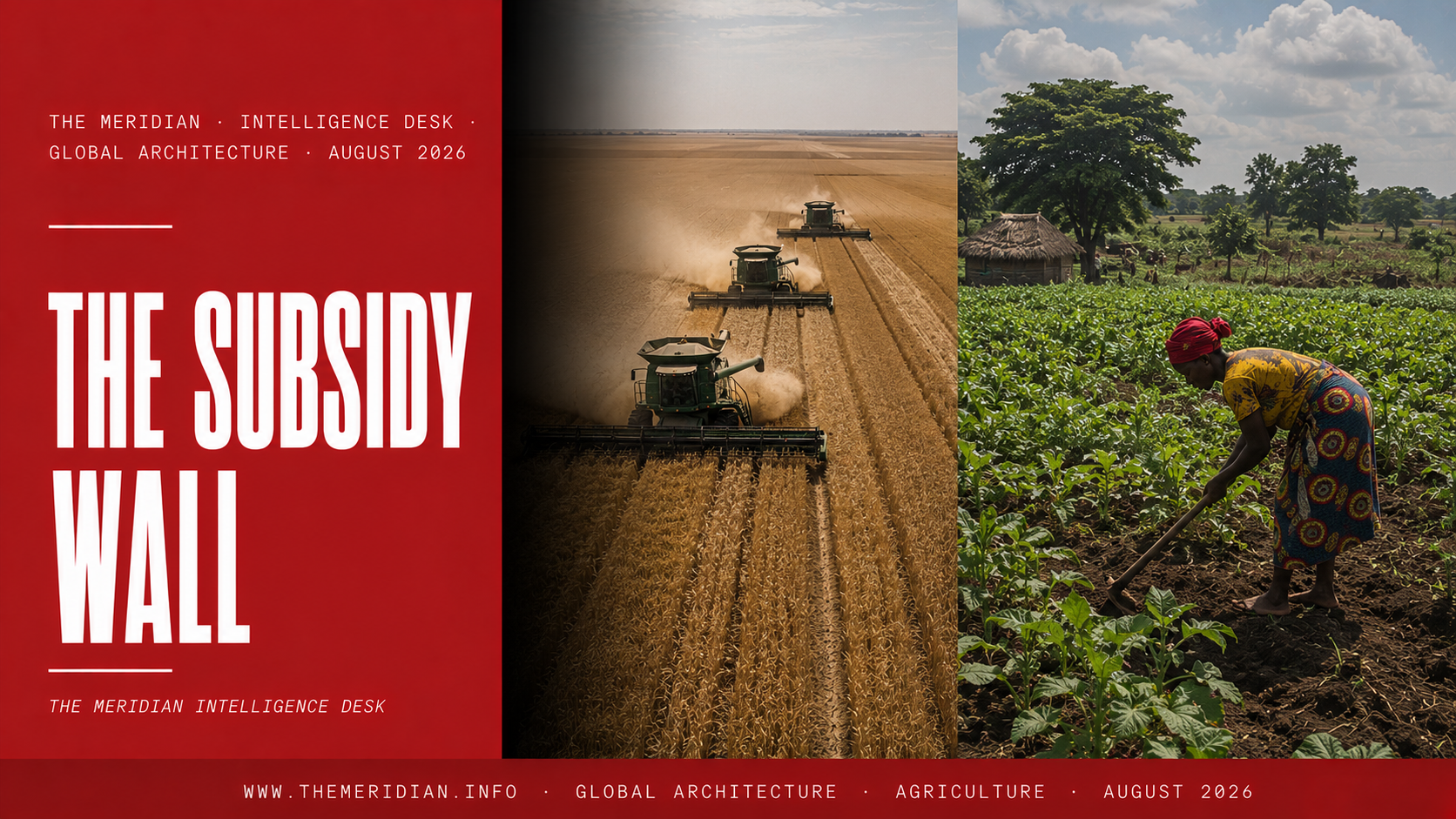
Total support to agriculture averaged $842 billion per year during the 2021-23 period across the 54 countries monitored by the OECD. Support remains concentrated in a few large economies, with China, the United States, India, and the European Union representing 37, 15, 14, and 13 per cent of the total respectively. Of that total, $629 billion on average is aimed at individual producers, with over half — $334 billion — arising from market price support policies that lift domestic prices above world prices. The WTO Agreement on Agriculture, signed in 1994, was supposed to discipline these subsidies. It is thirty years old. The Doha Round of trade talks collapsed in 2006 because the United States and the European Union refused to reduce agricultural subsidies. The Cotton Four of West Africa — Benin, Burkina Faso, Chad, and Mali — have been formally demanding subsidy reform for more than twenty years. The wall is intact. The cotton farmers are still waiting.
The arithmetic of the agricultural subsidy wall requires no interpretation. An American cotton farmer in Mississippi receives a government payment that reduces the effective cost of producing their cotton below what it actually costs. They sell that cotton on the world market. The world market price falls toward the American cost of production — which is not the true cost of production but the subsidised cost of production. The West African cotton farmer in Burkina Faso, who receives no subsidy, must sell their cotton at the world market price — the subsidised American price. They cannot compete. Their governments take the case to the WTO. The WTO agrees the subsidies are trade-distorting. The subsidies continue. The Doha Round — the negotiation designed to resolve this — collapses. The West African cotton farmer plants again next season at an unsubsidised disadvantage against a subsidised competitor. This sequence has repeated for thirty years. The arithmetic has not changed. The subsidies have not ended. The competitive disadvantage has not been corrected.
The observable contradiction is stated with OECD precision. Government support to agriculture averaged $842 billion per year in 2021-23. China, the United States, India, and the European Union together represent approximately 79 per cent of that total. These are the world's four largest economies — the same economies that dominate global food exports and set global agricultural commodity prices. The subsidy creates a direct and documented competitive advantage for their producers in world markets. The smallholder farmers of Sub-Saharan Africa, South Asia, and Latin America compete in those same markets without equivalent support. The playing field is not level. It has not been level since the Green Revolution transferred agricultural productivity gains disproportionately to well-capitalised, subsidy-supported producers in rich countries. The $842 billion annual subsidy total is not a distortion of an otherwise fair system. It is the system.
The asymmetry operates at multiple levels. At the commodity level: American cotton, European sugar, and American and European grain are sold on world markets at prices that reflect subsidised production costs rather than true economic costs. At the tariff level: agro-food products still face higher tariffs and trade barriers than other sectors, with market price support remaining common. Developing country producers face tariff escalation — low tariffs on raw commodities, higher tariffs on processed goods — that systematically prevents them from capturing the manufacturing and processing margin this edition has documented in cotton, cocoa, coffee, and sugar. At the standard level: food safety, phytosanitary, and quality standards required for export to rich-country markets are set by those markets to reflect their domestic regulatory frameworks — frameworks developed by well-resourced regulatory bodies that smallholder producers in developing countries lack the institutional capacity to navigate without significant technical assistance.
The first constraint is the Agreement on Agriculture's structural permissiveness. The Agreement established three categories of domestic support: the Amber Box, subject to reduction commitments; the Blue Box, for payments linked to production-limiting programmes; and the Green Box, for payments deemed minimally trade-distorting. All domestic support measures that do not fit into the exempt categories are subject to reduction commitments. This domestic support category captures policies such as market price support measures, direct production subsidies, or input subsidies. The Agreement's design problem is that the Green Box — the exempt category — has been consistently expanded and reinterpreted to accommodate the domestic support programmes of wealthy countries. Direct payments decoupled from production, environmental payments, and rural development programmes have been classified as Green Box — minimally trade-distorting — even when their aggregate effect is to maintain the financial viability of farming operations that would otherwise be uneconomic at world market prices. The Green Box is the wall's foundation. Its classification criteria were designed with sufficient flexibility to accommodate most of what wealthy countries wished to continue paying their farmers.
The second constraint is the negotiating power asymmetry. The Doha Round collapsed because the United States and the European Union refused to reduce agricultural subsidies to the extent developing countries required for a balanced outcome. The talks were finally suspended in June 2006 because the United States and the European Union refused to reduce agricultural subsidies. The developing country bloc — represented by the G-20 agricultural group including Brazil, India, China, and the African, Caribbean and Pacific group — could not secure the reduction commitments that would have made the Round's agriculture chapter meaningful. The multilateral negotiating process that was designed to discipline subsidy competition produced no additional subsidy reduction when the largest subsidisers declined to reduce. There is no enforcement mechanism short of a WTO dispute settlement ruling — and securing a ruling requires the complainant country to have the legal capacity, the political will, and the trade leverage to withstand the diplomatic consequences of suing its largest trading partner.
The third constraint is the IMF conditionality connection — a circularity this edition has now documented across multiple articles. The IMF, as Article 16 established, requires developing countries to eliminate or reduce agricultural subsidies — farm input support programmes, fuel subsidies, food price controls — as a condition of its loans. The Agricultural Subsidy Wall is the same dynamic in reverse: developing countries are required by the IMF to remove the subsidies that support their smallholder farmers, while the rich-country members of the same IMF's board continue to spend $842 billion annually subsidising their own agricultural sectors. The asymmetry is institutional. The same international financial architecture that disciplines developing country subsidy programmes protects developed country ones.
$842 billion in annual agricultural support from 54 countries. $334 billion in market price support lifting domestic prices above world prices. The WTO Agreement on Agriculture: thirty years old. The Doha Round: collapsed because the US and EU refused to reduce subsidies. The Cotton Four: waiting more than twenty years. The subsidy wall is not a relic of a past era of trade policy. It is the current global agricultural architecture. It is operating today.
The Agreement on Agriculture was itself the correction — to the pre-1994 system in which agricultural subsidies were essentially undisciplined under the GATT. The Agreement introduced binding commitments on domestic support levels, tariff reduction schedules, and the elimination of export subsidies over time. It was a genuine reform: it converted previously unconstrained agricultural protection into a system with bound limits and reduction commitments. The problem is that the bound limits were set at levels that reflected existing subsidy programmes rather than levels that would produce competitive neutral outcomes. The reductions required were measured from a base period of exceptionally high subsidy expenditure — meaning the bound limits permitted more distortion than actually existed at the time of signing in many product categories.
The Doha Round was the correction to the Agreement on Agriculture's insufficiency. Launched in 2001 with an explicit development mandate and a specific commitment to address the cotton subsidy issue raised by the West African Cotton Four, it aimed to produce substantially deeper reductions in domestic support, eliminate export subsidies, and improve market access for developing country agricultural exporters. In 2006, the United States maintained that it had made an ambitious offer of reductions in trade-distorting domestic support that had not been matched by agricultural tariff reductions by the EU or by market opening by Brazil and India. The EU and Brazil argued that the US offer on domestic support did not go far enough and would leave the United States in a position to spend more on such subsidies than under the Uruguay Round Agreement on Agriculture. Both arguments contained merit. Neither produced an agreement. The Round has been effectively dead since 2008, when the Geneva ministerial discussions collapsed.
The Nairobi Ministerial Decision on Cotton in 2015 was the most recent specific correction attempt. It contains provisions on improving market access for least-developed countries, reforming domestic support, and eliminating export subsidies on cotton. The Nairobi Ministerial Decision on Cotton contains provisions on improving market access for least-developed countries, reforming domestic support, and eliminating export subsidies. It also underlines the importance of effective assistance to support the cotton sector in developing countries. The Cotton Four welcomed the decision. The subsidies that the decision committed to reform have not been reformed at the scale the decision implied. The Cotton Four's formal WTO demand has been outstanding for more than twenty years. The Nairobi decision added another layer of commitment to a body of commitments that have not been implemented.
The evidence suggests that the agricultural subsidy wall is the extraction economy's most durable institutional feature — more durable than the dollar's reserve status, which is declining; more durable than TRIPS, which has been partially corrected by compulsory licensing; more durable than IMF conditionality, which at least acknowledges its social spending floor obligations. The $842 billion annual subsidy total has not declined. The OECD's 2025 report found that overall support to agriculture in 2022-24 remains well above pre-COVID levels. While nominal transfers to farmers have increased, expenditures benefitting consumers have declined. Support for innovation and other services is falling relative to the sector's size, which, together with persistent trade distortions, threatens global food security. The total is growing. The distortions are persistent. The WTO's own assessment is that they threaten global food security. This is not a contested claim. It is the finding of the international body responsible for monitoring agricultural trade policy.
The connection to this edition's commodity chain articles is direct. The cotton farmers of West Africa whose 98 per cent raw export rate was documented in Article 11 face not only the processing margin problem — that the value of spinning and weaving is captured elsewhere — but the subsidy problem: the world price at which they sell their raw cotton is suppressed by American and Chinese subsidies that allow their competitors to produce below true economic cost. The cocoa farmers of Ivory Coast and the coffee farmers of Ethiopia face world prices set by commodity markets in which their unsubsidised production competes against the subsidised agricultural systems of the largest economies. The subsidy wall is not a separate problem from the commodity chain problem. It is one of its structural foundations.
The Doha Development Round was launched in November 2001 with an explicit mandate to produce a development-oriented outcome in agricultural trade. The Doha Declaration committed WTO members to substantial reductions in trade-distorting domestic support, the elimination of export subsidies, and substantially improved market access for developing country agricultural exporters. The Cotton Four submitted their first formal demand in 2003.
The Doha Round was finally suspended in June 2006 because the United States and the European Union refused to reduce agricultural subsidies to the degree required for a balanced agreement. The Round has not been revived in any substantive form since.
The negotiation that was specifically designed to correct the agricultural subsidy wall failed because the largest subsidisers refused to reduce their subsidies. The multilateral trading system — the same system that enforces intellectual property obligations through TRIPS, that disciplines developing country subsidy programmes through its Agreement on Agriculture, and that adjudicates trade disputes through its binding dispute settlement mechanism — was unable to produce a subsidy reduction agreement when the reduction was required of its most powerful members. The system enforces its rules asymmetrically: rigorously against those without the leverage to resist, permissively toward those with the leverage to refuse. The cotton farmers of Burkina Faso have been waiting for twenty years to learn whether this will change. The evidence suggests it will not change on its own.
The agricultural subsidy wall closes Layer Three of this edition because it is the global architecture that underlies all of the commodity chains Layer Two examined. The sugar farmers of Mauritius, the cocoa farmers of Ivory Coast, the coffee farmers of Ethiopia, the cotton farmers of Benin all face a world agricultural market in which the prices they receive for their unsubsidised production are set in competition with the subsidised production of the world's largest economies. The $842 billion annual subsidy total is not context for their situation. It is the cause of part of it.
Layer Three has documented five pillars of the global architecture that enables the extraction economy: the shipping oligopoly that controls the infrastructure of trade; the dollar monopoly that controls the currency of debt; the patent wall that controls the price of essential goods; the IMF conditionality that controls the fiscal space of developing country governments; and the agricultural subsidy wall that controls the competitive terms of global agricultural trade. None of these five pillars operates in isolation. They reinforce each other: dollar-denominated debt requires IMF intervention when it becomes unsustainable; IMF intervention removes the agricultural subsidies that would help developing country farmers compete in markets distorted by the subsidies the IMF's rich-country board members maintain; those distorted markets produce commodity prices that are insufficient to service the dollar-denominated debt that triggered the IMF intervention in the first place.
The circle is not vicious by accident. It is the global economic architecture operating as designed — not through conspiracy but through the accumulated effect of institutional arrangements, historical power asymmetries, and rule systems that were written by the powerful, for the powerful, at moments when the Global South had neither the seat at the table nor the leverage to insist on different terms. Layer Four examines what building different terms actually requires.
Add comment
Comments