Tanzania's Democratic Recession: How One of Africa's Most Stable States Dismantled Its Own Democratic Institutions
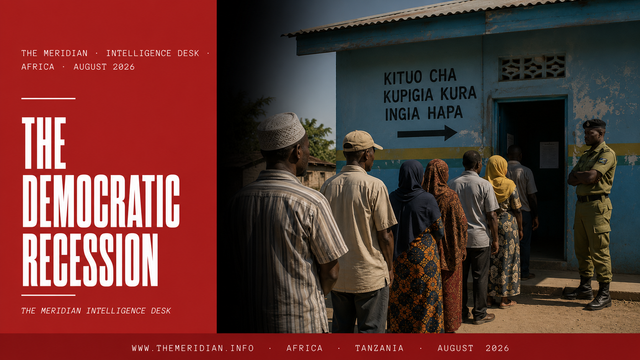
Tanzania recorded the second-largest single-year Freedom House score decline in the world in 2025, falling seven points. President Hassan's CCM party won 270 of the 272 directly elected parliamentary seats in polls characterised by extreme political repression and violence. She was re-elected with 97.66 per cent of the vote after major opposition figures were banned from competing and hundreds of people were killed in a violent crackdown on dissent. The main opposition party, CHADEMA, was barred from participating in the 2025 general elections until 2030 after refusing to sign a mandatory electoral code of conduct. Its leader, Tundu Lissu, was arrested and charged with treason. Tanzania has moved from Partly Free to Not Free, signalling an authoritarian turn as political freedoms and rights decline. This article traces the ten-year trajectory through which that movement occurred: not as a coup, not as a constitutional suspension, but as a sequence of incremental institutional decisions whose cumulative effect has been the institutionalisation of electoral authoritarianism in what was once regarded as one of Africa's most stable democracies.
Julius Nyerere governed Tanzania from independence in 1961 to 1985 as a single-party state, under a form of African socialism he called Ujamaa. He voluntarily relinquished power, an act without precedent in the region at that time, and spent his remaining years as an elder statesman. His legacy was a nation with an unusually strong sense of unified national identity, a working bureaucracy, and a political culture that prized stability above competitive pluralism. Tanzania moved to multiparty democracy in 1992. Six multiparty elections followed. The CCM won them all, making it one of Africa's longest-ruling independent parties. The opposition maintained some parliamentary representation. The press operated with constraints but not suppression. Civil society functioned. The trajectory was not liberal democracy in the Nordic sense, but it was not authoritarianism either. It was a system that political scientists call dominant party democracy: competitive in form, structured by incumbency advantage in practice, and stable in a way that Tanzania's neighbours, Uganda, Kenya, Burundi, were not. That system reached a turning point in 2015. The evidence of the subsequent decade shows what replaced it.
The ruling party's vote share shrank to its lowest point ever in 2015 when John Magufuli was elected, with the opposition gaining in both the presidential and parliamentary polls. When dominant political parties are threatened, they often resort to suppression and control to remain in power. Magufuli won with 58 per cent in 2015, the most genuinely competitive Tanzanian election since multiparty democracy began. The CCM's response to competitive pressure was not institutional adaptation. It was institutional closure. Under Magufuli, crackdowns on civil society and independent media increased, and laws were weaponised to silence dissent, including the Cybercrimes Act and the Electronic and Postal Communications (Online Content) Regulations. Other authoritarian tactics included the co-option of prominent opposition figures and the fusion of state and party, blurring the divide between public service and party loyalty.
The 2020 election was marred by widespread fraud and vote-rigging, threats of violence against opposition figures, and the use of police force against opposition demonstrators. Magufuli won with 84.5 per cent. CCM won 261 of 264 parliamentary seats: 98.7 per cent of the vote. The increase from 58 per cent in 2015 to 84.5 per cent in 2020 under conditions of documented electoral misconduct is the quantitative measure of the institutional closure that occurred between the two elections. It is not the result of CCM becoming more popular. It is the result of the competitive space contracting.
Magufuli died in March 2021. His vice president, Samia Suluhu Hassan, assumed the presidency: the first woman to hold the office in Tanzania and in any East African country. After a period of some liberalisation, President Hassan began to resort to similarly repressive tactics. A wave of violent, enforced disappearances of political activists took place during the year. The liberalisation period was real. Hassan repealed the ban on political assemblies outside election periods. She permitted some press criticism. International observers noted the shift. The shift did not last. In 2024, Hassan characterised opposition demonstrations as endangering law and order; police dispersed a number of events, and by year's end had announced that political rallies would no longer be allowed. The liberalisation that observers had credited her with in 2021 and 2022 was reversed by 2024. The direction of institutional movement had not changed since 2015. It had paused briefly, then resumed.
The observable contradiction in the Tanzanian case is between the formal maintenance of electoral procedure and the substantive elimination of electoral competition. Tanzania holds elections. It maintains an electoral commission, a multi-party registration system, and a parliamentary structure with 272 directly elected seats. The formal apparatus of democracy is intact. The substantive content of democracy, the possibility of incumbent defeat, the freedom of opposition to organise and campaign, the ability of voters to choose between genuine alternatives, has been progressively eliminated across three election cycles.
The trajectory of CCM's vote share is the most precise measurement of this elimination: 58 per cent in 2015, 84.5 per cent in 2020, 99.3 per cent in local government elections in November 2024, 97.66 per cent in the presidential election of October 2025. This is not the trajectory of a party growing in popularity. It is the trajectory of a party progressively eliminating the conditions under which its popularity could be tested. President Hassan sought to strongarm the country's election, meting out repression, violence, and arrests to anyone who dares challenge her. The Journal of Democracy's characterisation is not hyperbolic. It is sourced from the documented sequence of events in the twelve months preceding the October 2025 election.
The elimination of CHADEMA from the electoral process is the moment at which the Tanzanian case crosses from competitive authoritarianism into a qualitatively different category. The Independent National Electoral Commission officially announced on 12 April 2025 that it would bar the main opposition party from participating in the 2025 general elections as well as any by-elections until 2030, after CHADEMA declined to sign a mandatory electoral code of conduct. Barring the principal opposition party from elections for five years on the grounds that it declined to sign a code of conduct that it regarded as legitimising a fundamentally flawed electoral process is not an administrative procedure. It is the use of administrative machinery to achieve a political outcome: an election without opposition. CHADEMA had insisted that no elections should take place without comprehensive reforms in electoral laws and processes. The government's response to that demand was to remove CHADEMA from the process it was demanding be reformed.
In 2015, the CCM won with 58 per cent. In 2020, with 84.5 per cent under documented misconduct. In November 2024 local elections, with 99.3 per cent. In October 2025, with 97.66 per cent after the main opposition was barred. The numbers describe a system that holds elections. They do not describe a democracy.
The first constraint is structural and historical. The CCM has governed without interruption for over 60 years. It built the Tanzanian state. Its organisational reach extends into every local government, every district administration, and every village council in the country. The fusion of party and state that Magufuli accelerated was not created by Magufuli. It was inherited from the single-party era and never fully dismantled during the multiparty transition of the 1990s. Local administrative officials are technically nonpartisan, but most are CCM loyalists or former security personnel with significant power within their jurisdictions, and they have been especially repressive when overseeing opposition-oriented areas. Hassan appointed more hardliners to these roles, most notably Paul Makonda in Arusha. The institutional architecture of authoritarianism in Tanzania does not depend on exceptional measures. It operates through the ordinary administrative machinery of a state that was never fully separated from the party that built it.
The second constraint is the international community's limited leverage. Tanzania is not a highly aid-dependent country by African standards. Its economy includes significant mineral exports, a large tourism sector, and a growing services industry. The government's capacity to absorb international criticism without altering its domestic behaviour was demonstrated clearly in the post-election period. Hassan's inauguration on 1 November 2025 was held at a closed military ground in Dodoma, an unusual move that highlighted the tense atmosphere as authorities restricted public access to the event. The African Union noted exclusion of opposition candidates and pointed to systemic failures within electoral institutions. The African Union's observation did not prevent the inauguration. International pressure in contexts of post-election violence in African states has a documented track record of producing statements rather than outcomes.
The third constraint is the internal opposition's structural weakness. CHADEMA has been the principal vehicle of Tanzanian political opposition since the early 2000s. It has suffered through three election cycles of documented fraud, the imprisonment or forced disappearance of its senior figures, and now a five-year ban from electoral competition. Chadema deputy chairman John Heche has been detained since 22 October 2025. Ally Kibao, senior member of the Chadema secretariat, was abducted in September 2024 and found dead a day later with severe acid burns to his face and other signs of torture. President Hassan rejected calls for an independent inquiry into the disappearances. An opposition movement whose leaders are imprisoned, murdered, and disappeared, and whose party is barred from elections, faces the existential question of how to maintain organisational coherence and political relevance without the institutional mechanism of electoral competition.
The evidence suggests that Tanzania's democratic recession is the Bermeo-Laebens framework applied to a case that has passed beyond the diagnostic threshold and into a qualitatively different zone. Article 19 of this edition applied the executive aggrandisement framework cautiously to Mauritius, where the evidence raised questions that the framework required examination but did not reach a definitive diagnosis. Tanzania does not raise questions. It provides answers. The simultaneous decline of horizontal accountability (the judiciary compromised, the electoral commission captured, prosecutorial independence eliminated through the weaponisation of treason charges) and vertical accountability (the press suspended, civil society repressed, opposition barred from elections, protesters killed) is not ambiguous. It is the pattern the framework diagnoses in its most advanced form.
Tanzania is sliding into electoral authoritarianism: a system where polls are held, but within a manipulated process where the ruling party retains power through state control, patronage, violence, intimidation, and manipulation of electoral systems. The ISS Africa characterisation, electoral authoritarianism, is the precise term for the outcome that a decade of incremental institutional closure has produced. Tanzania still holds elections. The elections no longer function as accountability mechanisms. The formal procedure of democratic participation has been severed from its substantive content. The voter queue outside the polling station exists. The genuine choice it is supposed to represent does not.
Ally Kibao, senior member of the Chadema secretariat, was abducted by men who identified themselves as soldiers in September 2024 and found dead a day later with severe acid burns to his face and other signs of torture. President Hassan rejected calls for an independent inquiry into the disappearances.
Kibao's murder is not an isolated incident. Opposition activists and politicians were subject to enforced disappearances and torture ahead of the 2024 and 2025 elections. Several Chadema youth activists involved in planning protests against the government, including Deusdedith Soka and Dioniz Kipanya, disappeared after being arrested by police.
The President's rejection of an independent inquiry is the institutional response that transforms an act of violence into a statement of policy. A government that investigates the murder of a political opponent sends one signal. A government that rejects an independent inquiry into the murder of a political opponent by men identifying themselves as soldiers sends a different one. The signal is addressed to every remaining opposition member, every journalist, every civil society activist who observes the consequence and calculates the risk of continued public dissent. Tanzania's democratic recession is not primarily a story about electoral mathematics. It is a story about what governments do to the bodies of people who resist them, and what the refusal to investigate those acts communicates to everyone who might resist next.
Tanzania's democratic recession is significant not only as a national story but as a model of how dominant-party democracies in Africa complete the transition to electoral authoritarianism. The mechanism is the same in each case: an election in which competitive pressure is experienced, followed by institutional closure designed to prevent that pressure from recurring, followed by successive elections in which the closure is consolidated, followed by a moment at which the formal apparatus of democracy is retained and its substantive content eliminated.
The Nyerere legacy that Tanzania's political culture was built upon rested on two pillars: national unity and voluntary restraint of power. Nyerere built the first and demonstrated the second by leaving office. Both pillars are relevant to the current situation. The national unity that Nyerere's Ujamaa produced gave Tanzania a social cohesion that has partly insulated it from the ethnic conflict that has characterised political violence elsewhere in East Africa. The post-election violence of October and November 2025 was directed at political opponents, not ethnic communities. That distinction matters for the country's long-term stability even as it does not diminish the severity of what occurred.
The voluntary restraint of power that Nyerere modelled has not been inherited. The CCM that Nyerere built has now won six consecutive elections, the last of which featured a 97.66 per cent result after the principal opposition was barred. The distance between the statesman who voluntarily relinquished power and the government that murdered Ally Kibao and rejected an inquiry is the distance Tanzania's political culture has travelled in sixty years of independence. It is the distance that the evidence documents, and that the evidence requires naming.
Add comment
Comments