The 60-0 Mandate: What Problem Were Mauritians Trying to Solve on 10 November 2024, and Has It Been Solved?
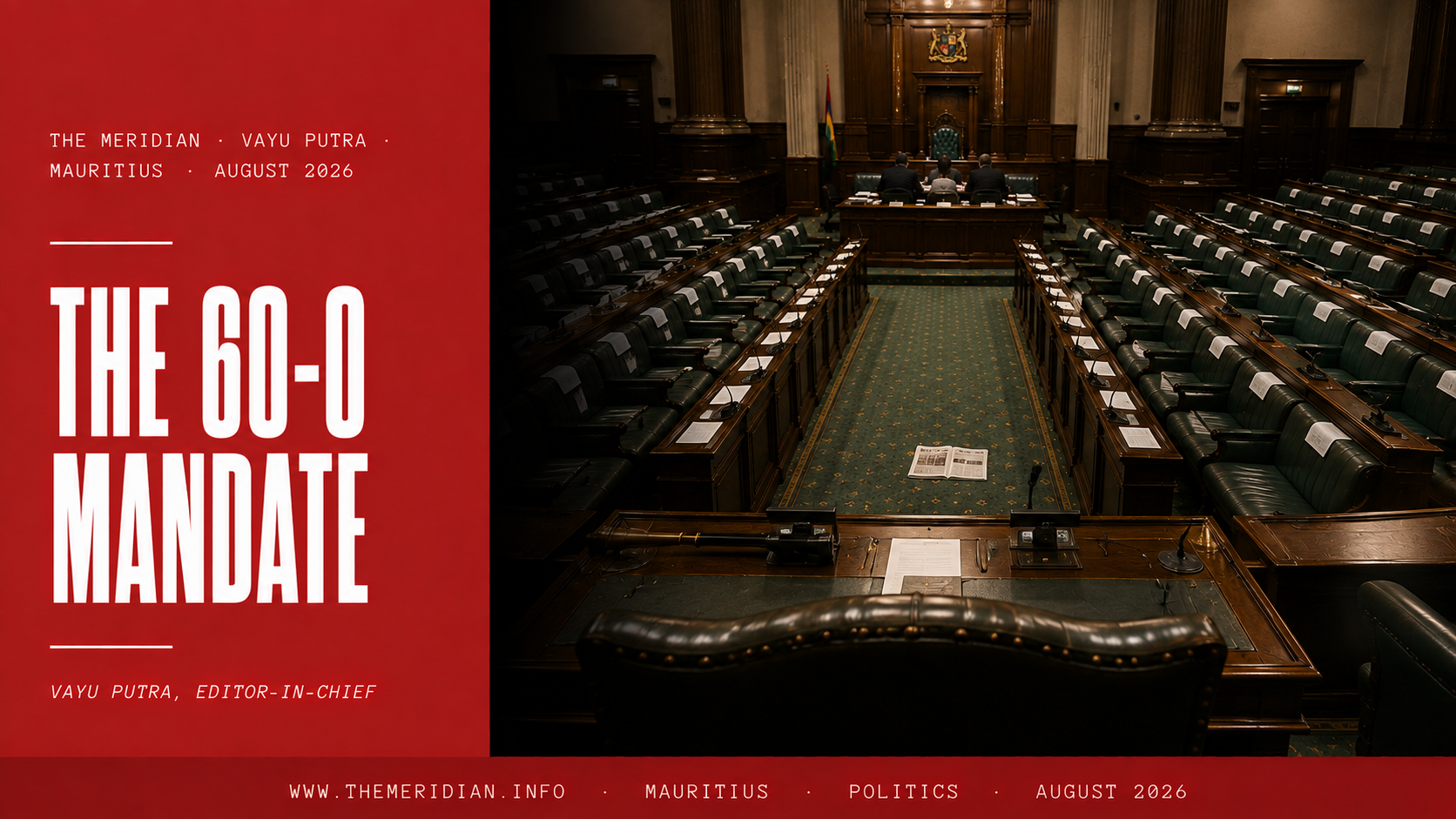
On 10 November 2024, Mauritius delivered the most decisive electoral verdict in its post-independence history. Sixty of sixty directly elected seats went to the PTR-MMM-Reform alliance led by Dr Navin Ramgoolam. The result was not a mandate for a programme. It was a verdict on a government. The electorate was solving four documented problems simultaneously. Twenty months later, The Meridian examines each problem against the evidence: the economic structure, the three exchange rates, the trade deficit, the Commissioner of Police nomination, the cabinet reshuffle, the cannabis scandal, the WhatsApp objection, the Constitutional Review Commission, the Finance Bill's pension provisions, the cost of living, and the media witch-hunt that operates on the same electoral cycle regardless of which dynasty holds power. The assessment is not partisan. It is evidenced. The scorecard is the article.
The 60-0 result requires contextualisation before it can be analysed. It was the largest parliamentary majority in Mauritius's post-independence history. It was also, in part, a statistical artefact of the first-past-the-post electoral system applied to a deeply divided opposition vote. The PTR-led alliance did not win 60-0 because 100 per cent of Mauritians supported it. It won 60-0 because the Jugnauth government's support had collapsed sufficiently and uniformly across constituencies to produce a clean sweep under a system that rewards geographic distribution of votes over aggregate national share. The mandate was real. Its scale was amplified by the system. That distinction matters for what follows, because a government that governs as though it has the unanimous consent of the population, rather than the decisive plurality of an electorate that wanted change, is a government that has misread what it was given.
What the electorate gave the PTR-led alliance on 10 November 2024 was a specific commission, not a blank cheque. The commission had four components, each traceable to documented public grievances that the electoral campaign addressed. This article examines each component, measures the evidence of the first twenty months against it, and presents the assessment without political sympathy for any party.
The first problem was the Jugnauth government's institutional overreach. Municipal elections postponed three times between 2021 and 2023, the third postponement removing the statutory basis of the first two entirely. The Commissioner of Police, supported by the anti-corruption body ICAC, bringing a constitutional challenge to the DPP's independence before the Supreme Court. A social media ban nine days before the election. The wiretapping scandal: private phone conversations of politicians and citizens leaked, the origin of the leaks never officially resolved. The ICTA regulation of 1 November 2024. The electorate wanted these institutional abuses ended and the institutions restored to independent function.
The second problem was the economic condition of ordinary Mauritian households. The cost of living had risen across every essential category: food, fuel, electricity, water, and transport. The structural causes, import dependence, dollar lock-in, the trade deficit, the STC's monopoly on essential petroleum imports, the three exchange rates that create arbitrage for the connected and costs for the ordinary, had not been addressed by the Jugnauth government. The electorate wanted relief, and they wanted a government that acknowledged the structural origins of the pressure rather than attributing it entirely to global factors beyond any government's control.
The third problem was corruption perception and institutional integrity. The coffres-forts case: Rs 224 million found at the Prime Minister's residences in February 2015, 23 FIAMLA charges, a prosecution that the Financial Crimes Division subsequently stayed on grounds of abuse of process after finding that the investigation had been politically motivated. The Jugnauth government's relationship with the prosecution of its predecessor had produced a perception of institutional capture that damaged Mauritius's international reputation. The electorate wanted a government whose own legal position did not compromise the institutions responsible for public accountability.
The fourth problem was the absence of a credible economic vision. Tourism, offshore financial services, and a residual textile sector: three pillars under simultaneous structural pressure, no industrial policy to build a fourth, no technology or AI investment strategy, no plan to reduce the trade deficit or the import dependence that makes every global price shock a domestic crisis. The electorate wanted a government with an economic direction, not merely an economic inheritance.
The three exchange rate architecture deserves specific examination because it is simultaneously the most technically complex and most consequential economic feature of the Mauritian system, and the least discussed in the domestic political conversation. The Bank of Mauritius publishes an official exchange rate. The commercial rate at which tourism receipts and offshore financial services transactions are converted is determined by market conditions and differs from the official rate by a margin that captures value for the banking system. The rate at which the STC imports petroleum products, including aviation fuel, diesel, and domestic cooking gas, is negotiated separately and passes through to domestic fuel prices through a pricing formula that the regulator reviews periodically but does not continuously adjust. The three-rate architecture means that the exchange rate risk of a depreciating rupee is not evenly distributed across the economy. It falls disproportionately on households and small businesses that pay retail fuel and food prices determined by the STC import rate, while the commercial rate captures a margin for the financial sector and the official rate provides a reference that corresponds to neither of the rates at which most economic actors actually transact. The government has not addressed this architecture. It has not acknowledged it publicly as a structural concern. The September edition will examine it in full.
Every Mauritian government since independence has operated the same media-political cycle. An election is won. A period of honeymoon follows. Then: a scandal emerges involving a minister or a minister's associate. The media amplifies it. The minister resigns or is reshuffled. The cabinet is reconfigured. The cycle repeats. The BTI 2026 identifies this cycle as part of the oligarchic alternation pattern: the scandals are real, the resignations are genuine, and the cycle serves a political function, it absorbs public attention, creates the appearance of accountability, and prevents the structural questions from dominating the public conversation.
This week's iteration: a junior minister's husband was arrested in connection with four cannabis plants. The minister resigned. The cabinet was reshuffled. The media covered the resignation extensively. The cabinet reshuffle produced new appointments. The structural economic questions, the trade deficit, the three exchange rates, the aviation fuel crisis, the Air Mauritius recovery, the pension reform's distributional consequences, remained in the background, exactly where the scandal cycle places them.
This is not an accusation that the scandal was manufactured or that the resignation was inappropriate. A junior minister whose spouse faces criminal proceedings has a legitimate reason to resign. The resignation was constitutionally correct. What the BTI framework observes is that a political system in which the media cycle consistently amplifies personal scandals while structural questions remain underreported is a system whose accountability mechanisms are functioning at the wrong level of analysis. The witch hunt is real. It is also a distraction. Both things are simultaneously true, and the Mauritian media, with notable exceptions, has consistently chosen the distraction over the analysis.
The Commissioner of Police in Mauritius is a constitutionally significant appointment. The CP commands the national police force, which is the primary instrument of domestic law enforcement. In the Jugnauth government's tenure, the CP was the institutional actor who brought a constitutional challenge to the DPP's independence before the Supreme Court, supported by the government's own anti-corruption body.
The current Commissioner of Police has been nominated by the Ramgoolam government. The nomination is constitutionally orthodox: the Prime Minister advises the President on such appointments. The appointment is exercised within the existing constitutional framework. What the Bermeo-Laebens framework asks is not whether the nomination is legal. It is whether the pattern of executive appointments to constitutionally significant positions, taken together with the other institutional observations this edition has documented, produces a configuration in which the accountability mechanisms that constrain the executive are progressively occupied by persons whose appointment depended on the executive's confidence.
The CP who challenged the DPP's independence was appointed by a Jugnauth government. The CP who now commands the police force is appointed by a Ramgoolam government. The DPP whose independence both appointments affect is the same constitutional officer whose role the Constitutional Review Commission is simultaneously examining. The institutional triangle of CP, DPP, and constitutional reform is the most consequential accountability configuration in Mauritius's current political landscape. All three vertices of the triangle are in motion simultaneously. The Meridian records this observation without characterising its direction. The direction will become apparent from what the Constitutional Review Commission recommends.
The Council of Ministers decision to formally notify Meta of Mauritius's opposition to the WhatsApp Username feature is the most recent data point in the pattern this edition has assembled. As documented in The Meridian's recent coverage, the feature is optional: it does not remove the phone number requirement for account creation and does not prevent any user from continuing to use WhatsApp exactly as before. India and Somalia have also objected. India cites cybercrime at scale among 850 million users. Somalia cites active Al-Shabaab use of the platform for extortion and propaganda.
Mauritius is a safe island with 1.3 million people, no terrorism, no insurgency, and no documented cybercrime crisis of comparable scale to either India or Somalia. Its objection to an optional feature that reduces social-level phone number exposure without eliminating state-level identification capacity through lawful process has no stated justification adequate to its specific context. Read in isolation, it is an unusual regulatory decision. Read within the pattern of the August edition, the Finance Bill's presidential approval requirements, the Constitutional Review Commission's mandate, the Sydney Pierre revocation, the historical social media ban, the CP-DPP triangle, it is the sixth observable data point in a sequence the Bermeo-Laebens framework asks us to take seriously.
The 60-0 was not a mandate for a second republic. It was not a mandate for a captured state. It was a mandate to govern better than what preceded it. The evidence of twenty months shows one problem solved completely, one partially addressed and simultaneously complicated, and two largely unaddressed. The electorate will make its next assessment in due course. The Meridian makes its assessment now, from the evidence, without waiting for the electoral cycle to provide cover for the analysis.
The 60-0 was the largest mandate in Mauritian democratic history. It carried the weight of a population that had endured ten years of institutional overreach, three postponed municipal elections, a social media ban, a wiretapping scandal, a cost-of-living crisis without structural response, and a government whose relationship with its own accountability institutions had become a daily source of public embarrassment. The electorate was not naive about what it was choosing. It was choosing change, decisively, within the only mechanism available to it.
Twenty months later, the change is partial, uneven, and in several domains producing institutional configurations that raise questions of the same kind, if not yet the same severity, as those it replaced. The structural economic condition has not improved. The trade deficit is wider. The rupee is weaker. The three exchange rates remain unreformed. Youth unemployment is unaddressed. The aviation fuel crisis has arrived without a resilience architecture in place to absorb it. The pension reform was fiscally necessary and distributionally inequitable. The cost of living has not fallen.
The institutional picture is more complex. The courts are still deciding. The press is still free. The Privy Council still has jurisdiction. The DPP is still appealing. These are genuine assets. Against them: the Constitutional Review Commission is examining DPP independence in a configuration that raises procedural questions the evidence requires naming. The CP has been nominated. The WhatsApp objection has been issued without adequate justification. The Sydney Pierre revocation was constitutionally imprecise in its stated grounds. The Electoral College amendment connects to a 2014 ambition the electorate rejected.
The 60-0 was not a mandate for any of this. It was a mandate to govern with institutional integrity, to address the structural economic condition honestly, and to demonstrate that the alternation of dynasties need not mean the alternation of abuses. The evidence of the first twenty months is that the mandate has been partially honoured and partially squandered. The electorate gave this government everything it needed. What it does with what it was given is the question that the next election will answer, and that The Meridian will continue to document, article by article, with the evidence the Mauritian public deserves to read.
Add comment
Comments