Aviation Fuel and the Cost of Getting to Mauritius: What the 2026 Price Spike Means for an Island That Cannot Set the Price
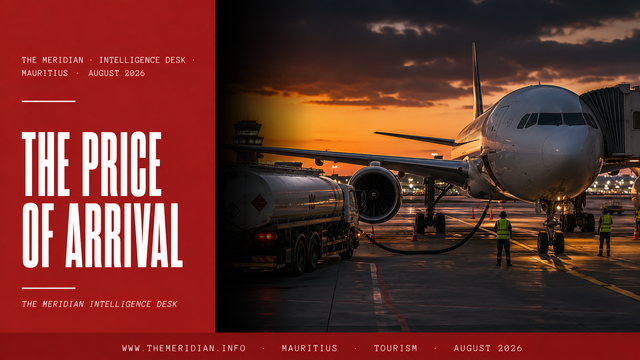
The jet fuel price at the US Gulf Coast spiked from $2.26 per gallon in February 2026 to $3.93 per gallon in April, a 74 per cent increase in two months, as Strait of Hormuz disruptions curtailed Middle East refined product exports and forced global aviation fuel buyers to compete for limited Atlantic Basin supply. US domestic airfares rose 27 per cent as a direct consequence. Mauritius imports every litre of aviation fuel it consumes. Its three largest traditional source markets, France, the United Kingdom, and Germany, are already recording declining arrivals. The current account deficit is projected to widen to 8.2 per cent of GDP in 2026. The rupee reached 47.53 per US dollar in June 2026, its weakest level on record. Air Mauritius carries EUR 317 million in accumulated losses since 2000 and is targeting profitability by the 2026-27 financial year. The 2026 aviation fuel crisis has arrived at the worst possible moment for an island economy whose external position is already structurally weakened, whose national carrier is in recovery, and whose tourism sector faces the prospect of European visitors choosing a cheaper destination.
Mauritius cannot produce aviation fuel. It has no oil refinery, no domestic crude supply, and no storage architecture capable of absorbing a sustained supply shock through strategic reserves. Every litre of jet fuel that lifts a plane from Sir Seewoosagur Ramgoolam International Airport is imported, priced in US dollars, and purchased in a global market whose conditions Mauritius has no capacity to influence. When that market experiences a 74 per cent price spike in two months, as it did between February and April 2026, the effect is transmitted directly and immediately to every flight operating through Mauritius's only international airport. Mauritius does not have a buffer. It has an exposure.
The dominant driver of the jet fuel price in 2026 was crude oil feedstock cost combined with an exceptional refinery crack spread. Strait of Hormuz disruptions pushed WTI above $100 per barrel in March and April. Simultaneously, the curtailment of Middle East refined product exports created a supply gap that Atlantic Basin refineries could not immediately fill, driving the Gulf Coast benchmark from $2.26 to $3.93 per gallon in two months. US scheduled domestic carriers' monthly fuel bills reached $5.06 billion in March 2026, up 56.4 per cent from February 2026 and up 30.4 per cent from March 2025. The crisis was not driven by increased consumption: domestic airlines used 1.627 billion gallons of fuel in the relevant month, a slight decrease from the previous year. Prices rose because supply was constrained, not because demand increased. Airlines absorbed an 84 per cent increase in their primary operating expense and passed approximately 27 per cent of it to passengers through fare hikes.
The UK June 2026 jet fuel price settled at $2.25 per gallon, lower than the US peak but still elevated relative to the 2024-2025 baseline. The global IATA benchmark eased from $141.64 per barrel in June to $116.63 by early July as the underlying Hormuz disruption moderated. The moderation is real. It does not undo the months of elevated costs already absorbed by carriers, or the fare increases already in place on routes serving Mauritius's primary source markets.
Mauritius recorded 1,436,250 tourist arrivals in 2025, a 3.9 per cent increase year on year. Tourism earnings are expected to exceed Rs 100 billion for 2025. The headline figure is positive. The composition of the growth is the concern. Arrivals from France, the UK and Germany were down 0.6 per cent, 2.0 per cent and 1.3 per cent respectively in 2025. These three countries are Mauritius's three largest traditional source markets. Growth was led by India, which increased 33.5 per cent, and by Italy, Spain, and smaller European markets. The structural shift is visible: Mauritius is growing its visitor base by replacing declining traditional European arrivals with growth from emerging markets, a diversification that is strategically sensible but logistically vulnerable.
The vulnerability is specific. European visitors typically arrive on long-haul flights from Paris, London, Frankfurt, and Amsterdam, on routes where fuel costs represent 25 to 33 per cent of airline operating expenses. A 74 per cent fuel cost spike over two months translates directly into higher fares on precisely the routes from which Mauritius is already seeing declining arrivals. The European visitor who was already reconsidering a long-haul Mauritius holiday in the context of persistent inflation in France, the UK, and Germany now faces airline ticket prices that have increased by 20 to 30 per cent on top of the cost of living pressures that were already suppressing discretionary travel spending. The marginal European visitor, who was on the edge of booking, does not book. Tourist arrivals in Mauritius fell from 115,165 in May 2026 to 89,098 in June 2026. The May to June decline corresponds precisely with the period of peak fare increases following the April fuel price spike.
Air Mauritius is the national carrier of a country whose economy depends on tourism. It operates 12 aircraft, serves 13 direct destinations, carries approximately 1.7 million passengers per year, and employs around 3,000 people. It was incorporated in 1967 specifically to establish international trade links, support tourism flows, and build a self-sustaining national carrier for an island state with no alternative aviation infrastructure. It has accumulated EUR 317 million in losses since 2000. It emerged from technical insolvency in 2025 under new leadership and a restructuring programme that cancelled overambitious Airbus A350 contracts, shed non-essential costs, and repositioned the airline around direct connectivity and national identity.
Air Mauritius reported a net profit of MUR 252.7 million (EUR 4.9 million) for the first quarter of its 2025-2026 financial year, described as its best first-quarter result in nine years. The profit was achieved against operational headwinds: one A330-900neo wide-body aircraft was out of service for eight of the thirteen weeks of the quarter, and 24 Aircraft on Ground incidents generated significant maintenance and disruption costs. The Q1 profit is a genuine achievement for an airline that was technically insolvent twelve months earlier. It is also a thin margin against the fuel cost environment it now faces.
Fuel represents 25 to 33 per cent of airline operating costs as a global average. For a small island carrier operating long-haul routes with a fleet of 12 aircraft, the fuel share is likely at the higher end of that range. Air Mauritius hedges fuel costs to some degree, as all commercial carriers do, and hedging positions established before the February-April 2026 spike will have provided partial protection. But hedging is time-limited: positions established at pre-spike prices expire, and rolling them at post-spike prices crystallises the new cost level into the airline's operating structure. Competition from regional carriers, volatile fuel prices, currency fluctuations, and post-pandemic market shifts are all external threats that will continue to test the airline's resilience. The MUR 252.7 million Q1 profit was achieved when the fuel price was, by the airline's own account, stable at approximately USD 66.76 per barrel. The Q2 2026 results, which will reflect the March-April fuel spike, have not yet been published. They will provide the next data point on whether the recovery is robust enough to absorb a structural input cost increase of the magnitude that occurred.
The 2026 fuel spike originated in the Strait of Hormuz. Approximately 20 per cent of the world's crude oil and 25 per cent of its liquefied natural gas passes through the Strait. The US-Iran tensions that drove the disruption have partially moderated but have not resolved. A second disruption episode would regenerate the fuel cost spike from a higher baseline, because Atlantic Basin refineries have already demonstrated their capacity constraints in responding to the first disruption.
The Strait of Hormuz is also relevant to Mauritius through a second channel: the Gulf hub connections that serve its Asian visitor market. Emirates, Air Arabia, Etihad, and Qatar Airways all operate through Gulf hubs that are geographically proximate to the Strait. Any sustained closure or disruption of the Strait does not merely raise fuel prices globally. It threatens the operational viability of the Gulf-hub routing on which a significant share of Mauritius's Asian, African, and Australian feeder traffic depends. A visitor from Mumbai, Nairobi, or Melbourne connecting through Dubai or Doha to Mauritius depends on a supply chain whose most critical chokepoint runs through a geopolitical flashpoint. Mauritius has no alternative hub architecture. It has one international airport, a national carrier in recovery, and an aviation fuel supply that runs through the same waterway that disrupted global prices for four months in 2026.
The macroeconomic context in which the aviation fuel crisis arrives makes its consequences more severe than the tourism numbers alone would suggest. The rupee reached 47.53 per US dollar in June 2026, its weakest level on record, having depreciated 4.43 per cent from a year earlier. The rupee dropped by close to 30 per cent between 2019 and 2024, and has weakened by around 5 per cent against both the US dollar and the euro since the start of 2026. The IMF's June 2025 Article IV assessment found that Mauritius's external current account deficit widened to 6.5 per cent of GDP in 2024, mostly reflecting higher imports and freight costs, with the nominal rupee-USD rate depreciating 6.7 per cent in 2024 alone.
Aviation fuel is purchased in US dollars. Air Mauritius's operating costs are partially dollarised. Mauritius's fuel import bill, which covers aviation fuel, diesel, petrol, and heavy fuel oil for the CEB's power stations, is entirely dollarised. Every rupee that depreciates against the dollar makes the fuel more expensive in local currency terms, even when the dollar price is stable. When the dollar price increases by 74 per cent simultaneously with a 5 per cent rupee depreciation, the compound effect on the rupee cost of aviation fuel approaches 80 per cent over two months.
The tourism sector's role in this equation is not merely economic. It is structural. The current account deficit is projected to widen to 8.2 per cent of GDP in 2026, due to weaker exports of goods and services. Tourism receipts are Mauritius's single largest source of foreign exchange earnings. Tourism revenues for January 2026 were Rs 11,287 million, lower than the Rs 12,127 million recorded for January 2025. A sustained decline in European arrivals, compounded by higher airfares that push the marginal visitor toward cheaper alternatives, reduces the foreign exchange inflow that the Bank of Mauritius requires to defend the rupee. A weaker rupee increases the rupee cost of every dollarised import, including fuel. Higher fuel costs raise airfares. Higher airfares reduce arrivals. Reduced arrivals lower foreign exchange earnings. Lower foreign exchange earnings weaken the rupee further. The feedback loop is not hypothetical. The data shows it beginning.
Aviation fuel is purchased in US dollars. Mauritius's tourism earnings are the primary source of the US dollars that pay for it. When fuel prices rise and tourism revenue falls simultaneously, the currency that connects the two is the rupee. And the rupee, at 47.53 per dollar in June 2026, is at its weakest level on record.
The 2026 aviation fuel crisis has not destroyed Mauritius's tourism sector. Q1 2026 arrivals were up 6.8 per cent year on year. Air Mauritius posted its best Q1 profit in nine years. The structural picture contains genuine resilience. The September edition of The Meridian will examine that resilience in depth, through the lens of the rentier trap that has made Mauritius's tourism dependence a structural vulnerability rather than a development asset.
What the 2026 aviation fuel crisis has done is arrive at the precise moment when Mauritius's external position is at its most vulnerable: the rupee at a record weak level, the current account deficit widening to 8.2 per cent of GDP, the trade deficit at its largest in ten months, the national carrier in a recovery whose Q2 results will reflect the full force of the spring fuel spike, and the three traditional European source markets already posting declining arrivals before the airfare increases landed.
Mauritius cannot produce aviation fuel. It cannot set the price. It cannot create a strategic reserve large enough to absorb a 74 per cent price spike. What it can do is reduce its structural dependence on the single-input, single-channel vulnerability that the aviation fuel crisis has exposed. A country whose primary foreign exchange earner arrives by air, whose primary operating cost is purchased in a currency it does not control, at a price set by a market it cannot influence, through a chokepoint it cannot secure, is a country that has built its prosperity on a supply chain whose fragility a single geopolitical event in the Persian Gulf can expose. That is not a criticism of any government. It is the description of a structural condition that the rentier trap literature has a precise term for. The September 2026 edition of The Meridian will supply it.
Add comment
Comments