The Oil That Africa Cannot Refine: How the World's Second-Largest Oil-Producing Region Sends Its Crude Elsewhere and Imports the Products Back
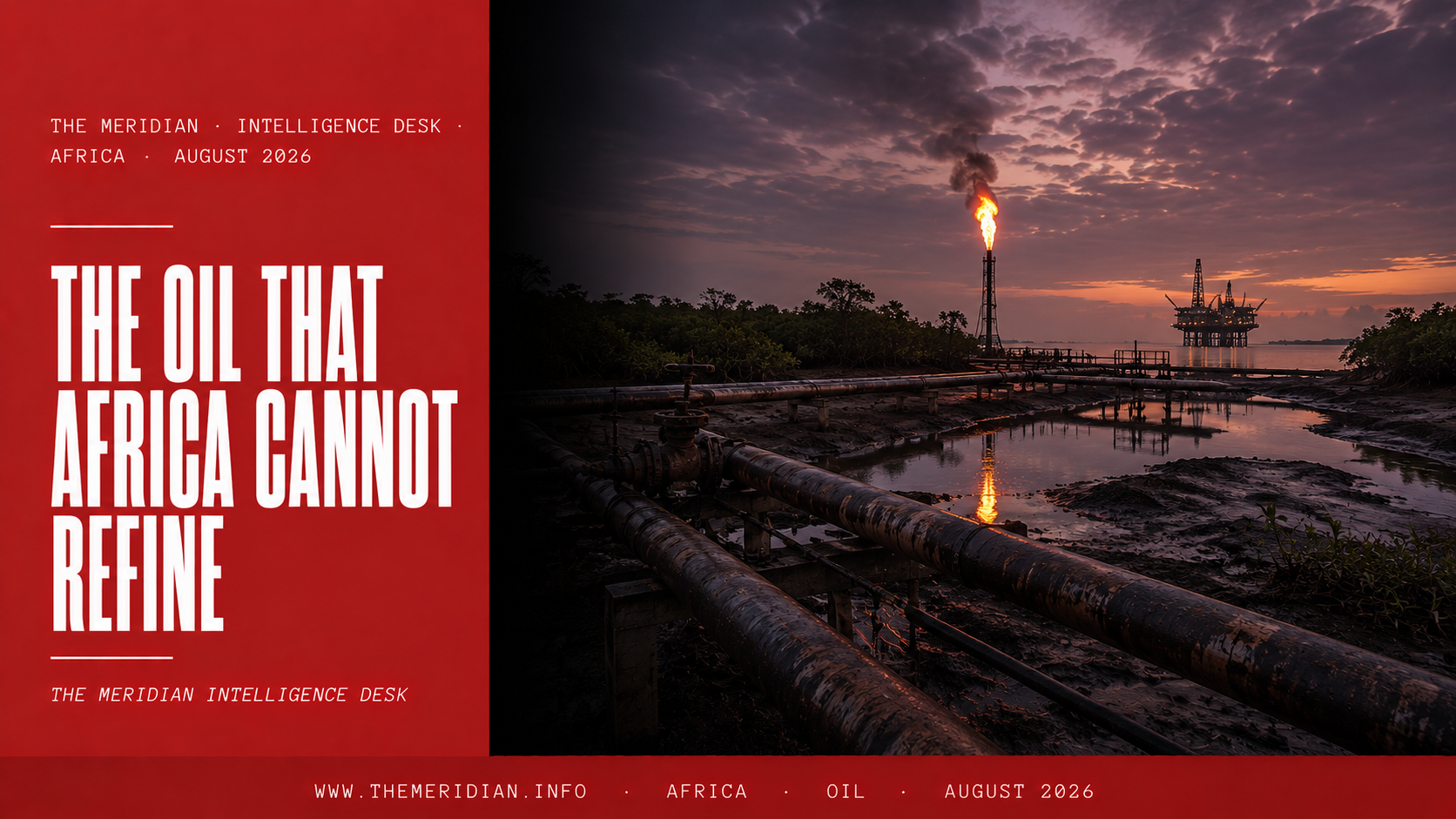
Nigeria produced approximately 1.56 million barrels per day in 2024 and oil provides over 90 per cent of Nigeria's export earnings. For most of the six decades since independence, Nigeria exported crude oil, imported refined petroleum products, and subsidised the difference at a fiscal cost that eventually consumed a significant share of the national budget. Africa's largest refinery opened in September 2024: the Dangote Petroleum Refinery in Lagos, designed to process 650,000 barrels of crude oil per day. It was the most ambitious domestic value-addition project in Nigerian industrial history. Between October 2025 and mid-March 2026, the refinery received only 29.21 million barrels against an estimated requirement of 108.74 million barrels over the same period, a supply performance of 26.9 per cent, because the NNPC had committed much of its output to service deals with financial lenders. Africa built the refinery. Africa's own institutions could not supply it. The oil that Africa cannot refine is sometimes oil that Africa cannot deliver to the refinery it spent billions building. The extraction economy's architecture is not only external. In its most advanced form, it is internalised.
The oil value chain is the extraction economy's most consequential single commodity architecture. Not because oil is more important than cocoa or gold or cobalt in any moral sense, but because the scale of the value transferred, from the Niger Delta to Rotterdam, from the Angolan offshore fields to Chinese and European refineries, from Libyan oil terminals to Mediterranean processing hubs, dwarfs every other commodity chain this edition has documented. Nigeria earned over $35 billion in oil revenues in 2022. Angola's oil accounts for 95 per cent of its exports. Libya, Gabon, Equatorial Guinea, Congo-Brazzaville, and South Sudan all derive the dominant share of their government revenues from a commodity extracted from their soil, priced by markets they do not influence, refined in facilities they do not own, and returned to them as petroleum products at a margin that captures every stage of processing value outside the continent that produced the raw material. The architecture has persisted since the first African oil was extracted in commercial quantities in the 1950s. The Dangote Refinery is the first serious challenge to it. The challenge, as the evidence shows, has met the architecture's most durable feature: not external resistance, but internal institutional capture.
The observable contradiction in the African oil value chain has two dimensions. The first is familiar from the gold and cocoa chains: the resource leaves as a raw material and returns as a processed product, with the processing margin captured outside the producing country. Nigeria leads Africa in oil production, pumping over 1.5 million barrels per day. Oil provides over 90 per cent of Nigeria's export earnings and makes up 7.5 per cent of its GDP. For most of the post-independence period, Nigeria exported crude oil and imported refined petroleum products: petrol, diesel, kerosene, and liquefied petroleum gas. The Port Harcourt, Warri, and Kaduna refineries, built in the 1960s and 1970s with a combined capacity of 445,000 barrels per day, operated at negligible throughput for decades, crippled by underinvestment, corruption in the NNPC, and a subsidy structure that made domestic refining commercially unviable relative to importing refined products at government-subsidised prices.
The second dimension is specific to the oil value chain and distinguishes it from gold or cocoa: the environmental cost of extraction remains entirely in the producing community. Theft, pipeline vandalism, and environmental damage in the Niger Delta continue to challenge production. The Niger Delta has suffered oil spills, gas flaring, and groundwater contamination for six decades. The communities that live above the oilfields that generate 90 per cent of Nigeria's export revenues receive neither the oil wealth nor environmental remediation at any scale commensurate with the damage. The oil is extracted from their land. The revenue flows to Abuja. The environmental cost stays in the Delta. The refining margin goes to Rotterdam. The producing community receives the residual of a value chain from which it is systematically excluded at every stage above extraction.
The first constraint is institutional: the NNPC's structural inability to supply the refinery it was supposed to feed. The Dangote Refinery requires an estimated 19.77 million barrels monthly to operate at full capacity. Between October 2025 and mid-March 2026, it received only 29.21 million barrels against an estimated requirement of 108.74 million barrels, a supply performance of 26.9 per cent. The NNPC had committed much of its output to service deals with financial lenders. This is the extraction economy's most ironic configuration: Nigeria's state oil company, whose mandate includes supplying the country's domestic refining capacity, had pre-committed so much of its crude allocation to debt service arrangements with international creditors that it could not supply the largest refinery on the African continent, located in Nigeria's own commercial capital, at more than a quarter of its requirement. The cost of this mismatch has been enormous. In 2025, the Dangote Refinery was compelled to import foreign crude valued at $3.74 billion from countries including Brazil, the United States, and Algeria. Nigeria, Africa's largest oil producer, was importing crude oil from Brazil to supply a refinery built to reduce Nigeria's dependence on imported petroleum products. That is not a failure of industrial policy. It is a failure of state institutional capacity, compounded by the debt architecture that this edition's IMF conditionality article documented in a different context.
The second constraint is Angola's structural oil dependence and its human development paradox. Angola's oil output averaged 1.03 million barrels per day in early 2025, down from a peak of 2 million barrels per day in 2008. Oil still accounts for 28.9 per cent of GDP and 95 per cent of exports. Despite this oil wealth, Angola ranks 148th of 193 on the 2025 Human Development Index. The poverty rate stands at 40.6 per cent. Youth unemployment is 43.3 per cent. Inflation reached 28.2 per cent in 2024. More than three-quarters of the Angolan economy depends on the oil sector. IMF staff estimate that 83 per cent of Angola's GDP benefits from higher oil prices. An economy in which 83 per cent of GDP correlates with the price of a single commodity it does not refine, whose benefits accrue primarily to the state rather than to the households that constitute 40.6 per cent of the population in poverty, is an economy in which the oil value chain is simultaneously the primary source of national income and the primary mechanism for concentrating that income in a narrow elite while the majority of the population remains below the poverty line. Angola imports refined petroleum products, including the petrol and diesel that its own crude oil, refined in Rotterdam or Ras Tanura, returns to its ports as finished goods.
Nigeria built Africa's largest refinery. Its state oil company committed its crude to debt service arrangements and could not supply it. The refinery imported crude from Brazil, the United States, and Algeria. Africa's largest oil producer spent $3.74 billion importing crude oil to supply a refinery built to reduce its dependence on imported petroleum products. The extraction economy's architecture is not only external. In its most advanced form, it is internal.
Africa's largest refinery opened in September 2024. By August 2025, it had reached an output of 610,000 barrels per day, just over its nameplate capacity of 650,000 bpd according to local reports. Its operators had already planned an expansion to 700,000 barrels per day by the end of 2025. Dangote is aiming to overtake Reliance Industries' Jamnagar complex in Gujarat, India, as the world's largest refinery. These are extraordinary achievements by any measure. Aliko Dangote, Africa's wealthiest individual, built the largest single industrial facility on the continent through private capital, against institutional resistance from the NNPC, through a procurement process that required importing specialised engineering from across the world, and brought it to near-nameplate capacity within a year of opening. The Dangote Refinery is the sovereignty blueprint applied to oil: domestic processing, domestic value addition, domestic capture of the refining margin.
Its limits are equally instructive. Nigeria is projected to become a net exporter of petroleum products as the Dangote Refinery scales up production. The removal of fuel subsidies has revitalized the downstream sector, making it commercially viable for the first time in decades. The subsidy removal, which imposed significant short-term cost-of-living increases on Nigerian households, was the fiscal precondition for domestic refining becoming commercially viable. The Dangote Refinery is profitable because the subsidy that previously made importing refined products cheaper than domestic refining has been removed. The cost of that removal was borne by Nigerian consumers. The benefit is being captured by the Dangote Group. This is not a condemnation of the refinery or of subsidy removal as a policy instrument. It is an observation about who bears the transition cost and who captures the transition benefit in a commodity chain correction of this kind.
Theft, pipeline vandalism, and environmental damage in the Niger Delta continue to challenge production. The Niger Delta is home to fields like Bonga and Egina. The Niger Delta's oil fields have generated over 90 per cent of Nigeria's export earnings since the 1970s. The communities that live above those fields have experienced decades of oil spills, gas flaring, groundwater contamination, and the destruction of the fishing and agricultural economies that previously sustained them.
The extraction economy's environmental accounting is as asymmetric as its financial accounting. The oil revenue flows upward through the NNPC to the Federation Account and then to state and federal governments whose capacity to invest it productively has been documented as limited. The environmental cost stays in the Delta, in the contaminated soil, the dead fish, the flare-lit nights, and the respiratory conditions that have no national statistics because they are not measured at the national level.
The Dangote Refinery, by processing Nigerian crude domestically, captures the refining margin for a Nigerian entity. It does not change the environmental distribution of extraction costs. The oil still comes from the Delta. The communities still bear the environmental consequences. The refining margin now accrues to a Lagos-based billionaire rather than a Rotterdam-based refinery. That is a form of value retention. It is not the same as the communities who bear the extraction cost receiving any share of the value they enable.
The evidence suggests three conclusions that connect the oil value chain to the broader extraction economy analysis of this edition and to the gold chain documented in the preceding article.
The first is that the refining gap, the systematic export of crude oil and import of refined products, is not a geological destiny. It is a product of specific historical decisions: the colonial extraction infrastructure designed for export rather than processing, the post-independence state oil companies whose institutional capacity was consumed by patronage rather than operational efficiency, the IMF structural adjustment conditions that prioritised subsidy removal without simultaneously investing in domestic refining capacity, and the international investment protection architecture that gave foreign oil companies the right to export crude without obligation to refine it domestically. Each of these decisions was made by specific actors at specific moments. The Dangote Refinery demonstrates that the decision can be unmade, at the cost of $20 billion in private capital and the political will to remove subsidies that had previously made domestic refining uncompetitive.
The second conclusion is that Angola's human development paradox is the most precise quantitative expression of the resource curse in the African context. Angola ranks 148th of 193 on the Human Development Index. Its poverty rate is 40.6 per cent. Youth unemployment is 43.3 per cent. Oil accounts for 95 per cent of its exports and 83 per cent of its economic activity correlates with oil prices. A country whose entire economy rises and falls with the price of a commodity it exports raw, refines abroad, and imports back as finished goods, is a country whose development trajectory is determined by decisions made in commodity trading rooms in London and Singapore rather than in policy ministries in Luanda. The resource curse literature has documented this configuration across 40 years of development economics research. Angola is its most precise current example.
The third conclusion connects to the sovereignty blueprint. The Dangote Refinery is the oil value chain's equivalent of Ghana's GoldBod: a private sector attempt to capture the processing margin domestically, constrained by the same institutional architecture that the extraction economy has built over decades. GoldBod is constrained by the LBMA accreditation requirement. Dangote is constrained by the NNPC's debt service commitments. In both cases, the domestic processing initiative exists. In both cases, the institutional environment built around the export-raw-material model creates frictions that prevent the initiative from operating at its designed capacity. The architecture resists correction even when the correction has already been built and opened and is ready to operate.
The oil value chain is the extraction economy at its most consequential scale and its most revealing configuration. Gold leaves Africa raw and is refined in Switzerland. Cocoa leaves Africa as beans and is processed in Europe. Oil leaves Africa as crude and is refined in Rotterdam, Houston, and Ras Tanura. In each case, the producing country receives a royalty, an extraction-stage tax, and the environmental cost of production. The processing margin, the quality premium, and the financial product layering are captured outside the continent.
What distinguishes oil from gold and cocoa is the scale of the domestic institutional failure that compounds the external extraction. The NNPC is not the London Bullion Market Association. It is Nigeria's own state oil company, created by Nigerians for Nigerians, whose debt service commitments to international creditors prevented it from supplying the largest refinery on the African continent with the crude oil that continent produces in abundance. The Dangote Refinery is spending $3.74 billion importing crude from Brazil while Nigerian crude leaves for Rotterdam. This is the extraction economy's most precise domestic expression: the state institution, captured by its own debt architecture, reproducing the external extraction pattern from the inside.
Angola has 40.6 per cent of its population in poverty and 95 per cent of its exports in a single commodity that it does not refine. Nigeria has Africa's largest refinery running at a quarter of its crude supply requirement because its state oil company committed the crude elsewhere. The Niger Delta has been absorbing the environmental cost of both countries' oil exports for sixty years without compensation commensurate with the damage. The extraction economy does not require foreign actors to sustain itself. It requires only that the institutions built to manage the resource are themselves captured by the financial architecture that the extraction economy produces. In Nigeria and Angola, that capture is documented. The correction, the Dangote Refinery, the subsidy removal, the upstream investment targets, is in motion. Whether it succeeds depends on whether Nigeria's institutional capacity can be rebuilt faster than its debt service commitments can consume it.
Add comment
Comments