The Demographic Fracture: How Russia's War Economy Is Rewiring Eurasian Supply Chains and What It Costs the Global South
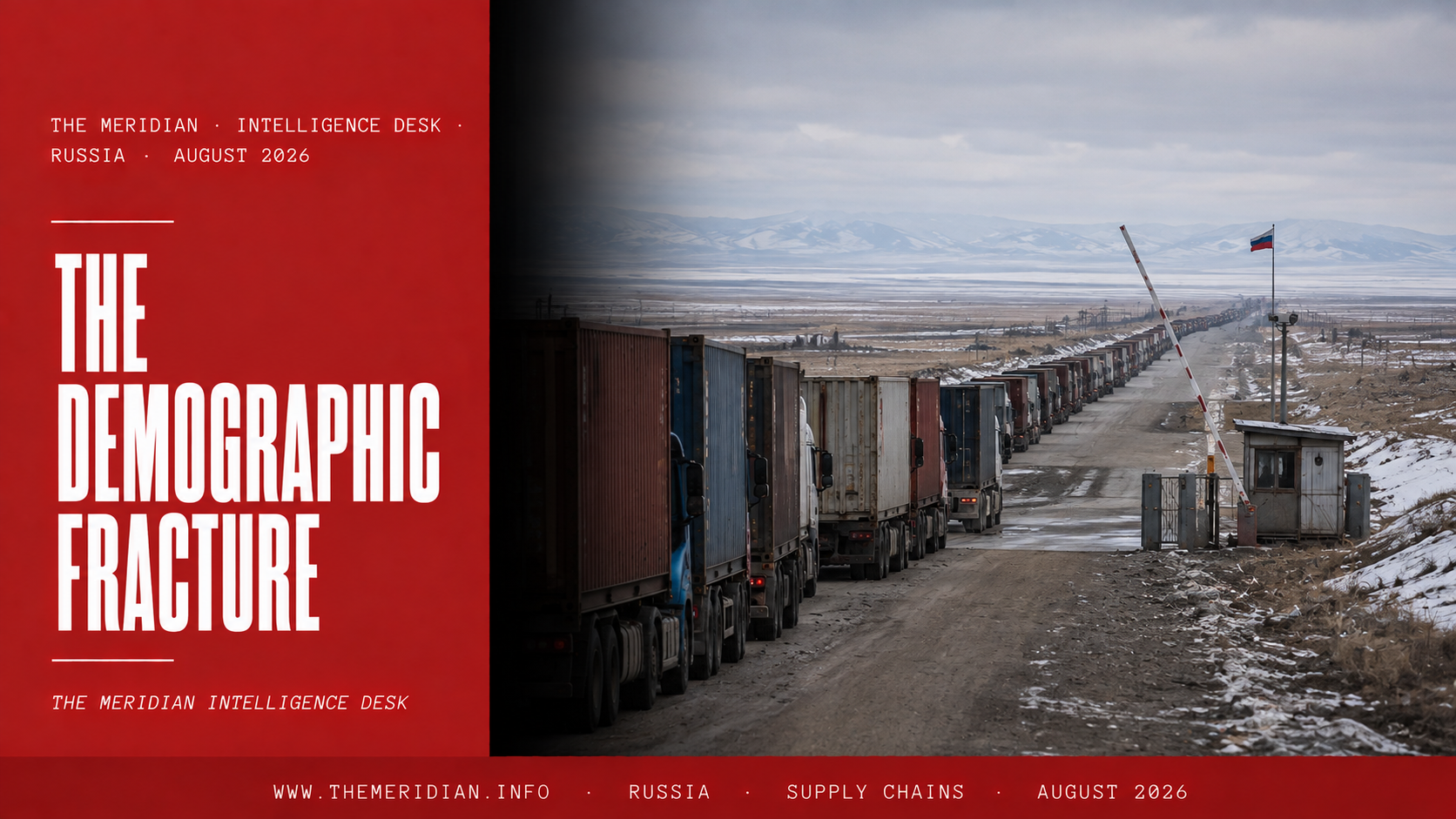
The year 2025 marked the end of Russia's wartime growth spurt of 2023 and 2024. After two years of expansion of more than 4 per cent, GDP growth for 2025 slowed to around 1 per cent, with the same headwinds persisting into 2026. The Institute of National Economic Forecasting of the Russian Academy of Sciences recorded a contraction of the Russian economy in Q1 2026 by 1.5 per cent year on year, the worst indicator since the beginning of the war. Russian companies faced a shortage of 2.6 million workers by end-2024, a 17 per cent increase on the previous year, with the most acute shortfalls in manufacturing (391,000 workers), trade (347,000), and transport (219,000). 90 per cent of manufacturing companies, 89 per cent of transport and logistics firms, and 88 per cent of service sector businesses report staffing shortfalls. A report titled Russia's Sanction Evasion Research 2025-2026 documents that Central Asia has become the primary backdoor route for sanctioned goods into Russia, with flows of Common High Priority List commodities increasing in 2025 from Kazakhstan, Kyrgyzstan, and Uzbekistan. The Russian war economy is not collapsing. It is fracturing. The fracture is rewiring Eurasian supply chains in ways that carry direct consequences for the Global South's food costs, fertiliser prices, and shipping route economics.
Russia matters to the Global South not because of any political solidarity or ideological alignment, but because of supply chain physics. Russia is the world's largest exporter of wheat, the second-largest exporter of natural gas, and a major exporter of potash, nitrogen fertilisers, palladium, nickel, and neon. It shares land borders with Kazakhstan, which has become the primary overland transit hub for sanctioned goods moving in both directions. It controls airspace that previously provided the most efficient routing for cargo between Europe and Asia. And it is conducting a war whose labour demands are consuming a civilian workforce that was already structurally insufficient to sustain a modern economy. The consequences of all of this are not abstract. They arrive in the price of bread in Dakar, the cost of fertiliser in Nairobi, the freight premium on cargo between Shanghai and Rotterdam, and the agricultural input costs in Mauritius. The Russian demographic fracture is a Global South economic event, whether or not the Global South has chosen to engage with it on those terms.
The Russian economy has largely exhausted the temporary drivers that underpinned growth in 2023 and 2024. In 2024, growth rested on a sharp rise in state spending: federal expenditures increased by roughly a quarter, rising to 40.2 trillion roubles from 32.35 trillion roubles in 2023, injecting demand into the economy. Those drivers were largely absent in 2025, and there is no obvious catalyst to revive growth in 2026. Defence spending reached 40.5 per cent of Russia's overall federal budget in 2025, a historic high. Compared with 2023, Russia's military spending increased by 31 per cent, and compared with the first year of the war in 2022, it rose by as much as threefold.
The two-track economy this produces is not difficult to describe but is consequential to measure. Military-industrial production is expanding, Russia now has more than 4,000 enterprises in its military-industrial complex, up from 1,400 in 2022. These enterprises employ approximately 4.5 million people. Civilian manufacturing, logistics, transport, construction, and retail are contracting or stagnating. Mining contracted 0.7 per cent in Q3 2025. Water and waste activities contracted 3.6 per cent. Wholesale and retail contracted 1.1 per cent. Transportation contracted 1.7 per cent. These are the sectors that move goods, process resources, and supply the logistics chains through which Eurasian trade flows. Their simultaneous contraction is not a cyclical fluctuation. It is a structural reorientation of the Russian economy away from civilian commerce and toward military production, at a pace and scale that the labour market cannot sustain.
The first constraint is demographic and structural. A demographic hole from the 1990s birth-rate collapse, emigration of 80,000 to 100,000 IT professionals since 2022, military mobilisation drawing workers from the civilian economy, and declining migrant inflows have combined to create the tightest labour market in modern Russian history. Russia's Ministry of Labour projects that by 2032 the economy will require approximately 12.2 million additional workers, an average of 1.7 million per year. As the Foreign Policy analysis published on 3 August 2026 concludes: "Russia's labour crisis is becoming a structural constraint on the Kremlin's wartime economy, domestic stability, and long-term geopolitical ambitions, its responses tend to exacerbate rather than resolve the problem."
The second constraint is the Eurasian logistics architecture's inability to absorb the volumes being rerouted through it. Russia has demonstrated significant adaptive capacity in mitigating the operational impact of Western sanctions, with Central Asia serving as a pivotal backdoor route for imports into Russia. Kazakhstan and Kyrgyzstan share open borders with Russia through the Eurasian Economic Union, removing customs inspections on intra-bloc trade. But the infrastructure that Kazakhstan built to handle its own trade volumes is not the infrastructure required to handle Russian rerouting at scale. Rail bottlenecks at the Chinese border, port congestion at Aktau on the Caspian, and the over-leveraged road haulage network across the steppe are all consequences of imposing wartime logistics volumes on peacetime infrastructure. The transit corridor that sanctions created is functional. It is also fragile and increasingly expensive to use.
The third constraint is secondary sanctions pressure on the transit countries themselves. US, EU, and UK officials found sufficient evidence in 2025 of sanctions-busting activity that several Kyrgyz banks were sanctioned, along with the cryptocurrency exchange Grinex. In April, the EU also sanctioned entities operating in Kyrgyzstan. Kazakhstan has been explicit in its determination not to become a sanctions-evasion hub, precisely because its own access to Western financial markets and investment depends on maintaining compliance. The transit corridor works until it is sanctioned. The sanctioning of Kyrgyz financial institutions in 2025 demonstrates that the corridor's operational lifespan is constrained by the political will of the sanctioning powers to pursue it through intermediary jurisdictions.
The connection between Russia's demographic fracture and the Global South's economic condition operates through four specific channels that this edition's analytical framework makes identifiable.
The first is fertiliser. Russia is a dominant global exporter of potash and nitrogen fertilisers. The demographic hollowing of Russia's civilian logistics workforce creates bottlenecks in fertiliser export supply chains that are distinct from, and compound, the price effects of the 2022 Black Sea grain deal collapse. A Mozambican smallholder farmer or a Zimbabwean commercial farm whose fertiliser costs are determined in part by Russian logistics capacity is experiencing the Russian demographic fracture as an input cost, not as a geopolitical abstraction.
The second is wheat. Russia remains the world's largest wheat exporter. The combination of constrained civilian logistics capacity, a labour shortage in agricultural machinery operation documented by Russia's own statistics, and the financial pressures of wartime fiscal management affects Russian wheat export volumes and pricing in ways that feed directly into the food price indices that determine caloric access across the Middle East, North Africa, and sub-Saharan Africa.
The third is shipping route economics. Russia's closure of its airspace to Western carriers in February 2022 forced a rerouting of air cargo between Europe and Asia that added significantly to freight times and costs. The Eurasian overland routes that sanctions and Russian airspace closure have made more strategically significant are infrastructure that the Global South's exporters and importers use: the China-Europe rail corridors that carry manufactured goods, the Central Asian transit routes that move commodities, and the Caspian shipping lanes that connect the Middle Corridor to Persian Gulf markets. When those routes become more congested, more expensive, and more legally uncertain, the cost increase is not confined to Russian trade. It is absorbed by every shipper using the same infrastructure.
The fourth connection is the most direct for Mauritius specifically. The Middle East conflict that drove aviation fuel prices up 76 per cent, documented in the August edition's aviation fuel article, is not separable from the Russian war economy context. The US-Iran war boosted demand for Russian hydrocarbons and their price, aiding Russian exports and public coffers towards the end of Q1 2026. The geopolitical chain that connects Russian war economics to Middle East energy prices to Mauritius aviation fuel costs to Mauritian tourism arrivals is not a theoretical construction. It is a documented sequence of causally linked events whose consequences this edition has measured at each stage.
The Russian labour shortage is not Russia's problem alone. It is a Global South supply chain problem, a food price problem, a fertiliser cost problem, and a shipping route problem. The demographic fracture in Moscow manifests as an agricultural input cost in Nairobi and a bread price in Dakar. The war economy's civilian sector compression is felt at every point in the Eurasian supply chain that the Global South depends on.
89 per cent of transport and logistics firms in Russia report staffing shortfalls. The most acute shortages are in manufacturing (391,000 workers), trade (347,000), and transport (219,000). Transport and logistics is the sector through which Russian commodity exports, including wheat and fertilisers, reach global markets. A sector in which 89 per cent of firms cannot find enough workers to operate normally is a sector whose output capacity is structurally constrained regardless of how much demand exists for its services.
The Kremlin's response has rested on three pillars: mobilising underutilised domestic labour, expanding prison labour, and increasing labour migration. Each proves to be either insufficient or self-defeating. The demographic hole created by the 1990s birth-rate collapse cannot be filled by policy instruments. Russia's working-age population is declining structurally, independent of the war's mobilisation demands. The war accelerates a demographic trajectory that was already constraining Russia's civilian economic capacity before February 2022.
For Global South supply chain planners, the 89 per cent transport sector staffing shortfall is the most operationally significant single figure in this article. It means that the Russian logistics sector operating capacity is approximately 11 per cent of firms functioning without staffing constraints. The Eurasian supply chain routes that depend on Russian logistics intermediation are operating through a sector that is structurally understaffed. The delays, cost increases, and reliability problems that Global South exporters and importers experience in Eurasian corridors are not temporary. They are structural features of a war economy that has consumed its civilian labour force.
The Russian demographic fracture is not a European story about a European war. It is a global supply chain story whose consequences are distributed across every economy that depends on Eurasian trade routes, Russian commodity exports, or the stability of the global food and fertiliser price architecture. The Global South, which did not cause the war, did not impose the sanctions, and has no representation in the institutions making the decisions that shape the Eurasian logistics environment, bears a disproportionate share of the adjustment cost.
The connection to this edition's core argument is direct. The extraction economy documented across twenty-four articles operates in part through the commodity price architecture that Russia's war economy is disrupting. Fertiliser prices that determine the cost of West African agricultural production. Wheat prices that determine caloric access across the Sahel and the Middle East. Shipping route costs that determine the freight premium on every container moving between Asia and Europe. Aviation fuel prices that determine whether European tourists can afford to fly to Mauritius. These are not separate stories. They are connected by the same supply chain physics that the Russian demographic fracture is rewiring.
The Meridian does not take a position on the war in Ukraine. It takes a position on evidence. The evidence shows that Russia's war economy is fracturing structurally, that the fracture is compressing civilian logistics capacity across the Eurasian supply chain, and that the compression is costing the Global South in food prices, fertiliser costs, shipping premiums, and aviation fuel surcharges. Naming that cost is not a political statement. It is an accounting obligation that the evidence of this edition imposes.
Add comment
Comments
An awesomely Surgical ANALYSIS of the Economic, and GEOPOLITICAL Consequences of the UKRAINIAN CONFLICT COUPLED WITH THE IRANIAN CONFLICT HAVE DOUBTLESSLY AFFECTED THE GLOBAL SOUTH ❗