South Africa's Grid Is Broken. The Politics of Who Broke It Are Worse. And the Recovery That Proves Reform Was Always Possible.
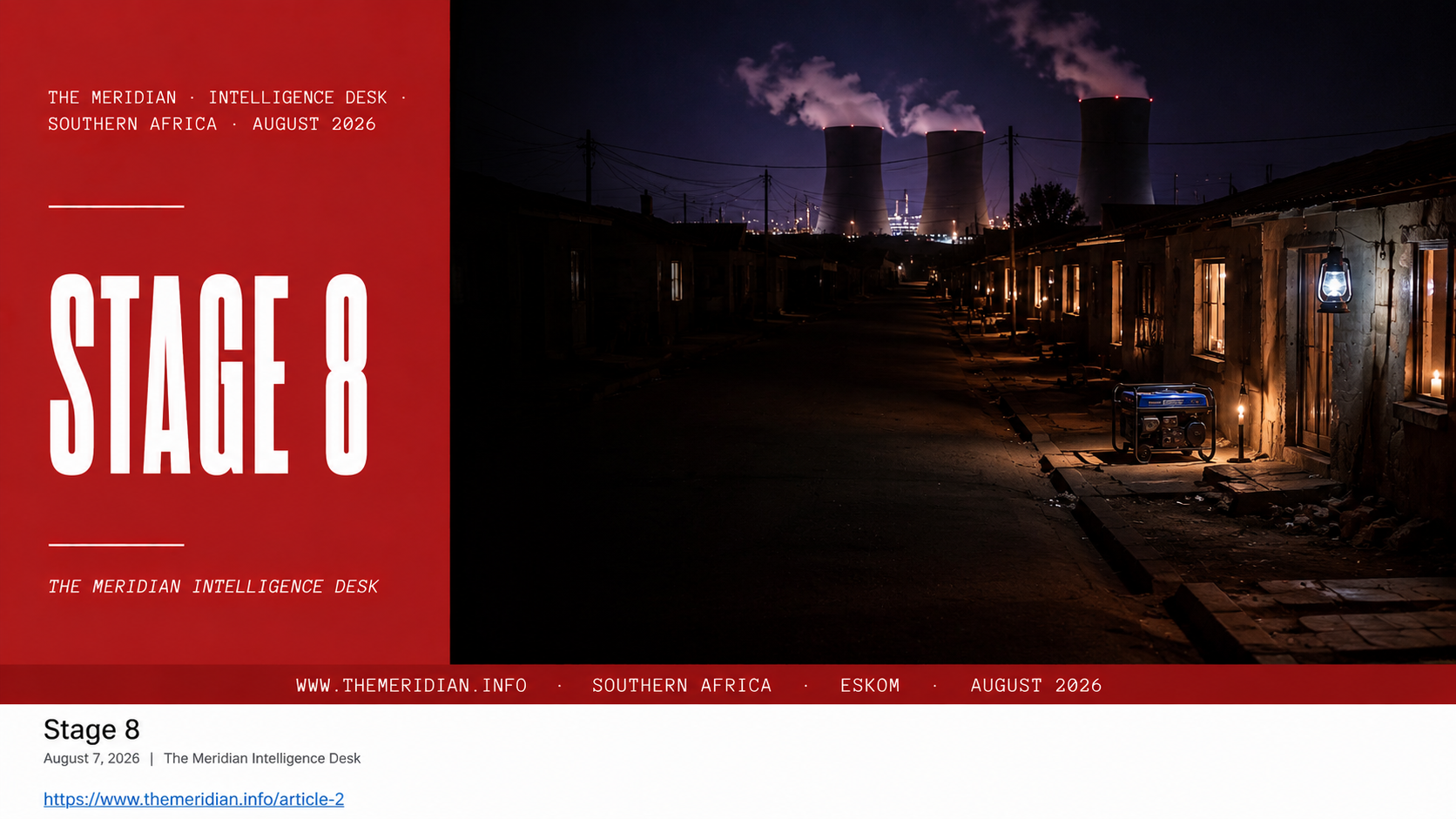
On 16 May 2026, Eskom quietly made history. South Africa had gone 365 consecutive days without a single second of load-shedding, a milestone the country had not seen since September 2018. The Board Chairperson described it as the product of three hard years of work. Eskom saved R26.9 billion ($1.47 billion) in diesel costs over three years. The grid's Energy Availability Factor improved from 54.56 per cent to 65.16 per cent. The milestone is genuine and significant. It is also the most important indictment in the entire story: if the grid could be recovered through intensive maintenance of existing infrastructure, regulatory reform, and the removal of politically connected procurement from the supply chain, then every year of the crisis that preceded it was not an inevitability. It was a choice. The Meridian examines who made that choice, why, what it cost the continent's largest economy, and what the recovery reveals about the political economy of public infrastructure when it is captured by private interests with state protection.
Eskom was once one of the most efficient electricity utilities in the world. Built during the apartheid era to power the mining and heavy industry complex that was the foundation of the South African economy, it operated with technical competence, maintained its coal fleet rigorously, and supplied electricity at prices that made South African manufacturing regionally competitive. The democratic transition of 1994 inherited this infrastructure. What followed was a thirty-year process in which political interference, cadre deployment, procurement corruption, and deliberate obstruction of renewable energy alternatives transformed a functional public asset into a machine for extracting rents from the state, while the population it was supposed to serve sat in the dark for up to twelve hours a day.
South Africans experienced 205 days with load-shedding in 2022, with 8.1 million megawatt hours shed from the grid. This worsened dramatically in 2023 to 335 days and 16.6 million MWh shed. In 2023, record blackouts cost the economy R2.9 trillion. GDP for 2024 was R4.7 trillion, a modest 0.6 per cent increase from the previous year. Exceptionally high load-shedding in 2023 is estimated to have reduced GDP growth by 1.5 percentage points, leading to sluggish growth of 0.7 per cent. The impact was estimated at 0.7 and 0.5 percentage points for 2022 and 2021 respectively.
The numbers are precise and they are large. But the number that matters most for understanding the political economy of the crisis is not the R2.9 trillion in 2023 economic losses. It is the R26.9 billion saved in diesel costs over three years of the recovery programme. Eskom's diesel generator expenditure reduced from R33 billion in FY2024 to about R17 billion in FY2025. For most of the crisis years, Eskom was burning diesel at enormous cost to run open-cycle gas turbines that were never designed for baseload operation, because the coal fleet was failing due to maintenance neglect, sabotage, and the systematic supply of low-grade coal by politically connected suppliers. The diesel was not an emergency measure. It was a permanent subsidy to a coal supply chain that had been captured.
The Eskom crisis was not primarily a technical failure. It was a political economy failure: the systematic subordination of a public infrastructure asset to the private interests of politically connected actors, over a sustained period, with the protection of the state apparatus. The Zondo Commission's report on Eskom, published in 2022 and running to thousands of pages of documented evidence, identified three primary mechanisms of the collapse.
The first was cadre deployment. The ANC's deployment of party activists to state-owned enterprises created criminal networks that destroyed national enterprises. Many cadres were not only ill-equipped for their jobs but sought to profit from their assignments through irregularities. The Zondo Commission found that the ANC's role in board appointments made it culpable for what transpired at Eskom: "The question that the people of South Africa are entitled to ask is: where was the ANC as the Guptas took control of important SOEs such as Transnet, Eskom and Denel?" Board members appointed through the ANC's deployment committee enabled corrupt procurement deals to proceed at the expense of Eskom's operational performance.
The second mechanism was what Eskom's former CEO Andre de Ruyter named the coal mafia. A coalition of actors in control of coal supply to Eskom exported high-quality coal on the international market and supplied low-grade coal to Eskom's power stations. This led to regular collapses of Eskom's generation units. The consequence was predictable and measurable: a generation fleet that was nominally functional but consistently underperformed because the fuel supply was being systematically degraded for the profit of the suppliers. The connection between the coal supply network and politically connected beneficiaries was documented by the Zondo Commission and confirmed by multiple whistleblowers.
The third mechanism was the deliberate obstruction of renewable energy alternatives. Zuma's efforts to delay the renewable energy procurement programme coincided with the expansion of narratives around radical economic transformation and the need to combat white monopoly capital. These narratives were repurposed to justify extractive rent-seeking practices at Eskom. The former Minister of Minerals and Energy, Gwede Mantashe, a former leader of the National Union of Mineworkers, was accused of blocking the transition to green energy. The Renewable Energy Independent Power Producer Procurement Programme, which had successfully contracted solar and wind capacity at competitive prices since 2011, was throttled precisely when Eskom needed new generation capacity most urgently. The coal mafia and its political allies needed the grid to remain coal-dependent. Renewable energy, which bypasses the coal supply chain entirely, was an existential threat to that dependency.
A utility that was destroyed through cadre deployment, coal mafia supply chain capture, and the deliberate obstruction of renewable alternatives was then repaired through intensive maintenance of existing infrastructure, the removal of politically connected procurement, and the opening of the market to private solar generation. The repair took three years. The destruction took fifteen. The repair cost R26.9 billion in saved diesel. The destruction cost R2.9 trillion in 2023 alone. The political economy of this arithmetic is the most consequential single fact in South African public life in the past decade.
The recovery that produced 365 consecutive days without load-shedding by May 2026 was not achieved through new infrastructure. Eskom's Generation Recovery Plan focused on intensive maintenance of existing coal plants, restoring 5,506 MW of capacity within one year, faster and cheaper than building new plants. Companies built 5,000 MW of solar capacity within 18 months of the licensing cap removal. The Renewable Energy Independent Power Producer Procurement Programme attracted ZAR 200 billion in private investment.
The most significant reform was structural rather than technical. In 2021, the South African government raised the licensing threshold for embedded generation from 1 MW to 100 MW. Subsequent reforms removed the cap entirely. GDP growth forecasts climbed from 1.3 per cent in 2025 to 1.6 per cent for 2026 and nearly 2 per cent for 2027, as businesses regained confidence in power supply. The private sector, given regulatory permission to generate its own electricity, responded immediately and at scale. Over 6,000 MW of rooftop solar was added by households and businesses by end-2024 alone. The grid that was supposedly impossible to fix without decades of new investment and billions in external capital began stabilising within months of the political obstruction being removed.
This is the recovery's most important analytical finding. The constraint was not financial or technical. It was political. The coal mafia, the cadre deployment network, and the Gupta-aligned procurement architecture that the Zondo Commission documented had created a political economy in which maintaining the crisis was more profitable for specific actors than resolving it. When the GNU government elected in May 2024 removed enough of those actors from the relevant decision points, the existing engineering capacity at Eskom was sufficient to stabilise the grid within a year. The grid was not broken beyond repair. It was being kept broken.
South Africa's economy is the largest and most industrially complex on the African continent. It is the primary trading partner for Botswana, Lesotho, Eswatini, Namibia, Zimbabwe, and Mozambique. Its electricity grid is physically connected to the Southern African Power Pool, which supplies power to multiple neighbouring states. Its manufacturing sector produces components, processed goods, and capital equipment that supply value chains across sub-Saharan Africa.
The economic losses due to power interruptions are estimated to cost between one and five per cent of GDP of countries across sub-Saharan Africa. South Africa's GDP was forecast to grow less than one per cent, with the problems at Eskom being one of the main contributing factors. When South Africa's manufacturing output falls because load-shedding makes production impossible for up to twelve hours a day, the regional supply chains that depend on that output are disrupted simultaneously. The cost of the Eskom crisis was not confined to the R2.9 trillion measured within South African borders. It radiated outward through every trade relationship the continent's largest economy maintains.
The recovery matters for the same reason. GDP growth forecasts for South Africa climbed as businesses regained confidence in power supply. A South Africa with a stable grid is a South Africa that can supply the regional manufacturing base, attract the foreign direct investment, and generate the fiscal revenues that make its role as the anchor economy of southern Africa sustainable. The Eskom story is not a domestic South African story. It is a continental one.
The Eskom crisis is the extraction economy's domestic application. The coal supply chain that degraded Eskom's generation fleet for a decade was not a market failure. It was a political economy design: connected actors used their access to state procurement and their protection from state accountability to extract rents from a public monopoly whose captive customers, the entire South African population, had no alternative supplier and no recourse. The mechanism is structurally identical to the cocoa farmer receiving 24 per cent of the retail value of a chocolate bar, or the Nigerian government watching its crude oil sail to Rotterdam while the Dangote Refinery waits for supply. In every case, a producing entity is systematically prevented from capturing the value of its own resource by an intermediary architecture that is maintained through political protection.
The recovery reveals the choice that was always available. Intensive maintenance of existing infrastructure, the removal of politically connected coal suppliers from the procurement chain, and the opening of the generation market to private solar investment: none of these required new technology, external capital, or a decade-long infrastructure programme. They required the political will to remove the actors who benefited from the crisis and replace them with actors whose incentive was to resolve it.
The GNU government elected in May 2024 provided enough of that political will to stabilise the grid within a year. The lesson for every African government managing a state-owned infrastructure enterprise whose performance has degraded under political interference is the same lesson the Zondo Commission documented and the Generation Recovery Plan confirmed: the technical capacity to restore performance almost always exists. What is lacking is not engineering. It is the political economy that allows engineers to do their jobs without the coal mafia telling them which fuel to burn, the cadre deployment committee telling them which board to answer to, and the minister blocking the renewable energy contracts that would make the coal supply chain unnecessary. Fix the political economy. The grid fixes itself.
Add comment
Comments