Somaliland Has Held Seven Elections. The World Still Will Not Recognise It.
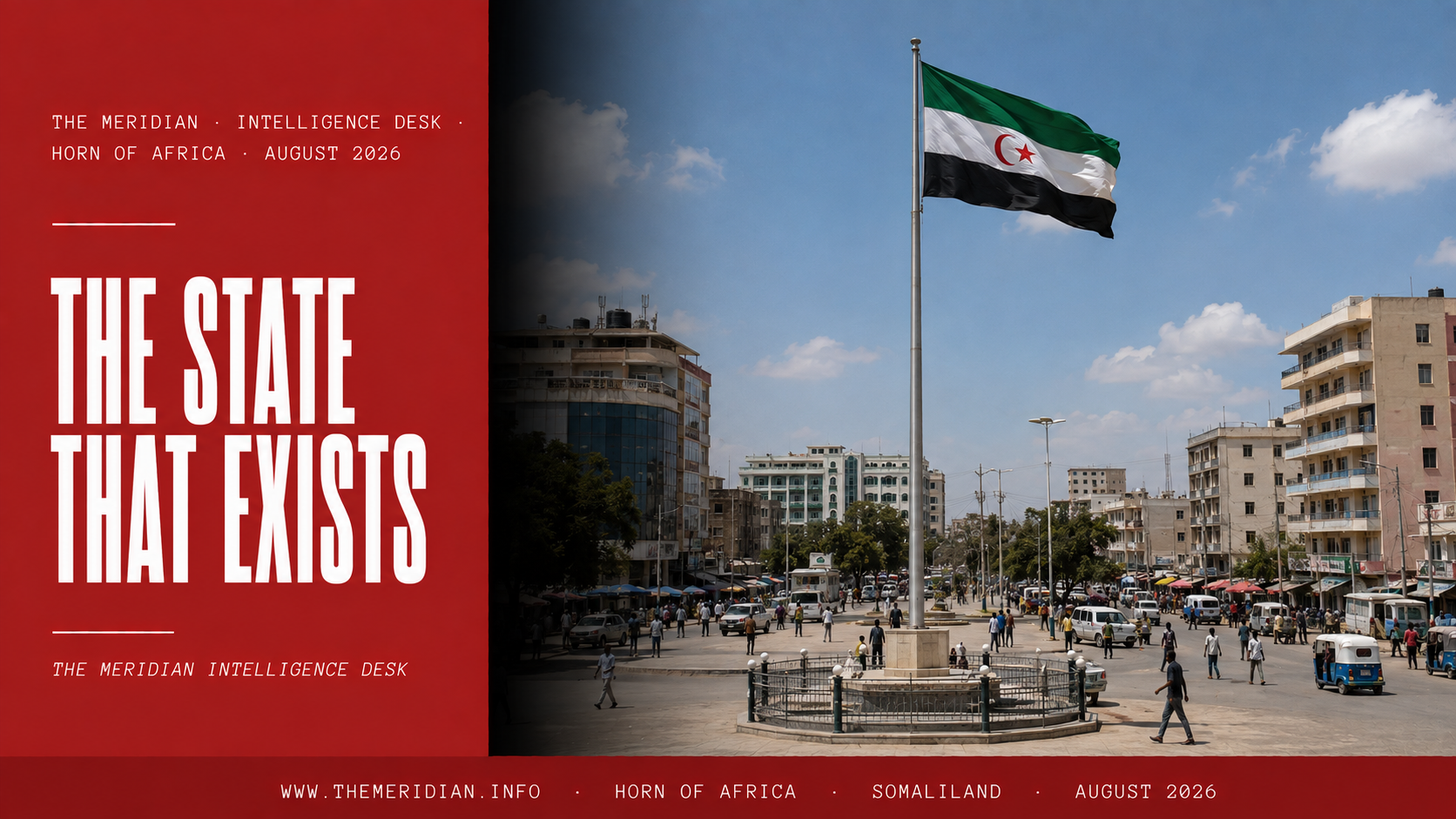
Somaliland went to the polls on 13 November 2024 in its ninth competitive election since its 1991 re-declaration of independence from Somalia. The opposition party Waddani won a peaceful transfer of power from the incumbent, one of only five such opposition victories recorded across Africa that year. International observers described the electoral process as credible and the result as a further step in consolidating Somaliland's reputation as one of the more stable democracies in the Horn of Africa. The US Embassy formally stated that Somaliland's impressive record of elections and peaceful transfers of power is a model for the region and beyond. No UN member state recognises it. The African Union declines to consider the question. Somalia insists it remains Somali sovereign territory. The Turkish-brokered Ankara Declaration of December 2024 effectively sidelined the one moment, the Ethiopian MoU of January 2024, when recognition was closer than at any point in Somaliland's thirty-three-year history. The Meridian examines what Somaliland's non-recognition costs the state, the region, and the international system whose rules it has followed more faithfully than most of its recognised neighbours.
The standard international law argument against recognising Somaliland is the uti possidetis principle: the borders established at independence should be maintained to prevent the continental fragmentation that African states have collectively agreed to avoid. The African Union's foundational commitment to inherited colonial borders, established in the 1964 Cairo Resolution and carried forward through the OAU and AU's institutional practice, reflects the collective judgement that border revision creates more instability than it resolves. This is not an irrational position. The African continent has approximately fifty-four recognised states and significantly more potential secessionist claims. Opening the border revision process risks a cascade of claims that the international system has neither the capacity nor the appetite to adjudicate.
The problem with applying this argument to Somaliland is that it misidentifies what Somaliland is. Somaliland is not a secessionist movement from an existing recognised state. It is the successor state to British Somaliland, a distinct colonial entity that gained independence on 26 June 1960, five days before it voluntarily unified with the former Italian Trust Territory of Somalia to form the Somali Republic. Somaliland's roots lie in the agreements signed between the United Kingdom and clans in the area in the late nineteenth century, which led to the establishment of the Somaliland Protectorate. On 26 June 1960, the protectorate was formally granted independence and became the State of Somaliland. Five days after gaining independence, it voluntarily united with the Trust Territory of Somalia, the former Italian colony to its east and south, thereby forming the Somali Republic. When Somaliland declared independence in 1991, it was not carving a piece from an existing state. It was dissolving a voluntary union with a state that had collapsed. The distinction is legally significant and politically decisive: the uti possidetis principle governs the borders of states that exist, not the revival of states that existed before a voluntary union that one party to the union has ceased to honour.
No UN member state or international organisation has formally recognised Somaliland's self-proclaimed independence. It is the world's largest unrecognised state by de facto controlled land area. What it has produced inside that unrecognised territory is a democratic record that the international system refuses to reward with the recognition that would enable it to consolidate further.
Since 2003, Somaliland has held multiple peaceful elections. International delegations including those from the United States, the United Kingdom, France, and the EU monitored its 2017 presidential contest. In 2024, Somaliland's democratic credibility was reinforced when the opposition party Waddani won a peaceful transfer of power, one of only five such opposition victories recorded across Africa that year. The democratic record is not aspirational. It is documented, monitored by international observers, and produces outcomes that the international system celebrates in every country where they occur, except in Somaliland, where celebrating the democratic achievement is institutionally easier than recognising the state that produced it.
The absence of international recognition continues to restrict Somaliland's access to global markets and development financing. A state that cannot access World Bank lending, cannot sign bilateral investment treaties, cannot issue internationally recognised passports, cannot join the African Development Bank, and cannot participate in the multilateral trade architecture is a state whose development trajectory is permanently constrained by an institutional exclusion that has nothing to do with its governance performance and everything to do with the political convenience of the states that control the recognition process. Somaliland's citizens pay for their government's democratic achievement with economic isolation that the international system imposes in the name of principles it does not apply consistently.
On 1 January 2024, Ethiopian Prime Minister Abiy Ahmed and outgoing Somaliland President Muse Bihi Abdi signed a memorandum of understanding that brought Somaliland closer to international recognition than at any point in its thirty-three-year history. The MoU stipulated that Ethiopia could lease a 20-kilometre coastline near Luqhaye and Zeila in Somaliland's Awdal region for fifty years to build a naval base. In exchange, Somaliland would receive a stake in Ethiopian Airlines and formal recognition as a sovereign country. For a landlocked country of 130 million people whose entire import and export traffic depends on the port of Djibouti, Red Sea access is not a diplomatic convenience. It is a strategic necessity. Abiy Ahmed had told the Ethiopian parliament in October 2023 that his country has natural rights to access the Red Sea. The Somaliland MoU was the operational expression of that position.
Six days after the MoU was signed, Somali President Hassan Sheikh Mohamud promulgated a law hastily approved by the parliament in Mogadishu nullifying the agreement. The approval of the law was described as an example of Somalia's commitment to protect its unity, sovereignty and territorial integrity under international law. The international response was immediate and almost universally aligned with Somalia's position. Several countries and international organisations including the United States, the United Kingdom, China, Turkey, the European Union, and the Arab League urged Ethiopia not to proceed with the deal, reaffirming their support for Somalia's territorial integrity. The alignment was striking: the United States and China, whose geopolitical rivalry defines the current international order, agreed on this question. The EU and the Arab League, whose interests diverge across almost every dimension of the Horn of Africa's political economy, agreed on this question. Turkey, whose largest overseas military base is in Somalia, agreed on this question.
The international community has produced unanimous consensus on precisely one question concerning Somaliland in thirty-three years of its existence: that Ethiopia should not recognise it. The same international community has produced no consensus on what Somaliland is supposed to do instead, how it is supposed to develop without access to international finance, or what democratic achievement it must produce before the question of recognition becomes discussable.
The mounting tension between Ethiopia and Somalia as a result of the MoU was resolved by the Ankara Declaration, signed on 11 December 2024, mediated by Turkey. Under the Ankara Declaration, Ethiopia recognised the territorial integrity and sovereignty of Somalia while Somalia acknowledged Ethiopia's interest in sea access through lease and contract under Somali sovereignty. Following strong opposition from Somalia, the Turkish-brokered Ankara Declaration effectively sidelined Ethiopian recognition of Somaliland. The recognition that the MoU had placed within reach for the first time was exchanged, within eleven months, for an arrangement that gives Ethiopia the sea access it sought without requiring it to honour the recognition commitment that was Somaliland's side of the bargain.
The African Union's objection to Somaliland recognition rests on the precedent argument: recognising Somaliland would open the door to recognition demands from every secessionist movement on the continent, from Ambazonia in Cameroon to Cabinda in Angola to Casamance in Senegal. The argument is politically intelligible. It is analytically insufficient.
The precedent argument applies symmetrically: if the AU recognised every secessionist movement whose case was legally comparable to Somaliland's, the resulting continental fragmentation would be destabilising. But Somaliland's legal case is not comparable to most secessionist movements. Somaliland was a distinct colonial entity that gained independence in 1960 and voluntarily united with a different colonial entity five days later. When that union collapsed in 1991, Somaliland dissolved it and reverted to its pre-union borders. The dissolution of a voluntary union between two states is not the same as a province seceding from a unitary state. The AU's precedent argument elides this distinction because acknowledging it would require the AU to engage with the actual legal question rather than the political consequence it fears.
The cost of this elision is paid by Somaliland's citizens. In Freedom House's 2024 index, Somaliland was rated Partly Free, scoring 43 out of 100, in stark contrast to Somalia's score of 8 out of 100, categorised as Not Free. The recognised state scores 8. The unrecognised state scores 43. The international system rewards the lower score with membership and the higher score with exclusion. That is the political economy of recognition that the AU's precedent argument sustains.
The costs of non-recognition are not abstract. They are measurable and they accumulate annually. Somaliland cannot access World Bank or IMF lending on sovereign terms. It cannot issue internationally recognised travel documents, which means its citizens travel on Somali passports from a state whose authority they do not recognise and whose institutions do not protect them. It cannot join the African Development Bank, the East African Community, or the Intergovernmental Authority on Development. It cannot sign bilateral investment treaties that would provide the legal certainty foreign investors require. It cannot participate in the WTO or benefit from preferential trade agreements.
The Port of Berbera represents the most significant economic asset Somaliland controls. In 2016, Somaliland and the Dubai-based DP World signed an agreement to develop and operate the Port of Berbera. The Somali government initially rejected this deal, accusing a breach of its sovereignty, but ultimately gave a green light after negotiations with the Somaliland president. Currently, Ethiopia relies on Djibouti for around 95 per cent of its import and export traffic, an expensive dependence. Development of the Berbera Corridor has made this an attractive alternative. The Berbera port is functional, modern, and strategically positioned on the Gulf of Aden. Its development potential as a regional logistics hub is constrained at every stage by the legal uncertainty that non-recognition creates for the international investors and shipping companies whose participation would make that potential real.
Somaliland's non-recognition is the international system's most coherent expression of its own contradiction. The system rewards democratic governance with the institutional access that enables further development. It withholds that access from Somaliland because recognising it would set a precedent that the states controlling the recognition process are unwilling to set, regardless of the democratic performance that would justify it. The result is a state that has produced one of the more consistent democratic records in the Horn of Africa, whose citizens cannot access the development finance that record should unlock, whose passport is not recognised in the countries whose governance Somaliland demonstrably outperforms, and whose closest approach to recognition was reversed by a Turkish-brokered deal that served the interests of every party except Somaliland.
The January 2024 MoU was the most significant development in Somaliland's diplomatic history. Ethiopia was prepared to offer recognition in exchange for sea access. Somaliland was prepared to accept the bargain. The international community, in its unanimous insistence that Ethiopia not proceed, demonstrated that it will actively intervene to prevent recognition rather than simply decline to extend it. The Ankara Declaration did not resolve the question. It deferred it while ensuring that the deferral serves Somalia's territorial claim, Turkey's regional ambitions, and Ethiopia's sea access requirements simultaneously. Somaliland's recognition interest was the only interest that the Ankara Declaration did not accommodate.
The US Congress has introduced a recognition bill. A senator has written to the President urging formal recognition. The argument for recognition is gaining ground in Washington in a way it has not previously. Whether that momentum produces a policy change depends on whether the United States calculates that the strategic benefits of a recognised, democratic, pro-Western Somaliland in the Gulf of Aden outweigh the diplomatic cost of challenging the AU precedent. That calculation has not yet been made. While it is being deferred, Somaliland's citizens continue to pay for a democratic achievement that the international system acknowledges, monitors, praises, and declines to reward.
Add comment
Comments