Mozambique Found the Gas. The Gas Did Not Find Mozambique.
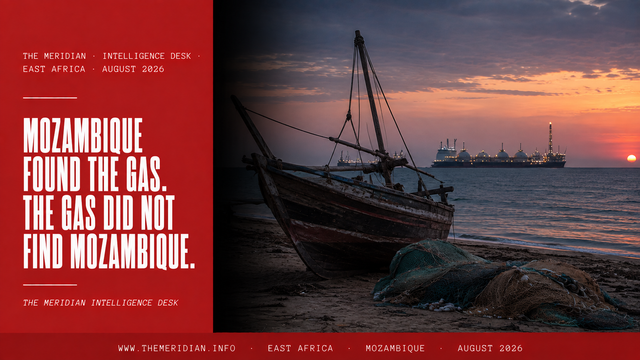
The Rovuma Basin, off the coast of Cabo Delgado province in northern Mozambique, holds between 160 and 200 trillion cubic feet of natural gas, according to the US Energy Information Administration, making it one of the largest reserves globally that is only just starting to be tapped. TotalEnergies froze operations on its $20 billion LNG project in April 2021 as the rebel movement gained strength and attacks spread across Cabo Delgado. The insurgency killed thousands and displaced more than 1 million people. Mozambique's gas revenues in 2024 totalled $91.8 million, from the single operational Eni platform, Coral South, which has been producing since mid-2022. Mozambique ranks 183rd of 193 countries on the Human Development Index. More than 70 per cent of the population lives in poverty. In 2026, TotalEnergies announced the full restart of its project, with first gas deliveries expected in 2029. The Meridian examines what it means to sit above one of the world's largest gas reserves and receive $91.8 million per year while the infrastructure to extract it requires a Rwandan army, a French legal case for war crimes, and the displacement of a million of your own citizens as its operating conditions.
The resource curse literature has a standard configuration: a country discovers a valuable natural resource, international companies extract it, the revenue flows to the government, the government distributes it poorly or corruptly, the non-resource economy atrophies, and the population that lives above the resource remains poor while the resource is sold abroad. Mozambique's gas paradox is something more acute than the standard configuration. It is the resource curse before the resource has even been extracted at scale. The gas was discovered. The investment was committed. The infrastructure was partially built. Then the insurgency arrived, made the extraction zone indefensible, forced the largest investor to declare force majeure and evacuate its workforce, and left Mozambique in a condition that combines the political costs of resource extraction, including the displacement of communities, the militarisation of the extraction zone, and the allegations of human rights abuses by security forces protecting the infrastructure, with almost none of the economic benefits that extraction at scale would generate. Mozambique found the gas. The gas did not find Mozambique. The distance between those two facts is measured in human cost.
The Rovuma Basin holds between 160 and 200 trillion cubic feet of natural gas, one of the largest reserves globally that is only just starting to be tapped. Three mega-developments have been approved to exploit the reserves. The only one in production since mid-2022 is operated by Eni, concessionaire of Area 4 of the Rovuma Basin. TotalEnergies, still on hold due to security issues, and ExxonMobil, awaiting a final investment decision, both have projects on the Afungi peninsula.
The operational Coral South platform has exported more than 120 LNG cargoes since it went online in 2022 and accounted for roughly 50 per cent of Mozambique's GDP growth in 2023 and is projected to drive approximately 70 per cent of GDP growth in 2024. Over its lifespan, Coral South is expected to generate $16 billion in tax revenues. These are the economic projections from a single floating platform. The TotalEnergies project, which has a planned capacity of 13.1 million tonnes per annum, dwarfs the Eni operation. TotalEnergies' Area 1 project secured $14.9 billion in financing in 2019 and was expected to come into production by 2024. It did not. The insurgency intervened between the financing decision and the production date. The gap between what was planned and what has arrived is the precise measurement of what the conflict has cost Mozambique.
The Cabo Delgado insurgency began in October 2017, when a group calling itself Al-Shabab, linked to the Islamic State, launched attacks on police posts in Mocimboa da Praia. The insurgency's origins are contested: the academic literature identifies a combination of factors including the exclusion of local Muslim communities from the economic benefits of gas exploration, the displacement of communities from ancestral land for LNG infrastructure development, the structural poverty of a province that had been historically marginalised within Mozambique, and the deliberate radicalisation effort of an external Islamist network that found fertile ground in communities with legitimate grievances.
By 2021, the largest natural gas project in northern Mozambique, led by TotalEnergies with an approved investment of over $20 billion, was suspended under a force majeure declaration. The project remains formally closed as of that declaration, though resumed in 2026. Under pressure from investors whose projects were put on hold, the government invited foreign forces to help fight the insurgency. Approximately 3,000 troops from Rwanda and the Southern African Development Community Mission in Mozambique were deployed to Cabo Delgado to support Mozambican forces. Three years later, SAMIM withdrew, claiming to have achieved its objective.
What SAMIM left behind was a security situation that is better in the immediate vicinity of the LNG infrastructure and significantly worse in the broader province. Between 26 August and 24 September 2025 alone, Cabo Delgado experienced a marked surge in violence, with civilian attacks on track to reach a record high in 2025, with 519 attacks reported by the end of August, compared to 448 in 2022, the previous record year. Attacks included civilian abductions, the kidnapping of a humanitarian worker, looting, killings, burning of homes, and ransom demands. Nearly 60,000 people were displaced to the small district of Chiure alone in July-August 2025. Over 90 per cent of internally displaced people are women, elderly, or people with disabilities. Over half of Cabo Delgado's health facilities are destroyed or damaged by conflict.
The Rwandan army secures the Afungi peninsula so that TotalEnergies can restart its $20 billion project. The Mozambican army conducts operations that humanitarian organisations report are affecting civilians. The communities that were displaced from the LNG zone are living in makeshift camps with insufficient food, water, and healthcare. The gas is there. The gas will eventually be extracted. The question the extraction economy framework requires us to ask is: extracted for whom, under what security architecture, at whose cost, and at what benefit to the people who were living above it before the infrastructure arrived?
In 2025, the European Centre for Constitutional and Human Rights filed a criminal complaint in France against TotalEnergies for complicity in war crimes, torture, and enforced disappearance. The case focuses on TotalEnergies' direct financial and material support for the Joint Task Force, consisting of Mozambican armed forces deployed to protect the gas production facility. There are allegations that in 2021, the JTF arrested, tortured, and killed dozens of civilians near the entrance to the gas facilities.
In November 2024, hundreds of members from local communities staged protests against TotalEnergies' project, tired of waiting for compensation payments or resettlement. Many had been unable to engage in subsistence farming for over a year, leaving families in extremely precarious situations. In 2024, France's state prosecutor opened an investigation into TotalEnergies for potential involuntary manslaughter and failure to assist people in danger.
The legal proceedings do not constitute a finding of guilt. They constitute documented allegations that a French state prosecutor found sufficiently credible to investigate. The connection between the security architecture protecting the LNG infrastructure and the human rights abuses documented in the surrounding communities is the precise mechanism through which the resource curse operates in its most acute form: the state's security apparatus is deployed primarily to protect the extraction zone, and the communities that live outside that zone bear the security cost of the insurgency that the extraction zone's presence helped generate.
TotalEnergies CEO Patrick Pouyanné announced the full restart of operations at an event attended by Mozambique President Daniel Chapo in Afungi. Pouyanné said the company expects first gas deliveries in 2029, promising a massive ramp-up of activity in the coming months. "The force majeure is over," he said. The project has been billed as one of Africa's largest energy investments and one that is expected to deliver economic growth to the struggling nation of 34 million people.
The restart is economically significant. When TotalEnergies' 13.1 million tonne per annum project reaches full production, combined with Eni's Coral South and Coral North platforms and a potential ExxonMobil project, Mozambique could produce over 34 million tonnes per annum by 2030. Coral South alone accounted for approximately 50 per cent of Mozambique's GDP growth in 2023. The upcoming Coral North project is forecast to yield $23 billion in state revenue over its 30-year operational life. At scale, the Rovuma Basin projects represent a transformation of Mozambique's fiscal position that no other development instrument could match.
What the restart does not resolve is the distribution question. The priority of the security deployment is securing the Afungi peninsula for the government that aims to be a major gas exporter. But by only protecting natural resources, not the people, you create a sort of green zone around the natural resources. How do you think that makes civilians feel? Over 600,000 displaced people have returned to Cabo Delgado, but the conditions they face are extremely difficult. The province's health infrastructure is more than half destroyed. The insurgency continues outside the security perimeter of the LNG zone. The communities that were displaced from the Afungi peninsula for the original infrastructure development have been waiting years for compensation and resettlement that has not fully arrived.
The Mozambique gas paradox is the extraction economy's most compressed single case. Nigeria extracted oil for sixty years and remained poor because the state captured the revenues before they reached the population. Angola extracted oil for fifty years and remains poor for the same reason. Mozambique has not yet extracted its gas at scale and is already experiencing the distributional consequences of the extraction architecture: communities displaced, security forces deployed to protect infrastructure rather than people, an insurgency whose grievances include the exclusion of local populations from the economic benefits of the resources extracted from their land.
The TotalEnergies restart is the best economic news Mozambique has received in a decade. First gas in 2029, combined with Eni's Coral North in 2028 and a potential ExxonMobil project by 2030, could transform Mozambique's fiscal position within five years. Whether that transformation reaches the 70 per cent of Mozambicans who currently live in poverty depends on institutional decisions that have not yet been made: how gas revenues are managed, how local communities are compensated, how the security architecture is restructured to protect people rather than infrastructure, and whether the political economy of the gas sector replicates the patronage distribution model that has failed every other major African oil and gas producer, or builds something different.
The gas is there. The infrastructure is restarting. The question that the extraction economy framework asks is not whether Mozambique will produce LNG. It will. The question is whether the LNG will produce Mozambique: a functional state with declining poverty, improving human development indicators, and communities that received a fair share of the wealth extracted from their land. That question has not yet been answered. It will be answered by decisions made between now and 2029. The evidence of every comparable African gas and oil producer suggests that the answer requires deliberate institutional design that has not yet been documented as underway. The gas found Mozambique. Whether Mozambique finds the gas is still an open question.
Add comment
Comments