Kigali Is Clean. The Question Is What It Costs to Be This Clean.
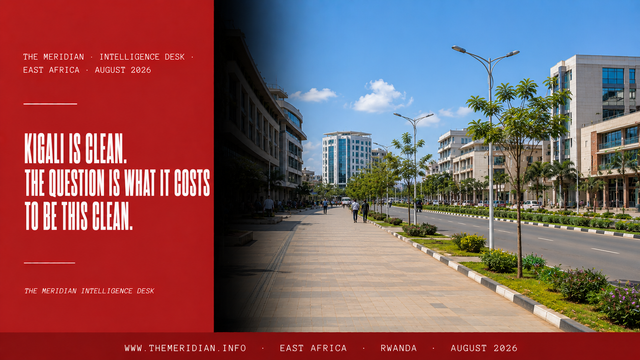
Rwanda's economy grew 9.4 per cent in 2025, following an impressive average growth of 8.5 per cent over 2022 to 2024. Rwanda aspires to become a middle-income country by 2035 and a high-income country by 2050. GDP per capita reached $1,040 in 2025, compared with $146 in 1994. Kigali is the cleanest city in Africa. The healthcare system has been cited internationally as a model for the continent. President Paul Kagame was re-elected for a fourth consecutive term in July 2024, with the ruling RPF coalition securing 68.8 per cent of parliamentary seats. Three journalists have been murdered, two have disappeared, and over thirty media outlets have been suspended since Paul Kagame came to power in 2000, according to RSF's monitoring. In their May 2024 report, the UN Group of Experts on the DRC documented 3,000 to 4,000 Rwandan troops present within Congolese territory. The Meridian examines both sides of the same documented reality and asks the question the development economics literature requires: is Rwanda's model replicable, is it sustainable, and what does it cost?
Rwanda is genuinely exceptional. That is the starting point that any rigorous analysis must establish before examining what exceptionalism costs. In 1994, the Rwandan genocide killed between 500,000 and 800,000 people in one hundred days. The economy collapsed. The institutional architecture of the state was destroyed. The international community, which had watched the genocide proceed and done almost nothing to stop it, subsequently provided the reconstruction aid and debt relief that enabled the post-genocide government to begin rebuilding. What Paul Kagame's government built from that starting point is one of the most remarkable development trajectories in the post-independence history of the African continent. The starting point matters because it contextualises both the achievement and the political architecture that produced it. Rwanda in 1994 was not a country in normal developmental difficulty. It was a country that had experienced one of the most extreme episodes of organised violence in the twentieth century. The question of what it took to rebuild from that point is not separable from the question of what it continues to cost.
Under President Paul Kagame's leadership since 2000, Rwanda implemented ambitious economic reforms and development programmes, leading to consistent GDP growth averaging 7.4 per cent annually since the new millennium. GDP grew 8.9 per cent in 2024 and 9.4 per cent in 2025. These are not statistical artefacts of a low base. Rwanda has sustained above-7 per cent growth for more than two decades, through global financial crises, regional conflicts, and a global pandemic. The development indicators are equally striking: child mortality has fallen dramatically, universal health insurance coverage through the Mutuelle de Santé scheme reaches over 90 per cent of the population, primary school enrolment is near universal, and the World Bank's governance indicators consistently rate Rwanda above the African average on regulatory quality, rule of law, and government effectiveness.
The health system is the development model's most documented success. The Mutuelle de Santé community health insurance scheme, introduced in 1999 and scaled nationally through the 2000s, covers over 90 per cent of the population at subsidised premiums. Child mortality under five fell from 196 per 1,000 live births in 2000 to below 40 per 1,000 by 2024, one of the fastest reductions recorded anywhere in the world in comparable conditions. Rwanda met most of its Millennium Development Goal targets ahead of schedule and is making measurable progress on several Sustainable Development Goals. The World Bank's Country Partnership Framework and multiple bilateral donors regard Rwanda as among the most effective aid recipients on the continent, citing its institutional capacity to absorb and implement development programmes at scale.
The development achievement is real. It is not propagandistic invention, and The Meridian does not suggest it is. The question this article asks is not whether Rwanda has developed. It has. The question is whether the political architecture that produced that development is a necessary condition of the development, or a concurrent feature of it that carries independent costs which the development model does not acknowledge.
President Paul Kagame's re-election for a fourth term in July 2024 reinforced the government's authoritarianism and censorship. Media owners must pledge allegiance to the government. Many journalists have been forced to attend a patriotism programme or become members of the ruling party. The authorities can intervene directly to fire those who resist. Defamation has been decriminalised but the 2018 penal code reform maintained prison sentences for contempt and defamation of the president in the media. The illegal surveillance of journalists' phone communications makes it hard for them to protect the confidentiality of their sources.
Three journalists have been murdered, two have disappeared, and over thirty media have been suspended since Paul Kagame came to power in 2000. The situation is so dire that the country's remaining media professionals have either gone into exile or are forced to self-censor. The 2023 death of investigative journalist John Williams Ntwali, officially ruled a car accident, was investigated by a consortium of seventeen international media organisations coordinated by Forbidden Stories. Their findings raised serious questions about the circumstances of the death that the Rwandan judicial process did not resolve to the satisfaction of the international press freedom community.
President Kagame has frequently threatened his critics and accused them of destabilising the country. In a 2019 speech, Kagame warned opponents in the diaspora that those making noise on the internet do so because they are far from the fire and that if they dare get close to it, it will burn them. Observers argued that Kagame's threats were genuine, as a number of Rwandan dissidents abroad have been killed, disappeared, or kidnapped and brought back to Rwanda to be imprisoned. Documents and testimonies obtained by Forbidden Stories and its media partners reveal intimidation tactics and troubling disappearances of exiled Rwandans, suggesting Rwanda has developed a system of surveillance and repression, even carrying out assassinations against members of its diaspora in Europe and Africa.
There are two different Rwandas. One is the Rwanda of the World Bank country report, the Doing Business Index, the Mutuelle de Santé, the clean streets of Kigali, and the 9.4 per cent GDP growth. The other is the Rwanda of the RSF press freedom index, the Forbidden Stories investigation, the UN Group of Experts on the DRC, and the diaspora members who do not return because of what Kagame said would happen to them if they did. Both Rwandas are real. The question that the development economics literature requires is which one is the cause of the other, and which one can exist without the other.
In their May 2024 report, the UN Group of Experts on the DRC documented that 3,000 to 4,000 Rwandan troops were present within Congolese territory. Kigali is specifically believed to support the M23 rebel group. Rwanda has consistently denied direct military involvement in the DRC, attributing its security interests to the presence of FDLR, the remnants of the Hutu extremist forces responsible for the 1994 genocide, in eastern Congo.
The DRC connection is the most sensitive dimension of Rwanda's development model because it connects the economic success story directly to a regional conflict that has produced some of the most severe humanitarian consequences on the African continent. The eastern DRC conflict, in which M23 and Rwandan forces are documented as participants, has displaced millions of people and killed tens of thousands. The minerals that flow through Rwanda's documented trade networks from eastern DRC, including coltan and gold, connect the clean streets of Kigali to the extraction economy that this edition has documented in the Mineral Corridor article.
The development model that produces Kigali's gleaming infrastructure and 9.4 per cent GDP growth is connected, through documented channels, to a regional conflict whose cost is borne by Congolese civilians. The Bermeo-Laebens framework applied in The Unfinished Ambition article examines how institutional power concentrates domestically. The DRC dimension extends that analysis regionally: Rwanda's state capacity, built through the political architecture of the Kagame government, is deployed both for development at home and for military and economic projection abroad. The two dimensions are not separable in the evidence.
The development economics literature has debated Rwanda's model for two decades. The core question is whether the political architecture is a necessary condition of the development outcomes, or whether the development outcomes could have been achieved through a more pluralistic political system. The Lee Kuan Yew argument, applied to Rwanda as it was applied to Singapore, holds that a strong authoritarian hand was necessary to impose the discipline, institutional coherence, and long-term planning that rapid development requires in post-conflict conditions where democratic institutions had no historical roots and where ethnic divisions had just produced genocide. The counter-argument holds that the political architecture imposes costs, in suppressed political competition, in the brain drain of exiled critics, in the regional conflict generated by military projection in the DRC, and in the long-term institutional fragility of a system that depends on the continued health and political will of a single individual, that the development model does not account for.
The replicability question is the most practically significant. Multiple African governments have cited Rwanda as a development model. The appeal is understandable: consistent high growth, effective service delivery, clean cities, low corruption by regional standards, and a government that appears to know what it is doing and enforces what it decides. What is not always acknowledged in the citation of Rwanda as a model is that the model includes the press freedom ranking of 144th, the documented surveillance of diaspora critics, the UN-documented military presence in a neighbouring country, and a presidential election in which the main opposition candidates were disqualified before voting began. A government that wants the Kigali convention centre without the Forbidden Stories investigation is seeking a model that Rwanda itself has not demonstrated is separable.
The Rwanda article is the hardest article in this East Africa series to write because it requires holding two documented truths simultaneously without allowing either to cancel the other. The development achievement is real, sustained, and significant. A country that had a GDP per capita of $146 in 1994, the year of the genocide, reached $1,040 in 2025 through three decades of consistent institutional investment in health, education, infrastructure, and governance capacity. That is not rhetoric. It is the World Bank's data.
The political architecture that produced that development is also real, documented, and significant. Three journalists murdered. Two disappeared. Thirty media suspended. The fourth consecutive term. Presidential candidates disqualified. Diaspora critics surveilled and some killed. UN-documented military presence in the DRC. A press freedom ranking of 144th. These are not the complaints of a hostile opposition. They are the findings of RSF, Freedom House, Forbidden Stories, the UN Group of Experts, the Committee to Protect Journalists, and the US State Department.
The question that both sets of evidence require is the question that any African government considering Rwanda as a model must answer for itself: is the development separable from the political architecture, or does the political architecture produce the development precisely because it suppresses the political competition that would otherwise redirect resources, slow decisions, and introduce the inefficiencies that strong development states eliminate by force? The development economics literature has not resolved this question. The Rwanda evidence has not resolved it either. What The Meridian can say, from the documented evidence, is that Kigali is clean. That the cleanliness is real. And that the question of what it costs to be this clean is a question that everyone who cites Rwanda as an African success story is obliged to ask alongside the GDP growth rate, not instead of it.
Add comment
Comments