Why Senegal Pays Europe's Price for Money It Cannot Control.
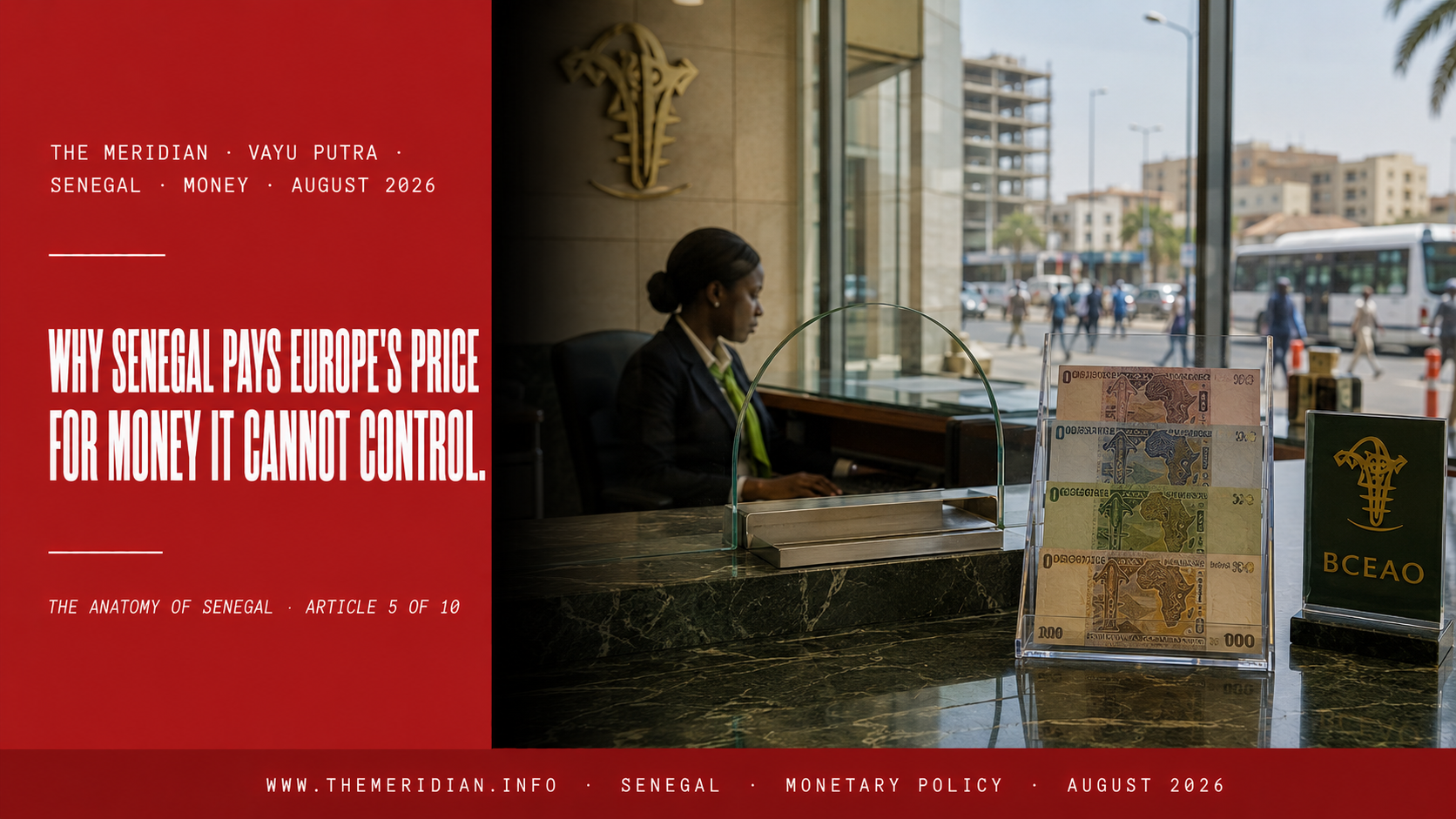
The West African CFA franc was created on 26 December 1945. The acronym originally stood for Colonies Françaises d'Afrique. The name changed after independence. The architecture did not. Eighty years later, Senegal's monetary policy is set by the BCEAO for eight countries simultaneously at a rate of 3.25%, with no mechanism for Senegal to respond to country-specific conditions. The currency is pegged to the euro at 655.957 XOF per euro, a rate fixed since 1999. The eurozone accounts for 19.7% of Senegal's exports. France specifically accounts for 2.8% of WAEMU exports. The currency of 100% of Senegal's monetary architecture is pegged to the currency of 19.7% of what it sells to the world. President Faye declared on Senegal's Independence Day in April 2025 that the CFA franc will soon be ancient history. An ECB official confirmed anonymously that the ECB has enormous power over West African economies through the peg, and that this is treated as a topic that cannot even be mentioned. In the first six months of 2025, Senegal borrowed more than 1,000 billion CFA francs on the regional market, ten times what it was borrowing three years earlier. The government declaring the currency ancient history is simultaneously the government most dependent on it. This article examines the mechanism, the costs, the exit options, and the central contradiction of Senegalese monetary sovereignty.
Every Senegalese worker who sends money home from Paris is participating, without knowing it, in a monetary architecture designed in 1945 by the French Treasury and not fundamentally altered since. The worker earns euros. They send them to Dakar. The euros convert to CFA francs at 655.957 per euro, a rate that has been fixed since 1999 and that will be the same tomorrow as it is today, regardless of how the Senegalese economy performs, regardless of whether the euro appreciates or depreciates against the dollar, regardless of whether Senegal's exports are competitive or not. The fixed rate is presented as monetary stability. What it actually is, is the permanent suppression of the exchange rate mechanism that allows economies to adjust to shocks, correct imbalances, and reflect the actual productive capacity of their citizens in the price of their currency. Senegal has had no access to that mechanism for eighty years.
The CFA franc was created as a colonial administrative instrument. Its purpose was to integrate France's African colonies into the French monetary system, allowing French commercial interests to transact across West Africa without currency conversion risk. After independence, the architecture was preserved because it served the same commercial interests under a different political arrangement. The governments that inherited independence also inherited the monetary framework that had organised their economies to serve the colonial metropole.
The BCEAO, headquartered in Dakar, is the common central bank for eight WAEMU member states: Benin, Burkina Faso, Ivory Coast, Guinea-Bissau, Mali, Niger, Senegal, and Togo. It sets one interest rate for all eight simultaneously. When the BCEAO raises or lowers the key rate, it does so for an economy as large as Ivory Coast and as small as Guinea-Bissau, for economies experiencing inflation and economies experiencing deflation, for economies with strong export growth and economies with collapsing terms of trade. The rate is currently 3.25%. Whether 3.25% is the right rate for Senegal's specific conditions in August 2026, given a fiscal deficit of 13.4% of GDP, a debt-to-GDP ratio of 99.67%, an oil windfall arriving at scale, and an inherited debt crisis requiring urgent fiscal consolidation, is a question that the BCEAO's mandate does not allow Senegal to ask independently.
The euro peg operates through the French Treasury guarantee of unlimited convertibility at the fixed rate. France guarantees that any holder of CFA francs can convert them to euros at 655.957 XOF per euro on demand. The guarantee is what gives the currency its credibility: markets know that CFA francs will always convert at the fixed rate because France stands behind that promise. The price of the guarantee is the peg itself: France's Treasury, and through it the European monetary system, retains effective authority over the monetary framework of fourteen African countries.
The CFA peg's costs to Senegal operate through four specific mechanisms that the official discourse of monetary stability consistently obscures.
The first is the exchange rate trap. Senegal exports oil and gold in dollars. It imports food, fuel, and manufactured goods from China, India, and the UAE partly in dollars and partly in euros. Its currency is pegged to the euro. When the dollar weakens against the euro, Senegal's dollar-denominated oil and gold revenues convert to fewer CFA francs and therefore to fewer euros. The same barrel of oil earns less purchasing power in the CFA system when the dollar is weak against the euro. Senegal cannot adjust its exchange rate to compensate. It bears the full currency mismatch between its dollar commodity revenues and its euro-pegged domestic price level.
The second is the interest rate trap. The BCEAO's key rate is set for eight economies simultaneously. Senegal's current fiscal position, with 99.67% debt-to-GDP and a 13.4% fiscal deficit, requires a monetary environment that supports fiscal consolidation without choking growth. Whether 3.25% is the correct rate for those specific conditions is a question Senegal cannot answer through its own monetary policy because it has no monetary policy. The rate is set in common with Ivory Coast, whose economic conditions differ, with Benin, whose conditions differ further, and with Guinea-Bissau, whose economic scale is incomparable to Senegal's. One rate for eight countries is not monetary stability. It is monetary averaging across divergent conditions, where the average is almost certainly wrong for most participants most of the time.
The third is the colonial transfer mechanism. The Meridian's analysis documented this mechanism in the discussion that preceded this series: Senegal exports commodities priced in dollars. France and the eurozone import them in euros. The fixed CFA peg means every dollar-denominated export converts to a fixed number of CFA francs regardless of the dollar-euro rate. When the dollar weakens against the euro, the eurozone's import cost from Africa falls in euro terms. Africa receives fewer francs for the same physical output. The peg systematically advantages the euro-zone buyer and disadvantages the dollar-earning African exporter. France is the only participant in the system that faces no exchange rate risk in either direction.
The fourth is the borrowing cost paradox. The CFA franc's euro peg imports European price stability, keeping Senegalese inflation structurally lower than most non-CFA African peers. Senegal's inflation in 2024 was 0.8%. This low inflation record gives Senegal access to the regional UMOA-Titres bond market at relatively favourable rates. The paradox is that the monetary stability the CFA provides is the primary tool Senegal is using to finance the fiscal deficit that the hidden debt crisis created. The IMF suspended its credit facility. International bond markets repriced Senegalese risk after Moody's downgrade. The CFA regional market became Senegal's primary financing mechanism precisely because the peg provides the stability that makes regional bonds credible to investors. In the first six months of 2025 alone, Senegal raised more than 1,000 billion CFA francs on the regional market, more than ten times its borrowing three years earlier. The government that declared the CFA franc ancient history is simultaneously the government most financially dependent on it.
The eurozone accounts for 19.7% of Senegal's exports. France accounts for 2.8% of WAEMU exports. The currency of 100% of Senegal's monetary architecture is pegged to the currency of 19.7% of what it sells to the world. An ECB official confirmed anonymously that the ECB has enormous power over West African economies through this peg, and that this is treated as a topic that cannot even be mentioned in West Africa. It is being mentioned now.
President Faye has presented three options for Senegal's monetary transition on his country's Independence Day in April 2025. The first is the ECOWAS Eco, the proposed common currency for all fifteen ECOWAS member states that was agreed in 2019 with a launch target of 2020, now postponed to 2027. The second is a WAEMU sub-regional currency that removes the euro peg while retaining the common monetary framework among the eight current members. The third is a national Senegalese currency with full monetary sovereignty.
Each option carries documented costs and benefits. The ECOWAS Eco, if launched, would be the most institutionally credible exit from the CFA framework because it replaces one common currency with another, preserving regional trade convenience. Its fundamental problem is Nigeria. ECOWAS central bank governors have reaffirmed a 2027 target, but Nigeria has signalled that the first phase could exclude UEMOA's eight CFA franc countries. A 2027 Eco that launches without the WAEMU zone is not an exit from the CFA system. It is a parallel currency project that leaves the CFA unchanged. Faye called the slowness of the Eco process deplorable. The process has not accelerated since that statement.
A WAEMU sub-regional reform, disconnecting the peg from the euro while retaining the BCEAO framework among the eight members, is institutionally more feasible than the full ECOWAS Eco. The 2019-2020 reform already removed the reserve deposit requirement with the French Treasury for WAEMU countries. France's guarantee of convertibility technically remains, but its operational significance has been reduced. A managed float of the WAEMU currency against a trade-weighted basket, replacing the pure euro peg, would be achievable through BCEAO governance reform without requiring the full ECOWAS convergence that the Eco demands. This is the option The Meridian has argued is most analytically coherent as a transitional step.
A national Senegalese currency is the option that maximises monetary sovereignty and minimises near-term feasibility. Guinea's exit from the CFA zone in 1960, within days of independence, is the primary historical precedent. The result was economic isolation, acute inflation, and a GDP collapse as France withdrew all technical and financial support simultaneously. Guinea's experience is not determinative for Senegal in 2026, which has oil revenues, established international credit relationships, and a more developed financial system than Guinea had in 1960. But it establishes that unilateral exit without adequate reserve preparation and institutional credibility carries documented costs that the sovereignty rhetoric does not always acknowledge.
The most analytically precise finding in this article is also the most uncomfortable for the Faye government's public positioning. Since the beginning of 2025, Senegal has overtaken Ivory Coast as the leading borrower on the UMOA-Titres regional bond market. In the first six months of 2025 alone, Dakar raised more than 1,000 billion CFA francs, more than ten times the amount Senegal was borrowing on the regional market just three years ago. This borrowing surge was driven directly by the need to finance the inherited fiscal deficit after the IMF suspended its credit facility.
The UMOA-Titres market is a CFA franc market. Its credibility with investors rests on the euro peg that gives the CFA its monetary stability. Every bond Senegal issues on that market is priced on the implicit guarantee that the CFA franc will remain pegged to the euro. If Senegal announced a credible, near-term exit from the CFA system, the investors who hold those bonds would immediately reprice the currency risk. The cost of regional market borrowing would rise. The fiscal consolidation path would become harder. The government that needs the CFA's stability most, precisely because of the hidden debt crisis, is the government most constrained in its ability to exit the CFA system.
This is not a reason not to exit. It is a reason to exit in the right sequence. Build oil-revenue reserves outside the BCEAO framework first. Establish monetary institution credibility through demonstrated fiscal discipline. Negotiate the exit terms with WAEMU partners who share the same interest in sovereignty. Then announce the transition, with sufficient reserves to absorb the bond market repricing that will follow. The sequence matters more than the destination. Senegal knows the destination. It has not yet published the map.
The CFA franc is eighty years old. It was designed to serve French colonial commercial interests and has served successive iterations of those interests through independence, structural adjustment, and the current moment of sovereignty politics. The economic analysis of its costs is no longer contested: the peg systematically advantages the eurozone buyer, disadvantages the dollar-earning African exporter, suppresses the exchange rate adjustment mechanism that allows economies to respond to shocks, and subjects fourteen African countries to a monetary policy designed for European conditions that may be entirely inappropriate for their specific circumstances.
The political analysis of the exit is more complex than the sovereignty rhetoric acknowledges. Senegal's fiscal crisis has made it more dependent on CFA-denominated regional borrowing than at any point in its history. The monetary stability that the euro peg provides is the primary tool available to finance a deficit that the IMF suspension left without multilateral support. Exiting the system that provides that stability, without adequate reserves and without a credible alternative monetary framework, carries the documented risk of replicating Guinea's 1960 experience in a more complicated twenty-first century financial environment.
President Faye is right that the CFA franc as currently constituted cannot serve Senegal's sovereignty interests. He is also governing a country that borrowed 1,000 billion CFA francs in six months on a market whose credibility depends on the peg he wants to exit. Both of these facts are simultaneously true. The path from the second fact to the first passes through the oil revenues, the sovereign wealth fund, the reserve accumulation, the institutional credibility, and the sequenced regional negotiation that The Meridian has documented across this series. The destination is clear. The map is not yet drawn. Drawing it is the most important economic policy task the Faye government has not yet completed.
Add comment
Comments