The Sun Is Free. The Electricity Is Not.
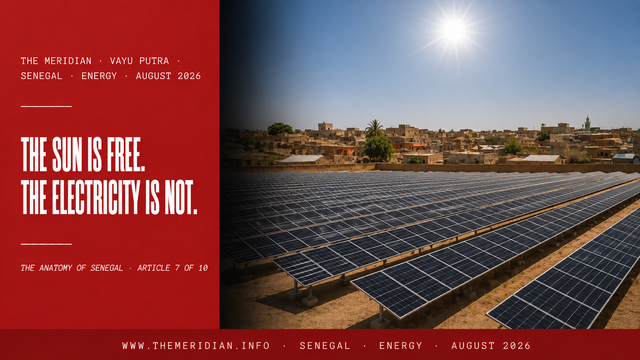
Electricity production in Senegal grew 38.1% between 2019 and 2023, reaching 1,960 MW of installed capacity. The electricity access rate rose from 70.4% to 74.2%, one of the highest in West Africa. Urban electrification stands at 96.1%, compared to 52.7% in rural areas. As of February 2026, Senegal has the third-largest installed solar capacity in West Africa at 671 MW. Renewables represent approximately 25% of installed capacity. The electricity mix remains 70% thermal, running primarily on heavy fuel oil and diesel. Electricity consumption grows at 7-8% annually. Senegal sits at 14 degrees north latitude, in one of the highest solar irradiation zones on the planet. It has 1,400 billion cubic metres of gas reserves now in production offshore. It has the Taiba Ndiaye wind farm, among the largest in West Africa. The JETP has committed EUR 2.5 billion to support the transition to 40% renewable capacity by 2030. Nearly a quarter of Senegalese citizens still live without electricity. The rural electrification rate is 52.7%. The sun costs nothing. The electricity it could generate has not yet reached the people who need it most. This article examines Senegal's energy paradox: abundant natural endowments, structural generation dependence on imported fuel, and a transition programme that is moving, but not fast enough for the rural citizen who has been waiting for the grid since independence.
The farmer in the Groundnut Basin does not have reliable electricity. The fisherwoman in Casamance does not have reliable electricity. The small trader in the Sahel borderlands does not have reliable electricity. The 52.7% rural electrification rate is not a statistic about infrastructure delay. It is a statement about whose development the Senegalese energy system has been built to serve. Urban Dakar has 96.1% electrification. The industries, hotels, government buildings, and commercial districts of the capital city are connected to the grid. The farmer who grows the food, the fisherwoman who provides the protein, the rural community whose labour subsidises the urban economy through agricultural exports are operating without the electricity that would transform their productivity, extend their working hours, refrigerate their produce, power their irrigation pumps, and connect them to the digital economy that the Faye government's Senegal 2050 vision promises. The energy access gap is not technical. The sun shines equally in Dakar and in Casamance. The energy access gap is political and financial: a consequence of infrastructure investment decisions that have prioritised urban commercial demand over rural productive capacity for decades.
Electricity production consists of 70% thermal and 30% renewable energy. The thermal generation runs primarily on heavy fuel oil and diesel, imported at international commodity prices in US dollars. This means Senegal's electricity cost is directly linked to global oil prices, to the dollar exchange rate, and to the shipping cost of getting petroleum products to West Africa. When the Hormuz crisis of early 2026 drove oil prices upward, Senegalese electricity generation became more expensive before a single policy decision was made in Dakar. The country's electricity tariffs, set by the national utility SENELEC, must either reflect the imported fuel cost, which makes electricity unaffordable for rural households, or be subsidised by the government, which adds to the fiscal deficit that the hidden debt has already made critical.
SENELEC is the state-owned national electricity company, responsible for generation, transmission, and distribution. Its generation portfolio includes its own thermal plants and purchases from independent power producers including Karpowership, which operates floating power stations off the Dakar coast. SENELEC has begun investing in converting its thermal generation units from heavy fuel oil or coal to natural gas, using domestic GTA gas as the transition fuel. This conversion is the most important near-term energy policy decision Senegal has made: replacing imported heavy fuel oil with domestically produced natural gas reduces both the fuel import bill and the foreign exchange drain on the current account, while keeping baseload generation available while solar and wind capacity is scaled up.
Senegal's solar expansion between 2023 and February 2026 is genuinely impressive. From 262 MW to 671 MW in under three years represents a 156% increase in installed solar capacity that makes Senegal the third-largest solar market in West Africa, behind only Nigeria and Ivory Coast, countries with significantly larger economies and populations. The Taiba Ndiaye wind farm, commissioned in 2021, is among the largest in West Africa. The trajectory of renewable capacity growth is real and accelerating.
The paradox is the mismatch between installed capacity and access. Senegal's exploitable solar technical potential is estimated at 1,500 MW. It has reached 671 MW. The remaining 829 MW of exploitable potential sits unused in the same sunshine that falls on every rural community without electricity. The reason it is unused is not technical. Solar panels work in Casamance as well as they work in Dakar. The reason is financial and infrastructural: grid extension into rural areas requires capital investment that neither SENELEC's tariff revenue nor the government's constrained fiscal position has been able to provide at the scale and speed that the access gap requires.
The 52.7% rural electrification rate is the most politically significant number in Senegal's energy statistics because it quantifies the productivity loss that the access gap imposes on the agricultural economy. A rice farmer with irrigation pump electricity produces more rice per hectare than a farmer without it. A fisherwoman with refrigeration extends the marketable life of her catch. A student with light can study after dark. A health clinic with electricity can store vaccines and power diagnostic equipment. The energy access gap is not merely an infrastructure problem. It is the physical expression of the development gap between the urban economy that the grid serves and the rural economy that the sovereignty agenda claims to represent.
Senegal has gas reserves of 1,400 billion cubic metres offshore. It has 671 MW of solar capacity and a technical potential of 1,500 MW. It receives some of the highest solar irradiation on the planet. It imported 1.5 million tonnes of crude oil from Nigeria in 2024 to keep its thermal power plants running. The rural electrification rate is 52.7%. The sun is free. The infrastructure to convert it into electricity for the people who live under it has not been built.
The most important near-term energy policy decision the Faye government has made is the commitment to use GTA natural gas domestically to replace heavy fuel oil in SENELEC's thermal generation fleet. This decision has three simultaneous benefits: it reduces the heavy fuel oil import bill, freeing foreign exchange that is currently being spent on energy imports; it reduces the carbon intensity of baseload generation relative to HFO; and it uses a domestic resource to serve domestic needs rather than exporting 100% of the gas production while continuing to import petroleum for electricity generation.
The transition is constrained by two factors. First, the GTA project's Phase 1 production of approximately 2.3 MTPA of LNG is primarily contracted for export to international buyers. The gas conversion of SENELEC's thermal plants requires a domestic gas supply agreement that redirects a portion of GTA production away from the export market and toward the domestic grid. The revenue trade-off, between export LNG revenue and domestic power generation savings, requires precise fiscal modelling that the government has not yet publicly released. Second, the physical conversion of SENELEC's HFO plants to gas requires capital investment in plant retrofitting and gas distribution infrastructure that must come from the oil revenues, the JETP grant allocation, or both.
The Just Energy Transition Partnership committed EUR 2.5 billion in grants and concessional loans to Senegal, targeting 40% renewable energy capacity by 2030, with a focus on solar energy, energy storage, power grids, and rural electrification. The JETP is the largest single external commitment to Senegal's energy transition and represents a genuine international partnership between the Senegalese government and a consortium of developed country donors.
The conditions attached to the JETP are the analytically significant dimension. Transition partnerships of this kind typically require governance commitments, regulatory reforms, procurement transparency, and climate reporting that impose administrative demands on a government that is simultaneously managing a fiscal crisis, an IMF programme negotiation, a Faye-Sonko political rupture, and a ten-article sovereignty agenda. The EUR 2.5 billion is transformative if disbursed and deployed effectively. The implementation capacity of the Senegalese public sector, under conditions of fiscal austerity, is the constraint that determines whether the JETP produces the grid extension and solar capacity the rural electrification target requires.
The energy transition is the one dimension of the sovereignty agenda where external financing is most available and where the natural endowments are most favourable. Senegal does not need to discover solar potential. It sits in it. The JETP provides the financing. The implementation capacity and the political prioritisation of rural electrification over urban commercial expansion are the variables that determine whether 52.7% becomes 90% within the oil window or remains the permanent geography of Senegalese energy inequality.
Senegal's energy situation in 2026 is the clearest available illustration of the gap between natural endowment and developmental outcome. The country sits in extraordinary solar irradiation, has offshore gas reserves that could power its thermal fleet without a single barrel of imported crude oil, and has a wind resource that the Taiba Ndiaye farm has demonstrated is commercially viable at scale. It has EUR 2.5 billion in JETP financing committed for the transition. It has a government that has articulated energy sovereignty as a central dimension of the Senegal 2050 vision.
And 52.7% of rural Senegalese citizens do not have electricity. The farmer in the Groundnut Basin does not have an irrigation pump powered by solar panels. The fisherwoman in Casamance does not have refrigeration for her catch. The student in the Sahel borderlands does not have light to study by after dark. The health clinic in the rural Sine-Saloum does not have electricity for vaccine cold chain.
The energy transition that Senegal is attempting is technically feasible, externally financed, and naturally endowed. What it requires, beyond the JETP disbursement and the gas conversion of SENELEC's thermal fleet, is the political decision to prioritise rural electrification over urban commercial expansion in the allocation of every marginal kilometre of grid extension, every marginal watt of new solar capacity, and every marginal franc of transition investment. The oil window provides the fiscal space. The JETP provides the external capital. The sun provides the resource. The question is whether the political economy of Senegalese infrastructure investment, which has historically prioritised Dakar, will be reoriented toward the 52.7% who live outside the city and have been waiting for the grid since 1960.
Add comment
Comments