The Most Valuable Piece of Real Estate in West Africa. Why Dakar Has Not Claimed It Yet.
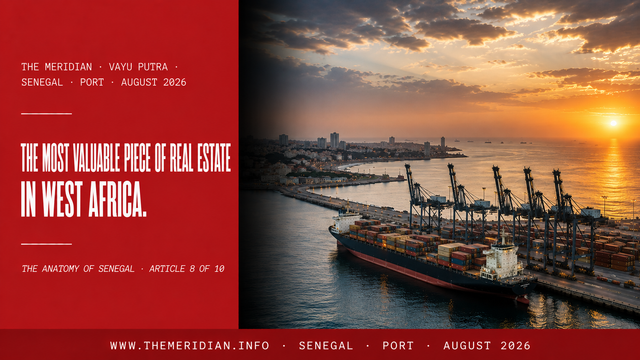
Container throughput at the Port of Dakar increased from 265,000 TEUs in 2008 to 850,000 TEUs in 2025. Vessel waiting times fell from 35 hours to near zero. It is now the highest-ranked port in Sub-Saharan Africa for efficiency, according to the World Bank's Container Port Performance Index. It is also operating at its physical limits. DP World completed dredging at the new Port of Ndayane, located 50 kilometres south of Dakar, thirteen months ahead of schedule in August 2026. Phase 1 will create capacity for 1.2 million TEUs annually. A second phase will add a further 410-metre quay. British International Investment estimates the Port of Ndayane will boost Senegal's GDP by 3% and add $15 billion in trade value by 2035, supporting 2.3 million jobs across the economy. Dakar is the westernmost point of continental Africa, geographically superior to every competitor for Atlantic transshipment traffic from Europe and the Americas. The competition is Abidjan, Lomé, Tema, and Nigeria's Lekki. None of them has Dakar's Atlantic position. The question this article examines is not whether Dakar's geography makes it the natural logistics gateway of West Africa. It does. The question is why it has taken sixty-five years of independence to build the port that the geography has always entitled it to have.
Geography is the one sovereign asset that no government can create and no competitor can replicate. Dakar sits at 14.7 degrees north latitude, on the Cap-Vert peninsula, the westernmost point of the African continent. A container ship sailing from Rotterdam to West Africa reaches Dakar before it reaches any other major port on the region's coast. A vessel from Santos, Brazil, or New York, crosses the Atlantic and arrives at Dakar before it arrives at Abidjan, Lomé, Lagos, or Tema. The transit time savings for a vessel calling at Dakar rather than routing through a competing hub are measurable in hours and in fuel cost. Every hour saved is revenue. Every tonne of fuel not burned is margin. For a shipping industry operating on ultra-thin margins across enormous volumes, the geometry of the Atlantic matters more than the quality of the cargo handling software. Dakar has the geometry. It has had it since before the first European ship anchored in the bay. The question is not whether Dakar is the natural Atlantic gateway of West Africa. It is. The question is what it did with that advantage for sixty-five years, and whether the Port of Ndayane, whose dredging was completed thirteen months ahead of schedule in August 2026, represents the moment Dakar finally claims what its latitude has always entitled it to be.
The Port Autonome de Dakar is the primary commercial gateway for Senegal and for the landlocked Sahel countries, Mali, Burkina Faso, Niger, and Chad, whose export and import traffic must cross Senegalese territory to reach the sea. It handles containerised cargo, bulk commodities including cereals and petroleum, vehicles, and specialised cargoes including oil and gas equipment for the Sangomar and GTA projects. The port operates one of the largest shipyards in West Africa, with repair and maintenance facilities that serve regional maritime traffic.
DP World has operated the Port of Dakar container terminal since 2008, investing approximately $340 million in its modernisation and capacity expansion. Container throughput increased from 265,000 TEUs in 2008 to 850,000 TEUs in 2025. Vessel waiting times fell from 35 hours to near zero. The transformation of the Port of Dakar under the DP World concession is one of the most successful port PPP stories in Sub-Saharan Africa. The World Bank's Container Port Performance Index now ranks Dakar the most efficient port in Sub-Saharan Africa, a ranking that reflects a genuine operational transformation from the chronically congested, inefficient facility that the port was before the concession.
The physical constraint is also real. The Port of Dakar is embedded in a densely urbanised area. The city of Dakar has grown around it. There is no room to expand the existing terminal within its current footprint. At 850,000 TEUs in 2025 and with regional trade volumes growing steadily, the existing port will reach its capacity ceiling within the current decade. The Ndayane project is not aspirational infrastructure. It is the necessary next stage of a port that has already run out of room to grow.
The dredging completion at Port Ndayane, announced by DP World in August 2026, is the most significant logistics infrastructure news in West Africa this year. The dredging was scheduled for completion in September 2027. It was completed in August 2026, thirteen months early. The 5-kilometre shipping channel of sufficient depth and width to enable the world's largest container vessels to pass safely under tug escort is now complete. Construction has moved to the next phase of marine and civil works, with the port on track for completion in 2028.
The early completion is analytically significant beyond the project management achievement. Port infrastructure projects in Africa routinely run over schedule and over budget. Ndayane running thirteen months ahead of schedule signals that the DP World-Government of Senegal partnership has the execution capacity to deliver complex infrastructure on time, and that the political priority given to the project by the Faye government is producing the coordination that complex port development requires. DP World Group chairman Sultan Ahmed bin Sulayem said: "The Port of Ndayane will elevate Senegal and impact trade across the African continent." DP World also intends to develop an economic zone near the port and nearby Blaise Diagne International Airport, in collaboration with British International Investment.
The economic zone adjacent to the port and airport is the dimension that transforms Ndayane from a transshipment hub into an integrated trade and industrial cluster. The combination of a deep-water port capable of handling super post-Panamax vessels, a freight terminal at Blaise Diagne Airport scheduled for completion in 2028 with 80,000 tonnes per year capacity, the planned Train Express Regional rail extension to the airport, and an economic zone with industrial and logistics parks connected to both, is the infrastructure architecture that would position the Dakar-Diamniadio-Ndayane corridor as the logistics backbone of West African trade.
Dakar is the westernmost point of Africa. A ship from Rotterdam reaches it before Abidjan, before Lomé, before Lagos. Lomé handles 2.3 million TEUs per year. Dakar handles 850,000. The difference is not geography. Geography favours Dakar. The difference is sixty-five years of underinvestment in the infrastructure that would convert the geometry of the Atlantic into trade revenue. Ndayane is the correction. The question is whether it arrives in time to compete with ports that built their capacity while Dakar waited.
The West African port competition is more intense in 2026 than at any previous point in the region's history. Lomé, in Togo, has built a transshipment hub that handles approximately 2.3 to 2.5 million TEUs annually, making it the dominant container port in the sub-region. Its competitive advantage is not geography: Togo sits south of Ghana and is less favourably positioned than Dakar for Atlantic shipping. Its competitive advantage is execution: Lomé invested in deep-water capacity and operational efficiency earlier, built the concession framework that attracted the terminal investment, and captured the regional transshipment market while Dakar was constrained by its urban footprint and governance limitations.
Abidjan's Ivory Coast International Terminal on the Vridi Canal, with a 16-metre draft, is a direct competitor for the Sahel hinterland traffic, particularly Mali and Burkina Faso, that both Abidjan and Dakar serve. Tema in Ghana has completed a major terminal expansion with a 16-metre draft. Nigeria's Lekki Deep Sea Port, designed to handle 2.5 million TEUs with a 16.5-metre draft, is the largest new port project in West Africa and positions Nigeria as both a self-sufficient port economy and a potential competitor for regional transshipment.
Dakar's competitive differentiation against all of these is its Atlantic position. The fuel and time savings for a vessel calling at Dakar rather than routing through Lomé or Abidjan are real and calculable. Airport CEO Askin Demir noted that DP World's development of Ndayane reinforces Blaise Diagne Airport's importance for connectivity: "With the new investment in Senegal on the highways, it will be much more interesting for the neighbouring countries like Mali, Gambia, and Guinea." The landlocked Sahel hinterland, including Mali, is Dakar's most critical competitive asset. Mali's trade has historically routed through Dakar, but political developments under the Traore military government and the creation of the Alliance des États du Sahel have introduced geopolitical uncertainty into Senegal's transit revenue base.
Senegal's port competitiveness depends significantly on Mali. The Dakar-Bamako corridor is the primary transit route for Malian imports and exports to the sea. Mali is Senegal's largest export market at 21% of Senegal's total exports. Malian transit traffic generates port fees, logistics revenue, customs receipts, and ancillary service employment across the corridor.
Since the 2021 and 2022 military coups, Mali has been governed by a junta that has expelled French forces, ended the MINUSMA peacekeeping mission, and aligned itself with Russia through the Wagner/Africa Corps presence. The Alliance des États du Sahel, comprising Mali, Burkina Faso, and Niger, has created a political bloc that is actively building alternative transit routes, including through Guinea and Mauritania, to reduce dependence on coastal ECOWAS member states.
If Mali successfully develops alternative transit routes that reduce its dependence on the Dakar port, Senegal's hinterland traffic base contracts precisely as Ndayane is opening its new capacity. The geopolitical risk to the Mali corridor is not hypothetical. It is being actively constructed by the junta governments of the Alliance des États du Sahel as a deliberate sovereignty strategy. The Port of Ndayane's $15 billion trade value projection by 2035 is predicated on Senegal maintaining its position as the natural gateway for Sahelian trade. That position is not guaranteed.
The Port of Ndayane, whose dredging was completed thirteen months ahead of schedule in August 2026, is the most important single piece of infrastructure in Senegal's sovereignty agenda. More important than the oil revenues, because oil runs out. More important than the CFA exit debate, because monetary architecture is negotiated over years. More important than the agricultural programme, because food sovereignty is a generation's work. The port is the infrastructure that converts Dakar's irreplaceable geographic advantage, the westernmost point of Africa on the Atlantic, into recurring, compound, diversified economic value that will outlast the oil, survive the monetary transition, and sustain the agricultural transformation.
Every container that transships through Ndayane rather than Lomé or Abidjan generates port fees, logistics employment, warehousing revenue, customs receipts, and ancillary services that remain in Senegal. The $15 billion in trade value by 2035 and the 2.3 million jobs are not the output of the port alone. They are the multiplier effect of positioning the most geographically advantaged port on the West African Atlantic coast as the logistics backbone of a region of 400 million ECOWAS consumers.
The geopolitical risk from Mali is real and must be managed. The competitive pressure from Lomé, Abidjan, and Lekki is real and must be met with operational excellence and corridor investment. The opportunity is also real, documented, and time-sensitive: the Port of Ndayane will open in 2028, and the trade flows of West Africa are being organised right now around the ports that are ready to receive them. Dakar's latitude has always made it the natural choice. For the first time since independence, it is building the infrastructure to make the natural choice the obvious one.
Add comment
Comments