Three Curricula. Three Futures. One Country.
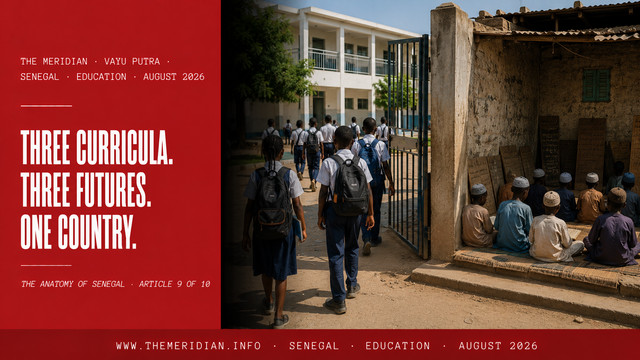
In Senegal in 2026, three separate educational systems are running simultaneously, serving different populations, in different languages, toward different civilisational destinations, with no mechanism to translate the credentials of one into the currency of another. The first is the formal French-medium secular system, inherited from the colonial administration, in which the Baccalauréat is taught in French, the official language of a country where most people speak Wolof. Only 21% of Grade 2 students achieve basic reading proficiency. The national literacy rate is 57.7%. The second is the daara system, the traditional Quranic school network, which in 2017 comprised 22,000 schools accommodating nearly two million learners. Less than 10% of those schools have been integrated into the formal system as of 2024. The third is the Turkish Maarif Foundation school network, operating in Dakar and elsewhere in West Africa, which teaches Turkish language alongside the national curriculum and is documented in The Meridian's August 2026 article on Turkey's educational soft power. Three curricula. Three languages of aspiration. Three different answers to the question of who Senegal's children will become. The Faye government has committed to systematic change. It has appointed a reform-oriented education minister, committed to introducing national languages into the curriculum by 2026, and begun the integration of the daara system into formal education. Whether it can unify three civilisational trajectories into one coherent national system within the oil window is the most difficult domestic policy challenge it faces.
The child who walks to school in Dakar in 2026 and the child who enters the daara in the same street and the child whose parents enrolled them in a Maarif Foundation school in the same neighbourhood are receiving three entirely different answers to the same fundamental question: what kind of person is the education system trying to produce? The formal French school is producing a citizen who can navigate the French-medium bureaucracy, access UCAD, write a letter to a ministry official, and compete for the educated middle-class jobs that the formal economy offers to those who clear the Baccalauréat. The daara is producing a believer: someone who has memorised the Quran, who understands Arabic, who is embedded in the Sufi brotherhood network that provides social capital and economic support across Senegalese society in a way that no formal government institution can replicate. The Maarif Foundation school is producing something more ambiguous: a bilingual francophone-Turkish student whose education opens doors in Ankara and in the network of institutions that Turkey has been building across Africa since 2016. Three children. Three schools. One street in Dakar. Three different futures that the Senegalese state has not yet decided how to reconcile.
The Senegalese education system is based on its French equivalent. The curriculum places an emphasis on French grammar and reading, mathematics and science, and geography. This architecture has been in place since the colonial administration established the école coloniale to produce the literate functionaries that French West Africa required. It was maintained after independence by President Senghor, who allegedly said that French is the language of the gods and who produced some of the most sophisticated French-language literature of the twentieth century while governing a country where the majority of citizens spoke Wolof.
The structural problem with a French-medium education system in a Wolof-speaking country is documented in the learning outcome data. Only 21% of Grade 2 students achieve basic reading proficiency. The reason is straightforward: most children enter school without French proficiency. They are being taught to read in a language they do not speak. The mismatch between the language of instruction and the language of thought produces the catastrophic early literacy rates that have persisted across five decades of Senegalese education policy. A child who cannot read by Grade 2 in Senegal is almost certain not to complete secondary school. The Baccalauréat completion rate, the literacy rate of 57.7%, and the primary school dropout rate all flow from this single architectural decision made in Paris in the nineteenth century and maintained in Dakar through independence.
By 2024, the government committed to systematically introducing national languages into basic education curricula by 2026. The Ministry of Education introduced the Harmonised Model of Bilingual Education, which develops literacy skills in the child's mother tongue, either Wolof or Pulaar, alongside French, until the end of Grade 4. The commitment to bilingual education is the most significant curriculum reform in Senegalese education since independence. Its implementation faces documented obstacles: teacher training shortages for instruction in national languages, resource gaps in curriculum materials, and the institutional inertia of a system whose examination structure, from the BFEM at middle school to the Baccalauréat, remains entirely in French.
The daara is a Wolof word derived from the Arabic dar, meaning house or dwelling. It designates the Quranic school that has been the primary educational institution for most Senegalese children since the introduction of Islam to the region. In 2017, the National Federation of Quranic Schools Associations reported 22,000 daaras accommodating nearly two million learners. The figure has grown since. The daara is not a marginal institution in Senegalese education. It is the primary educational experience of a significant portion of the population.
The daara's curriculum centres on memorisation of the Quran and mastery of Arabic. The most accomplished daara students, the hafiz who can recite the entire Quran from memory, command extraordinary social respect within the Sufi brotherhood networks that organise Senegalese civic and economic life. The Mouride and Tijaniyya brotherhoods, which together represent the majority of Senegalese Muslims, provide social capital, credit networks, labour market connections, and community support systems that the formal state has never been able to replicate. A certificate from a respected daara is not worthless in Senegalese society. It is a credential within a different credentialing system, whose value is social and spiritual rather than formal and professional.
The state has made repeated attempts to integrate the daara into the formal education system. The 2015 draft law on daara regulation sought to standardise operations, curb the practice of talibé begging, in which children in some boarding daaras are sent into the streets to beg for their marabout's income, and create pathways to formal schooling. By 2022, over 500 daaras had been integrated under the PAPSE II programme. In 2024, the Ministry of National Education announced the addition of 600 more Quranic schools to the formal system. Less than 10% of the total daara population remains covered by these integration efforts.
The integration challenge is cultural and political as much as administrative. The marabouts who lead the major daara establishments are among the most powerful social figures in Senegal. Their endorsement of political candidates has historically been decisive in presidential elections. A government that attempts to regulate the daara too aggressively risks the political consequences of alienating the brotherhood leadership whose support it needs to govern. The sovereignty agenda that proposes to decolonise the formal French curriculum has no equivalent agenda for the daara system, whose authority is grounded in religious legitimacy rather than colonial legacy and cannot be reformed by the same political logic.
A Senegalese child who attends only the formal French school will struggle to read in the language of instruction. A child who attends only the daara will memorise the Quran but cannot access a university or a professional qualification. A child in a Maarif Foundation school is being prepared for a relationship with Turkey that most of their parents cannot locate on a map. Three systems. No bridge between them. One country trying to decide who its citizens should become.
The Turkish Maarif Foundation's presence in Senegal and across West Africa is documented in detail in The Meridian's August 2026 article on Turkey's educational soft power strategy. The August 2026 issue of this series established that the Maarif Foundation operates 125 schools in Africa and 63 in ECOWAS countries, following Turkey's strategy of using educational infrastructure as a diplomatic and cultural influence tool across the Global South. Senegal is one of the primary targets of this expansion.
The Maarif schools offer a curriculum that combines the host country's national curriculum with Turkish language instruction, creating a generation of graduates with language skills and cultural orientation toward Turkey. The Foundation's curriculum operates on the basis of the national curriculum of the country in which it works, meaning Maarif schools in Senegal teach the Senegalese national curriculum as required by law. The additional layer is Turkish language and the cultural orientation that follows from it.
The Maarif Foundation's expansion into Senegal's educational space is the third civilisational track running through the same classrooms. French is the language of formal power and bureaucratic access. Arabic is the language of spiritual authority and brotherhood network membership. Turkish is the language of a new geopolitical patron offering scholarships, university places in Ankara, and a cultural alternative to the French-Arabic binary that has organised Senegalese identity since independence. For the Faye government, which has explicitly positioned its sovereignty agenda against French influence, the presence of a Turkish educational network operating on Senegalese territory is an analytical tension that has not yet been resolved in public policy.
The Faye government has positioned itself as a departure from the colonial education model. Minister of National Education Moustapha Guirassy has committed to introducing local languages throughout the education system, creating additional vocational training structures, and filling gaps left in the formal education sector. The government committed to systematically introducing national languages into basic education curricula by 2026 and has increased the Ministry budget by 65.7 billion FCFA to 975 billion FCFA for the 2024-2025 fiscal year.
What has been delivered, as of August 2026, is the commitment and the budget increase. The bilingual education framework, the MOHEBS model developed in 2020, provides the pedagogical architecture. The obstacles that previous governments failed to overcome remain: teacher training for instruction in Wolof and Pulaar is insufficient, curriculum materials in national languages are scarce, and the examination architecture that determines access to higher education remains entirely in French. Changing the language of primary instruction without changing the language of the Baccalauréat produces bilingual primary schools that feed into a French-only secondary and tertiary system. The reform requires coherence across the full educational pipeline, not just the early grades.
The most important education reform the Faye government could make is also the most politically difficult: a single national curriculum, taught progressively in Wolof and French from primary through secondary, with a reformed Baccalauréat that assesses competence in both languages, and a STEM component that prepares students for the technology economy that the Senegal 2050 vision promises. This would require confronting the brotherhood leadership on daara integration, the French government on curriculum sovereignty, and the Turkish Foundation on the scope of its cultural presence. It would require the political will to make the classroom the site of the sovereignty agenda, not just the presidency and the ministry buildings.
Education is the longest investment a sovereignty agenda can make. The oil window closes in approximately twelve years. The children who start school in Senegal today will be the workforce of 2040, long after the Sangomar oil has peaked and declined. Whether the technology economy, the logistics hub, the agricultural sector, and the data centres that the Senegal 2050 vision promises will have a workforce capable of staffing them depends on decisions being made in classrooms right now, in three different languages, under three different authorities, toward three different futures.
The French system produces graduates who can access the formal economy but who learned to read in a language that was not their first thought. The daara produces believers who are embedded in the social networks that make Senegalese civil society function but who cannot access a university or a professional qualification without a bridge programme that barely exists. The Maarif Foundation produces bilingual students with Turkish cultural orientation in a country whose sovereignty agenda is explicitly directed at reducing foreign cultural influence.
The education reform that Senegal needs is not more schools. It is fewer parallel systems and more coherent ones. A single national curriculum, taught in Wolof and French from primary through secondary, with a reformed examination architecture, a STEM pipeline, a vocational track that connects to the port, the data centres, and the agricultural cooperative, and a daara integration programme that preserves the spiritual and social value of Quranic education while adding the literacy and numeracy that the formal economy requires. This reform does not require oil revenues. It requires political will, and the willingness to tell three competing cultural authorities, France, the brotherhoods, and Turkey, that the classroom belongs to the Senegalese citizen and to no one else.
Add comment
Comments