South Asia's Growth Paradox: When GDP Rises but Lives Do Not
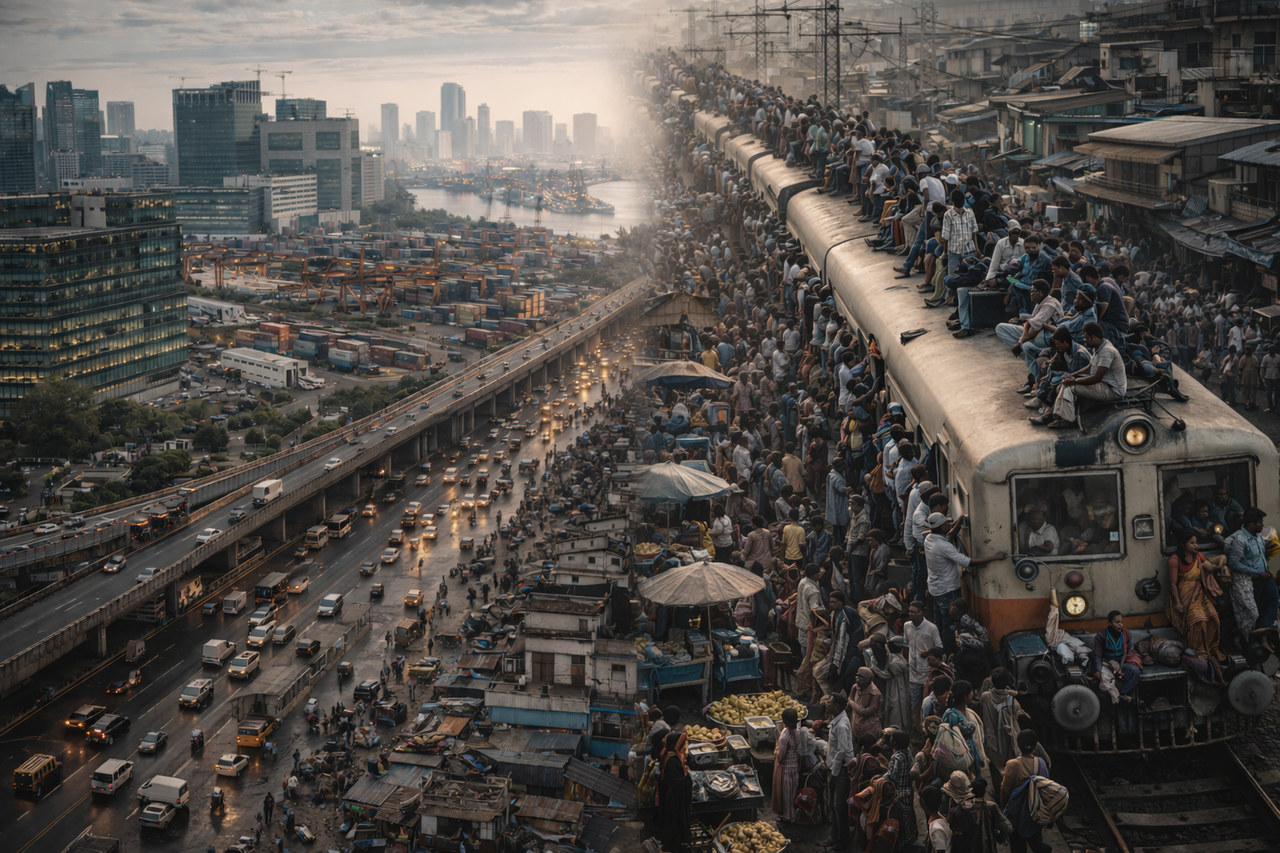
Three hundred kilometres south, Bangalore's tech corridor hums with venture capital, infrastructure investment, and rising incomes. India's software exports exceed 150 billion dollars annually. GDP growth hovers near 7 percent.
These realities coexist. South Asia posts growth rates that much of the developing world envies. India accounts for nearly four-fifths of regional output and is routinely described as an emerging economic powerhouse. Bangladesh has recorded steady expansion. Sri Lanka retains a diversified economic base despite serial crises. Pakistan, even in weaker years, has not collapsed.
And yet South Asia remains home to the largest concentration of poor people on earth.
This is not a paradox born of bad data or ideological bias. It is a well-documented structural outcome. Growth has happened. Poverty rates have fallen. But growth has been neither deep enough nor inclusive enough to transform lives at the scale required. The region has grown, but not developed.
Growth That Performs, But Not Exceptionally
Between 1981 and 2005, South Asia reduced its poverty rate from roughly 60 percent to 40 percent. That looks like progress.
In absolute terms, however, the number of poor people rose. From 549 million in 1981 to 595 million in 2005. India, which accounts for three-quarters of the region's poor, saw numbers climb from 420 million to 455 million. Population growth outpaced poverty reduction.
So did South Asia underperform? World Bank analysis shows the region sits close to the global regression line linking income growth to poverty reduction. India, Sri Lanka, Bangladesh, and China all fall near the trend. Their poverty reduction matches what economic growth would predict. They did not fail. But nor did they excel.
That distinction matters. China grew faster, for longer. Thailand grew faster, for longer. East Asian economies outperformed not by avoiding inequality, but by sustaining high growth over decades. In this framework, growth "trumps" inequality when it comes to poverty reduction. South Asia simply did not grow fast enough to offset its demographic scale.
South Asia reduced poverty at the rate growth predicted. It just did not grow fast enough, long enough.
Bangladesh offers partial exception. Its garment sector employed millions, mostly women, in formal jobs with measurable incomes. Poverty fell faster than GDP growth alone would predict. But Bangladesh is small. Its success, while real, does not shift regional aggregates.
Pakistan's trajectory is grimmer. Persistent instability, energy shortages, and underinvestment in human capital have kept growth anaemic. Yet the state has not collapsed. Informal networks, remittances, and agricultural resilience provide cushion. Poverty persists, but catastrophe has been avoided.
Sri Lanka, despite political crises and a devastating 2022 economic collapse, retained literacy rates above 90 percent and health outcomes superior to income level. The foundation for recovery exists. But debt distress and governance failure now threaten even this base.
Nepal remains poor but stable. Remittances from Gulf labour markets support rural households. Growth is slow. Transformation has not occurred.
The regional story is therefore one of adequacy without excellence. Poverty rates fell in line with growth. But poverty numbers rose because growth was insufficient for the scale of need.
Inequality: The Red Herring
Did inequality block progress? The data says no.
India's Gini coefficient rose modestly between 1990 and 2010. China's rose faster. Yet China reduced poverty at twice India's rate. The difference was not distribution. It was growth speed.
This finding upends conventional assumptions. Inequality matters for social cohesion, political stability, and long-term sustainability. But in the short to medium term, fast growth reduces poverty even when inequality rises. China proved this. India, by growing slower, could not.
The policy implication is uncomfortable: redistribution alone does not solve poverty when the economy is not generating enough surplus to redistribute. Growth must come first. But growth of what kind, and at what social cost, remains the harder question.
The Human Development Deficit
If the poverty story is merely adequate, the social story is plainly incomplete.
Adult literacy improved in South Asia at rates matching global trends. That progress is real. But secondary and tertiary education lag badly. India's secondary school enrolment ratio stands at 40 percent, compared with 70 percent in East Asia. That gap is structural.
In Punjab, one of India's wealthier states, government schools struggle with teacher absenteeism and infrastructure decay. In Bihar, the situation is worse. Classrooms lack furniture. Teachers are untrained. Dropout rates spike after primary school, especially for girls.
The urban-rural divide compounds the problem. Cities attract resources. Villages do not. A child in Delhi has access to coaching centres, libraries, and internet connectivity. A child in rural Jharkhand has a school building with no electricity.
Health outcomes are grimmer still. South Asia carries a disproportionate burden of neglected tropical diseases. India accounts for one-quarter of global intestinal worm infections and more than half of the world's cases of leprosy and visceral leishmaniasis. These are diseases of poverty, poor sanitation, and weak health systems.
Malnutrition remains endemic. South Asia has some of the highest child malnutrition rates in the world relative to income level. This is not marginal underperformance. It is dramatic deviation from global norms.
Gujarat and Haryana are as far above the malnutrition trend line as Bihar. This is not about bad governance in poor states. This is structural.
This pattern reveals the problem is not simply poverty. It is systemic failure in translating income into nutrition, health, and capability. Even relatively rich states cannot convert growth into child welfare.
Undernourished children perform worse cognitively, stay in school for fewer years, and earn less as adults. Growth that fails to address malnutrition reproduces itself on a weaker foundation. Each cohort of malnourished children becomes a cohort of less productive adults.
Gujarat and Haryana are among India's most prosperous states. Both have high per capita incomes, strong industrial bases, and reputations for business-friendly governance. Yet both show child malnutrition rates as high as Bihar and Uttar Pradesh, two of India's poorest states.
This is not about poverty. It is about priorities. Gujarat invests heavily in infrastructure for industry but underinvests in rural health clinics and anganwadi centres (government-run childcare facilities). Haryana has excellent highways but weak school meal programmes. Prosperity does not automatically translate into nutrition when political incentives favour capital over people.
Kerala, by contrast, invested early in public health and education. Despite lower per capita income than Gujarat, Kerala has near-universal literacy, low infant mortality, and child malnutrition rates closer to global norms. The difference is policy choice, not resource availability.
Gender: The Missing Half of Growth
Perhaps the most persistent failure is gender inclusion.
Globally, income growth pulls women into the labour force. In South Asia, that mechanism is broken. Female labour force participation remains far below global norms. India stands at 35 percent, compared with 58 percent in low-income countries overall. Most South Asian economies sit below the trend line linking growth to female employment.
Cultural practices shape these outcomes. Dowry systems persist despite legal prohibition. The expectation that families of brides will pay substantial sums to grooms creates perverse incentives. Girls are seen as financial burdens. Investment in their education and health declines. Early marriage follows. The cycle reinforces itself.
Legal systems have failed to intervene. Dowry Prohibition Acts exist across South Asia. Enforcement is negligible. Prosecutions are rare. Social norms override legal frameworks.
Violence against women remains high. Death rates for young girls exceed boys. Sex-specific abortions targeting female foetuses persist, particularly in Punjab, Haryana, and parts of Uttar Pradesh. Son preference is not fading with prosperity.
The informal sector absorbs those women who do work. Domestic labour, agricultural work, and home-based production dominate female employment. These jobs lack contracts, social protection, or wage transparency. Women work, but their work remains invisible in official statistics and unprotected by labour law.
Growth that excludes women leaves vast productive capacity idle. The inefficiency is not subtle.
Bangladesh's garment sector offered an alternative. By employing women in formal factory jobs, the sector created measurable incomes, social mobility, and bargaining power within households. Female labour force participation in Bangladesh rose accordingly. The model worked. But it has not been replicated at scale elsewhere in the region.
Education gains for girls stall at higher levels. Primary school enrolment has reached parity in most of South Asia. But dropout rates spike after grade eight. Cultural pressure, safety concerns, and lack of sanitation facilities in schools drive girls out of education before secondary completion.
The economic cost is staggering. Educated women have fewer children, invest more in their children's health and education, and participate more fully in economic life. Excluding half the population from productive activity is not just moral failure. It is economic inefficiency on a massive scale.
Institutional Failure and the Informal Trap
Why does growth not translate into capability?
The answer lies partly in institutional failure. States that cannot deliver basic services, cannot enforce contracts, and cannot regulate markets produce growth that benefits elites while bypassing the poor.
In India, 90 percent of the workforce operates in the informal sector. These workers lack contracts, social security, or legal protections. When growth occurs, it flows to formal sector participants. Informal workers see wages rise slightly, but precarity remains.
Urban-rural divides worsen the problem. Infrastructure investment concentrates in cities. Rural areas receive roads, electricity, and water supply decades later, if at all. Service delivery follows the same pattern. Teachers posted to rural schools often do not show up. Clinics lack medicines. Courts are distant and expensive.
The result is a two-tier system. Urban elites access private education, private healthcare, and gated infrastructure. The rural poor depend on failing public systems. Growth widens the gap rather than closing it.
Land acquisition laws illustrate the problem. When states acquire land for industrial projects, compensation is often inadequate. Legal processes are slow. Displaced farmers receive cash payments but lose livelihoods. They migrate to cities, join the informal sector, and become urban poor.
Corruption compounds failure. Public spending on health and education leaks through procurement fraud, ghost employees, and contractor kickbacks. Money allocated for rural development does not reach villages. Growth creates fiscal space for social investment, but weak institutions cannot convert budgets into outcomes.
This is not accidental. Elites benefit from a system where public services remain weak, forcing the middle class into private alternatives while the poor are left with underfunded public systems. Capture, not incompetence, explains much of the failure.
Why "Grow First, Fix Later" Failed
The conventional development model holds that growth creates fiscal space, and fiscal space enables social investment. First you grow the economy. Then you fix education, health, and inequality.
South Asia demonstrates the limits of this logic.
When human development lags too far behind income growth, the growth process itself becomes fragile. Productivity stagnates because workers are malnourished and poorly educated. Inequality hardens into caste and class structures that resist reform. Political legitimacy erodes as voters see GDP rise while their lives do not improve.
China avoided this trap not through superior redistribution, but through sustained high growth coupled with massive rural investment in the 1980s and 1990s. Township and village enterprises created jobs. Land reforms gave farmers security. Public health campaigns reached villages. Growth and social investment happened concurrently, not sequentially.
South Asia tried the sequential approach. India liberalised in 1991, posted higher growth, and assumed social outcomes would follow. They did not. Bangladesh focused on garment exports, achieved impressive poverty reduction, but health and education systems remain weak. Pakistan pursued growth through remittances and agriculture, but underinvested in everything else.
The World Bank's conclusion is unambiguous: growth is necessary, but not sufficient. Redistribution cannot rely solely on public transfers. Social progress cannot be postponed until some future income threshold is reached. Policies must integrate growth and human development from the outset.
The Post-2020 Reality
COVID-19 exposed and deepened these failures. School closures lasted longer in South Asia than almost anywhere else. Children from poor families lacked internet access. Learning losses were catastrophic. Malnutrition worsened as incomes fell and food prices rose.
Climate stress now compounds the challenge. Erratic monsoons, heat waves, and flooding disrupt agriculture. Food security deteriorates. Migration to cities accelerates. Informal sector employment expands further.
Labour markets are becoming more skill-intensive. Automation and artificial intelligence threaten even low-skilled manufacturing jobs. Countries that failed to invest in secondary and tertiary education now face a workforce unprepared for the jobs that remain.
Political consequences are emerging. Voters in democracies express frustration through populism, ethnic nationalism, and anti-elite anger. Governments respond with short-term subsidies rather than long-term investment. The cycle of inadequate reform continues.
A Regional Warning, Not a Regional Failure
South Asia's paradox should not be misread as total failure. The region has avoided collapse. It has integrated into global markets. Poverty rates have fallen. Literacy has improved.
But it has also normalised a development path in which rising GDP coexists with stubborn deprivation. That path is no longer defensible.
As global trade fragments, climate stress intensifies, and labour markets become more skill-biased, the costs of underinvestment in people will rise sharply. Countries that fail to convert growth into capability will find themselves richer on paper, weaker in reality.
The lesson extends beyond South Asia. Fast growth without institutional depth, social investment, or inclusion produces economies that look strong until they are tested. Venezuela grew on oil wealth without diversifying. Kazakhstan grew on commodities without transforming governance. Mauritius grew on services without ensuring broad-based development.
South Asia's lesson is therefore universal: growth that does not transform lives eventually runs out of legitimacy and momentum.
• Growth reduces poverty rates, but not automatically poverty numbers when population growth is high
• Inequality does not block poverty reduction if growth is fast enough and sustained long enough
• Human development gaps (education, health, nutrition) weaken long-term growth potential
• Gender exclusion is an economic cost, not just a social injustice
• "Grow now, fix later" is not a sustainable development strategy
• Even prosperous regions fail when institutional priorities favour capital over people
• Informal sector dominance perpetuates precarity and limits transformation
This analysis draws on World Bank Economic Premise #53 (March 2011), "The South Asian Development Paradox: Can Social Outcomes Keep Pace with Growth?" by Ejaz Ghani, alongside recent data on post-2020 trends in the region.