Europe Built a Carbon Border Tax That Will Reshape Industry Across Africa and Asia. Nobody Voted on That Part.
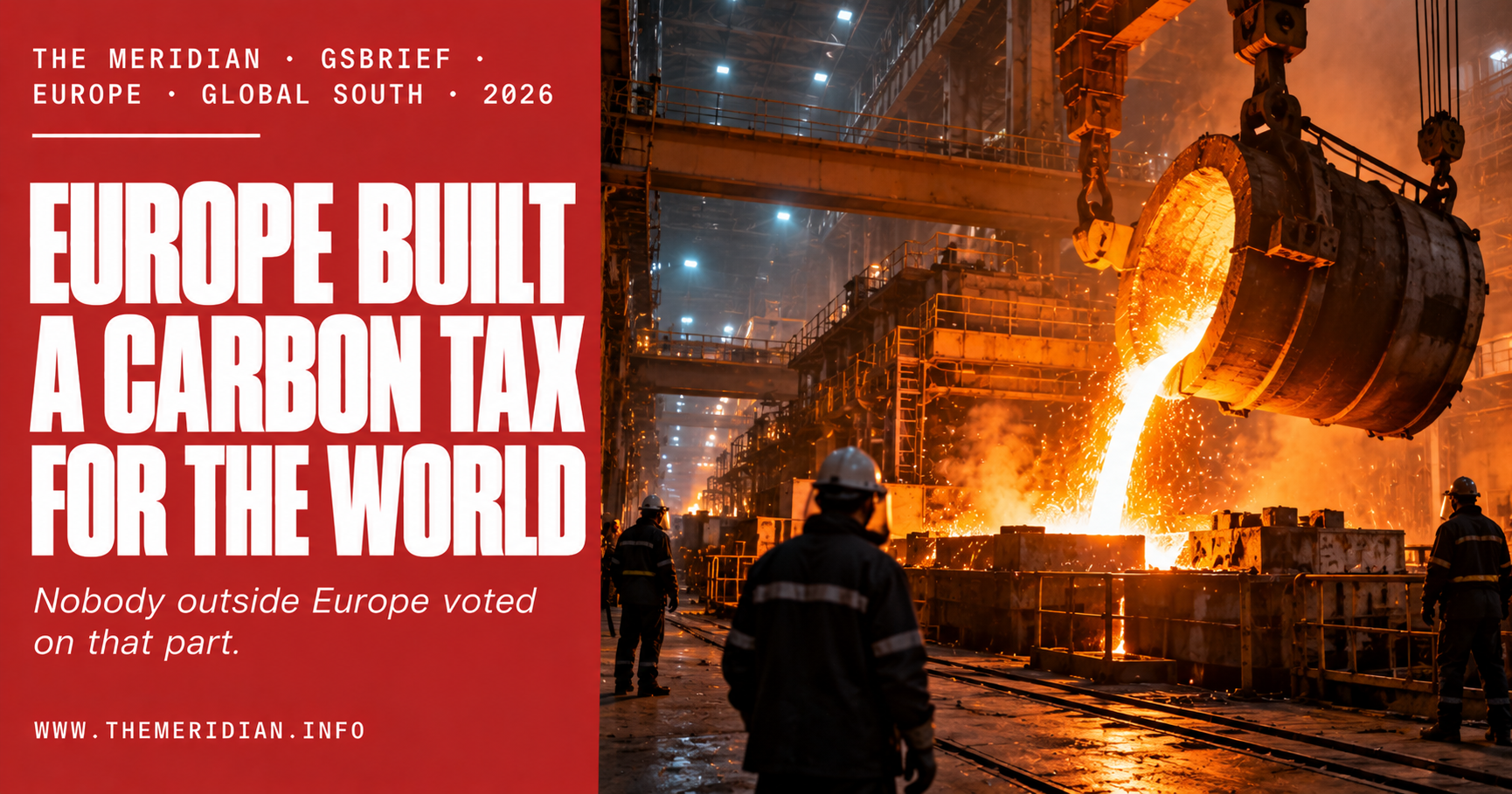
The EU's Carbon Border Adjustment Mechanism is described as a climate policy. It is also, simultaneously, a trade barrier, an industrial subsidy for European manufacturers, and a regulatory export. The countries that will pay for it were not in the room where it was designed.
On 1 January 2026, the European Union's Carbon Border Adjustment Mechanism moved from its reporting phase into its definitive phase. Importers bringing steel, aluminium, cement, fertilisers, electricity, or hydrogen into the EU must now purchase and surrender CBAM certificates priced at the weekly average EU Emissions Trading System auction price -- currently running at approximately sixty to seventy euros per tonne of carbon dioxide. The European Commission describes this as a climate policy. The description is accurate. It is also incomplete.
CBAM is three things simultaneously. It is a carbon price equalisation mechanism, designed to prevent carbon leakage as the EU phases out free ETS allowances for its own heavy industry between 2026 and 2034. It is a trade barrier that raises the cost of exporting six industrial product categories into the world's largest single market. And it is an industrial subsidy -- a shield protecting European steel mills, aluminium smelters, cement producers, and fertiliser manufacturers from competition by exporters who have not priced carbon into their production costs. The European Commission designed it, the European Parliament and Council passed it, and the revenue flows into European budgets. The countries bearing the adjustment cost were not consulted on the design.
Regulation (EU) 2023/956, adopted May 2023 as part of the Fit for 55 package, is the governing document. EU importers of covered goods must register as authorised CBAM declarants, report embedded carbon emissions annually, and purchase certificates to cover those emissions at the EU ETS price. If the exporting country already prices carbon domestically, that cost is deducted from the CBAM obligation. If it does not -- or if its carbon price is lower than the EU's -- the importer pays the difference. The regulation is explicit on revenue: certificate proceeds flow to EU member state budgets. By 2030 the European Commission projects CBAM revenues at approximately nine billion euros per year. That money does not go to the countries whose exporters generated it.
The carbon leakage rationale is the regulation's stated justification: if EU manufacturers pay for their carbon and non-EU competitors do not, production migrates to less-regulated jurisdictions and global emissions rise. The logic is defensible. The European Commission estimates CBAM will cover approximately two percent of total EU emissions once fully implemented. Two percent is the climate impact of a mechanism that will structurally restructure industrial competitiveness across six sectors in every country that exports to Europe.
Mozambique provides the clearest illustration of the asymmetry. Aluminium accounts for approximately sixty-eight to ninety-seven percent of Mozambique's total exports, and roughly ninety-seven percent of that aluminium goes to the EU. The World Bank's Relative CBAM Exposure Index identifies Mozambique as the most exposed country in the world on direct emissions. Mozambique did not design CBAM, did not participate in its legislative process, and does not receive its revenues. What it receives is a carbon adjustment charge on the product that constitutes the majority of its national export earnings.
South Africa exported approximately $5.7 billion in iron and steel products to the EU. The South African government has labelled CBAM "coercive" and described it as a threat to the "delicate national consensus" on climate change -- a consensus it has been building domestically through its own carbon tax, introduced in 2019. Kazakhstan, meanwhile, becomes the most exposed country globally when indirect emissions from electricity generation are included in the CBAM calculation. Kazakhstan's coal-heavy power grid means the electricity used to produce its aluminium, steel, and other CBAM-covered exports carries a carbon intensity significantly above the EU average.
The EU projects CBAM will cover approximately two percent of total EU emissions. That is the climate impact. The trade impact -- restructuring industrial competitiveness across six sectors in every exporting country -- is considerably larger.
CBAM carries a second-order cost that the regulation's text does not feature prominently. Before an exporter in Mozambique, South Africa, or Kazakhstan can benefit from a deduction for carbon already priced at home, that carbon pricing must be measured, reported, and verified in a format the European Commission recognises. Building that measurement, reporting, and verification infrastructure is not free. The World Bank estimates it could cost between 0.5 and 1.5 percent of GDP for developing countries in the initial years. This is a fixed cost of being permitted to sell to Europe. It falls on the exporting country. It is paid whether or not the exporter successfully secures a deduction.
At COP30 in November 2025, countries formally discussed trade-linked climate measures like CBAM in a multilateral forum for the first time. This was after the regulation had passed, entered its transitional phase, and moved into its definitive phase. Formal international discussion of CBAM's distributional consequences began after the design was complete and the legal text was in force. China, India, Russia, Brazil, South Africa, and Indonesia have raised formal WTO objections. India has announced WTO dispute proceedings. Russia filed a formal complaint in May 2025. In July 2025, BRICS nations collectively condemned and rejected the mechanism. The legal argument centres on the principle of Common But Differentiated Responsibilities under the Paris Agreement, which holds that countries with different historical contributions to emissions and different development levels should bear different obligations.
The EU's position is not without substance. Carbon leakage is a genuine risk, not simply a pretext. If European manufacturers price carbon and competitors do not, emissions migrate rather than decline. The deduction mechanism means exporters with domestic carbon pricing receive credit for it. The European Commission has discussed directing some CBAM revenues toward climate finance and compliance infrastructure support for affected countries. The regulation is designed, in its own terms, to treat imported and domestically produced goods equivalently on carbon cost -- which is the basis of its claimed WTO compatibility.
There is also a harder argument: European manufacturers have invested under ETS carbon cost pressure since 2005. Exempting foreign competitors from equivalent carbon costs is not climate neutrality -- it is a subsidy to less-regulated production. The CBAM resolves that asymmetry without abandoning European climate ambitions. For European industry, it is a matter of competitive fairness.
The Meridian has published a comprehensive manual covering the full CBAM regulatory architecture: sector coverage, certificate pricing, MRV requirements, the deduction mechanism, country-by-country exposure analysis, and compliance strategy. Essential reading for any organisation exporting to Europe, advising clients who do, or monitoring the WTO dispute timeline.
Get the CBAM Manual →
What CBAM does not resolve is the question of legitimacy. A regulatory architecture designed by one jurisdiction, carrying trade consequences for all others, generating revenue for the designing jurisdiction, and requiring compliance infrastructure investment from countries that did not choose the system -- this is not a climate governance framework. It is unilateral climate governance that produces multilateral trade consequences. The distinction matters, and the WTO disputes will eventually determine whether international trade law recognises it.
The public article frames the structural question. The intelligence product maps your specific exposure. GSBrief and The Meridian Economic Intelligence produce commissioned research for organisations navigating CBAM's commercial, regulatory, and geopolitical consequences.
We assess specific country and sector exposure, model cost impact on particular export categories, analyse MRV infrastructure requirements for specific jurisdictions, track the WTO dispute timeline, and monitor EU scope expansion proposals as they develop.
We also cover Europe's broader regulatory export across the Digital Markets Act, supply chain due diligence legislation, and sanctions architecture -- and their consequences for Africa, Asia, and the Global South.
Contact us: editor@themeridian.info
The European Union designed CBAM to solve a genuine problem: how to maintain climate ambition without subsidising carbon leakage. The technical rationale is sound. What CBAM also does -- and what European climate policy discourse largely omits -- is transfer the cost of Europe's decarbonisation ambition onto countries that did not design the system, whose governments were notified rather than consulted, whose compliance infrastructure costs fall on their own public budgets, and whose certificate revenues flow to European treasuries.
Mozambique's aluminium industry did not cause the climate problem CBAM is designed to address. Its competitiveness on the EU market will now be determined by a carbon price set in Brussels.
The question the regulation does not answer: when a domestic climate policy becomes, in practice, a foreign industrial policy, what governance framework applies? That question is now before the WTO. The answer will determine whether CBAM is a template for global climate governance or a precedent for regulatory power dressed as environmental protection.
The EU Carbon Border Adjustment Mechanism, established by Regulation (EU) 2023/956, prices the carbon embedded in selected goods imported into the EU. From January 2026, importers of cement, iron and steel, aluminium, fertilisers, electricity, and hydrogen must purchase and surrender certificates priced at the weekly average EU ETS price -- currently around €60-70 per tonne of CO₂. The stated purpose is to prevent carbon leakage as EU manufacturers face increasing carbon costs and free ETS allowances phase out between 2026 and 2034.
Mozambique is identified by the World Bank's Relative CBAM Exposure Index as the most exposed country on direct emissions. Aluminium accounts for approximately 68 to 97 percent of Mozambique's total exports, with around 97 percent going to the EU. South Africa faces approximately $5.7 billion in iron and steel exports affected and has labelled CBAM "coercive." Morocco and Egypt face significant fertiliser export impacts. Across Africa, approximately $25 billion in exports are directly affected by CBAM in its current scope.
CBAM certificate revenues flow into EU member state budgets. The European Commission projects revenues of approximately €9 billion per year by 2030. No automatic transfer mechanism exists to redirect these revenues to affected developing countries. The EU has discussed directing some revenues toward climate finance for affected countries, but the default position is that revenue generated by the carbon intensity of exports from Mozambique, South Africa, Kazakhstan, or India stays in Europe.
The EU maintains CBAM is WTO-compatible because it treats imported and domestically produced goods equally on carbon cost. However, China, India, Russia, Brazil, South Africa, and Indonesia have raised formal WTO objections. India has announced WTO dispute proceedings. Russia filed a formal WTO complaint in May 2025. Objecting countries argue CBAM violates non-discrimination provisions, conflicts with the Paris Agreement's principle of Common But Differentiated Responsibilities, and functions as a protectionist measure. The WTO disputes are ongoing.
Kazakhstan is identified by World Bank and IMF analysis as the most exposed country globally when indirect emissions -- specifically from electricity generation used in production -- are included in the CBAM calculation. Kazakhstan's energy mix is heavily coal-dependent, meaning electricity used to produce its aluminium, steel, and other CBAM-covered exports carries high carbon intensity. Although Kazakhstan has a domestic carbon pricing mechanism, the gap between its domestic carbon price and the EU ETS price creates a significant CBAM adjustment obligation for Kazakhstani exporters.
Add comment
Comments