Afghanistan Is Diverting the Amu Darya. Uzbekistan Will Lose 250,000 Jobs.
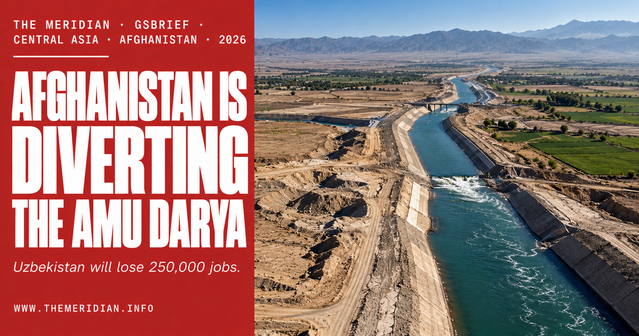
The Qosh Tepa Canal diverts up to 25 percent of the Amu Darya's annual flow. Afghanistan is not party to any binding regional water treaty. Western media calls it an infrastructure achievement or an environmental concern. The agrarian data calls it something else.
In 2022, the Taliban administration began digging. The Qosh Tepa Canal stretches 285 kilometres across northern Afghanistan -- from the Amu Darya in Balkh Province through Jowzjan and into Faryab. It is 100 metres wide and 8.5 metres deep. More than 200 kilometres have been excavated. The Taliban government calls it the most important infrastructure project in Afghan history. When complete, it will irrigate 550,000 hectares of land that is currently desert, delivering water security and agricultural employment to a country that has known neither for decades.
Western coverage has framed this as either an achievement or an environmental concern. Both framings are accurate. Both miss the central story. The Qosh Tepa Canal is, first and most consequentially, an employment crisis for Uzbekistan that has not yet happened but is now structurally certain.
The German Economic Team -- an advisory group operating under mandate from the German Ministry of Economic Cooperation -- has quantified the downstream impact with precision. At full operational capacity, the Qosh Tepa Canal will divert between 20 and 25 percent of the Amu Darya's annual flow. Combined with the effects of climate change on glacial melt that feeds the river, total water availability in the Amu Darya basin is projected to decline by 7.4 percent by 2025, 18.9 percent by 2028, and 29.4 percent by 2030. Under a 25 percent diversion scenario, employment in crop production in Uzbekistan falls by 27.6 percent. That reduction equals approximately 250,000 jobs.
Agriculture accounts for 25 percent of Uzbekistan's GDP and 27 percent of its total employment. Ninety percent of all water consumption in Uzbekistan occurs in the agricultural sector. The Amu Darya is the primary water source for five of Uzbekistan's regions: Surkhandarya, Kashkadarya, Bukhara, Khorezm, and Karakalpakstan. The canal does not threaten Uzbekistan's water supply abstractly. It threatens the specific economic foundation on which Uzbekistan's rural population depends.
The political architecture surrounding this dispute is as consequential as the hydraulic one. In 1992, the five newly independent Central Asian republics -- Kazakhstan, Kyrgyzstan, Tajikistan, Turkmenistan, and Uzbekistan -- signed the Almaty Agreement, which codified Soviet-era water allocation quotas for the Amu Darya basin. The Soviet-era protocol had assumed Afghanistan would divert 2.1 billion cubic metres of Amu Darya water annually. The Qosh Tepa Canal alone could divert up to 10 billion. Afghanistan was not a party to the Almaty Agreement. It has not signed the 1992 UN Convention on the Protection and Use of Transboundary Watercourses. No binding multilateral framework governing the Amu Darya currently includes Afghanistan.
There is no international mechanism with the legal standing to compel a resolution. Uzbekistan and Afghanistan signed a bilateral joint management agreement in the spring of 2025, and Tashkent has moderated its public rhetoric since. The Uzbek Minister for Water Resources stated that Afghanistan too has the right to draw water from the Amu Darya. These are the diplomatic gestures available when the legal instruments do not exist. A bilateral agreement between two states does not constitute a basin-wide governance framework. Turkmenistan, which could face a reduction of up to 80 percent in its Amu Darya water share, is not party to that bilateral arrangement.
The Soviet-era protocol assumed Afghanistan would use 2.1 billion cubic metres of Amu Darya water per year. The Qosh Tepa Canal could divert up to 10 billion. The agreement was never updated. Afghanistan was never included.
Two hundred and fifty thousand lost jobs in crop production is a labour market statistic. On the ground in Karakalpakstan -- the autonomous republic at the lower end of the Amu Darya basin, already devastated by the Soviet-era destruction of the Aral Sea -- it is a social collapse that has already begun once before and is now being prepared again by a different upstream decision made without consultation. The Aral Sea, once one of the world's four largest lakes, has been reduced to a fraction of its 1960s extent by Soviet-era irrigation diversions. The communities on its former shores are among the poorest in Central Asia. The Qosh Tepa Canal is not a new event in a stable system. It is a new pressure on a system already in managed decline.
For Uzbekistan's agricultural regions, the consequence is not abstract. When water availability falls by 29 percent by 2030, the crops that are not planted, the irrigation channels that run dry, and the rural employment that disappears do not disappear into a GDP aggregate. They disappear from the household incomes of farmers in Khorezm and the cotton fields of Surkhandarya. The GDP impact the German Economic Team estimates at 0.7 percent is an economy-wide dilution of a pain that is geographically and occupationally concentrated.
Afghanistan's position is not without foundation. The country has one of the lowest rates of per capita water use in the region despite originating or bordering many of the river systems Central Asian states depend on. Afghan officials note that the canal's actual intake, even at full capacity, will represent no more than 12 percent of the Amu Darya's total flow during high-water periods, far below the worst-case projections. Afghanistan's food insecurity is acute. The canal is the largest domestic investment the Taliban administration has undertaken. For a government with almost no international legitimacy, delivering visible agricultural development to its northern provinces is a political and economic imperative that exists entirely outside the framework of Central Asian water diplomacy.
The engineering concerns are real and may constrain the canal's impact. Without concrete-lined walls, the Qosh Tepa Canal loses significant volumes of water to absorption in the sandy soil. In December 2023, a section of the canal wall collapsed, sending floodwater across more than 30 square kilometres of surrounding land. A canal that loses large volumes to seepage before it reaches its intended fields diverts less from the downstream countries than a fully efficient system would.
The Qosh Tepa Canal will be operational. The question is not whether Afghanistan will divert water from the Amu Darya. It is whether the diversion will be governed by a framework that acknowledges the downstream states' dependence on that water, or whether it will simply proceed as a unilateral act in a legal void -- legitimate under no treaty, constrained by no institution, and accountable to no regional body in which all affected parties hold standing.
The public article identifies the problem. The intelligence product maps it. GSBrief and The Meridian Economic Intelligence produce commissioned research for organisations operating in or studying Central Asia.
On the Qosh Tepa Canal specifically, we can produce deeper work covering the hydrology data by province, the economic modelling for each affected Uzbek region, Turkmenistan's exposure in detail, the full treaty landscape, the institutional options for basin governance, and the political economy of the Taliban's infrastructure programme.
We cover Central Asia, Africa, Europe, and the United States across political economy, water and resource security, trade, and investment intelligence. If the questions this article raises are material to your organisation's decisions, we go further.
Contact us: editor@themeridian.info
The Qosh Tepa Canal is described as a climate or environmental concern in most Western coverage. It is both of those things. It is more precisely a political economy crisis with a countdown attached. The canal will reach operational capacity around 2028. The institutional framework capable of managing its impact does not exist. The gap between those two facts is the crisis.
Uzbekistan and Afghanistan have a bilateral agreement signed in 2025. Turkmenistan has a problem and no agreement. The Almaty Agreement has a legal architecture with a missing party. The UN water conventions have signatories with no enforcement mechanism against a state that did not sign. The Aral Sea is the previous chapter of this story. It ended with a sea that no longer exists.
The question the water data does not answer is institutional: what body, with what authority, and on what legal basis, can manage the Amu Darya as a shared resource when one of its primary users has not joined any of the frameworks designed to govern it? That question will determine whether this is a difficult negotiation or a slow catastrophe.
The Qosh Tepa Canal is a 285-kilometre irrigation canal being constructed in northern Afghanistan by the Taliban administration. Construction began in 2022 and completion is expected by 2028. The canal draws water from the Amu Darya River in Balkh Province and passes through Jowzjan and Faryab provinces. At full capacity it is designed to irrigate 550,000 hectares of currently arid land, significantly expanding Afghanistan's agricultural capacity in the north.
At full operational capacity, the Qosh Tepa Canal is expected to divert between 6 and 10 cubic kilometres of water per year from the Amu Darya -- representing approximately 20 to 25 percent of the river's annual average flow. Afghan officials argue the figure will be closer to 12 percent during high-water periods. The German Economic Team's modelling uses a 25 percent diversion scenario as the basis for its impact projections.
Agriculture accounts for 25 percent of Uzbekistan's GDP and 27 percent of its total employment, with 90 percent of the country's water consumption directed to the agricultural sector. The Amu Darya is the primary water source for five Uzbek regions. The German Economic Team estimates that a 25 percent diversion of the Amu Darya's flow, combined with climate-related reductions in glacial melt, will reduce total basin water availability by 29.4 percent by 2030, cutting crop production employment by 27.6 percent -- equivalent to approximately 250,000 jobs.
No binding international treaty currently obliges Afghanistan to limit its use of the Amu Darya. The 1992 Almaty Agreement, which established water allocation quotas among the five Central Asian republics, was not signed by Afghanistan. Afghanistan has also not signed the 1992 UN Convention on the Protection and Use of Transboundary Watercourses. The only existing bilateral framework is a joint water management agreement signed between Uzbekistan and Afghanistan in spring 2025, which is non-binding and does not include Turkmenistan.
Turkmenistan faces a potentially more severe impact than Uzbekistan. Agriculture accounts for 10 percent of Turkmenistan's GDP and the country depends heavily on the Amu Darya for irrigation water. Estimates suggest Turkmenistan could face a reduction of up to 80 percent in its Amu Darya water share under worst-case diversion scenarios. Turkmenistan is not party to the bilateral Uzbekistan-Afghanistan joint management agreement, leaving it without any formal framework to address the diversion's impact on its water supply.
Add comment
Comments