Kazakhstan Is Spending 5.3 Trillion Tenge to Reform Its Sovereign Wealth Fund. The Money Stays Inside the State.
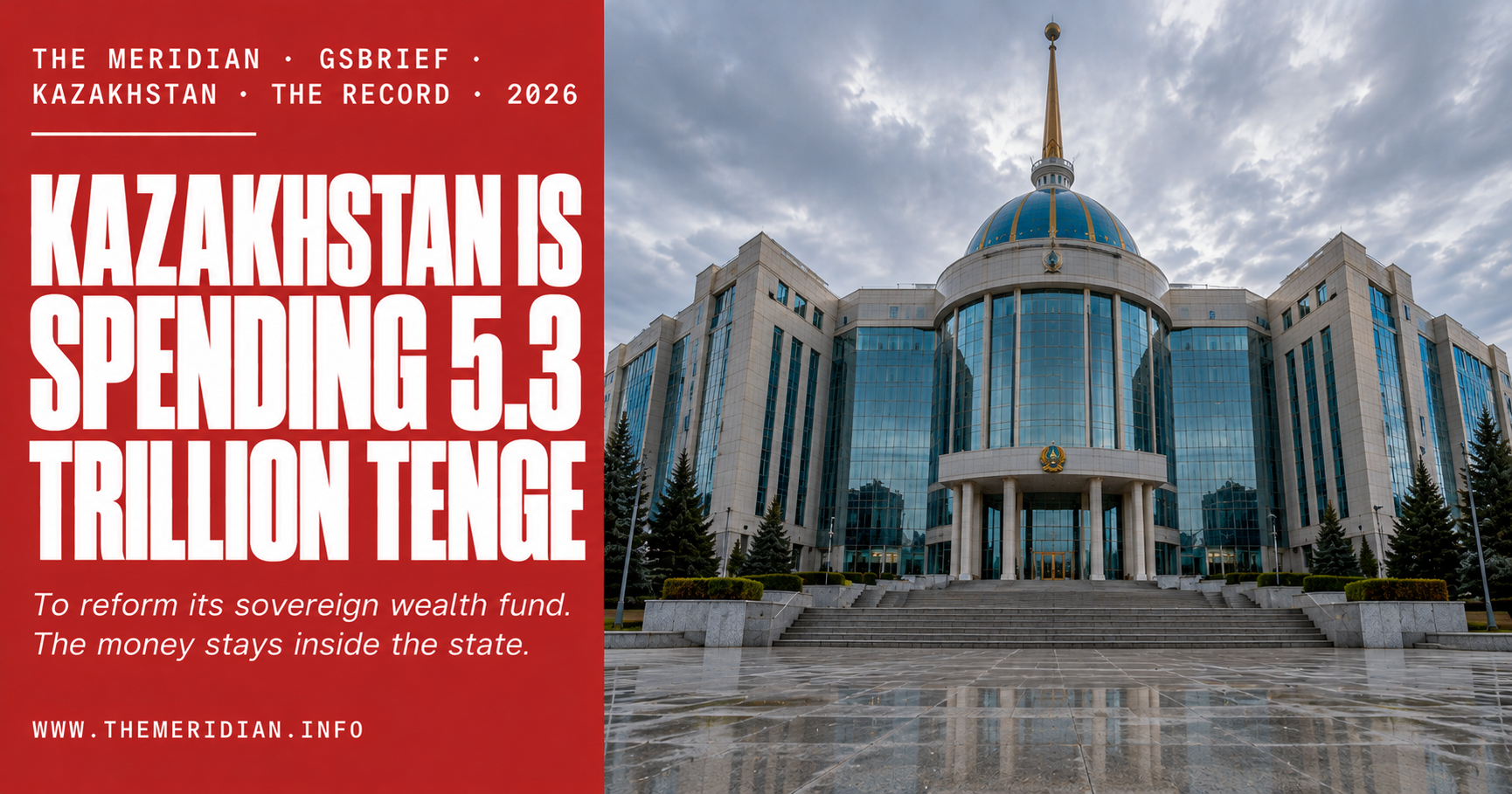
Kazakhstan announced Samruk-Kazyna would be reformed after the January 2022 protests. GSBrief reads the budget lines, the ownership records, and the procurement structure. The documents suggest a different word for what is happening.
In January 2022, Kazakhstan experienced the most violent civil unrest in its post-Soviet history. At least 238 people were killed. The immediate trigger was a surge in liquefied petroleum gas prices -- a cost that bore most heavily on households in the western regions. The protests moved quickly beyond fuel prices to something larger: three decades of concentrated wealth, opaque state enterprises, and an economy organised primarily for the benefit of a small number of families. Political analyst Sergei Duvanov put it directly to Eurasianet at the time: "The gas crisis that caused the mass protests is essentially the result of the mismanagement at Samruk-Kazyna."
President Kassym-Jomart Tokayev announced on January 21, 2022, that Samruk-Kazyna would be fundamentally reformed. Four years and nine months later, Samruk-Kazyna's assets under management stand at $88 billion -- up 9 percent from the previous year. The state owns more, not less.
The Samruk-Kazyna Annual Report 2025 and the Prime Minister's board meeting records are the primary documents. They show a fund that is financially robust, structurally expanding, and investing at a scale that has no modern precedent in Kazakhstan's history. Revenue reached 19.1 trillion tenge in 2025. EBITDA came in at 5.4 trillion tenge. Total assets at year-end were 44.243 trillion tenge, up 7.6 percent year-on-year. For 2026, planned investment expenditure is set at 5.3 trillion tenge -- more than double the 2.7 trillion deployed in 2025, and more than two and a half times the approximately 2 trillion of 2024.
These are not the financial indicators of an institution being wound down, privatised, or meaningfully opened to market competition. They are the indicators of an institution scaling up. The question the annual report does not address is who benefits from that scale.
The procurement data is where the reform narrative meets its most direct challenge. In 2025, Samruk-Kazyna and its group companies concluded total procurement contracts worth 3,997 billion tenge. Of that total, 2,481 billion tenge -- 62 percent of all procurement -- was awarded through single-source tender. Single-source procurement means no competitive process. A supplier is selected directly, without open bidding. In a fund that controls Kazakhstan's oil and gas, railways, electricity generation, nuclear fuel production, and telecommunications, awarding 62 percent of procurement without competition is not a marginal governance detail. It is the structural mechanism through which value circulates within the state sphere rather than entering the competitive private market.
The fund's own annual report highlights that procurement from domestic producers nearly doubled in 2025, reaching 2.2 trillion tenge across approximately 9,000 contracts. This is presented as evidence of reform -- and in a narrow sense it is: more money is reaching Kazakhstani companies rather than foreign suppliers. But domestic producer and private sector entrepreneur are not synonymous categories in an economy where the state owns the dominant enterprises in every critical sector. Capital cycling between state enterprises and state-affiliated suppliers is not the same as capital entering the open market.
Sixty-two percent of Samruk-Kazyna's procurement was awarded without competitive tender in 2025. The fund calls this domestic producer support. A different word for it is capture.
Kazakhstan has operated three successive comprehensive privatisation plans since 2014. Each has produced a list of assets to be transferred to competitive markets. Each has underdelivered on its flagship commitments. The current record on the largest assets is instructive. Kazakhstan Temir Zholy -- the national railway, one of Samruk-Kazyna's most significant holdings and a critical piece of the Middle Corridor infrastructure -- has had an IPO announced and deferred multiple times. As recently as July 2025, the Prime Minister told parliament a KTZ IPO would occur by year-end. The National Office for Privatisation said in March 2025 that KTZ was not yet ready. QazaqGaz, the national gas company, has been moved to a 2026-2027 IPO window. QazaqAir, a smaller airline asset, was privatised in 2025 -- with Samruk-Kazyna retaining 49 percent.
The pattern across privatisation cycles is consistent: small and non-strategic assets move; the large, revenue-generating, monopoly-position assets remain. The subsidiary count has been reduced from approximately 600 to approximately 300, which is genuine rationalisation. But rationalisation of a portfolio is not the same as reduction of state dominance in the economy when the largest and most economically consequential assets remain untouched.
Following the January 2022 protests, Tokayev launched an asset recovery campaign targeting individuals and families who had accumulated wealth through proximity to the Nazarbayev administration. The Organised Crime and Corruption Reporting Project documented the process in 2022: "all decisions related to anti-corruption, de-monopolization, or asset recovery are made at the top, in complete dependence on Tokayev's political will." More precisely, the assets recovered from Nazarbayev-era beneficiaries did not flow to competitive markets or to public trusts with independent governance. They returned to state control -- in most cases, to the same institutional architecture that had allowed their concentration in private hands in the first place.
This is the structural distinction that the reform narrative obscures. Moving assets from one set of private beneficiaries back to the state holding company is not democratisation of economic access. It is repatriation of rents to a different principal. The mechanism of concentration -- the sovereign wealth fund with monopoly positions across all critical sectors, procuring 62 percent of its contracts without competitive tender -- remains structurally identical.
The Tokayev administration's reform record is not without genuine content. The subsidiary reduction from 600 to 300 entities represents real rationalisation. The doubling of domestic procurement to 2.2 trillion tenge in 2025 directs purchasing power toward Kazakhstani suppliers at a scale that was not achieved under the previous administration. Constitutional reforms were passed. The political infrastructure around Nazarbayev's personal authority was dismantled. These are not cosmetic changes.
The investment case for the 5.3 trillion tenge programme is also defensible on its own terms. Kazakhstan's infrastructure deficit is real. The Trans-Kazakhstan railway corridor, energy generation capacity, and digital infrastructure all require capital at a scale that the private sector cannot currently mobilise domestically. Sovereign capital filling infrastructure gaps is a legitimate function of a development-stage state enterprise in a landlocked economy with limited private capital markets.
What the documents do not resolve is the sequence. Reform, if it is genuine, reduces the state's dominant position over time as private capacity develops. The Samruk-Kazyna indicators for 2025 and 2026 -- $88 billion in assets, 5.3 trillion tenge in planned investment, 62 percent single-source procurement -- describe an institution expanding its footprint, not contracting it. The privatisation programme, running now through its third cycle, continues to defer the assets that would actually change the structure of the economy.
The public article frames the question. The intelligence product answers it for your specific context. GSBrief and The Meridian Economic Intelligence produce commissioned research for organisations that need to understand what Kazakhstan's state enterprise architecture means for investment, supply chains, market entry, or institutional engagement.
On Samruk-Kazyna specifically, we can map the full subsidiary ownership structure, the procurement flows by sector, the privatisation timeline by asset, the political economy of the Tokayev reform programme, and the exposure of specific industries to state competition or state dependency.
We cover Central Asia, Africa, Europe, and the United States. If questions this article raises are material to decisions your organisation is making, we go deeper.
Contact us: editor@themeridian.info
GSBrief does not question that Samruk-Kazyna has changed since January 2022. Personnel changed. Some assets moved. The subsidiary count fell by half. The procurement from domestic producers rose. These are real data points and they belong in any honest account of the Tokayev period.
What the documents do not show is a reduction in the state's economic dominance. Assets under management grew from an estimated $69 billion at the time of the protests to $88 billion today. Investment expenditure for 2026 is set at 5.3 trillion tenge -- the largest single-year commitment in the fund's history. Sixty-two percent of procurement goes through single-source tender. The flagship privatisation assets remain in state hands through their third postponement cycle.
The distinction between reform and consolidation is not ideological. It is empirical. Reform reduces state dominance over time. The indicators point in the other direction. GSBrief will read the next annual report when it is published and report what it says.
Samruk-Kazyna is Kazakhstan's sovereign wealth fund and the country's largest holding company. It manages strategic assets across oil and gas, railways, energy generation, nuclear fuel production, telecommunications, and aviation. As of 2025, its assets under management stood at $88 billion, with total balance sheet assets of 44.243 trillion tenge. Its portfolio companies account for significant shares of Kazakhstan's GDP and employ hundreds of thousands of people directly and indirectly.
The January 2022 protests -- known as Bloody January or Qandy Qantar -- were triggered by a surge in liquefied petroleum gas prices and escalated into broader unrest against economic inequality and the concentration of wealth accumulated under former President Nursultan Nazarbayev. At least 238 people were killed. Samruk-Kazyna was identified as central to Kazakhstan's economic mismanagement; the gas price crisis was attributed directly to its operations. President Tokayev announced fundamental reform of the fund on January 21, 2022, alongside a broader asset recovery campaign targeting Nazarbayev-era beneficiaries.
Single-source procurement means awarding a contract directly to a supplier without a competitive bidding process. In 2025, 62 percent of all Samruk-Kazyna procurement -- amounting to 2,481 billion tenge -- was awarded through single-source tender. This matters because competitive procurement is the mechanism through which state spending enters the open market and supports private sector development. When the majority of procurement bypasses competition, capital tends to circulate within existing state-affiliated networks rather than broadening access to the wider economy.
Kazakhstan has run three consecutive comprehensive privatisation plans since 2014, each committing to transfer major state assets to competitive markets. The results on flagship assets have been consistently delayed. Kazakhstan Temir Zholy (the national railway) has had an IPO announced and postponed multiple times, most recently in 2025. QazaqGaz (national gas company) has been pushed to a 2026-2027 window. Smaller assets have been sold, and the subsidiary count has been reduced from approximately 600 to approximately 300, but the large revenue-generating monopoly assets that would most change the economy's structure remain in state hands.
Samruk-Kazyna's planned investment expenditure of 5.3 trillion tenge for 2026 is the largest single-year commitment in the fund's history -- more than double the 2.7 trillion deployed in 2025 and more than two and a half times the approximately 2 trillion of 2024. This capital flows primarily into energy, transport, and digital infrastructure. Given that 62 percent of the fund's procurement goes through single-source tender, the majority of this investment will be allocated without competitive bidding, meaning the primary beneficiaries will be determined by the fund's internal selection processes rather than open market competition.
Add comment
Comments