Africa Digs the Minerals. The World Sells the Products Back. The Gap Is Where the Wealth Disappears.
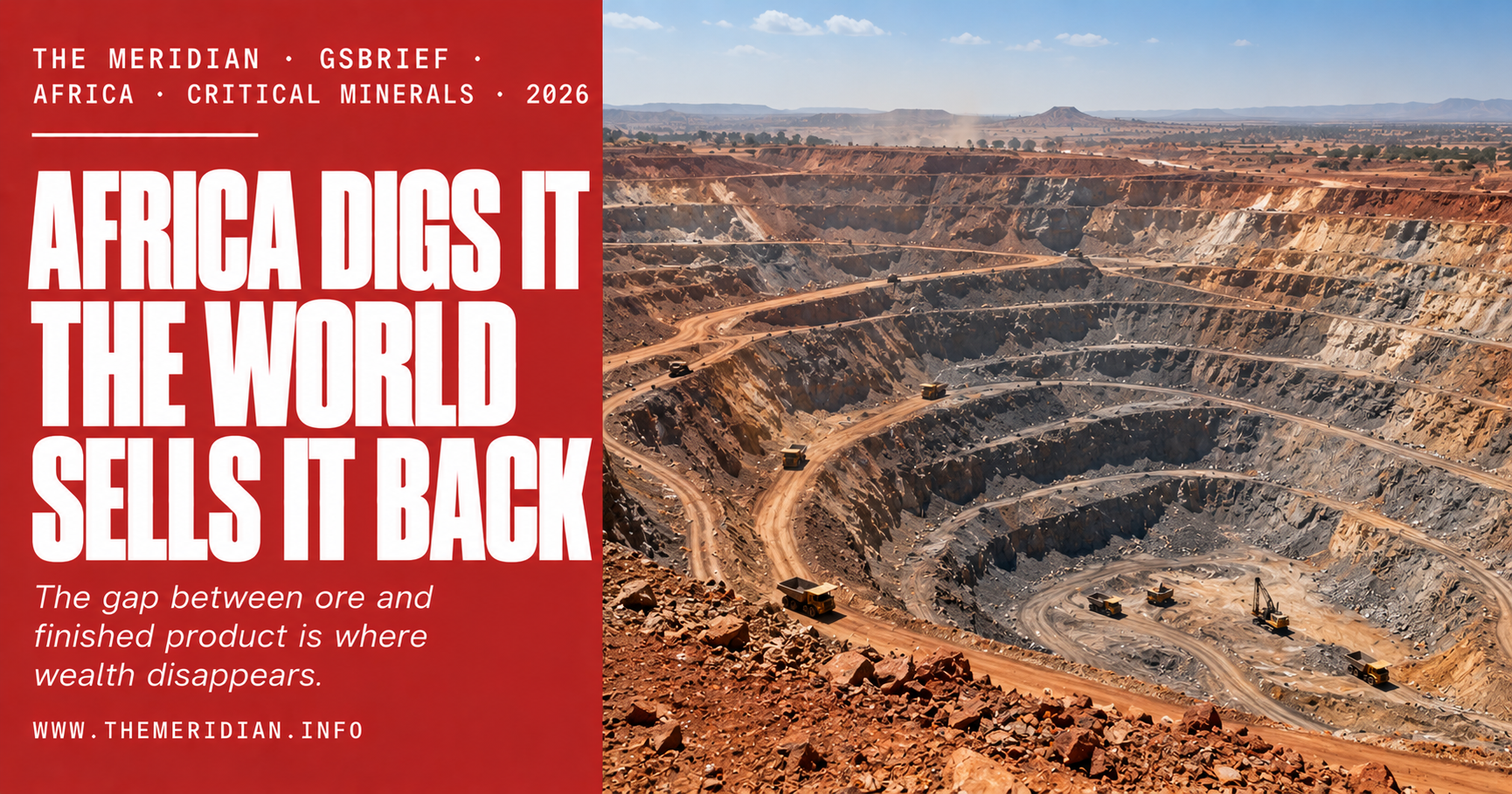
Africa produces more than 70 percent of the world's cobalt and holds approximately 30 percent of global critical mineral reserves. It receives 10 percent of global mineral revenues. No African country manufactures a battery on commercial scale. GSBrief applies the Corridor Test to a continent.
The Democratic Republic of the Congo produced approximately 230,000 tonnes of cobalt in 2025, accounting for roughly 70 to 72 percent of global supply. That cobalt is essential to the lithium-ion batteries that power electric vehicles, smartphones, laptops, and grid storage systems. The global market for those batteries and the products they power runs into the hundreds of billions of dollars per year. The DRC's share of that market, at the point where it contributes, is the value of the ore leaving the mine. Everything that happens after the ore crosses the border -- the refining, the processing, the cell manufacturing, the pack assembly, the vehicle -- happens elsewhere.
The African continent holds approximately 30 percent of the world's known critical mineral reserves. According to Brookings and African Union data, it receives approximately 10 percent of global revenues from those minerals. The gap between those two numbers is not a market failure. It is a structural condition with identifiable causes, identifiable beneficiaries, and identifiable consequences for the countries where the minerals are dug.
Africa's position in the critical mineral supply chain is defined by what it does not do as much as what it does. South Africa holds approximately 38 percent of global manganese reserves and produces roughly 36 percent of global manganese output, making it the world's largest manganese producer. It exports more than 80 percent of that manganese ore for beneficiation abroad, according to trade and policy research. The DRC's cobalt, extracted primarily as a by-product of copper mining, leaves the country mainly as cobalt hydroxide precipitate -- an intermediate product that is then shipped to Chinese refineries for conversion into battery-grade cobalt sulphate and other compounds. Zimbabwe, now Africa's largest lithium producer, has banned unprocessed lithium exports, but the processing investment that followed is almost entirely Chinese-financed and largely destined for Chinese supply chains.
The International Energy Agency's Global Critical Minerals Outlook 2026 confirmed what market participants have known for years: China controls approximately 72 percent of processing capacity across key energy minerals globally. On specific minerals, China's dominance is more precise: 65 percent of cobalt refining, 58 percent of lithium refining, 35 percent of nickel processing, and 40 percent of copper processing. No African country holds a meaningful share of any of these figures.
The African Union has attempted to quantify what the processing gap costs. Its estimates -- cited across regional analysis and confirmed in the November 2025 data -- describe three scenarios. If Africa continues exporting raw minerals at current rates, the annual revenue from those exports is approximately $11 billion. If African countries moved to precursor production -- converting raw ore into the intermediate chemical compounds that feed battery cell manufacturing -- the value of that output would be approximately $271 billion. If Africa built full battery assembly capacity, processing its minerals all the way through to finished battery cells, the potential value would be approximately $1.1 trillion.
One point one trillion dollars is not a forecast. It is an illustration of the distance between where Africa sits in the value chain and where the value is captured. The cobalt in a battery in an electric vehicle sold in Stuttgart or Shanghai was likely dug in the DRC. The value of that battery is priced in the vehicle, not in the ore. Africa participates in the first transaction. It is a consumer in all the subsequent ones.
Africa holds 30 percent of the world's critical mineral reserves and receives 10 percent of global mineral revenues. The gap between those two numbers is not a market imperfection. It is the structure of the market.
The gap is not structural in the sense of being immovable. It is structural in the sense of having specific causes. The IEA estimates that building refining and processing capacity outside established hubs -- meaning primarily China -- costs between 20 and more than 150 percent more in capital terms, with operating costs running approximately 50 percent higher. The reasons are identifiable: reliable industrial-scale electricity, affordable chemical inputs, transport infrastructure, skilled technical labour, and the accumulated expertise of decades of processing at scale. These are not geological facts. They are the product of investment decisions made over decades, most of them made outside Africa.
The investment that is now moving into African mineral processing is largely Chinese. Benchmark Mineral Intelligence estimates that 90 percent of Africa's planned lithium supply through 2030 is destined for Chinese supply chains. Chinese companies own significant shares of the DRC's largest cobalt and copper operations, including the Tenke Fungurume and Kisanfu mines operated by China Molybdenum. The processing investment responding to African export bans -- in Zimbabwe, in Nigeria, in Namibia -- is principally Chinese capital building Chinese supply chain infrastructure on African soil. The ore stays slightly longer on the continent before leaving. The value capture question is more complicated.
African governments are not passive in this arrangement. The DRC banned cobalt exports entirely in February 2025 to address oversupply and price collapse, then replaced the ban with a rigid quota system of 96,600 tonnes for 2026. Zimbabwe banned unprocessed lithium exports. Namibia restricted raw mineral exports across battery metals categories. The AfCFTA and the proposed Zambia-DRC Battery Corridor represent regional attempts to build supply chain integration that keeps more value within Africa. A 2024 study by the UK's Manufacturing Africa programme found that Africa could refine critical minerals at costs 29 to 40 percent below the global average -- the cost disadvantage is real but not insurmountable.
The IEA's own modelling suggests that if sub-Saharan Africa builds downstream processing capacity, it could capture 12 percent of global mineral revenues and grow its GDP by 12 percent. The direction of policy in the most mineral-rich African states is clearly toward more domestic processing. The pace and the ownership structure of that processing remain the contested questions.
The gap between Africa's 30 percent share of global mineral reserves and its 10 percent share of mineral revenues is the operating condition. The distance between $11 billion in raw exports and $1.1 trillion in potential battery value is the opportunity cost. The structural question is not whether African countries can close the gap -- the cost data suggests they can do so competitively -- but whether the investment flows, the ownership structures, the power infrastructure, and the policy frameworks that are now being assembled will allow African governments and African workers to capture the value when processing eventually moves to the continent.
The public article maps the gap. The intelligence product closes it for specific decisions. GSBrief and The Meridian Economic Intelligence produce commissioned research for organisations operating across Africa's mineral supply chains.
We can assess specific country and mineral exposure in detail, model the processing investment requirements by sector, analyse ownership structures and offtake agreements, track the policy and regulatory landscape for export restrictions, and evaluate the investment case for specific downstream processing opportunities.
We cover Africa's mineral economy, trade, regulation, and political economy with country-specific depth across the DRC, South Africa, Zambia, Zimbabwe, Namibia, Morocco, and beyond.
Contact us: editor@themeridian.info
The energy transition is the largest structural shift in global industrial demand since electrification. It runs on cobalt, lithium, manganese, copper, graphite, and nickel. Africa has large or dominant shares of all of them. The transition will create enormous industrial value as raw materials move through processing, cell manufacturing, and battery assembly. Africa's current position is to supply the raw material and purchase the finished product.
The export bans in Zimbabwe and the DRC, the quota systems, the AfCFTA mineral protocols -- these are attempts to change that position. They will produce results in some places. The structural question is whether the pace is fast enough, and whether the investment that responds to African policy demands is arriving on terms that actually allow African economies to build the industrial base that battery processing requires.
The Corridor Test asks whether infrastructure moves value through a place or causes it to remain. Africa's mineral infrastructure currently moves value through the continent toward processing centres elsewhere. The test will be whether the next wave of investment changes the direction of that flow or simply extends the corridor.
The Democratic Republic of the Congo alone produced approximately 230,000 tonnes of cobalt in 2025, representing roughly 70 to 72 percent of global supply according to USGS and mining industry data. Including other African producers such as Zambia and Madagascar, the African continent accounts for approximately 75 to 76 percent of global cobalt mine production. Despite this dominance, China controls approximately 65 percent of global cobalt refining capacity, meaning the valuable processing stages largely occur outside Africa.
The processing gap refers to the difference between the value of minerals when they leave Africa as raw ore and the value of the finished products manufactured from those minerals. Africa holds approximately 30 percent of global critical mineral reserves but receives only around 10 percent of global mineral revenues. The African Union estimates that Africa's raw mineral exports generate approximately $11 billion annually, while moving to precursor chemical production would generate $271 billion and full battery assembly would generate $1.1 trillion. The gap persists because refining and manufacturing capacity is concentrated outside Africa, primarily in China.
China has built dominant processing capacity over decades through sustained investment in refining infrastructure, chemical production, skilled technical labour, and supply chain integration. The IEA estimates that building refining capacity outside established hubs costs 20 to over 150 percent more in capital terms, with operating costs approximately 50 percent higher. China also controls significant shares of the actual mining operations in Africa, with Chinese companies owning major DRC cobalt and copper assets. Benchmark Mineral Intelligence estimates 90 percent of Africa's planned lithium supply through 2030 is destined for Chinese supply chains.
Several African governments have implemented export restrictions designed to force processing investment onshore. Zimbabwe banned unprocessed lithium exports. Namibia restricted raw exports of battery metals including lithium, cobalt, manganese, and graphite. The DRC imposed a cobalt export ban in February 2025, replaced by a strict annual quota system of 96,600 tonnes for 2026 and 2027. At the regional level, the AfCFTA mineral protocols and the proposed Zambia-DRC Battery Corridor are attempting to build integrated regional supply chains. A 2024 Manufacturing Africa study found Africa can process minerals at costs 29 to 40 percent below the global average, suggesting the economic case is viable if investment and infrastructure follow.
No African country currently manufactures lithium-ion batteries on a commercial scale. Africa's role in the battery supply chain is confined almost entirely to mining raw materials. Processing investment is beginning to arrive in several countries, but this predominantly involves converting raw ore into intermediates such as cobalt hydroxide or lithium carbonate concentrate -- not cell or pack manufacturing. BloombergNEF data confirms that China dominates all downstream stages: approximately 80 percent of global battery mineral refining, 77 percent of cell production, and 60 percent of components manufacturing.
Add comment
Comments