The Fed Raises Rates to Fight American Inflation. Nairobi, Lusaka and Karachi Pay the Bill.
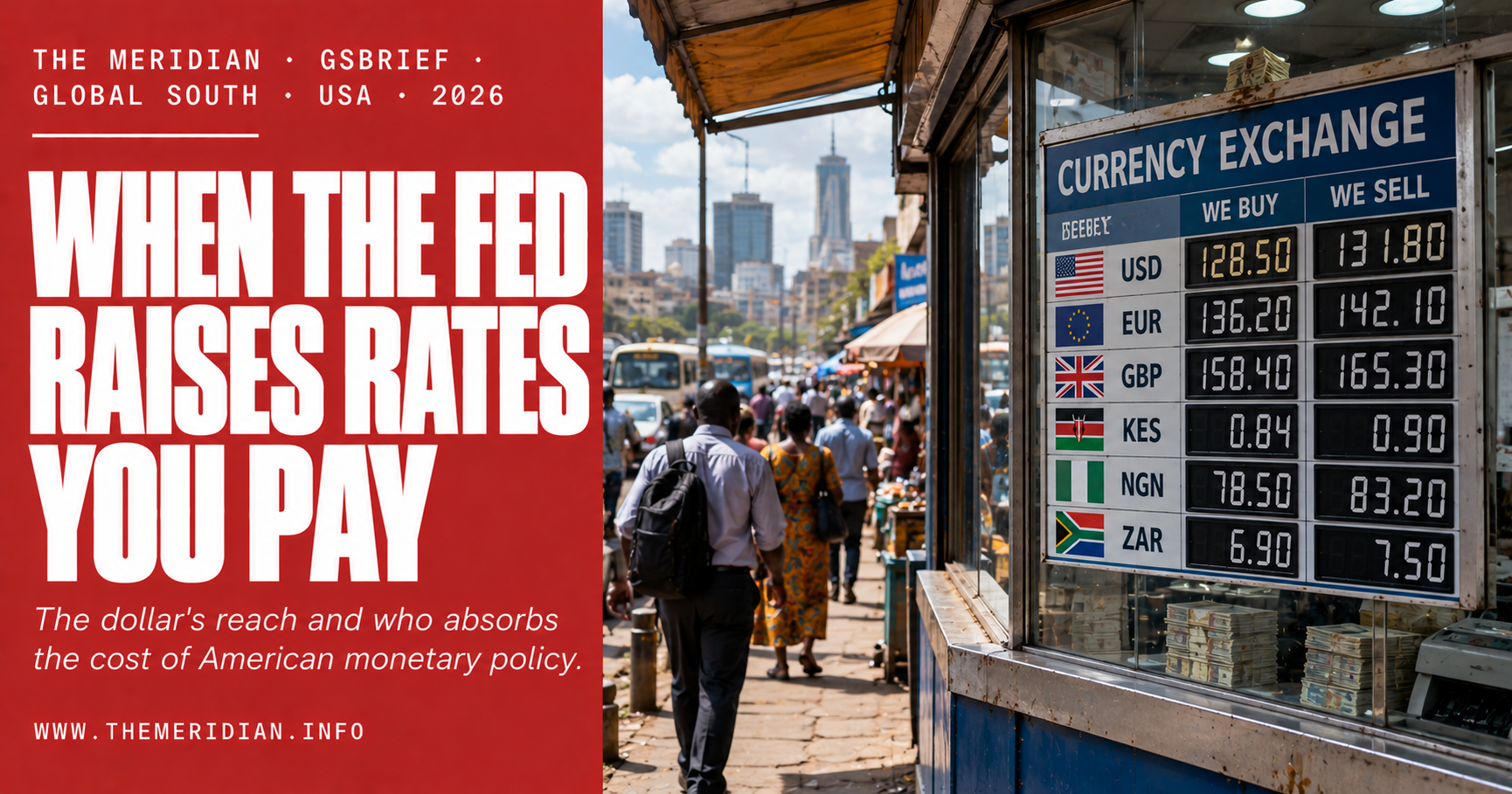
When the Federal Reserve raises interest rates, it does so to manage inflation inside the United States. The mechanism works as described within American borders. Outside them it operates differently, and the cost is borne by countries that were not responsible for the inflation the Fed was fighting.
On September 16, 2026, the Federal Open Market Committee voted unanimously to raise the federal funds target range by 25 basis points to 3.75 to 4.00 percent. It was the first rate increase since July 2023, a limited recalibration, in the Fed's own framing, rather than the start of a new full hiking cycle. The stated rationale was straightforward: a timelier return to the 2 percent inflation target in conditions of continued labour market strength. The decision was about the American economy. The consequences are not confined to it.
Between March 2022 and July 2023, the Federal Reserve raised rates eleven times, a total increase of 525 basis points to a peak of 5.25 to 5.50 percent, the highest level since 2001. The stated purpose was identical: managing American inflation. In 2023, developing countries paid a record $1.4 trillion in external debt service, including $406 billion in interest payments alone. The inflation was American. The austerity was global.
The sequence is documented and consistent. When the Federal Reserve raises rates, dollar-denominated assets become more attractive to global investors seeking yield. Capital flows toward the United States. Emerging market and developing economy currencies depreciate against the dollar. Import costs rise in local currency terms. Domestic inflation increases in countries that were not generating it. Central banks in Nairobi, Lusaka, Karachi, and Tashkent face a decision: raise their own rates to defend the currency and control imported inflation, or allow depreciation to continue and risk the consequences for import-dependent populations.
Either path has costs. Raising rates to defend the currency tightens domestic credit in economies where commercial lending is already constrained. Allowing depreciation raises the real burden of dollar-denominated debt, which constitutes between 60 and 85 percent of external public debt in most low-income countries according to UNCTAD data. The BIS reports that emerging markets hold nearly $30 trillion in total debt, approximately 28 percent of the global bond market. The dollar's role as the dominant denomination of that debt means that a decision made in Washington has a direct mechanical impact on the fiscal space of governments that had no voice in making it.
Debt Service
Among the 45 countries that were eligible for the G20's Debt Service Suspension Initiative, the world's poorest nations, the dollar's appreciation during the Fed hiking cycle averaged 22.5 percent against their currencies. That appreciation increased their collective debt burden in domestic-currency terms by more than $34 billion. The DSSI itself had suspended $12.9 billion in debt service across 2020 and 2021 to provide fiscal relief during the pandemic. The Fed hiking cycle erased that relief more than twice over, through the currency channel alone, without any policy decision from those governments and without any consultation with them.
Zambia illustrates the specific arithmetic. Zambia defaulted on its external debt in 2020 and entered the G20's Common Framework for Debt Treatments. It received approximately $700 million in temporary DSSI relief. The depreciation of the kwacha against the dollar during the subsequent Fed hiking cycle increased its debt burden by $1.7 billion, more than double the relief it had received. Kenya's central bank governor Patrick Njoroge called Federal Reserve Chair Jerome Powell directly to request that the Fed give greater consideration to the impact of its policies on developing nations. The request was noted. The hiking cycle continued.
In 2022, 26 countries with a combined population of 1.3 billion people paid more in debt service than they received in new financing. The inflation driving those payments was not theirs.
$406 billion in interest payments by developing countries in 2023 is not an abstract financial statistic. It is the diversion of fiscal capacity from public services to creditors. Every dollar service payment made in Lusaka, Islamabad, or Accra in 2023 is a dollar that did not fund a school, a hospital, a road, or a subsidy on essential food. The World Bank President warned at the time that approximately 60 percent of lower-income countries were at high risk of debt distress from the combination of higher rates and high levels of dollar-denominated debt. That warning was not a prediction of a distant risk. It was a description of conditions already in progress.
The mechanism by which this happens is not mysterious. Governments collect their revenues in local currency. They service most of their external debt in dollars. When the dollar strengthens, the local currency cost of those payments rises proportionally, without any change in the nominal dollar value of the debt, without any new borrowing, and without any act of mismanagement by the debtor government. The exchange rate does the damage automatically.
The Federal Reserve's mandate is domestic. It is required by law to pursue maximum employment and stable prices within the United States. It is not designed, empowered, or instructed to consider the spillover effects of its decisions on countries that use the dollar as a reserve currency and debt denomination without having any influence over its supply or price. This is not a cynical observation. It is the institutional design of the system as it currently exists.
Research from the Dallas Fed also notes that the 2022-2023 hiking cycle produced fewer destabilising currency crises than previous episodes of comparable Fed tightening, because many larger emerging markets had reduced their dollar debt exposure, built larger reserves, and actually began hiking their own rates before the Fed did, demonstrating that the vulnerability is not uniform and can be mitigated with the right policy preparation. Some economies with remittance inflows also benefited from the stronger dollar through increased domestic purchasing power of those transfers.
On September 16, 2026, the Federal Reserve raised rates again. The transmission mechanism that cost developing countries $1.4 trillion in debt service in 2023 has reactivated, at a smaller scale for now, but with the same structural logic. Dollar-denominated debt becomes more expensive in local currency terms. Central banks in the Global South face the same choice they faced in 2022: defend the currency and tighten domestic credit, or absorb depreciation and watch the real debt burden rise.
The public article maps the mechanism. The intelligence product quantifies it for specific countries and portfolios. GSBrief and The Meridian Economic Intelligence produce commissioned research on dollar transmission, sovereign debt dynamics, and monetary policy spillovers for organisations managing exposure across the Global South.
We can model the specific debt service impact of the September 2026 Fed hike on individual country balance sheets, assess currency risk for specific portfolios, track central bank responses across Africa and Asia, and analyse the fiscal space implications for specific sovereign borrowers.
Contact us: editor@themeridian.info
The phrase is not original, it was used by a US Treasury Secretary in a different context decades ago, but its precision has not diminished. The dollar's role as the global reserve currency and the dominant denomination of international debt means that the Federal Reserve's domestic monetary policy decisions have direct fiscal consequences for governments that have no representation in the FOMC and no mechanism to influence its decisions.
The 2022-2023 hiking cycle produced a record $1.4 trillion in developing country debt service payments in a single year. Twenty-six countries paid more in debt service than they received in new financing. Zambia's DSSI relief was more than doubled in cost by currency depreciation alone. Kenya's central bank governor called the Fed chair directly. None of this changed the policy path.
The structural question the September 2026 hike reactivates is the same one the 2022-2023 cycle raised without answering: what obligations does the issuer of the global reserve currency carry toward the countries that depend on that currency without choosing it? The system does not currently have an answer. The countries bearing the cost do not currently have a forum in which to insist on one.
When the Federal Reserve raises interest rates, dollar-denominated assets become more attractive to global investors, drawing capital away from emerging and developing economies. This causes local currencies to depreciate against the dollar. Since between 60 and 85 percent of low-income country external debt is denominated in dollars, depreciation raises the local currency cost of debt service without any new borrowing. Simultaneously, central banks in affected countries face pressure to raise their own rates to defend their currencies, tightening domestic credit in economies that did not cause the inflation the Fed was fighting.
Developing countries paid a record $1.4 trillion in external debt service in 2023, including $406 billion in interest payments alone, according to Observer Research Foundation and World Bank data. In 2022, 26 countries with a combined population of 1.3 billion people paid more in debt service than they received in new financing. Among the 45 poorest countries eligible for the G20's Debt Service Suspension Initiative, average currency depreciation of 22.5 percent against the dollar increased their collective debt burden by more than $34 billion, more than twice the $12.9 billion in relief the DSSI had provided.
Zambia defaulted on its external debt in 2020 and entered the G20's Common Framework for Debt Treatments, receiving approximately $700 million in temporary relief under the Debt Service Suspension Initiative. During the subsequent Federal Reserve hiking cycle, the depreciation of the Zambian kwacha against the dollar increased its debt burden by approximately $1.7 billion, more than double the relief it had received. This illustrates how dollar appreciation mechanically erodes the benefit of debt relief programmes without any additional borrowing by the debtor country.
Low-income countries typically lack deep domestic bond markets capable of absorbing sovereign debt at scale in local currency. International lenders, development banks, and bond market investors predominantly transact in dollars, making dollar denomination the standard condition for access to international capital. This is what economists call the "original sin" of international finance for developing countries. UNCTAD estimates that the foreign currency share of external debt runs between 70 and 85 percent for low-income countries, leaving them structurally exposed to dollar fluctuations they cannot control.
On September 16, 2026, the Federal Open Market Committee voted unanimously to raise the federal funds target range by 25 basis points to 3.75 to 4.00 percent, the first rate increase since July 2023. The Fed described this as a limited recalibration to support a timelier return to its 2 percent inflation target, rather than the start of a new multi-year hiking cycle. The dot plot implied one additional 25 basis point increase by year-end 2026, with the rate expected to hold near 4.1 percent through 2027. This reactivates the dollar transmission mechanism that produced record debt service costs for developing countries during the 2022-2023 hiking cycle.
Add comment
Comments