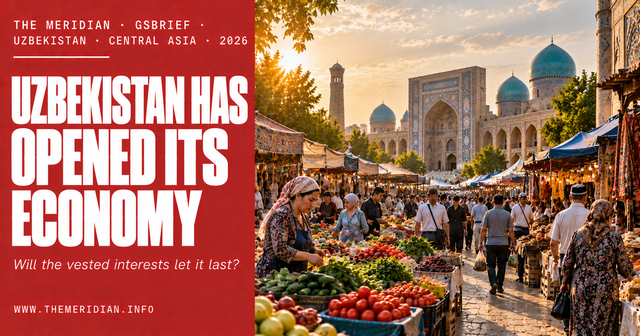
Uzbekistan Has Opened Its Economy. Will the Vested Interests Let It Last?
Since 2017, Uzbekistan has pursued the most decisive structural reform programme in Central Asia. The numbers are real. The question is whether the reform can reach the sectors where vested political and commercial interests remain concentrated, and whether it can survive the point at which it begins to cost them something.
When President Islam Karimov died in September 2016 after 27 years in power, Uzbekistan was one of the most closed economies in the former Soviet space. The som was not freely convertible. Foreign exchange was rationed by the state. The private sector operated largely in the informal economy because formal operation required navigating a bureaucratic and regulatory architecture designed to protect state enterprises. Foreign investors avoided the country. The World Bank classified it as a lower-middle-income economy with limited growth prospects.
Under President Shavkat Mirziyoyev, what followed was the most significant structural shift in Central Asia in a generation. The currency was liberalised in 2017. Investment legislation was modernised. Trade barriers were reduced. State enterprise reform was announced and partially implemented. The private sector grew. By 2025, GDP was expanding at 7.7 percent, FDI had grown more than 60 percent in a single year, and Moody's had upgraded Uzbekistan's credit outlook from stable to positive for the first time. The economy that was closed is open. The question is how open, for how long, and to whose benefit.
The World Bank confirmed in its April 2026 update that Uzbekistan's real GDP grew 7.7 percent in 2025, up from 6.5 percent in 2024 and 6.3 percent in 2023. Real GDP has averaged 6 percent annually between 2017 and 2025. The economy reached $115 billion in 2024 and is among the three fastest-growing in Europe and Central Asia. Foreign investment grew more than 60 percent in 2024 to $34.9 billion, according to Uzbekistan's Ministry of Investment, with projections of $42 billion in 2025. The national som strengthened 6.93 percent by end of 2025, the first meaningful currency appreciation in years, reducing the cost of servicing external debt by 4.7 percent for the government.
The structural shift beneath these headline figures is more significant than the growth rate alone. Over the past five years, the share of state participation in the economy fell from over 55 percent to 37 percent. The number of state-owned enterprises decreased by 40 percent since 2019. The number of small and medium-sized enterprises increased by 25 percent. Competition improved across 17 previously highly concentrated industries. Uzbekistan implemented a "Yellow Pages Rule" prohibiting the establishment of a new state enterprise in any sector where five or more private operators already exist. As of April 2025, the country had established 28 Special Economic Zones, 389 Small Industrial Zones, and 23 technology parks.
Sector
Sector
GSBrief applies the same question to Uzbekistan's reform programme that it applies to every infrastructure investment in Central Asia. Is this building productive capacity that generates domestic employment, enterprise, and retained value, or is it primarily creating conditions for foreign capital to extract value through capital-intensive sectors, leaving the population with growth statistics but not with structural economic participation?
The OECD's investment roadmap for Uzbekistan, published in 2026, notes that FDI has grown steadily in response to liberalisation since 2017, but remains concentrated in capital-intensive sectors such as energy. The World Bank's April 2026 update explicitly warns that the significant state presence in the economy and the dominance of state-owned enterprises continue to limit private sector development. The IMF's May 2026 paper on state-owned enterprises identifies the banking sector as the critical outstanding challenge: nine state-owned commercial banks still dominate financial sector assets, meaning credit allocation for private sector development remains substantially under state influence. Without credit market reform, the formal private sector operates in an economy where the terms of financing are set by the state for the benefit of state priorities.
The state's share of the economy fell from 55 percent to 37 percent in five years. That is genuinely structural. The question is whether the remaining 37 percent includes the sectors that matter most.
The relevant comparison is Kazakhstan. Kazakhstan's Samruk-Kazyna sovereign wealth fund controls assets equivalent to roughly a third of national GDP. Its comprehensive privatisation plans, running now through three successive cycles since 2014, have consistently deferred the flagship asset transfers. Kazakhstan Temir Zholy has had an IPO announced and delayed multiple times. The state's dominant position in Kazakhstan's economy has not meaningfully contracted. Samruk-Kazyna's assets under management grew from an estimated $69 billion to $88 billion in the four years following the January 2022 protests that were explicitly about economic inequality and state capture.
Against this benchmark, Uzbekistan's reduction of state participation from 55 to 37 percent is not marginal. It is the structural change that Kazakhstan has promised and not delivered. The World Bank projects Kazakhstan's growth at 4.7 percent in 2025 and 3.5 percent in 2026, compared to Uzbekistan's 7.7 percent and projected 5.7 to 5.9 percent. The economic divergence between the two largest Central Asian economies is becoming measurable.
The IMF, World Bank, and ADB all identify the same boundary. The reform has been genuine in the sectors where it did not threaten the concentrated interests of the political and commercial networks that underpin the Mirziyoyev administration. It has been slower and more contested where it does. The banking sector remains state-dominated. Large SOEs including Navoi Mining, UzGas, and Uzbekenergo retain dominant positions in their sectors. The ADB's April 2026 assessment is direct: without deeper SOE reform, the shift toward productivity-led growth will be difficult to sustain, even if headline growth remains strong.
Moody's June 2025 decision to upgrade Uzbekistan's outlook to positive was accompanied by the observation that persistent institutional weaknesses, low per capita income, and governance concerns remain, alongside increased liabilities linked to SOE borrowing and public-private partnership projects. The upgrade is a signal of direction, not arrival.
The reform sceptic's case is real and important, but it can be overstated. Reducing state participation from 55 to 37 percent of the economy in five years while growing GDP at 6 to 7.7 percent, attracting $34.9 billion in FDI, strengthening the currency, and reducing the fiscal deficit to 3.3 percent of GDP is not a cosmetic achievement. These are structural outputs. They require institutional change to produce. The Yellow Pages Rule, the 40 percent reduction in SOE numbers, the competition improvement across 17 sectors, the 25 percent SME growth: these are not announced and imaginary. They are documented and partially verified.
Uzbekistan's WTO accession process is also significant. WTO membership imposes binding commitments that provide external discipline against reform reversal. The ADB specifically identifies WTO accession as a mechanism for anchoring structural reforms and improving policy predictability. If accession proceeds, some of the most critical remaining protections for SOEs become harder to maintain within the legal framework.
Structural reform in transition economies follows a consistent pattern. The first phase is politically accessible: liberalise the currency, remove price controls, reduce barriers to entry, register more businesses. The second phase is politically costly: privatise the assets that the political system controls, reform the banking sector that the political system uses to allocate credit, regulate the monopolies that the political system's networks operate. Uzbekistan completed the first phase between 2017 and 2023. It is now in the territory of the second.
The public article identifies the question. The intelligence product answers it for specific decisions. GSBrief and The Meridian Economic Intelligence produce commissioned research for organisations evaluating Uzbekistan as an investment destination, supply chain partner, or institutional engagement priority.
We can assess the specific sectors where reform has been deepest, the sectors where SOE dominance persists, the credit market structure and its implications for private sector finance, the WTO accession timeline and its regulatory consequences, and the political economy of the Mirziyoyev administration's second-phase reform capacity.
Contact us: editor@themeridian.info
Uzbekistan has done what Kazakhstan has not: it has actually reduced the state's share of the economy. The reduction from 55 to 37 percent is structural, not rhetorical. The GDP growth rate, the FDI inflow, the currency strengthening, the Moody's outlook upgrade: these are real outputs of real policy change.
What makes GSBrief cautious is not the first-phase record. It is the second-phase challenge. The banking sector is still state-controlled. The largest remaining SOEs are in politically sensitive sectors. The IMF, World Bank, and ADB all use the same phrase in their 2026 assessments: SOE reform must go deeper. That formulation is not a mild observation. It is an identification of the specific boundary beyond which the reform has not yet gone.
The Corridor Test asks whether infrastructure and economic development create productive capacity that benefits the population, or whether they create conditions in which value passes through the country to external beneficiaries and internal elites. Uzbekistan is building productive capacity. Whether the second phase of reform is politically feasible within the current administration's constraints will determine whether the gains are structural or another well-executed first act with an uncertain second.
Since President Mirziyoyev came to power in 2016, Uzbekistan has implemented a broad structural reform programme including the liberalisation of the foreign exchange regime in 2017, modernisation of investment legislation, trade barrier reductions, and substantial state enterprise reform. The share of state participation in the economy fell from over 55 percent to 37 percent over five years. The number of state-owned enterprises decreased by 40 percent since 2019, while the number of small and medium-sized enterprises grew 25 percent. A "Yellow Pages Rule" was implemented prohibiting new state enterprises in sectors where five or more private operators already exist.
Uzbekistan's real GDP grew 7.7 percent in 2025, up from 6.5 percent in 2024 and 6.3 percent in 2023, according to the World Bank's April 2026 update. Real GDP has averaged 6 percent annually between 2017 and 2025. The country is among the three fastest-growing economies in Europe and Central Asia. GDP reached $115 billion in 2024. The World Bank projects growth of approximately 5.7 to 5.9 percent for 2026, while Moody's forecasts 5.8 percent for 2025 and 5.7 percent for 2026.
Uzbekistan has achieved structural change that Kazakhstan has promised and not delivered. Uzbekistan reduced state participation in the economy from over 55 percent to 37 percent over five years, while Kazakhstan's Samruk-Kazyna sovereign wealth fund grew its assets under management from approximately $69 billion to $88 billion in the same period. Kazakhstan's comprehensive privatisation plans, running through three successive cycles since 2014, have consistently deferred flagship asset transfers. The World Bank projects Kazakhstan's growth at 4.7 percent in 2025 and 3.5 percent in 2026, compared to Uzbekistan's 7.7 percent and projected 5.7 percent respectively.
The IMF, World Bank, and ADB all identify state-owned enterprises and state-dominated banking as the critical remaining obstacles. Nine state-owned commercial banks still dominate financial sector assets, meaning credit allocation for private sector development remains substantially under state influence. Large SOEs including Navoi Mining, UzGas, and Uzbekenergo retain dominant positions in their sectors. The IMF's May 2026 paper concluded that "deepening SOE reforms is essential" and the ADB's April 2026 assessment stated that "without deeper SOE reform, the shift toward productivity-led growth will be difficult to sustain, even if headline growth remains strong."
In June 2025, Moody's affirmed Uzbekistan's long-term issuer rating at Ba3, which is speculative or non-investment grade, while upgrading the outlook from stable to positive. This was the first positive outlook Moody's had assigned to Uzbekistan. The upgrade reflects the country's reform momentum, energy sector liberalisation, and improving fiscal discipline. The fiscal deficit declined to 3.3 percent of GDP in 2024 and is projected to remain below 3 percent. Moody's noted that if reform momentum continues and economic indicators improve further, an upgrade to the credit rating itself is possible.
Add comment
Comments