The West Imposed Sanctions on Russia. The Global South Paid the Food and Energy Bill.
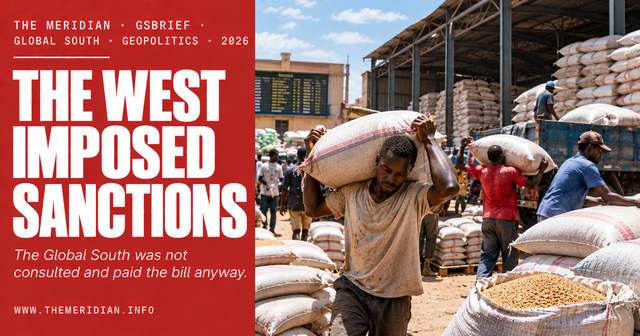
When the European Union and the United States sanctioned Russia following the February 2022 invasion, the intended target absorbed significant economic pain. So did countries that had started nothing, voted for nothing, and were consulted on nothing. The food price shock that followed was not a side effect. It was a foreseeable consequence of a sanctions architecture designed without accounting for its distributional reach.
On 24 February 2022, Russian forces entered Ukraine. Within days, the United States, the European Union, the United Kingdom, and their allies began constructing the most extensive sanctions regime in modern economic history. Russian banks were cut from SWIFT. The central bank's foreign reserves were frozen. Export controls were imposed on technology, aerospace, and defence components. The sanctions were presented, correctly, as a response to an unprovoked invasion of a sovereign state. They were also, from the day of their imposition, a global food and energy price event.
Russia and Ukraine together accounted for approximately 30 percent of global wheat exports, 20 percent of global maize exports, 30 percent of global barley exports, and 78 percent of global sunflower oil exports. Russia alone supplied approximately 22 percent of global ammonia exports, 14 percent of urea, and 14 percent of monoammonium phosphate. Russia and Belarus together supplied more than 40 percent of global potash. These are not marginal positions in marginal markets. Wheat, maize, and fertiliser are the inputs on which the food security of low-income countries depends. When the conflict disrupted exports from the Black Sea region and sanctions complicated the financial and logistics infrastructure through which those exports moved, the price consequences were immediate, large, and global.
The FAO Food Price Index averaged 159.3 points in March 2022, up 12.6 percent from February and 33.6 percent higher than March 2021. It was the highest level recorded since the index's inception in 1990. The FAO Cereal Price Index was 17.1 percent higher in March than in February. The FAO Vegetable Oil Price Index rose 23.2 percent in a single month, driven by sunflower oil, of which Ukraine is the world's leading exporter. These were not modest adjustments. They were the steepest food price increases recorded in the three decades the index had been measuring them.
The fertiliser dimension compounded the food price shock with a second, slower-moving one. Global fertiliser prices were already elevated before February 2022, driven by post-pandemic energy costs and supply chain disruptions. The sanctions regime, which targeted the owners of Russian fertiliser companies even when the products themselves were not formally sanctioned, disrupted the financial and logistics infrastructure through which those exports moved. Potash from Russia and Belarus, which together supplied more than 40 percent of global exports, was particularly affected because Belarusian exports had already been restricted by Western sanctions imposed in 2021. The resulting fertiliser price spike reduced planting in the 2022-2023 agricultural cycle across the developing world, compounding the price shock with a supply reduction in the subsequent harvest.
Wheat Exports
The countries that designed and implemented the sanctions were, almost without exception, net food exporters or wealthy net food importers capable of absorbing price increases through fiscal support to consumers. The countries that bore the greatest cost of the food price shock were net food importers with limited fiscal space and structural dependence on Black Sea grain and fertiliser.
Somalia imported approximately 90 percent of its wheat from Russia and Ukraine before the conflict. Egypt, the world's largest wheat importer, sourced the majority of its wheat from the same two countries. Tunisia, Lebanon, and several sub-Saharan African states were in comparable positions. When port closures in Ukraine and financial disruptions to Russian export logistics reduced the volume available on global markets, the price consequences fell hardest on the countries with the least capacity to pay them and the fewest alternative suppliers to turn to. The World Food Programme estimated that the food price crisis pushed tens of millions of additional people into acute food insecurity in 2022, primarily in Africa and the Middle East.
The G7 countries that designed the sanctions package collectively export food. The countries most exposed to the food price shock import it. This is not coincidence. It is the structure of the global food system.
The sanctions were not designed to disrupt food exports. The United States and the European Union both explicitly carved out agricultural products, fertilisers, and food commodities from the formal sanctions texts. The UN Secretary-General negotiated the Black Sea Grain Initiative in July 2022, which reopened Ukrainian grain export corridors. Russia exempted food exports from its retaliatory export controls. The G7 and the European Commission repeatedly stated that the sanctions were not targeting food.
None of this prevented the food price shock. The financial sanctions froze the payment infrastructure through which Russian agricultural trade moved. Shipping companies avoided Russia-linked transactions to reduce sanctions exposure, regardless of whether the specific cargo was formally exempted. The owners of major Russian fertiliser companies were sanctioned personally, disrupting their ability to manage logistics and finance even for products not formally targeted. The practical effect of a comprehensive financial sanctions package is not confined to the categories formally designated. It radiates through the entire trade and payment system of the targeted country.
The case for the sanctions is not without weight. Russia's invasion of Ukraine itself disrupted Ukrainian agricultural exports, damaged farmland, and destroyed storage infrastructure before any Western response had been formulated. The food price shock was not caused by the sanctions alone. It was caused by the invasion, and the sanctions were a response to the invasion. If the argument is that the costs of the sanctions fell disproportionately on the Global South, the prior argument is that the costs of the invasion itself fell even more directly on Ukraine's own population and food system.
The Western governments also provided substantial humanitarian funding in response to the food crisis. The United States, the European Union, and allied governments collectively disbursed billions in emergency food assistance and development funding to affected countries in 2022 and 2023. The Black Sea Grain Initiative, however imperfectly, functioned for over a year before Russia withdrew from it in July 2023. These responses were imperfect and late, but they existed.
The structural question the sanctions episode raised has not been answered. When a group of states -- the G7, the EU, their partners -- imposes a comprehensive sanctions regime that generates foreseeable and significant economic consequences for countries outside that group, what obligation do the sanctioning states carry toward the affected bystanders? The sanctions were designed to impose costs on Russia. They imposed costs on Somalia, Egypt, Tunisia, Lebanon, and dozens of other states that were consulted on nothing and voted on nothing.
The public article frames the distributional question. The intelligence product maps it for specific decisions. GSBrief and The Meridian Economic Intelligence produce commissioned research on sanctions architecture and its economic consequences for organisations navigating the intersection of geopolitical risk and supply chain exposure.
We can assess the specific exposure of individual countries or sectors to ongoing sanctions regimes, model the supply chain consequences of potential future sanctions events, track the WTO legal challenges to existing sanctions, and analyse the fiscal impact of food and energy price shocks on specific sovereign borrowers.
Contact us: editor@themeridian.info
Sanctions are a tool of geopolitical leverage. Their legitimacy in the case of Russia's invasion of Ukraine is defensible. The question GSBrief is asking is not whether the sanctions were justified. It is whether the distributional consequences of the sanctions, which were foreseeable and large, were adequately considered, adequately compensated, and adequately consulted upon.
The FAO Food Price Index reached its highest level in three decades within weeks of the invasion and the sanctions response. The countries that absorbed the food price shock were not the ones that had invaded anyone. They were the ones that imported wheat from the Black Sea and fertiliser from Russia and Belarus because those were the cheapest and most accessible sources in the global market. The market does not ask who started the conflict before it prices the shortage.
The geopolitical order is managed by states with the economic capacity to impose sanctions. The food price consequences are absorbed by states without that capacity. Until the sanctions architecture includes a systematic mechanism for compensating the bystanders it affects, the cost of Western geopolitical leverage will continue to be distributed in inverse proportion to the voice that shaped the decision to use it.
The FAO Food Price Index averaged 159.3 points in March 2022, up 12.6% from February and 33.6% higher than March 2021, the highest level since the index's inception in 1990. Russia and Ukraine together accounted for approximately 30% of global wheat exports and 78% of sunflower oil exports. Financial sanctions complicated the payment and logistics infrastructure through which Russian agricultural trade moved, even though food and fertiliser were formally exempt from the sanctions. The combined effect of the invasion, port disruptions, and financial complications caused a global food price shock concentrated in net food-importing developing countries.
Countries most affected were net food importers structurally dependent on Black Sea grain and Russian fertiliser. Somalia imported approximately 90% of its wheat from Russia and Ukraine before the conflict. Egypt, the world's largest wheat importer, sourced the majority of its wheat from the same countries. Tunisia, Lebanon, and multiple sub-Saharan African states faced similar exposure. The World Food Programme estimated that the food price crisis pushed tens of millions of additional people into acute food insecurity in 2022, primarily in Africa and the Middle East. These countries neither designed the sanctions nor had any mechanism to influence their design.
No. Both the United States and the European Union explicitly exempted agricultural products, fertilisers, and food commodities from the formal sanctions texts. The UN Secretary-General also negotiated the Black Sea Grain Initiative in July 2022, which reopened Ukrainian grain export corridors. However, the financial sanctions froze the payment infrastructure through which Russian agricultural trade moved, and shipping companies avoided Russia-linked transactions regardless of formal exemptions. The owners of major Russian fertiliser companies were sanctioned personally, disrupting logistics even for non-targeted products. The practical effect of a comprehensive financial sanctions package radiates beyond formally designated categories.
Russia alone accounted for approximately 22% of global ammonia exports, 14% of urea exports, and 14% of monoammonium phosphate (MAP) exports according to Rabobank data cited in 2022. Russia and Belarus together supplied more than 40% of global potash exports. These three fertiliser nutrients, nitrogen (from ammonia and urea), phosphate (from MAP), and potassium (from potash), are the essential inputs for crop production worldwide. Disruptions to this supply, whether direct or indirect through financial and logistics complications, reduced fertiliser availability and raised prices in the 2022-2023 agricultural cycle across the developing world.
GSBrief's argument is not that the sanctions on Russia were unjustified. It is that the distributional consequences of those sanctions, specifically the food and fertiliser price shock that fell on developing countries, were foreseeable, large, and inadequately compensated. The countries that designed the sanctions were, almost without exception, net food exporters or wealthy net food importers. The countries that absorbed the greatest food price consequences were net food importers with limited fiscal space. The sanctions architecture was designed without a systematic mechanism for compensating affected bystanders. GSBrief argues this is a structural deficiency in how Western geopolitical tools are designed and deployed.
Add comment
Comments