Cobalt Crashed. The DRC Banned Exports. The Price Spiked. Africa Still Did Not Capture the Value.
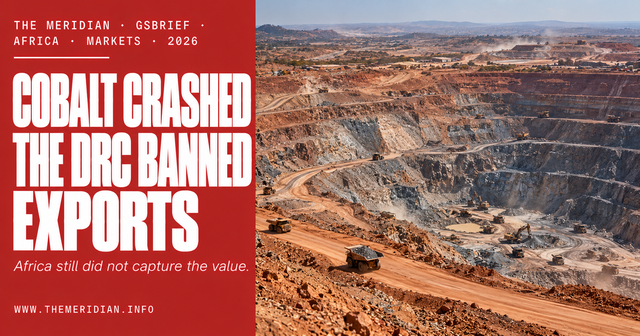
In January 2025, cobalt hit its lowest price since the LME first listed the contract in 2010. The Democratic Republic of Congo produces approximately 70 percent of the world's supply. In February it banned exports. The price surged 160 percent. The country that holds the resource still does not hold the margin.
The cobalt market completed one of the most dramatic cycles in commodity history between 2022 and 2026. The price peaked at approximately $82,000 per tonne in April 2022, driven by post-pandemic supply chain stress and accelerating electric vehicle battery demand. It then fell steadily for nearly three years as the Democratic Republic of Congo's large-scale and artisanal mining operations flooded the market with supply that demand could not absorb. By January 2025, the LME cobalt price had reached $21,275 per tonne -- the lowest level since the exchange first listed the cobalt contract in 2010. The DRC, which produces approximately 70 percent of the world's cobalt, watched the price of its most important critical mineral fall 74 percent from peak to trough while its mines kept producing.
On February 22, 2025, the DRC government imposed a total suspension on cobalt hydroxide exports. It was presented as a temporary measure. It lasted, through two extensions, until October 16, 2025, when a quota system replaced the ban. The price recovered. Cobalt metal rose 160 percent from February 2025 to approximately $57,320 per tonne by April 2026. Cobalt hydroxide, the primary product the DRC actually exports, quadrupled from its depressed lows. The intervention worked as a price mechanism. The structural question it left unanswered is whether a country can capture the value of a mineral it produces when it does not control the processing of what it sells.
The 2024 trough reflected two converging forces. On the supply side, CMOC Group, the Chinese company that holds majority stakes in DRC's two largest cobalt-copper mines, more than doubled its annual cobalt production in 2024 to approximately 114,165 tonnes. Artisanal mining in the DRC added further untracked volumes to global supply. On the demand side, electric vehicle growth in key markets ran below the trajectory battery supply chains had been built to serve. The result was a structural oversupply that depressed prices to levels at which most cobalt projects outside the DRC were no longer commercially viable.
The DRC government's February ban was a straightforward market intervention: if the country supplying 70 percent of global cobalt stops exporting, the price will rise. President Felix Tshisekedi described the ban as "a real lever to influence this strategic market" after years of what he called "predatory strategies." The cabinet minutes from October 2025 confirmed the government's view that the export freeze had driven a 92 percent rebound in prices since March of that year. The ban was extended twice before the quota system replaced it in October 2025. The 2026 annual quota of 96,600 tonnes, covering both 2026 and 2027, represents less than half the country's 2024 production volume -- a sustained structural restriction of supply rather than a temporary shock.
The quota system itself produced a visible split between the two largest producers in the DRC. Glencore, the Swiss-British miner, supported the quota system. CMOC Group, the Chinese company that is the world's largest cobalt producer and controls majority stakes in the DRC's Tenke Fungurume and Kisanfu mines, opposed it. The opposition from CMOC is legible: as the largest producer, volume restrictions cost it more than anyone else. It had doubled production in 2024 to 114,165 tonnes precisely to scale into growing EV demand. A quota that caps total DRC exports at 96,600 tonnes constrains CMOC's commercial ambitions directly. Glencore, with a smaller DRC footprint, gains more from higher prices than it loses from volume limits.
The country that produces 70 percent of the world's cobalt banned exports and watched the price recover 160 percent. The companies that own the mines and do the processing captured most of that recovery. The DRC set the floor. It did not set the ceiling.
The DRC exports cobalt primarily as cobalt hydroxide precipitate, an intermediate product. That hydroxide is shipped, predominantly to Chinese refineries, where it is processed into battery-grade cobalt sulphate and other compounds. The refining margin -- the value added between hydroxide and finished battery material -- stays in China. When the ban caused cobalt hydroxide values to quadruple, that four-fold price increase flowed to the sellers of hydroxide at the point of export. The Chinese refineries that process the hydroxide then sell battery-grade cobalt sulphate at a further premium. The DRC captures the price of what leaves the country, not the price of what is made from it.
This is the structural condition that the export ban and quota system cannot resolve on their own. The DRC controls the resource and, since the ban, has demonstrated that it can control the price of the raw export. What it does not yet control is the processing infrastructure that would allow it to capture the refining margin. The 9,600-tonne strategic quota reserved for the DRC government itself in 2026 is a step toward direct state participation in the cobalt market. It is a small step relative to the structural gap the GSBrief Corridor Test identifies: the infrastructure moves the value through the country; it does not yet cause value to remain.
The DRC's intervention was not without measurable effect. The cobalt price rose from a level that was destroying the commercial viability of cobalt projects globally. At $21,275 per tonne, many miners outside the DRC could not operate profitably. The recovery to above $57,000 restores a level at which exploration, new project development, and supply diversification become viable again. The DRC's ability to move the global cobalt price by restricting supply is not incidental -- it is the single most consequential leverage any country holds in the critical minerals market. No other producing nation can unilaterally shift a global battery material price by 160 percent. That leverage, properly managed, is the foundation on which processing investment can be attracted and negotiated.
The quota system also introduced something the raw export market had never produced: predictability of scarcity. When buyers know the DRC will restrict supply to 96,600 tonnes annually, they face an incentive to invest in processing within the DRC to access feedstock more reliably. This is the theory. Whether the investment follows depends on the regulatory environment, the power infrastructure, and the willingness of the DRC government to offer terms that attract capital without surrendering the processing margin that is the whole point of the exercise.
The DRC has demonstrated that it can control the cobalt price. The question the quota system cannot yet answer is whether price control, in the absence of processing capacity, is sufficient to change the structure of who captures the value. The cobalt hydroxide that leaves the DRC under quota still goes to China for refining. The battery-grade material that comes back into global supply chains still carries a Chinese refining margin. The DRC has moved from price-taker to price-setter at the raw material stage. The processing margin remains elsewhere.
The public article covers the price cycle. The intelligence product maps the ownership structure and commercial exposure. GSBrief and The Meridian Economic Intelligence produce commissioned research for organisations with exposure to cobalt supply chains, critical minerals markets, and DRC political economy.
We can assess the quota allocation by producer, the CMOC and Glencore DRC footprints in detail, the processing investment landscape, the 2026 and 2027 supply balance, and the political economy of the Tshisekedi administration's mineral strategy.
Contact us: editor@themeridian.info
The export ban and quota system represent the most decisive use of resource leverage by any African government in the critical minerals era. The DRC moved the global cobalt price by 160 percent through a single administrative decision. That is genuine market power. It is also incomplete market power. The country sets the price of the hydroxide that leaves. The value of the battery material made from that hydroxide accrues elsewhere.
The structural question the GSBrief Corridor Test asks of every infrastructure story in Central Asia applies identically to the DRC cobalt market: does the supply chain move value through the country, or does it cause value to remain? The ban raised the price of what passes through. It has not yet changed the direction of where value accumulates.
The quota system is a permanent feature of the cobalt market until at least 2027. Whether the DRC uses that window to attract processing investment on terms that keep the refining margin onshore -- or whether the quota simply raises the price of the same hydroxide leaving for the same Chinese refineries at a higher number -- is the question that will determine whether the 2025 intervention was a structural shift or an expensive floor.
Cobalt prices peaked at approximately $82,000 per tonne in April 2022 before falling 74 percent to a ten-year low of $21,275 per tonne in January 2025. The crash reflected two converging forces: a supply surge driven by CMOC Group more than doubling its DRC production in 2024 to approximately 114,165 tonnes, combined with artisanal mining output, and demand growth in electric vehicles that underperformed the trajectory battery supply chains had been built to serve. The structural oversupply made most cobalt projects outside the DRC commercially unviable.
The DRC imposed a total suspension on cobalt hydroxide exports on February 22, 2025. Cobalt metal prices rose 160 percent from the February 2025 level to approximately $57,320 per tonne by April 2026, according to Glencore's first-quarter 2026 production report. Cobalt hydroxide values, the primary DRC export product, quadrupled from their depressed lows during the ban period. The ban was extended twice before being replaced by a quota system in October 2025.
In October 2025, the DRC replaced its total export ban with a quota system administered by ARECOMS, the state minerals regulator. Annual export allowances were set at 96,600 tonnes for both 2026 and 2027, which represents less than half the country's 2024 production volume. The DRC government reserved 9,600 tonnes as a strategic government quota in 2026. The system will remain in place until at least the end of 2027. Glencore supported the quota system while CMOC Group, the world's largest cobalt producer and major DRC mine owner, opposed it.
The DRC exports cobalt primarily as cobalt hydroxide precipitate, an intermediate product. This hydroxide is shipped predominantly to Chinese refineries, where it is processed into battery-grade cobalt sulphate. The refining margin, the value added between hydroxide and finished battery material, remains in China. The DRC captures the price of what leaves the country, not the price of what is manufactured from it. China controls approximately 65 percent of global cobalt refining capacity according to the IEA's Critical Minerals Outlook. The export ban raised the price of the hydroxide leaving the DRC but did not change the destination or the margin structure of the processing stage.
CMOC Group, a Chinese mining company formerly known as China Molybdenum Corp, is the world's largest cobalt producer and holds majority stakes in the DRC's two largest cobalt-copper operations: an 80 percent stake in the Tenke Fungurume mine and a 71.25 percent stake in the Kisanfu mine. CMOC produced approximately 114,165 tonnes of cobalt in 2024, more than doubling its 2023 output of 55,600 tonnes. Glencore, the Swiss-British commodity company, is the second-largest cobalt producer in the DRC through its Katanga (KCC) and Mutanda operations.
Add comment
Comments