Kazakhstan's January 2022 Protests Were Not a Coup Attempt. They Were an Economic Event.
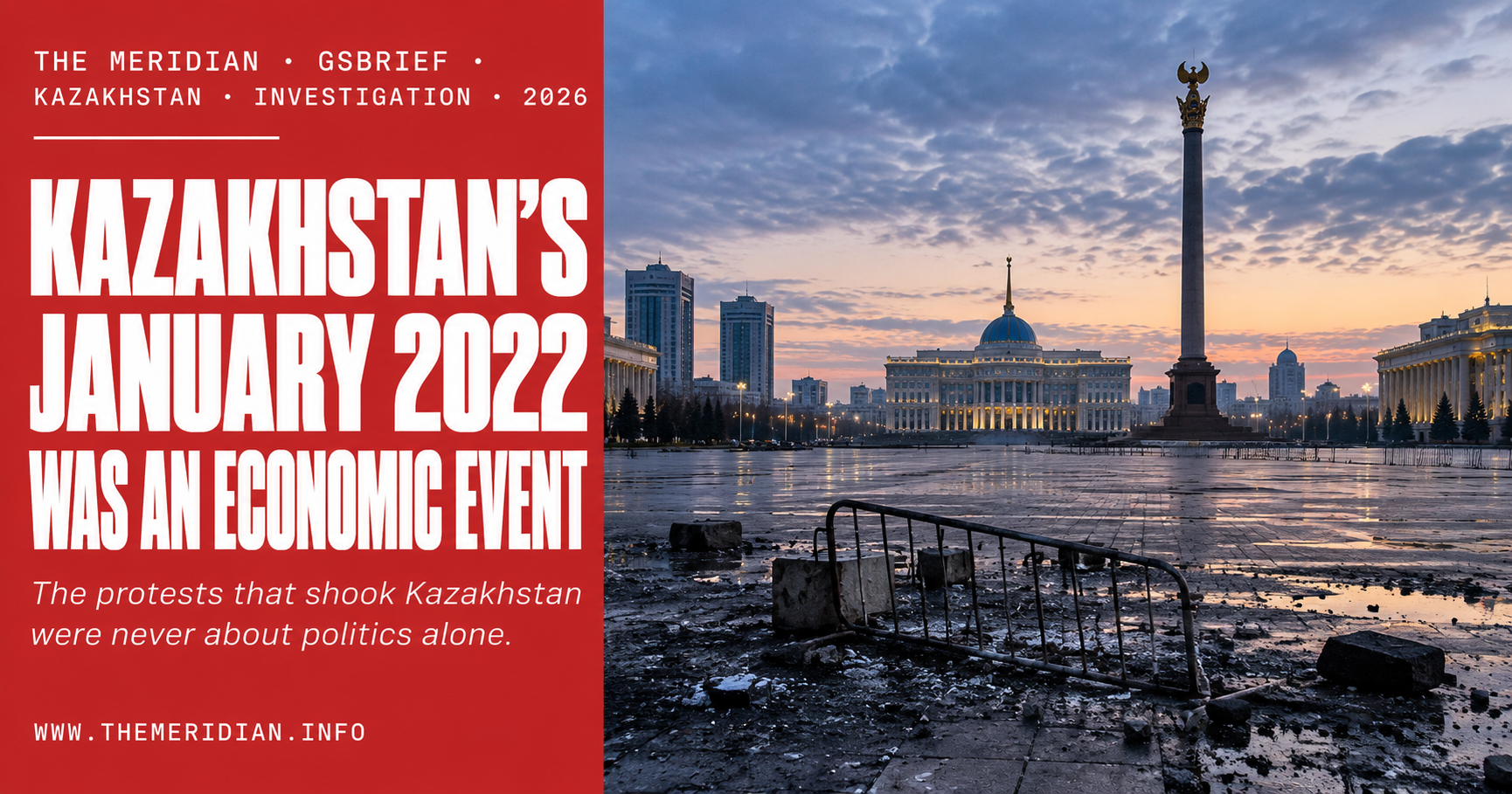
In January 2022, Kazakhstan experienced its worst civil unrest since independence. The government called it a coup attempt by terrorist gangs trained abroad. 238 people died. GSBrief reads the economic data and concludes that what happened in Zhanaozen on January 2 was not a coup attempt. It was a fuel bill.
On January 1, 2022, the Kazakhstan government lifted price controls on liquefied petroleum gas. In the Mangystau region of southwestern Kazakhstan, the price at the pump rose overnight from 60 tenge per litre to 120 tenge per litre -- a 100 percent increase, effective on the first day of the new year. In Mangystau, between 70 and 90 percent of vehicles run on LPG. It is the fuel households and workers use because it is cheaper than petrol in a region that sits on top of some of the country's largest hydrocarbon reserves. On January 2, residents of Zhanaozen, an oil town in Mangystau, gathered to protest. By January 4, protests had spread to Aktau, Aktobe, Atyrau, Shymkent, Taraz, and Almaty. The government estimated 10,000 to 50,000 people were in the streets across the country.
President Kassym-Jomart Tokayev declared a state of emergency and invited Collective Security Treaty Organisation troops to assist in restoring order. On January 5, in a televised statement, he described the protesters in Almaty as "terrorist gangs who have undergone training abroad." When it was over, the official death toll stood at 238. Approximately 8,500 people had been detained. Of the 238 deaths, only 12 cases have produced convictions of perpetrators. The government declared it had defeated a coup attempt. What the LPG price data describes is something more precise: a population that had run out of patience with the economics of living in a wealthy country that had organised its wealth for somebody else's benefit.
Zhanaozen is not an arbitrary starting point. It is the same town where oil workers were killed in 2011 during a strike over wages and conditions in Kazakhstan's energy sector. Mangystau province is one of the most hydrocarbon-rich regions in the country. Its residents depend on LPG rather than petrol as a vehicle fuel precisely because LPG was, under the regulated pricing system, affordable in a way that petrol was not. The government's decision to deregulate LPG pricing, moving it to a commodity exchange-based system, was presented as a market efficiency measure. For the households of Zhanaozen, it was a 100 percent increase in the cost of getting to work.
The government reversed itself within four days. On January 4, after the protests had spread nationally, an emergency price cap was imposed at 50 tenge per litre -- below the pre-deregulation level of 60 tenge. The reversal demonstrated two things simultaneously: that the price increase had been unjustifiable in social terms, and that the political system had no mechanism to understand this before people died in the streets to communicate it.
The LPG price was the trigger, not the cause. What the rapid national spread of the protests revealed was a country in which the fuel price increase functioned as a signal -- a confirmation of something large numbers of Kazakhs already understood about the relationship between the country's resource wealth and their own economic position. Kazakhstan had been producing and exporting hydrocarbons for three decades. The wealth those exports generated had concentrated in the institutions, families, and networks that controlled the state. The population in the extraction zones had the environmental costs, the economic dependency, and, when the subsidy was removed, the market price.
The broader economic conditions were not ambiguous. Commercial credit was inaccessible to ordinary entrepreneurs at base rates that have since ranged from 18 percent down to 16.25 percent. The sovereign wealth fund controlling roughly a third of the economy was opaque, concentrated, and resistant to meaningful privatisation. Youth outside the formal economy -- the NEET rate -- sat at approximately 5.8 percent. The protests were not about any of these abstract economic facts. They were about a fuel price. But the fuel price was legible because everything behind it was already understood.
A country that sits on top of oil cannot afford to sell fuel to its own oil workers at an unsubsidised price. That is not a political paradox. It is the definition of a rentier economy that has failed to convert resource wealth into broadly distributed prosperity.
President Tokayev's response to the protests had two tracks. The first was the declaration of a state of emergency, the invitation of CSTO troops, and the framing of the unrest as a foreign-backed coup attempt. This narrative served immediate political purposes: it allowed the government to use lethal force with a legal and rhetorical cover, and it allowed Tokayev to distance himself from the Nazarbayev era by positioning the violence as an attack on Kazakhstan's sovereignty rather than a popular response to economic mismanagement. Human Rights Watch noted that Kazakhstani authorities "arbitrarily arrested peaceful protesters and others, ill-treated and tortured some detainees."
The second track was structural announcement. On January 21, Tokayev announced the fundamental reform of Samruk-Kazyna, the sovereign wealth fund that an analyst cited by Eurasianet had identified as the root cause of the LPG crisis: "The gas crisis that caused the mass protests is essentially the result of the mismanagement at Samruk-Kazyna." An asset recovery campaign was launched, targeting Nazarbayev-era beneficiaries. Constitutional reforms were passed. The programme was described as a comprehensive transformation of Kazakhstan's economic architecture.
Four years later, GSBrief reads the structural indicators. Samruk-Kazyna's assets under management stood at approximately $88 billion in 2025 -- up from an estimated $69 billion at the time of the protests. The fund invested more, not less, in 2026 than in any previous year. Sixty-two percent of its procurement remains single-source. The flagship privatisations -- Kazakhstan Temir Zholy, QazaqGaz -- have been announced and deferred through multiple cycles. The assets recovered from Nazarbayev-era beneficiaries returned to state control rather than to competitive markets. The Organisation for Crime and Corruption Reporting Project confirmed that "all decisions related to anti-corruption, de-monopolization, or asset recovery are made at the top, in complete dependence on Tokayev's political will."
The base rate, which was 18 percent when the protests occurred, is now 16.25 percent following four cuts in 2026. The structural inaccessibility of commercial credit for entrepreneurs has not materially changed. The NEET rate is 5.8 percent. Transparency International's Corruption Perceptions Index places Kazakhstan at approximately 36 out of 100. The fuel price that triggered the protests was reversed within four days. The economic conditions that made the protests inevitable have not been reversed at all.
The Tokayev administration's reform record since January 2022 is not entirely cosmetic. The reduction of Samruk-Kazyna's subsidiary count from approximately 600 to 300 is real rationalisation. Constitutional changes reduced the president's formal powers and introduced limitations on the dynastic perpetuation of the Nazarbayev family's influence. Several Nazarbayev-era figures were prosecuted and imprisoned. The government did not simply pretend nothing had happened. It acted -- within the constraints of its own interests.
The harder argument is whether the reforms announced in January 2022 were designed to address the causes of the protests or to manage their consequences. The causes were a rentier economy's structural inequality and the absence of mechanisms for distributing resource wealth beyond the elite. The responses were largely administrative restructuring within the same concentrated institutional architecture.
The January 2022 events were suppressed. They were not resolved. The LPG price was capped. The economic structure that made the price cap necessary -- the concentration of resource wealth, the inaccessibility of commercial capital, the absence of domestic productive enterprise -- remains intact and, by several measures, more entrenched than before. The question the structural data poses is not whether Kazakhstan has changed since January 2022. It has changed in ways that matter at the margins. The question is whether the conditions that produced Qandy Qantar have been addressed or managed, and whether the next iteration of that question will find the same answer.
The public article frames the political economy of January 2022. The intelligence product maps the structural risk for organisations with exposure to Kazakhstan. GSBrief and The Meridian Economic Intelligence produce commissioned research on Kazakhstan's political economy, institutional reform trajectory, and sovereign risk.
We can assess the specific reform outcomes against stated commitments, model the structural risk indicators over a 2026-2028 horizon, analyse the Samruk-Kazyna privatisation pipeline in detail, and evaluate the fiscal and social stability outlook under current monetary and structural conditions.
Contact us: editor@themeridian.info
The government's coup attempt narrative served its immediate political purpose. It allowed lethal force, it displaced responsibility onto foreign actors, and it gave Tokayev the political cover to consolidate power from the Nazarbayev network under the banner of restoring order. None of that narrative is supported by the economic sequence of events: a deregulated fuel price in an oil-producing region, a population that had no other mechanism to communicate economic grievance, and a government that reversed the price within four days -- an action impossible to reconcile with the coup attempt framing.
What January 2022 said, in the plainest possible terms, is that the distribution of Kazakhstan's resource wealth is not experienced as broadly shared by the population that lives on top of it. The LPG price was the clearest possible statement of that structural condition. The government heard it, capped the price, and spent the following four years restructuring the institutions that produce the condition without materially changing the condition itself.
GSBrief will continue reading Kazakhstan's budget lines, procurement records, and structural indicators. The evidence will determine the conclusion. The evidence so far suggests that what happened in Zhanaozen in January 2022 was not resolved. It was managed until the next time.
On January 1, 2022, Kazakhstan lifted price controls on liquefied petroleum gas (LPG). In the Mangystau region, the price rose overnight from 60 tenge per litre to 120 tenge per litre -- a 100 percent increase. Between 70 and 90 percent of vehicles in Mangystau run on LPG, making it an essential daily cost for working households. Protests began on January 2 in Zhanaozen, an oil town that had already seen deadly clashes in 2011, and spread rapidly to cities across Kazakhstan including Aktau, Aktobe, Atyrau, Shymkent, Taraz, and Almaty.
The official Kazakhstan government death toll stands at 238 people killed during the January events. This figure is confirmed by Human Rights Watch, the Open Dialogue Foundation, the International Partnership for Human Rights, and IWPR. Human rights organisations note the actual figure may be higher. Approximately 8,500 people were detained according to the Human Rights Alliance. The Prosecutor General's Office was investigating 329 cases of alleged torture. By 2025, only 12 of the 238 killings had produced convictions of perpetrators, according to the Human Rights Alliance "Shoot to Kill" report.
GSBrief's analysis identifies three economic facts that define the January 2022 events. First, the immediate trigger was a 100 percent fuel price increase in an oil-producing region -- the LPG deregulation was an economic policy decision with directly traceable consequences. Second, the protests spread nationally because the fuel price crystallised a broader economic grievance: Kazakhstan's resource wealth had not translated into broadly distributed prosperity. Third, the government reversed the price within four days, which is inconsistent with the coup attempt narrative and consistent with a government responding to an economic protest it could not sustain. The political framing served immediate interests but is not supported by the economic sequence.
President Tokayev announced the fundamental reform of Samruk-Kazyna on January 21, 2022. An asset recovery programme targeted Nazarbayev-era beneficiaries. Constitutional reforms reduced presidential powers and limited dynastic influence. The Samruk-Kazyna subsidiary count was reduced from approximately 600 to 300. Several Nazarbayev-era figures were prosecuted. However, Samruk-Kazyna's total assets grew from approximately $69 billion to $88 billion over the same period. Sixty-two percent of procurement remains single-source. The KTZ and QazaqGaz privatisations have been repeatedly deferred. The OCCRP confirmed that recovered assets returned to state control rather than competitive markets.
By most structural indicators, the economic conditions have not materially changed. Kazakhstan's base rate has fallen from 18 percent to 16.25 percent, but commercial lending to businesses still runs at approximately 22 percent, maintaining the structural inaccessibility of credit for entrepreneurs. Samruk-Kazyna's assets have grown, not contracted. The flagship privatisations remain uncompleted. The NEET rate (young people neither employed nor in education) remains at 5.8 percent. Transparency International's Corruption Perceptions Index places Kazakhstan at 36 out of 100. The LPG price was reversed in four days. The structural conditions that made the LPG price politically explosive have not been reversed in four years.
Add comment
Comments