Copper, Lithium, Manganese. Africa Prices the Ore. The World Prices the Product. The Margin Lives Elsewhere.
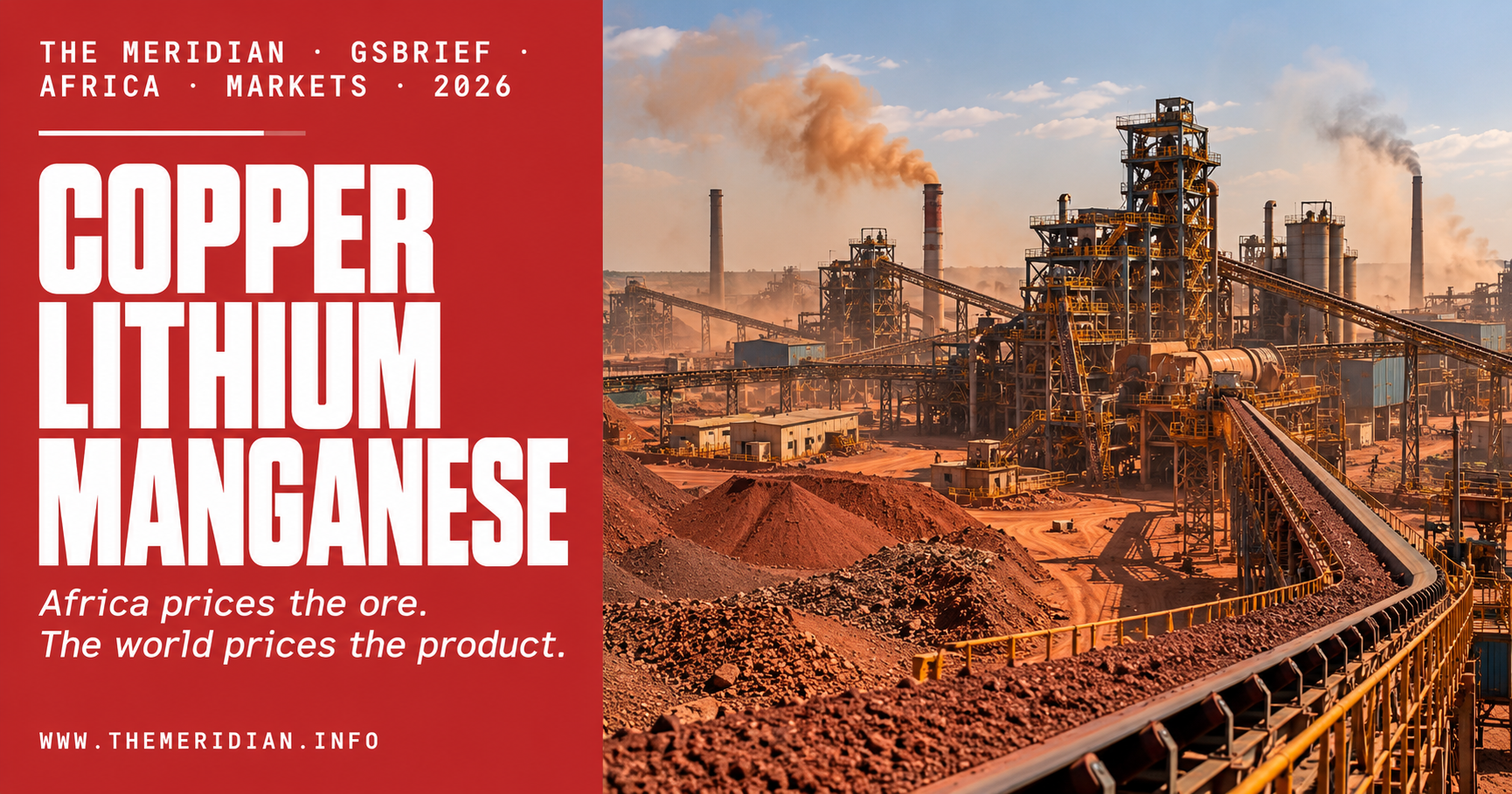
The global energy transition is the largest minerals demand event in modern economic history. Africa holds the reserves that make it possible. Three minerals tell the same structural story: the continent produces the ore, the world processes the product, and the value added between the two states accrues elsewhere.
Every battery cell in every electric vehicle requires copper for the wiring, lithium for the chemistry, and manganese for the cathode. These three minerals are not interchangeable. They are structural inputs. The global supply chains for each of them flow, in their raw or partially processed form, from Africa to processing facilities in China and then back into the world economy as refined materials and manufactured components. Africa holds the geological resource. It does not hold the industrial infrastructure. The energy transition is therefore structured, at its current stage of development, as another iteration of the same commodity architecture that has defined the continent's relationship with global manufacturing for generations.
The numbers for each mineral tell a variation on the same story. South Africa holds approximately 42.7 percent of the world's known manganese reserves, and Africa as a continent holds approximately 61 percent of global reserves. The Democratic Republic of Congo and Zambia together produce approximately one-sixth of global copper output. Zimbabwe holds the largest lithium reserves in Africa and has rapidly become a major global supplier, with African lithium supply growing 44 percent in 2025 to reach 14 percent of global production. The continent is not peripheral to the energy transition's mineral requirements. It is central to them. The question is how much of the value generated by that centrality stays within its borders.
The gap between what Africa holds and what Africa processes defines the structural problem. For manganese, approximately 80 percent of South Africa's ore is shipped without any domestic beneficiation, according to a South African government review. China accounts for approximately 95 percent of global High-Purity Manganese Sulfate Monohydrate production and approximately 93 percent of refined manganese metal. South Africa and Gabon together account for 87 percent of global manganese ore exports by value. The ore goes to China. The chemicals come back. The processing margin does not return.
For copper, the DRC and Zambia export primarily as concentrate rather than refined cathode copper. China accounts for approximately 54 to 57 percent of global primary copper consumption, which includes the processing of imported concentrate into refined copper products. Zambia's copper represents approximately 70 percent of its export earnings and 22 percent of its net tax revenue, making it existentially dependent on a commodity it exports at an early stage of the value chain. Copper prices climbed 15 percent in the first quarter of 2026, reaching record highs in January, and the World Bank forecasts a 21 percent annual price rise for the full year. The price environment is favourable. The structural position in which African producers capture it is not.
Lithium illustrates the structural problem in its sharpest form. Zimbabwe holds the largest lithium reserves in Africa and ranks seventh largest globally. Chinese companies invested more than one billion dollars in Zimbabwe's lithium deposits, including Zhejiang Huayou Cobalt, Sinomine Resource Group, Chengxin Lithium Group, and Yahua Group. Production surged 222 percent in 2024, reaching 2.4 million tonnes of lithium concentrate, with a further 3.26 million tonnes forecast for 2025. Zimbabwe exported 586,197 tonnes of lithium concentrate in the first half of 2025, a 30 percent increase year on year.
None of this translated into proportionate revenue. Lithium prices crashed more than 80 percent between November 2022 and early 2024. Zimbabwe's volumes kept growing even as the price of what it was selling collapsed. The reason is structural: Zimbabwe exports lithium as spodumene concentrate, a raw partially processed rock. Chinese refineries convert that concentrate into battery-grade lithium carbonate and lithium hydroxide. The price difference between the concentrate that leaves Zimbabwe and the chemical that goes into a battery cell is the refining margin. That margin is captured in China, not Harare. Zimbabwe grew its production by 222 percent and watched its revenues fail to keep pace because it was selling more of a commodity that was worth less at the stage of the value chain it occupied.
The continent grew lithium supply by 44 percent in one year. The lithium price fell 80 percent. These two facts are not unrelated. Africa is positioned as a volume supplier in a market where pricing power belongs to those who control the chemistry, not those who control the rock.
The DRC cobalt export ban of 2025, which GSBrief covered in the previous Markets piece, was not an isolated intervention. It was the first visible implementation of a policy logic that African mineral-producing governments are increasingly applying across multiple commodities. Zimbabwe mandated that lithium mining companies submit local refining plans, giving operators a deadline to demonstrate how they would process concentrate domestically rather than exporting it raw. Gabon announced a plan to ban unprocessed manganese ore exports from 2029. South Africa's government is in active discussion about export taxes on manganese ore to incentivise local alloy production. These are policy signals pointing in the same direction: the raw ore export model is under political pressure from multiple African governments simultaneously.
China's response is also legible. Chinese companies have invested in African mineral deposits not to build processing capacity in Africa but to secure raw material supply for processing facilities in China. The Project Blue analysis is direct: China has invested in Africa's mineral industry to secure access to high-quality raw materials while keeping production of high-value products within China. When African governments mandate local processing, the initial response is resistance, legal challenge, and lobbying. When mandates are enforced, Chinese companies begin evaluating whether to build processing facilities in Africa or to seek alternative sources. This is the negotiation in which African governments are now engaged.
The counterargument to the processing mandate approach is not without substance. Processing facilities require reliable electricity, which multiple African mineral-producing states cannot guarantee at industrial scale. They require skilled labour, which takes years to develop. They require capital, which is more expensive in Africa than in China. They require a stable regulatory environment that gives investors confidence over multi-decade time horizons. Zimbabwe's power grid is acknowledged even by supporters of local refining as a structural bottleneck for lithium processing. Gabon's 2029 manganese export ban is a credible threat only if Gabon can simultaneously attract the refining investment needed to replace export revenue from raw ore. The DRC cobalt ban demonstrated that price leverage exists. It did not demonstrate that processing capacity can be built at the pace the policy requires.
The energy transition creates a structural demand for African minerals that is not going away. The IEA projects a 25 percent global copper supply gap by 2035 under its stated policies scenario, with new African output seen as essential to closing it. Lithium demand is forecast to grow 13.2 percent in 2026 alone. Manganese battery demand is rising alongside the growth of LMFP battery chemistry. The demand environment is the most favourable Africa's mineral sector has ever faced.
The public article maps the structural gap. The intelligence product quantifies it for specific investments and portfolios. GSBrief and The Meridian Economic Intelligence produce commissioned research for organisations with exposure to African critical minerals, energy transition supply chains, and Chinese processing dominance.
We can model the specific processing investment requirements for copper, lithium, and manganese in specific African jurisdictions, assess the regulatory trajectory of export controls, analyse the Chinese company ownership structures in DRC, Zimbabwe, and South Africa, and evaluate the political economy of beneficiation mandates on a country-by-country basis.
Contact us: editor@themeridian.info
The structural pattern across copper, lithium, and manganese is identical to the cobalt story GSBrief covered in the previous Markets piece and identical to the minerals story covered in the earlier Africa analysis. The continent holds the geological advantage. The processing architecture is elsewhere. The value added between the state in which Africa exports and the state in which the world buys finished products accrues outside Africa's fiscal borders.
The DRC cobalt intervention demonstrated that supply leverage exists and that African governments can use it to move prices. What it also demonstrated is that price leverage over raw exports, without processing capacity, is incomplete leverage. The price of cobalt hydroxide quadrupled. The processing margin on battery-grade cobalt sulphate remained in China. The same constraint applies to copper concentrate, lithium spodumene, and manganese ore.
The question the energy transition poses for Africa is not whether the continent's minerals are needed. They are needed more than at any previous point in history. The question is whether the regulatory, infrastructure, and capital conditions can be assembled quickly enough to convert that geological advantage into an industrial one before the next wave of supply, from alternative sources, reduces the leverage window that currently exists. The resource map is Africa's. The processing map is not yet.
The Democratic Republic of Congo and Zambia together account for approximately one-sixth, or 17 percent, of global copper output. The DRC produced 3.3 million tonnes of copper in 2024 and Zambia produced 680,000 tonnes, out of global production of 23 million tonnes according to USGS data. Zambia is targeting output above 1 million tonnes in 2026, backed by major investments from First Quantum and Barrick. Copper accounts for approximately 70 percent of Zambia's export earnings. Africa is the fastest-growing copper region globally but continues to export primarily as concentrate rather than refined cathode copper.
Zimbabwe's lithium production grew 222 percent in 2024 and African lithium supply grew 44 percent in 2025 to reach 14 percent of global production. However, global lithium prices fell more than 80 percent between November 2022 and early 2024 due to oversupply from Chinese producers and slower-than-forecast EV demand. Africa exports lithium as spodumene concentrate, a raw mineral rock, while Chinese refineries process this into battery-grade lithium carbonate and hydroxide. The refining margin between the concentrate price and the chemical price is captured in China. Growing volumes of a raw commodity in a price-depressed market resulted in revenue that failed to keep pace with production growth.
Africa holds approximately 61 percent of global known manganese reserves, with South Africa alone accounting for 42.7 percent of global reserves according to the USGS Mineral Commodity Summaries 2026. South Africa produced approximately one-third of global manganese output in 2024 at 7.4 million tonnes and accounts for nearly half of seaborne manganese trade. However, approximately 80 percent of South Africa's ore is exported without domestic processing. China accounts for approximately 95 percent of global High-Purity Manganese Sulfate Monohydrate production and 93 percent of refined manganese metal. South Africa holds the ore; China holds the chemistry.
Multiple African governments are implementing or considering policies to capture more of the processing margin. The DRC imposed a cobalt export ban in February 2025 and replaced it with a quota system in October 2025, driving a 160 percent price recovery. Zimbabwe mandated that lithium mining companies submit local refining plans, with the government requiring processing investment as a condition of continued export permits. Gabon announced a plan to ban unprocessed manganese ore exports from 2029. South Africa's government is in active discussion about export taxes on manganese ore to incentivise local alloy production. These are coordinated signals of a policy shift across the continent toward beneficiation requirements.
Copper prices climbed 15 percent in the first quarter of 2026 and reached record highs in January according to the World Bank's April 2026 Commodity Markets Outlook, which forecasts a 21 percent annual price rise for 2026. Morgan Stanley projects LME copper to average approximately $12,075 per tonne for the full year 2026. The price environment is highly favourable for African producers. However, because the DRC and Zambia export primarily as copper concentrate rather than refined copper, they capture the ore price rather than the cathode price. The refining margin between concentrate and finished copper cathode accrues to the countries and companies that process the material, primarily in China.
Add comment
Comments