The Tenge Is Stable. The Base Rate Is 16.25%. The Cost of Borrowing Is Still Killing the Private Sector.
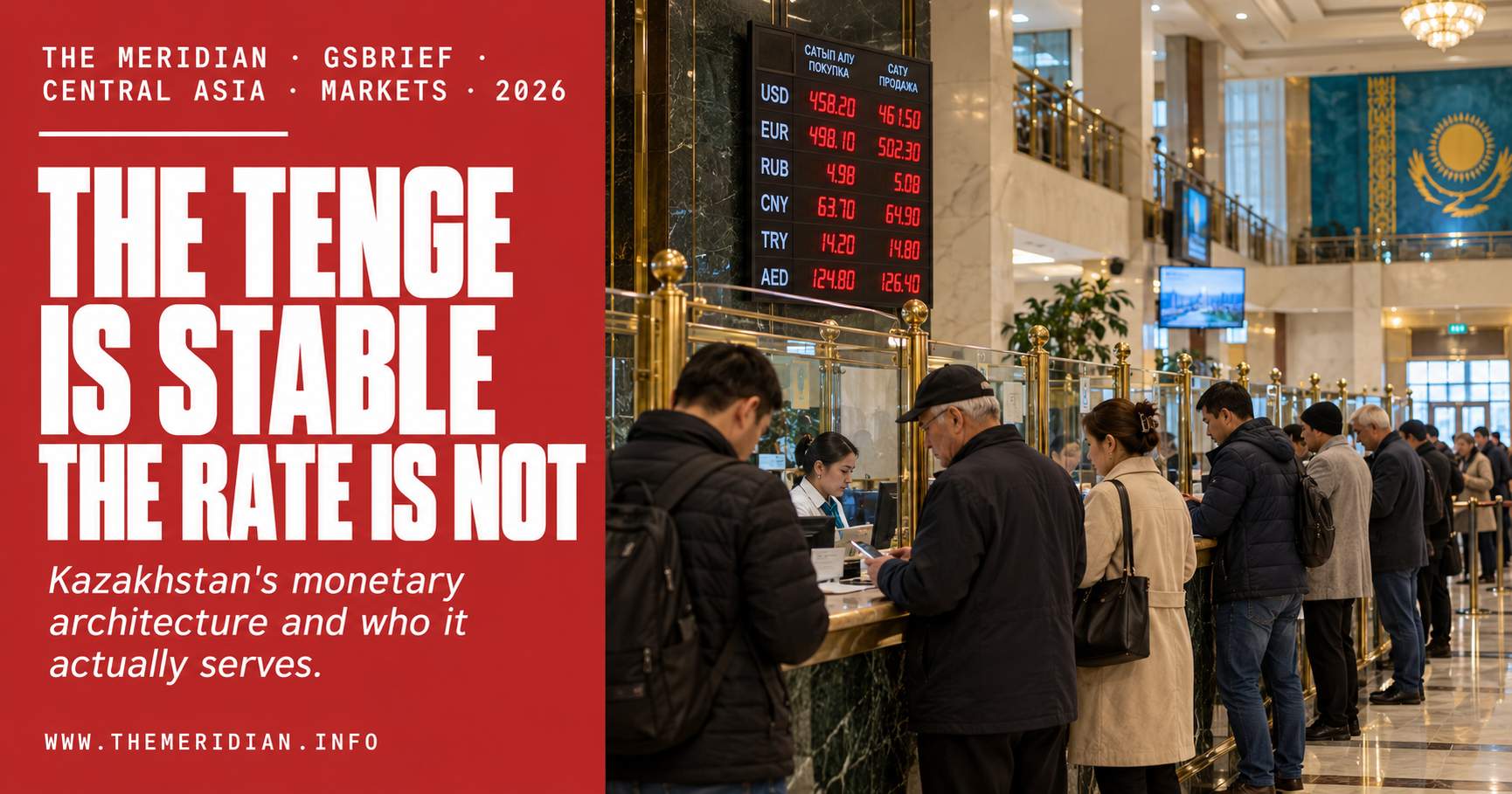
The National Bank of Kazakhstan cut its base rate four times in 2026, from 18 percent to 16.25 percent. The tenge has strengthened. Inflation is falling. The weighted average commercial lending rate to businesses in November 2025 was 22.3 percent. The gap between those two numbers is where Central Asia's private sector development problem lives.
On September 4, 2026, the Monetary Policy Committee of the National Bank of Kazakhstan set the base rate at 16.25 percent, the fourth cut of the year. The rate had stood at 18 percent since October 2025. The cuts came as inflation slowed -- the NBK cited a rate of 9.8 percent by the time of the September decision -- and as the tenge strengthened, moving from approximately 514 tenge per US dollar in December 2025 to 487.4 tenge by June 2026. On the indicators the central bank directly controls, Kazakhstan's monetary policy is working in the intended direction. The question is what happens between the policy rate and the rate at which a small business in Almaty or Aktau can borrow money to invest in its own growth.
The answer, documented by the OECD's Financing SMEs and Entrepreneurs 2026 report, is a gap of approximately four to six percentage points. The SME lending rate in Kazakhstan in 2025 was 20 percent. The rate on loans to large enterprises was 17.4 percent. The weighted average tenge business lending rate across the entire banking sector in November 2025 was 22.3 percent, according to NBK data cited by DKNews. The NBK's own communications acknowledged the asymmetry directly: deposit pricing responds to base rate cuts faster than retail lending rates do. Banks, as the same source noted, are unlikely to rush into significant reductions. The transmission mechanism exists. It is slow, incomplete, and skewed against the borrowers who need it most.
The structure of the problem is legible in the data. The base rate represents the cost of money in the interbank market. Commercial lending rates represent the cost of money for businesses, after the banking sector has added its credit risk premium, its operational margin, and its assessment of the borrower's collateral and repayment capacity. In well-functioning credit markets with competitive banking sectors, the spread between the policy rate and the SME lending rate is typically two to four percentage points. In Kazakhstan it runs to six percentage points between the September base rate and the November 2025 weighted business lending average. In Uzbekistan the lending rate was 23.35 percent in October 2025, even higher than Kazakhstan despite Uzbekistan's GDP growing at 7.7 percent in 2025.
The spread between the NBK base rate and the SME commercial lending rate is not a technical anomaly. It is a structural feature of the credit market. Kazakhstan's banking sector has 23 licensed commercial banks. Lending is concentrated. The largest institutions set pricing that smaller banks follow. When the base rate rises, commercial rates adjust upward rapidly -- the SME rate in 2024 was 20 percent against a base rate of 18 percent, a spread of two points. When the base rate falls, commercial rates adjust slowly -- the SME rate in 2025 was still 20 percent even as the base rate had been at 18 percent through October before the June 2026 cut cycle began. The asymmetry is not accidental. It reflects the pricing power of institutions that face limited competitive pressure from alternative sources of credit.
The tiering within the commercial rate structure is equally legible. Large enterprises pay 17.4 percent. SMEs pay 20 percent. The difference is attributed to credit risk: larger companies have more collateral, more audited financial history, more predictable cash flows, and stronger negotiating positions with lenders. This is a standard risk-pricing rationale. It is also a structural barrier that prevents the businesses employing 48 percent of Kazakhstan's workforce from accessing credit at rates consistent with investment in productive capacity. SMEs generated 40.9 percent of Kazakhstan's GDP in 2025 while borrowing at a rate that leaves a thin margin for profitable expansion in all but the highest-return activities.
The NBK sets the base rate. The banks set the commercial rate. The spread between them is where the private sector's access to capital is determined. That spread has not narrowed in proportion to the policy cuts. It will not narrow automatically.
The government's response to the credit access problem is subsidisation rather than structural reform of the credit market. The Damu Entrepreneurship Development Fund, operating since 2010, places state funds in commercial banks for on-lending to SMEs at concessional rates under the Business Roadmap programme. The government essentially pays the spread between the commercial rate and the rate at which it wants SMEs to be able to borrow. This is a mechanism that provides access to credit for priority sectors and regions but does not change the underlying architecture that produces the gap. The commercial rate for non-subsidised borrowers remains 20 percent. The state subsidy is the patch, not the repair.
The Uzbekistan comparison illuminates the regional dimension. Uzbekistan's commercial lending rate was 23.35 percent in October 2025, higher than Kazakhstan's despite Uzbekistan having reduced state participation in its economy from 55 to 37 percent and grown GDP at 7.7 percent in 2025. The structural credit problem in Central Asia is not Kazakhstan-specific. It is a regional feature of banking systems where state-owned banks remain large, alternative financing markets are underdeveloped, and monetary policy transmission through the commercial banking channel is structurally limited. GSBrief covered the Uzbekistan structural story in an earlier analysis. The credit cost data shows that the structural reforms which produced GDP growth have not yet produced credit market conditions consistent with the private sector scale that the growth rate suggests.
The tenge's stabilisation since 2022 is a genuine monetary policy achievement. Kazakhstan's currency depreciated sharply following the Russian invasion of Ukraine and the associated sanctions shock, but the NBK's sustained high rates defended the currency through 2023 and 2024. By June 2026, the tenge had strengthened to 487.4 per US dollar from approximately 514 in December 2025. The NBK governor confirmed that the stronger tenge had reduced import price pressures and contributed to the disinflation trend that made the 2026 rate cuts possible. This is the intended sequence working as designed.
The question the tenge's strength raises for commercial credit is the dollarisation dynamic. When the tenge is perceived as likely to depreciate, businesses prefer to borrow in tenge -- accepting a high rate in exchange for certainty about their repayment obligations in a currency they earn revenue in. When the tenge strengthens, dollar lending becomes more attractive to some borrowers because the effective tenge cost of dollar debt falls. Kazakhstan's business credit in foreign currency was approximately KZT 5.4 trillion in March 2026 against KZT 18.4 trillion in local currency -- a foreign currency share of roughly 23 percent of business lending. This is not an alarming level of dollarisation, but it limits the NBK's ability to influence total business credit costs through tenge rate decisions alone.
The case for the NBK's current approach is not without substance. Cutting rates too fast in an environment where inflation has not yet reached the single-digit target risks reigniting price pressures and tenge depreciation, which would erase the monetary gains of the past two years. The SME loan portfolio grew 18.6 percent in 2025 and new lending grew 7.9 percent, which means credit is flowing at increasing volumes even at current rates. The Eurasian Development Bank forecast in December 2025 that the base rate would fall to 14 percent by year-end 2026 -- a further 225 basis points from the current 16.25 percent -- which, if realised, would compress the spread and bring SME rates meaningfully closer to viable investment thresholds.
If the EDB forecast is correct and the base rate reaches 14 percent by December 2026, the relevant question is not whether SME rates will fall. They will, eventually, with a lag. The question is whether a 14 percent base rate, with a four to six point spread, produces an SME lending rate of 18 to 20 percent -- which is still structurally prohibitive for most productive investment -- or whether competition in the banking sector intensifies enough to compress the spread alongside the base rate. Kazakhstan's banking concentration, limited alternative capital markets, and the government's subsidisation model do not currently suggest the spread will compress automatically. The base rate is the instrument. The credit market architecture is the constraint.
The public article maps the rate architecture. The intelligence product models its impact on specific sectors and portfolios. GSBrief and The Meridian Economic Intelligence produce commissioned research on Central Asian monetary policy, credit market dynamics, and the cost of capital for organisations evaluating investment, lending, or institutional exposure across Kazakhstan, Uzbekistan, and the broader region.
We can assess the NBK rate trajectory and its transmission to commercial rates, model the credit cost environment for specific sectors, analyse the Damu Fund's subsidisation reach and its limitations, and evaluate the banking sector concentration dynamics that maintain the spread.
Contact us: editor@themeridian.info
Four base rate cuts in 2026, a strengthening tenge, and falling inflation represent the most favourable monetary environment Kazakhstan has seen in several years. The NBK is doing what central banks are designed to do. The transmission of those cuts through the commercial banking system into the credit costs faced by the 97 percent of Kazakhstan's enterprises that are small and medium-sized is where the policy intention meets the market reality.
The SME lending rate of 20 percent in 2025 against a base rate of 18 percent is not a crisis. It is a structural condition. The same spread applied at a 14 percent base rate produces an SME rate of 18 percent. An 18 percent cost of borrowing is still structurally prohibitive for most investment in productive capacity outside the highest-margin sectors. The private sector in Central Asia needs monetary easing. It also needs a banking sector that transmits that easing competitively and capital markets that offer alternatives to bank credit. Neither of those structural conditions is currently in place.
The tenge is the vehicle. The base rate is the fuel. The credit market architecture is the road. GSBrief's view, consistent across every Kazakhstan article in this series, is that the road is the constraint. The vehicle can improve and the fuel can be refined without the road being built. Until the spread compresses, the cuts are a signal without a destination.
Kazakhstan's National Bank set the base rate at 16.25 percent per annum on September 4, 2026, the fourth rate cut of the year. The rate had stood at 18 percent since October 2025. The NBK cut to 17 percent on June 5 -- the first cut since October 2025 and described as a surprise by ING analysts -- citing slowing inflation and tenge strength. Subsequent cuts on July 24 to 16.75 percent and September 4 to 16.25 percent followed, totalling 175 basis points of easing in 2026. The Eurasian Development Bank forecast in December 2025 that the rate would fall to 14 percent by year-end 2026.
The SME lending rate in Kazakhstan was 20.0 percent in 2025, according to the OECD's Financing SMEs and Entrepreneurs 2026 report. The rate for large enterprises was 17.4 percent, a spread of 2.6 percentage points reflecting the higher credit risk premium charged to smaller borrowers. The weighted average tenge business lending rate across the entire banking sector reached 22.3 percent in November 2025, according to NBK data. The National Bank's own communications acknowledged that commercial lending rates adjust to base rate cuts more slowly than deposit rates.
The spread between Kazakhstan's base rate and commercial SME lending rates reflects several structural factors. Kazakhstan's banking sector is concentrated among 23 licensed commercial banks with limited competitive pressure to reduce lending margins. SMEs are assessed as higher credit risks than large enterprises, commanding a premium to cover expected defaults. The government's own subsidisation model through the Damu Fund indicates that the market rate is not viable for broad SME access, which is why the state pays the spread for priority borrowers. Alternative capital markets -- bonds, equity, venture -- remain underdeveloped, limiting competitive pressure on bank lending. The NBK itself confirmed that "banks are unlikely to rush into significant cuts" following base rate reductions.
Uzbekistan's commercial bank lending rate was 23.35 percent in October 2025, approximately five points above Kazakhstan's base rate and three points above Kazakhstan's weighted business lending rate. This places Uzbekistan's credit costs higher than Kazakhstan's despite Uzbekistan having grown GDP at 7.7 percent in 2025 and reduced state participation in the economy from 55 to 37 percent. The structural credit problem in Central Asia is regional rather than country-specific: banking sectors dominated by state-owned institutions, limited alternative financing markets, and monetary policy transmission channels that are structurally constrained produce persistently high commercial rates even when policy rates are declining.
Small and medium-sized enterprises accounted for 97.3 percent of all enterprises in Kazakhstan in 2025, employed approximately 48 percent of the total workforce, and generated 40.9 percent of GDP in 2025, up from 36.5 percent in 2022. The outstanding SME loan portfolio grew 18.6 percent in 2025 to KZT 9,343 billion, and new SME lending grew 7.9 percent. Despite this scale and growth, SMEs pay a commercial lending rate of 20 percent compared to 17.4 percent for large enterprises, and the government maintains an active subsidisation programme through the Damu Fund to compensate for the gap between the market rate and the rate at which viable investment becomes possible.
Add comment
Comments