Globalisation Is Not Dying. It Is Being Rewired. And the New Wiring Bypasses Most of the Global South.
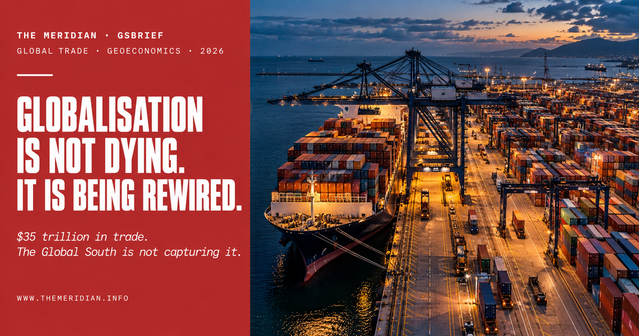
World trade reached a record $35 trillion in 2025. Goods and services trade is projected to grow another 4% in 2026. Global growth is slowing to 2.6%. Developing economies as a group are falling from 4.7% to 4% growth while income convergence with advanced economies has stalled since the mid-2010s. Developed economies captured 70% of greenfield investment in strategic sectors between 2020 and 2025. An advanced AI server rack sends 68% of its value to post-tax profits and under 15% to workers. UNCTAD's Trade and Development Report 2026 is not a story about the death of globalisation. It is a story about who globalisation now works for.
The standard argument against the deglobalisation thesis points to the numbers: world trade hit a record $35 trillion in 2025, goods and services trade is expanding at roughly 4% in 2026, and supply chains, however reorganised, are not collapsing. UNCTAD's Trade and Development Report 2026 accepts the numbers and reframes the question. The issue is not whether trade is happening. It is who is organising it, who is setting its terms, who is capturing its value, and which economies are being repositioned from participants in the system to suppliers of raw inputs into somebody else's industrial strategy.
The headline growth figures carry the tension. Global growth slows from 2.9% in 2025 to 2.6% in 2026. Developing economies as a group drop from 4.7% to 4%. The aggregate developing-economy figure conceals a more pointed divergence: a handful of fast-growing Asian economies -- India at 7.3%, Indonesia at 5.2%, Vietnam at 7.8%, Uzbekistan at 7.9%, Kyrgyzstan at 8.8% -- are driving the group average upward while much of the rest falls behind. Asia accounts for 59% of global growth in 2026. Outside those economies, UNCTAD documents a pattern that has been building for over a decade: income convergence between developing and advanced economies has stalled since the mid-2010s. The gap is not closing. In many cases it is widening.
The most instructive data point in the UNCTAD report is not a country-level growth figure. It is a product-level case study. UNCTAD traces the value chain of an advanced AI server rack and finds that post-tax profits captured 68% of the value added along the supply chain. Workers received under 15%. The product is manufactured in a relatively small number of locations, assembled from components concentrated in East Asia and a handful of other economies, and the value it generates accumulates overwhelmingly at the point of intellectual property ownership and financial return rather than at the point of physical production.
"Developed economies captured 70% of announced greenfield investment in semiconductors, AI infrastructure and clean technologies between 2020 and 2025. Developing economies received 60% of new FDI in critical minerals. The pattern is not coincidental."
This is the Corridor Test applied at global scale. The server rack case study illustrates a broader pattern that UNCTAD documents across the strategic sectors defining the next phase of industrial development: semiconductors, AI infrastructure and energy-transition technologies. Between 2020 and 2025, developed economies attracted approximately 70% of the value of announced greenfield investment in those sectors. Developing economies, by contrast, account for 60% of new foreign direct investment in critical minerals and strategic materials. The division is not random. Advanced economies are receiving the investment that produces finished goods and captures intellectual property rents. Developing economies are receiving the investment that extracts the inputs those goods require.
The geoeconomic rewiring that UNCTAD describes is not primarily about trade declining. China-US trade has fallen by more than 20% since 2024, but East Asia has expanded trade with both China and North America simultaneously, absorbing and rerouting flows that the direct bilateral channel is no longer carrying. The overall trade volume holds. What changes is the architecture: governments are increasingly using industrial policy, export controls, investment screening and supply-chain conditions to pursue strategic goals, particularly in sectors tied to national security and technology leadership. The result, as UNCTAD frames it, is that globalisation continues, but along newly contested lines, and those lines are being drawn by governments with the fiscal capacity to subsidise, restrict and redirect that most developing economies do not possess.
Official development assistance is projected to fall almost 7% in 2026, its third consecutive annual decline. Portfolio capital flow volatility has doubled since the West Asia conflict began. Brent crude rose from approximately $70 to over $110 per barrel in the weeks after the conflict began, imposing an energy cost shock on every net importing economy. For developing economies that are simultaneously losing aid, facing higher energy costs, and watching strategic investment flow primarily to advanced economies, the fiscal space to mount any equivalent industrial policy response is close to absent. The traditional routes to income convergence -- manufacturing expansion, merchandise export growth, global value chain participation -- are becoming less reliable precisely as the new routes require fiscal and institutional resources that most developing economies cannot mobilise.
There are genuine signals of Global South agency in the UNCTAD report. India has agreed to share its digital public infrastructure with 23 countries, an architecture that could reduce the cost of financial inclusion and government service delivery across a significant portion of the developing world. Brazil is extending its Pix instant-payment system across South America. Renewables now cost less than the cheapest new fossil-fuel alternative in more than 90% of cases globally, which in principle reduces the energy cost barrier to industrial development for countries that can build the grid. The question UNCTAD leaves open is whether these instruments of domestic or regional agency are sufficient to offset the structural disadvantage imposed by the concentrated flow of strategic-sector investment into advanced economies. The signals are real. The arithmetic of the investment distribution is also real, and at present the arithmetic is stronger than the signals.
The World Bank has announced plans to increase its minerals financing from $3.6 billion during 2021-25 to $19 billion during 2026-30, with 20 potential partner countries identified. Its stated objective is to retain more processing, employment and value inside producer countries. Whether this represents a genuine shift in the extractive model or a better-organised version of the existing one is the editorial question GSBrief will continue to track.
The Meridian Economic Intelligence tier produces institutional briefs on global trade flows, geoeconomic investment patterns and developing-economy industrial capacity. Commissioning enquiries: editor@themeridian.info
The UNCTAD Trade and Development Report 2026 is not a counsel of despair. It acknowledges the genuine growth of fast-moving Asian economies, the real potential of digital public infrastructure, the structural advantage that cheaper renewables offer to countries building new energy systems from scratch. It does not dismiss the record trade volume as meaningless.
What it documents, with granular precision, is the distribution problem. An AI server rack that sends 68% of its value to profits and under 15% to workers is a compressed version of the wider pattern: strategic sectors are generating large returns, and those returns are accumulating in the economies, companies and financial structures that own the intellectual property, control the platforms and have the fiscal capacity to protect the position through industrial policy. Developing economies are receiving the minerals investment, not the manufacturing investment. They are participating in global value chains, not anchoring them.
Globalisation is being rewired. The rewiring is not neutral. Understanding which economies are becoming regional anchors and which remain throughput nodes in somebody else's industrial strategy is the essential analytical task for any serious engagement with the global economy in 2026. UNCTAD has provided the framework. The country-level evidence is what GSBrief will continue to build.
UNCTAD's case study shows that 68% of the value in an AI server rack goes to profits and under 15% to workers. The physical manufacture of that rack occurs overwhelmingly in East Asia and a small number of other locations. The question GSBrief leaves open is this: if developing economies supply the critical minerals that go into the server rack, manufacture components in its lower-value portions of the supply chain, and provide the energy that runs the data centres the rack populates, what specifically would need to change -- in ownership structure, in intellectual property law, in industrial policy capacity, or in multilateral trade rules -- for those economies to capture a share of the 68% that currently flows elsewhere?
GSBrief · The Global South BriefPublished by The Meridian (themeridian.info). All rights reserved. Reproduction of this article in whole or in part without written permission is prohibited. For licensing and syndication enquiries: editor@themeridian.info
UNCTAD found that globalisation is not reversing but is being reorganised along geoeconomic lines. World trade reached a record $35 trillion in 2025 and is growing 4% in 2026. But global growth slows to 2.6%, developing economies fall from 4.7% to 4% growth, income convergence has stalled since the mid-2010s, and developed economies captured 70% of strategic sector greenfield investment between 2020 and 2025.
UNCTAD's AI server rack case study found that 68% of value added goes to post-tax profits and under 15% to workers. AI is now a major driver of merchandise trade but the gains are concentrated in a small number of economies and companies that own the intellectual property and platform infrastructure.
They receive investment in critical minerals extraction but not in strategic manufacturing. Developed economies took 70% of strategic sector greenfield investment from 2020 to 2025. ODA is falling for the third consecutive year, capital flow volatility has doubled, and energy costs have risen sharply since the West Asia conflict began.
Asia dominates: Kyrgyzstan 8.8%, Uzbekistan 7.9%, Vietnam 7.8%, India 7.3%, Mongolia 7.0%, Tajikistan 6.6%, Indonesia 5.2%. Asia accounts for 59% of global growth in 2026. Outside these economies the income convergence trend has broadly stalled.
Geoeconomic fragmentation is the use of trade, industrial and financial policy for strategic and security purposes rather than purely commercial ones. Export controls, investment screening and subsidies are directing capital toward allied countries. Developing economies cannot match the fiscal firepower required to compete for strategic manufacturing investment, and traditional routes to income convergence are becoming less reliable as a result.
Add comment
Comments