Africa Is Growing at 4.5 Percent. Inflation Is Rising, Aid Is Falling, and the Climate Is Not Waiting.
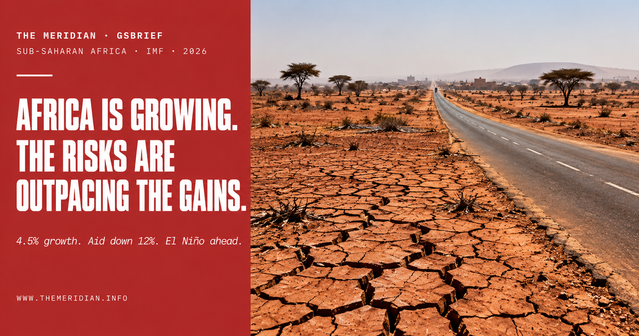
The IMF now forecasts 4.5% growth for Sub-Saharan Africa in 2026. The headline is better than last year. The structure underneath it is not. Median inflation is projected to rise from 3.4% in 2025 to 5% by 2027. Development assistance is forecast to fall another 12% this year. An intense El Niño weather system could reduce 2027 growth by approximately half a percentage point while pushing inflation up a further 2.6 percentage points. The IMF's Regional Economic Outlook Update for Sub-Saharan Africa, released 15 October 2026, is a study in the difference between economic expansion and economic resilience.
Growth of 4.5% in Sub-Saharan Africa in 2026 is a number that belongs in a press release about regional momentum. It is also a number that conceals a distribution problem, a fiscal problem, a monetary problem, and a climate problem that are all moving in the wrong direction simultaneously. The IMF's October 2026 Sub-Saharan Africa Regional Economic Outlook documents the headline and then systematically qualifies every component of it. What emerges is not a picture of a region building resilience from a growth foundation. It is a picture of a region growing despite the progressive removal of the external conditions that have historically supported that growth.
The most straightforward tension is between growth and inflation. While overall regional growth is strengthening, median inflation is moving in the opposite direction: from 3.4% in 2025 to a projected 5% by 2027. The rise is not uniform across the region, and it does not originate primarily from domestic monetary policy failure. The energy price shock that followed the West Asia conflict has passed through import costs into consumer prices in economies that import refined petroleum products, which is most of Sub-Saharan Africa. Food price volatility tied to climate disruption compounds the import channel. The net effect is that the purchasing power of household incomes in much of the region is being eroded at the same time as growth figures suggest expansion. The expansion is real. So is the erosion.
The second structural pressure is the aid environment. Official development assistance to Sub-Saharan Africa is forecast to fall by another 12% in 2026. This is the third or fourth consecutive year of declining external finance for much of the region, depending on the country in question. The cumulative effect is a progressive narrowing of fiscal space for governments that cannot easily replace ODA with domestic revenue mobilisation at the speed aid is contracting. Public investment in health, education and climate adaptation that was partially financed by concessional flows is being squeezed. Governments face a choice between cutting the programmes or borrowing commercially to maintain them, at interest rates that are materially higher than the concessional rates ODA carried.
"Africa may be growing, but governments possess increasingly limited capacity to protect households from food, fuel and climate shocks when the instruments that would fund that protection are contracting."
This is not an abstract fiscal observation. It translates directly into the capacity of governments to respond to the third risk the IMF identifies: climate volatility. An intense El Niño weather system would, according to the IMF's modelling, reduce 2027 growth by approximately half a percentage point across the region while simultaneously raising inflation by 2.6 percentage points. For governments with adequate fiscal reserves and low existing debt, an El Niño shock is a manageable if painful disruption. For governments that have spent the past three years absorbing successive shocks with diminishing concessional finance and elevated commercial borrowing costs, it arrives as a compounding event in a sequence that has not yet allowed any recovery of buffers.
The 4.5% growth figure for Sub-Saharan Africa as a whole is a weighted average that includes fast-growing resource exporters, commodity-price beneficiaries, and a small number of economies with diversified and expanding domestic demand. It does not describe the experience of the median household in the median country in the region. Growth at the aggregate level is compatible with rising food insecurity in net food-importing economies, declining real wages in informal sectors where most employment is located, and increasing debt-service ratios in governments that borrowed commercially during the post-pandemic period and are now servicing those obligations at rates that were not anticipated when the borrowing occurred.
The IMF's framing -- that the figures expose the difference between economic expansion and resilience -- is precise. An economy can expand in gross terms while simultaneously becoming more fragile: more exposed to external shocks, less able to buffer its population against price volatility, and less capable of investing in the productive capacity that would make the expansion self-sustaining rather than dependent on commodity cycles or external finance flows that are themselves contracting.
The strongest case against this reading is that 4.5% growth in a high-interest, high-inflation, declining-aid environment represents a genuine demonstration of underlying economic resilience: that Sub-Saharan African economies are growing through a sequence of external shocks that would have produced larger contractions in earlier periods. There is demographic momentum behind the consumption and labour supply numbers. There is genuine private sector expansion in several economies. The mobile money infrastructure that has developed across East and West Africa represents a real structural change in financial inclusion that reduces transaction costs and broadens economic participation in ways that earlier growth episodes did not include.
These observations are accurate. The question they leave open is whether the structural improvements are accumulating fast enough to offset the simultaneous contraction of external support and the acceleration of climate risk. That question cannot be answered by a single year's growth figure.
The IMF's Regional Economic Outlook should be read alongside the World Bank Africa Economic Update released on 6 October 2026, which found that 47.8% of Sub-Saharan Africa's population lives below $3 per day despite comparable growth figures in recent years. The two documents together describe a region where economic expansion has not consistently translated into poverty reduction, and where the instruments that might accelerate that translation -- fiscal space, concessional finance, climate adaptation investment -- are contracting.
The Meridian Economic Intelligence tier provides institutional analysis on African fiscal dynamics, sovereign debt and climate exposure. Commissioning enquiries: editor@themeridian.info
The IMF's October 2026 Sub-Saharan Africa Regional Economic Outlook does what the best institutional forecasting does: it gives you the number and then explains why the number does not tell you what you need to know.
Growth of 4.5% in an environment of rising inflation, falling aid and compounding climate risk is expansion without accumulation. The region is growing, but the fiscal buffers that would allow governments to protect households in a bad year are not growing at the same pace as the headline figure suggests. The concessional finance that historically funded the social infrastructure making growth translate to welfare is being withdrawn. The climate system that periodically cuts the growth figure and raises the inflation figure is becoming more volatile, not less.
The question for any government in the region is not whether 4.5% growth is real. It is. The question is how much of that growth is being converted into the durable productive capacity, institutional strength and household welfare that would allow the economy to sustain a comparable outcome in 2027 when external conditions may be materially worse.
The IMF projects that an intense El Niño could reduce Sub-Saharan Africa's 2027 growth by half a percentage point and raise inflation by 2.6 percentage points -- in a region where official development assistance is already falling, where median inflation is already rising, and where fiscal buffers in many countries are already thin. At what point does the sequence of compounding external shocks -- energy price shock, aid withdrawal, climate volatility -- require not a growth forecast revision but a fundamental reassessment of which development model is viable in the current external environment?
GSBrief · The Global South BriefPublished by The Meridian (themeridian.info). All rights reserved. Reproduction of this article in whole or in part without written permission is prohibited. For licensing and syndication enquiries: editor@themeridian.info
The IMF's Regional Economic Outlook Update for Sub-Saharan Africa, released 15 October 2026, forecasts regional growth of 4.5% in 2026. This aggregate figure conceals significant variation between countries and does not reflect the experience of most households in the region, where inflation is rising and real wages in the informal sector are under pressure.
Median inflation is projected to rise from 3.4% in 2025 to 5% by 2027. The primary drivers are the energy price shock following the West Asia conflict, which raised import costs for refined petroleum products, and food price volatility linked to climate disruption. These are external shocks passing through to consumer prices rather than domestic monetary policy failures.
Development assistance is forecast to fall another 12% in 2026, continuing a multi-year decline. The practical effect is that public investment in health, education and climate adaptation is being squeezed. Governments that borrow commercially to maintain programmes face materially higher interest rates than the concessional rates ODA carried.
An intense El Niño could reduce Sub-Saharan Africa's 2027 growth by approximately half a percentage point while raising inflation by 2.6 percentage points. This would compound a situation where fiscal buffers are already thin, aid is declining and inflation is already projected to rise.
Economic expansion means GDP is growing. Economic resilience means an economy has the fiscal buffers, institutional capacity and structural depth to sustain growth through shocks and protect households when conditions deteriorate. The IMF's October 2026 report finds Africa demonstrating expansion while the conditions for resilience -- adequate fiscal room, stable concessional finance, managed climate exposure -- are weakening simultaneously.
Add comment
Comments