The IMF Says AI Is Holding Up World Growth. The Problem Is That Almost Nobody Outside a Handful of Countries Is Benefiting From It.
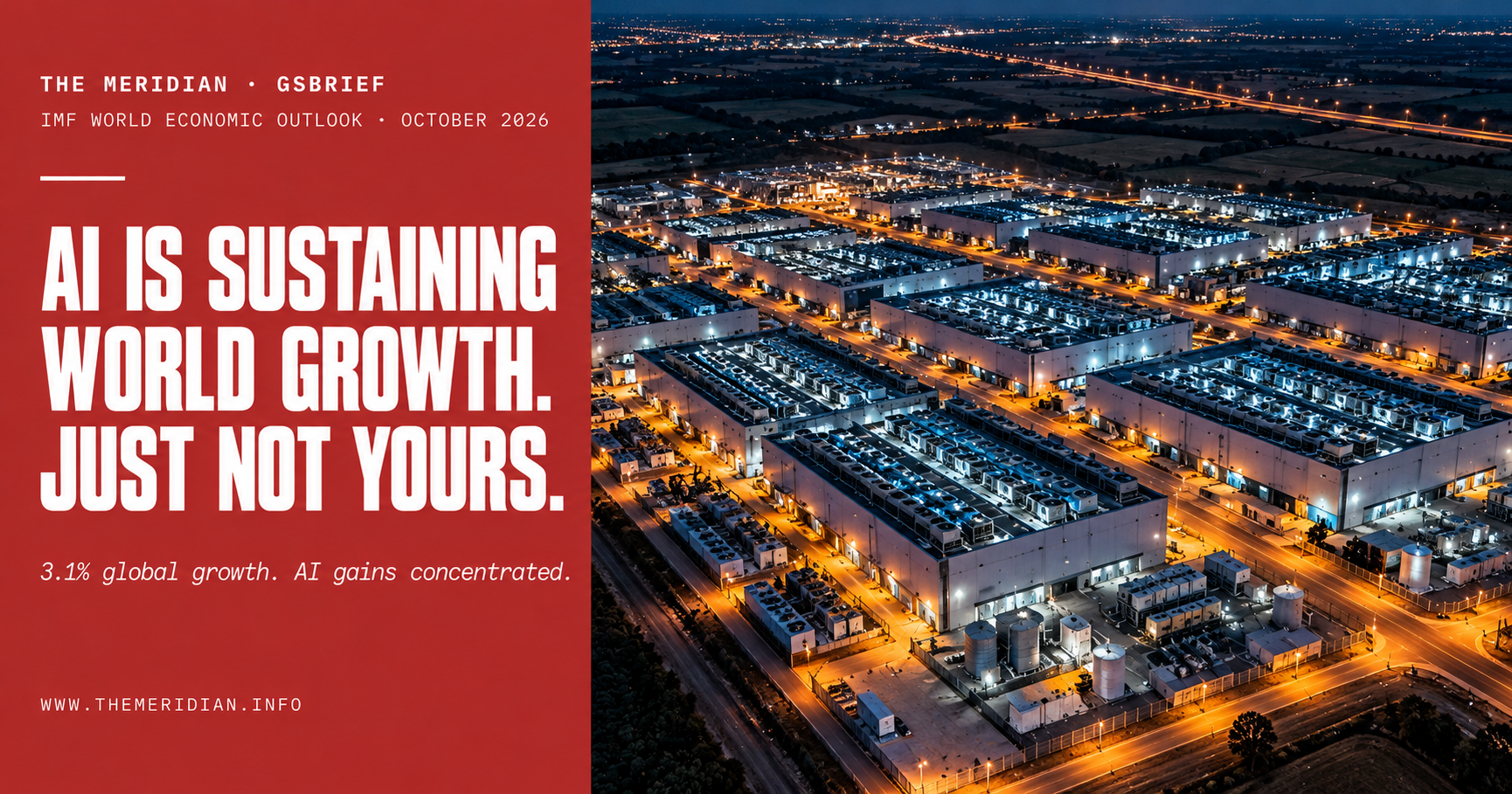
Global growth is 3.1% in 2026 and is projected to rise to 3.4% in 2027. The IMF's October 2026 World Economic Outlook briefing attributes the relative stability of these figures, against a backdrop of energy price shocks and geopolitical friction, primarily to AI. Investment in AI infrastructure and AI-related trade are counteracting the negative drag from elevated energy costs and geoeconomic fragmentation. There is one structural problem with that story: the supply chains and the investment flows that constitute the AI economy are concentrated in a relatively small number of countries, sectors and firms. For most of the Global South, AI is propping up a global growth figure they are not participating in generating.
The IMF's World Economic Outlook is the most widely cited economic forecast in the world, and the October 2026 edition carries a story that looks, at first reading, relatively reassuring: global growth of 3.1% in 2026, rising to 3.4% in 2027, maintained against the headwinds of a significant energy price shock and continuing geoeconomic fragmentation. The mechanism the IMF identifies as responsible for holding the global forecast up is artificial intelligence: AI investment and AI-related trade are providing a positive offset to the negative forces that would otherwise pull global growth lower. This is a significant finding. It is also a finding that requires immediate qualification, because the AI economy that is sustaining the global aggregate is not distributed in a way that reaches the majority of the world's economies.
The IMF's own framing of the distribution question is precise: AI supply chains are concentrated in relatively few countries, sectors and firms. This is not a qualification that appears in small print at the back of the outlook. It is a central structural observation about the nature of the growth that AI is generating. The investment flowing into AI infrastructure -- data centres, semiconductor fabrication, training compute, power systems -- is going overwhelmingly to a small number of countries and a small number of companies within those countries. The trade flows being driven by AI are similarly concentrated. When the IMF says AI is counteracting the drag from the energy shock, it is describing a mechanism that operates primarily within and between a small number of advanced economies and a handful of strategically positioned emerging markets. For most developing economies, the AI contribution to global growth is statistical background rather than operational reality.
The most analytically useful way to read the WEO finding is through a three-category lens that the IMF's own research implies but does not always make explicit.
Most of Sub-Saharan Africa, much of South Asia outside India, and large parts of Latin America fall into the second or third category. They are in the global economy that the IMF is measuring. They are not in the economy that is doing the work of counteracting the energy shock.
"High borrowing costs are simultaneously reducing governments' fiscal room. For countries that must borrow to invest in AI capacity, the price of entry is rising at the same time as the returns are concentrating elsewhere."
The second structural observation in the IMF's October 2026 WEO is that high borrowing costs are reducing governments' fiscal room to respond to the situation the first observation describes. The irony is precise: the period in which strategic AI investment is most important for long-term economic positioning is also the period in which the cost of the borrowing that would fund that investment is at its highest for much of the developing world. Countries that entered the current cycle with high debt-to-GDP ratios and external debt denominated in hard currencies are facing debt service costs that constrain their ability to direct public resources toward the infrastructure, skills and industrial policy that would improve their position in the AI value chain.
This is not a temporary problem that resolves when interest rates fall. The concentration of AI investment in advanced economies is self-reinforcing: early movers attract talent, build capacity, generate intellectual property and set the technical standards that future entrants will be required to adopt. The window in which strategic entry into AI infrastructure production is possible may be shorter than the window in which most developing economies will have the fiscal capacity to make that entry. The IMF does not say this explicitly. The structure of its own data implies it.
Global growth of 3.1% in 2026 is approximately where it was before the pandemic period, and its projection to 3.4% in 2027 is not dramatically below historical averages. In that sense the WEO carries a message of relative stability rather than crisis. The stability is real. It is also, as UNCTAD's Trade and Development Report published the previous week also found, increasingly organised around a smaller number of economies and sectors than the aggregate suggests. The global growth figure is an average. Averages average. A 3.1% global figure that reflects 7% growth in India, 6%+ growth in several Central Asian economies and 4.5% growth in Sub-Saharan Africa alongside much lower or negative growth in economies facing fiscal crisis, commodity price volatility and climate disruption is not the same economic situation as a 3.1% figure distributed more evenly across the world economy.
The IMF WEO should be read alongside the UNCTAD Trade and Development Report 2026, which documented that an AI server rack sends 68% of its value to post-tax profits and under 15% to workers, and that developed economies captured approximately 70% of greenfield investment in strategic sectors between 2020 and 2025. The two documents together describe a global economy where AI is generating real growth that is captured almost entirely within a narrow geography.
The GSBrief Central Asia evidence ledger tracks AI investment, digital infrastructure and industrial capacity across Kazakhstan, Uzbekistan, Kyrgyzstan, Tajikistan and Turkmenistan. The fastest-growing economies in the UNCTAD dataset -- Kyrgyzstan at 8.8%, Uzbekistan at 7.9% -- are Central Asian. Whether that growth reflects AI-economy integration or commodity and remittance dynamics is the editorial question GSBrief is building the evidence to answer.
The Meridian Economic Intelligence tier provides institutional analysis on AI concentration, geoeconomic investment patterns and emerging market positioning. Commissioning enquiries: editor@themeridian.info
The IMF World Economic Outlook October 2026 carries a legitimate story about AI and global growth. AI investment and AI-related trade are providing a real positive contribution that is helping to maintain global growth in a period of energy price shocks and geoeconomic fragmentation. This is documented, not speculative.
What the WEO also documents, in its structural observations about concentration, is that the story it is telling about global growth is not the story most of the world's economies are living. For most developing countries, the AI contribution to global growth is statistical. The supply chains are elsewhere. The investment is elsewhere. The intellectual property and the financial returns are elsewhere. High borrowing costs reduce the fiscal capacity to change that position, and the technical standards and platform architectures being established now will govern future market entry conditions on terms set by the countries that moved first.
GSBrief's framework distinguishes countries that manufacture AI infrastructure from those that import AI services and those that supply energy and minerals to the AI build-out. The IMF's October 2026 WEO provides strong institutional authority for that distinction. The global growth figure is 3.1%. For most of the Global South, the relevant question is not where that number sits relative to historical averages. It is which category they are in and whether the gap between categories is widening.
The IMF identifies AI as the primary positive force counteracting the energy shock and geoeconomic fragmentation in the October 2026 World Economic Outlook. The AI supply chains that produce this positive force are concentrated in a small number of countries, sectors and firms. High borrowing costs reduce the fiscal capacity of developing economies to enter those supply chains. At what point does a technology that sustains the global growth figure while concentrating its gains in a narrow geography cease to function as a development opportunity for the majority of the world economy, and become instead a new structural mechanism for divergence?
GSBrief · The Global South BriefPublished by The Meridian (themeridian.info). All rights reserved. Reproduction of this article in whole or in part without written permission is prohibited. For licensing and syndication enquiries: editor@themeridian.info
The IMF World Economic Outlook October 2026 briefing, released 13 October 2026, projects global growth of 3.1% in 2026, rising to 3.4% in 2027. AI investment and AI-related trade are identified as counteracting the negative drag from elevated energy costs and geoeconomic fragmentation.
AI investment and trade are providing a positive contribution to global growth. However, the IMF notes that AI supply chains are concentrated in a relatively small number of countries, sectors and firms, meaning the AI contribution to the global aggregate is generated primarily within advanced economies with limited direct participation by most developing countries.
AI infrastructure manufacturers have semiconductor fabrication, AI hardware design and data centre capacity and generate the investment flows the IMF credits for supporting global growth. AI service importers buy AI-enabled tools and experience real productivity benefits but do not capture the high-value manufacturing and intellectual property rents. Most developing economies fall into the importer or critical minerals supplier category.
High borrowing costs reduce fiscal capacity to invest in AI infrastructure, skills and industrial policy at precisely the moment when strategic positioning matters most. The period in which entry into AI supply chains is most important may be shorter than the period in which most developing economies will have the fiscal capacity to make that entry.
It is approximately consistent with pre-pandemic averages and reflects relative stability against significant headwinds. However, the aggregate averages together economies growing at 7%+ alongside economies under fiscal stress and climate disruption. The global stability does not describe the experience of economies outside the AI supply chain, where growth conditions are more constrained.
Add comment
Comments