India's Quiet Acquisition of the Indian Ocean
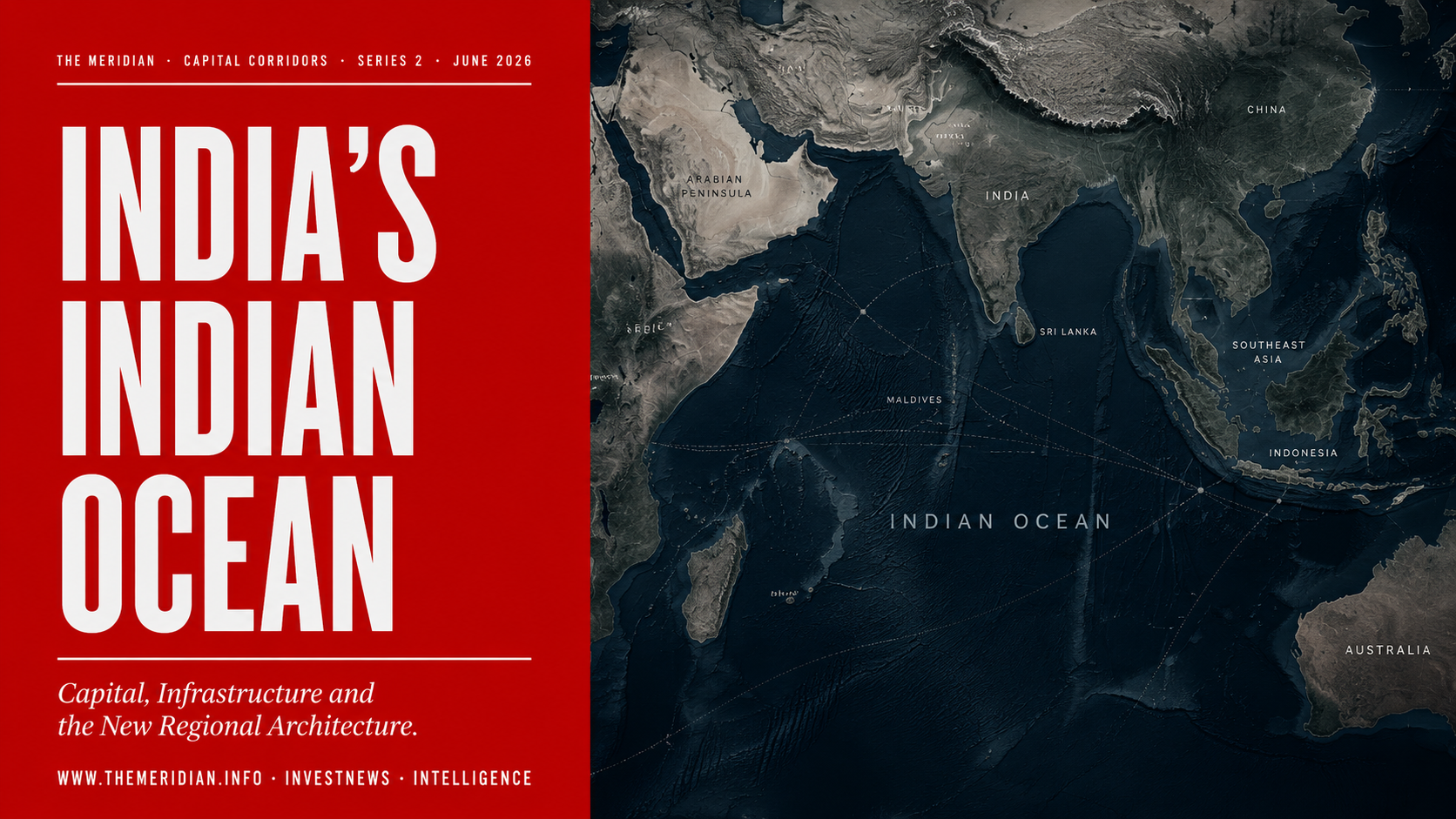
How Indian state-backed entities, private conglomerates and digital infrastructure are methodically moving into Mauritius, the Maldives, Sri Lanka, Seychelles and Madagascar. What island states are receiving, what they are conceding, and what the investment architecture looks like from the inside. This is the second article in The Meridian's Capital Corridors series on investment flows across Asia, Africa and the Indian Ocean.
When Prime Minister Narendra Modi arrived in Port Louis in March 2015 and signed five agreements with Mauritius, including a deal to develop infrastructure on the remote island of Agaléga, most commentators treated the event as a routine diplomatic visit. It was not. It was the visible surface of a capital deployment strategy that has been expanding quietly, systematically and with considerable sophistication across the Indian Ocean for more than a decade.
India's engagement with the Indian Ocean island states is not aid. It is not charity. It is not soft power for its own sake. It is a structured, state-backed investment programme designed to achieve three simultaneous objectives: secure strategic infrastructure along maritime trade routes that carry forty percent of the world's seaborne trade, embed Indian digital and financial architecture into the economic systems of neighbouring states before China does the same, and position Indian private capital for the returns that follow once the infrastructure is in place and the regulatory frameworks have been aligned.
Understanding this requires separating what India says from what it does. The official language is all Neighbourhood First, SAGAR doctrine, Security and Growth for All in the Region, mutual benefit, development partnership. The operational reality is considerably more specific: runways long enough for P-8 maritime patrol aircraft, deep-water jetties capable of hosting naval vessels, payment infrastructure that routes transactions through Indian systems, pharmaceutical supply chains that lock in dependency, and financial structuring through Mauritius that serves Indian capital as much as Mauritian sovereignty.
"India is not building relationships in the Indian Ocean. It is building architecture. The relationships are the vehicle. The infrastructure, the digital integration and the capital flows are the destination."
India's Indian Ocean investment strategy operates through four distinct but interconnected channels. The first is sovereign credit through the Export-Import Bank of India, which extends concessional Lines of Credit to partner governments for infrastructure projects on the condition that a minimum of seventy-five percent of goods and services are sourced from India. This is not aid. It is export finance structured to create infrastructure dependency while generating Indian export revenues.
The second channel is direct state-to-state agreements for strategic infrastructure, the most significant of which is the Agaléga development in Mauritius and the Coastal Surveillance Radar networks installed across the Maldives and Seychelles. These are funded by India but serve Indian strategic interests as much as host country interests.
The third channel is digital infrastructure. UPI, now operational or linked with payment systems in Mauritius, Sri Lanka, the UAE, Singapore, and eight other countries, is not merely a payment convenience. It is the most effective means yet devised of embedding Indian financial architecture into host country economies. Every transaction that flows through UPI generates data in Indian systems, reduces dependency on Western payment rails, and creates a structural link between the host economy and India that is considerably harder to unwind than a physical infrastructure project.
The fourth channel is private capital routing. Mauritius, by virtue of its treaty architecture and VCC structuring capabilities, serves as the primary conduit through which Indian private equity, family office capital, and institutional funds route into Africa and the wider Indian Ocean. This gives Mauritius a structural role in Indian capital strategy that is independent of any individual government relationship.
Mauritius occupies a singular position in India's Indian Ocean strategy. It is simultaneously a strategic military partner, a financial routing hub for Indian capital into Africa, a UPI-linked digital economy, and a politically sensitive bilateral relationship in which seventy percent of the Mauritian population trace their heritage to India.
The Agaléga development is the most visible element. India has constructed a three-kilometre runway on the remote northern Mauritius island, along with two deep-water jetties, radar installations and what satellite imagery suggests is accommodation and support infrastructure consistent with a permanent forward operating base. Both governments describe this as a logistics facility and coast guard support project. The runway's length, capable of accommodating the Indian Navy's Boeing P-8I maritime patrol aircraft, tells a more complete story. India has, in practical terms, established a forward surveillance and operational capability approximately 1,100 kilometres north of mainland Mauritius and 1,767 kilometres from Diego Garcia.
The financial architecture is equally significant. Mauritius maintains Double Taxation Avoidance Agreements with India and more than forty other countries. The Variable Capital Company structure, introduced in 2022, allows Indian family offices and institutional investors to establish multi-cell fund structures in Mauritius that route capital into Africa through a compliant, treaty-protected framework. The Financial Services Commission estimates that Mauritius-based funds manage exposure to over thirty African jurisdictions. A significant proportion of that capital originates from India.
In 2025, India agreed to provide an additional USD 680 million in economic assistance to Mauritius covering healthcare, infrastructure and maritime security. The healthcare component includes pharmaceutical supply arrangements that will deepen Mauritius's dependency on Indian generic manufacturers -- a dependency that is commercially advantageous for Indian pharma exporters and strategically useful for the bilateral relationship.
What India is deploying: USD 680 million economic assistance package, Agaléga military-logistics facility (USD 87 million+), UPI-MauCAS digital payment integration via RuPay, pharmaceutical supply arrangements, concessional credit lines for infrastructure. What Mauritius is receiving: infrastructure funding, digital payment connectivity, defence capability support, economic assistance. What Mauritius is conceding: strategic sovereignty over Agaléga, structural dependency on Indian pharmaceutical supply, routing of capital transactions through Indian-designed digital architecture.
India's engagement with Sri Lanka illustrates how economic crisis becomes a structural investment opportunity for a well-positioned neighbour. When Sri Lanka's economy collapsed in 2022, running out of foreign exchange, unable to import fuel or food, facing the worst economic crisis since independence, India moved with a speed and scale that no other bilateral partner matched.
Total Indian financial support to Sri Lanka during the crisis and its immediate aftermath reached approximately USD 1.9 billion: a USD 400 million currency swap, a USD 500 million credit line for food and medicine through the State Bank of India, a USD 55 million credit line for fertiliser through India Exim Bank, and USD 1 billion in additional credit for fuel. This was not philanthropy. It was the largest bilateral economic intervention in Sri Lanka's history, and it came with the standard India Exim Bank condition: the majority of goods and services procured under the credit lines must be sourced from India.
The digital dimension followed. Sri Lanka launched UPI in 2023, linking its payment infrastructure to India's system. Six Sri Lankan banks established Nostro accounts in Indian rupees, facilitating trade finance with Indian counterparties. The Reserve Bank of India designated the rupee as a currency for bilateral trade settlement. By 2024 and 2025, Sri Lankan banks were lending excess foreign currency liquidity to Indian banks, completing a financial integration loop that would have seemed improbable five years earlier.
On port infrastructure, India's engagement has been more contested. The 2019 agreement for India and Japan to develop Colombo Port's eastern container terminal was cancelled amid domestic political resistance. India was subsequently offered the western container terminal through Adani Group, while the eastern terminal went to a Chinese company. This division of the port between Indian and Chinese interests reflects the structural tension that defines Sri Lanka's position: too strategically important to be left to one power, too economically weak to resist either.
What India is deploying: USD 1.9 billion in crisis credit lines (2022), UPI integration and RuPay linkages, rupee trade settlement framework, Adani Group port terminal development, Maritime Rescue Coordination Centre in Colombo with sub-centre at Hambantota, INR-LKR banking corridors. What Sri Lanka is receiving: emergency financial stabilisation, digital payment infrastructure, port development capital. What Sri Lanka is conceding: procurement dependency under EXIM credit conditions, digital infrastructure aligned with Indian systems, strategic positioning of Indian corporate interests in port infrastructure.
No Indian Ocean relationship better illustrates the limits of India's acquisition strategy than the Maldives. India has invested more deeply in Maldivian security infrastructure than in almost any other Indian Ocean partner: a ten-station Coastal Radar System handed over by External Affairs Minister Jaishankar, helicopter and aircraft operated by Indian personnel for surveillance and rescue missions, development assistance across housing, water and connectivity projects, and a planned bridge project described as the largest infrastructure project in Maldivian history at four times the length of the Chinese-built Sinamalé Bridge.
And yet the political trajectory has been one of recurring, embarrassing reversal. The Maldivian government that took power in late 2023 campaigned explicitly on an India Out platform, signed a military assistance agreement with China, and asked India to withdraw the approximately eighty security personnel operating the surveillance aircraft. India responded by commissioning a new naval base, INS Jatayu, on Minicoy Island in its Lakshadweep archipelago in March 2024 -- a strategic counter that places Indian naval capability closer to the Maldives without requiring Maldivian permission.
The Maldives case demonstrates a fundamental vulnerability in India's Indian Ocean investment strategy. Physical infrastructure can be built. Digital systems can be installed. But political alignment in small democracies with active opposition politics cannot be purchased indefinitely with credit lines and radar stations. The China-Maldives dynamic that India fears most -- a government in Male that tilts decisively toward Beijing -- is precisely the outcome that heavy-handed Indian security engagement has repeatedly risked provoking.
What India is deploying: Coastal Radar System (10 stations, integrated with Indian Navy IFC-IOR), helicopter and aircraft operations, housing and water infrastructure projects, planned bridge project (4x length of Chinese Sinamalé Bridge), development assistance across multiple sectors. What the Maldives is receiving: security infrastructure, development capital, connectivity projects. What the Maldives is conceding: partial intelligence integration with Indian naval systems, exposure to political backlash domestically. The relationship is the most politically unstable in India's Indian Ocean portfolio and the most actively contested by China.
Seychelles occupies the western anchor of India's Indian Ocean surveillance network. India has installed a Coastal Surveillance Radar system on Mahé Island, the country's capital, feeding into the Indian Navy's Information Fusion Centre for the Indian Ocean Region. Four agreements signed during Modi's visit covered hydrographic survey, renewable energy, infrastructure development and joint navigation chart production. India offered a USD 500 million concessional credit line for infrastructure projects.
The Assumption Island episode is instructive. India sought to develop strategic assets on Assumption Island, a remote Seychellois territory. The project was subsequently blocked by the Seychellois government following civil society opposition concerned about sovereignty and militarisation. India eventually withdrew the proposal. The episode parallels the Agaléga sensitivity in Mauritius: island populations in the Indian Ocean have long memories of sovereignty being traded away by distant governments, and the post-Chagos political climate makes any infrastructure deal with a geopolitical dimension acutely sensitive to public scrutiny.
What survived the Assumption Island setback is the surveillance and digital cooperation architecture. The radar network remains. The intelligence sharing continues. And the USD 500 million credit line for civilian infrastructure keeps Seychelles within the Indian capital dependency framework even without the military base that India originally sought.
What India is deploying: Coastal Surveillance Radar on Mahé integrated with Indian Navy IFC-IOR, USD 500 million concessional credit line, hydrographic and renewable energy cooperation agreements, joint navigation chart development. What Seychelles is receiving: infrastructure capital, capacity building, energy cooperation. What Seychelles is conceding: integration into Indian naval surveillance network, procurement dependency under credit line conditions. The Assumption Island military development was blocked by domestic opposition, demonstrating the limits of India's strategic infrastructure ambitions in smaller democracies.
Madagascar sits at the periphery of India's Indian Ocean investment architecture but is increasingly relevant as India looks to deepen its western Indian Ocean presence and as the island's strategic position -- off the Mozambique Channel, through which significant volumes of oil and commercial shipping pass -- becomes more economically and militarily significant.
India's engagement with Madagascar has historically been lighter than with the island states to its east. Indian diaspora communities are present but smaller. The EXIM Bank has extended credit lines for infrastructure projects. Indian pharmaceutical companies supply a significant proportion of Madagascar's generic medicine requirements. Agricultural technology transfer programmes operate through Indian development assistance frameworks.
The Mozambique Channel is the emerging driver. As Indian naval capability expands from its Agaléga base, Madagascar becomes relevant as a surveillance and logistics consideration for India's western Indian Ocean operating environment. The Agaléga airstrip's documentation notes explicitly that it facilitates maritime patrols over the Mozambique Channel, now a significant passage for oil tankers and commercial shipping. Madagascar's position makes it a likely target for expanded Indian engagement as the Agaléga facility becomes operational.
What India is deploying: EXIM Bank credit lines for infrastructure, pharmaceutical supply chains (generic medicines), agricultural technology transfer, development assistance through bilateral frameworks. What Madagascar is receiving: infrastructure financing, medicine supply, agricultural capacity. What Madagascar is conceding: supply chain dependency on Indian pharmaceutical sector, early-stage integration into Indian development finance architecture. The Mozambique Channel's strategic significance and proximity to Agaléga suggests deeper Indian engagement is coming.
The honest assessment of India's Indian Ocean investment strategy requires holding two things simultaneously. The infrastructure is real. The credit lines are real. The digital integration produces genuine economic benefits. UPI reduces transaction costs, improves financial inclusion, and connects Indian Ocean economies to a payment system that processes over sixteen billion transactions per month. These are not fictitious gains.
But the dependency structures are equally real. EXIM Bank credit lines that require seventy-five percent Indian procurement lock host country governments into Indian supply chains for the duration of the infrastructure's operational life. Pharmaceutical dependency creates single-source vulnerability. Radar networks integrated into the Indian Navy's intelligence architecture represent a form of surveillance sovereignty cession that no island state would describe in those terms in public but that every strategic analyst understands.
The political resistance that has emerged repeatedly -- in the Maldives, over Assumption Island in Seychelles, over Agaléga in Mauritius, over Sri Lankan port access -- reflects a genuine tension that India has not yet resolved. The populations and civil societies of Indian Ocean island states understand the strategic logic of Indian engagement even when their governments do not articulate it. They have watched what happened in Chagos. They read about Hambantota. They notice when a runway capable of hosting military surveillance aircraft is described as a coast guard logistics facility.
"The most durable form of Indian Ocean presence is not the one that India builds with the most concrete. It is the one that island populations do not feel they need to resist."
For private investors, the Indian engagement in the Indian Ocean creates several distinct opportunity zones that are already attracting capital and will attract significantly more as the infrastructure matures.
Financial services through Mauritius. The expansion of UPI to Mauritius and the MauCAS integration makes Mauritius a more credible routing point for Indian capital into Africa. The VCC structure, combined with the DTAA architecture and the UPI payment link, creates a financial services infrastructure that is uniquely positioned to serve Indian institutional capital deploying into African markets. Family offices, private equity managers and fund administrators who understand this architecture have a first-mover advantage that will narrow as the market becomes more crowded.
Port and logistics in Sri Lanka. The Colombo port development, split between Indian and Chinese interests, is proceeding. The western container terminal under Adani Group development will serve shipping routes that increasingly transit the Indian Ocean as supply chains reorient away from the traditional transpacific corridors. Logistics infrastructure proximate to Colombo port -- warehousing, cold chain, last-mile distribution -- is in structural undersupply relative to the traffic volumes that the port expansion implies.
Renewable energy across the island chain. India's energy cooperation agreements with Seychelles, Mauritius and the Maldives all have a renewable energy component. These islands face extreme vulnerability to fossil fuel price volatility -- they import essentially all their fuel -- and have ambitious renewable transition targets driven by both economics and climate vulnerability. Indian engineering and financing capability in solar, wind and battery storage is competitive. The EXIM credit line structure can be applied to renewable energy projects with the same procurement conditions that apply to conventional infrastructure.
Pharmaceutical distribution and healthcare infrastructure. Indian generic pharmaceutical manufacturers supply a significant proportion of medicine requirements across Indian Ocean island states. The healthcare assistance components of India's bilateral packages create distribution infrastructure and regulatory relationships that private pharmaceutical distributors and healthcare investors can access. The Mauritius healthcare agreement and Sri Lanka's medicine credit line both create commercial pathways for Indian pharma capital.
Digital infrastructure and fintech. UPI's expansion creates a payment rail that fintech companies can build on. Transaction data, merchant payment solutions, credit scoring and insurance products that leverage the UPI infrastructure represent a market that is early-stage across the Indian Ocean island economies. The regulatory alignment that India is creating between its own digital framework and those of its Indian Ocean partners will give early-moving fintech investors a structural advantage as these markets develop.
India's Indian Ocean investment strategy is the most consequential long-term capital deployment programme operating in this geography. It is state-led, systematically executed, and designed to produce returns across military, economic and geopolitical dimensions simultaneously. For private investors, it creates a template: where Indian state capital goes first, Indian private capital follows, and then international capital follows the infrastructure that both have built.
The risks are real. Political volatility in small democracies creates reversibility risk on individual projects. The China-India competition for influence creates uncertainty about the stability of bilateral relationships. EXIM credit line conditions create procurement constraints that reduce the addressable market for non-Indian suppliers. And the sovereignty sensitivity of island populations creates political risk that no credit line can fully hedge.
But the structural direction is clear. India is building an Indian Ocean architecture that will be the defining investment geography of the next twenty years. The infrastructure, the digital systems, the pharmaceutical supply chains, and the financial routing structures being put in place now are not temporary. They are the foundation of a regional economic order that India intends to anchor, and around which private capital will increasingly organise.
Add comment
Comments