The Human Rights Defenders: Who Is Being Killed for Upholding the UDHR in 2026, and Where
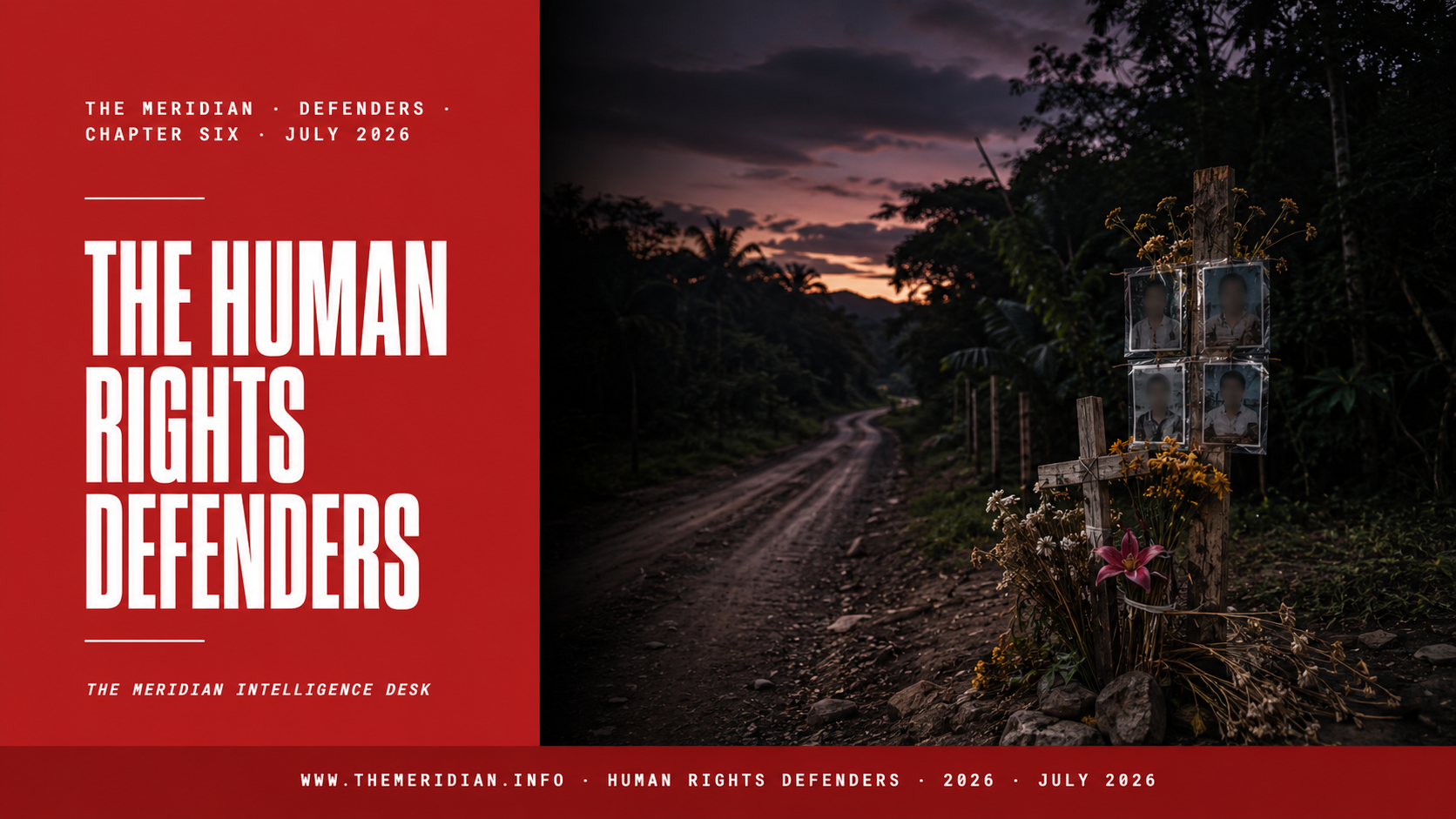
Every right examined in this edition has, somewhere, a person who decided to defend it -- formally, publicly, and at personal risk. Three hundred and twenty of those people were killed in 2025, according to Front Line Defenders' annual global analysis. Most were defending land. Most were indigenous. Most had reported receiving threats before they were killed. The Meridian publishes the record, and asks what it means that the people doing the work this edition has spent sixteen articles documenting are dying for it at a rate the international system has come to treat as a stable, predictable annual statistic rather than an emergency.
A human rights defender, in the terminology used by the United Nations and by the organisations that monitor their safety, is anyone who acts to promote or protect human rights -- a definition deliberately broad enough to encompass lawyers, journalists, trade unionists, indigenous land custodians, environmental campaigners, LGBTQ+ activists, and ordinary citizens who, often without formal training or institutional backing, document abuses, organise communities, or simply refuse to leave land that powerful interests want them to abandon. Front Line Defenders, the Dublin-based organisation that has tracked killings of defenders globally since 2014, recorded 320 confirmed killings in 2025 -- a figure consistent with the elevated levels the organisation has documented for nearly a decade, following years in which the toll exceeded 300 with grim regularity.
This edition has spent sixteen articles documenting human rights violations -- in pre-trial detention cells, in Sahel plazas, in Sudanese displacement camps, in Nigerian airport security rooms, in Bangladeshi garment factories, in Sri Lankan IMF adjustment programmes, in the Aegean Sea, on Mauritian tuna processing floors, in pharmaceutical patent offices and seed monopoly courts. Behind nearly every one of those violations is, somewhere, a person or an organisation that documented it, that advocated against it, that represented its victims, or that simply refused to be silent about it. Three hundred and twenty of those people did not survive 2025. This article is, in the structure of this edition, the place where the cost of doing the work this publication has spent an entire edition describing is made explicit.
The pattern in Front Line Defenders' annual data has been remarkably consistent for years, and 2025 was no exception. The largest single category of defenders killed were land and environmental defenders -- people resisting mining concessions, logging operations, agribusiness expansion, hydroelectric projects, and other large-scale land use changes that displaced or threatened the communities the defenders belonged to or represented. A substantial proportion of those killed were indigenous, reflecting the disproportionate exposure indigenous communities face when their customary land rights -- frequently unrecognised or weakly protected in formal national law -- come into conflict with commercial interests that hold the formal legal title or concession rights the state has granted.
Perhaps the most damning statistic in the annual data, repeated with consistency across multiple years of Front Line Defenders' reporting, is the proportion of killed defenders who had previously reported receiving threats to authorities, to civil society networks, or to the organisations that track defender safety, before they were killed. This is not a population taken by surprise. It is, in the overwhelming majority of documented cases, a population that identified the danger it faced, reported it through the channels available, and was killed regardless -- a pattern that indicts not the absence of warning, but the absence of any protective response to warnings that were, in fact, given.
Colombia has, for multiple consecutive years, recorded more human rights defender killings than any other country tracked by Front Line Defenders, and 2025 continued this pattern. The country's 2016 peace accord with the FARC formally ended the longest-running armed conflict in the Western Hemisphere, but the territorial vacuum left by FARC's demobilisation has been filled, in many regions, by a fragmented landscape of dissident FARC factions, the ELN guerrilla group, paramilitary successor organisations, and organised criminal groups linked to drug trafficking and illegal mining -- all of whom have targeted social leaders, land restitution claimants, and community organisers who resist their territorial and economic control.
Land restitution -- the legal process through which Colombians displaced during the armed conflict can reclaim land seized or abandoned during the violence -- has been a particularly dangerous activity for the social leaders who assist claimants through the process, because successful restitution claims directly threaten the economic interests of the armed and criminal groups that frequently occupy or profit from the contested land. Colombia's own state human rights and ombudsman institutions have, in repeated public statements over several years, acknowledged the scale of the killings and the state's limited capacity to provide effective protection to the social leaders most at risk, despite formal protection programmes that exist on paper.
Colombia has a formal protection programme for threatened social leaders. It has led the global defender death toll for years regardless. The existence of a protective institution does not, on its own, protect anyone -- a lesson this edition has documented repeatedly, from Mauritius's underfunded human rights commission to the EU's own Frontex oversight architecture that failed to halt the pushbacks it existed to prevent.
The Philippines has, across the same multi-year period that Front Line Defenders has tracked global defender killings, consistently appeared among the countries with the highest recorded tolls, though the mechanism through which Filipino defenders have been targeted differs in important respects from the Colombian pattern. Red-tagging -- the public labelling of activists, journalists, and community organisers as communist insurgents or terrorist sympathisers by state security forces or government-aligned figures -- has been documented extensively by Filipino and international human rights organisations as a precursor to subsequent killings, disappearances, or arbitrary detention of the individuals targeted.
The practice operates as a form of state-enabled threat that this edition's earlier examination of Nigeria's DSS watchlist system in Article 6 will be structurally familiar with: an administrative or rhetorical labelling mechanism, applied without judicial process or evidentiary standard, that does not itself constitute a formal charge but that demonstrably increases the risk of violence against the person labelled, by signalling to both state and non-state armed actors that the individual is a legitimate target. Anti-Terrorism legislation passed in the Philippines in 2020 has, according to documented analysis by Philippine and international human rights organisations, been used in ways that compound this dynamic, providing a formal legal mechanism that red-tagged individuals can subsequently be charged under.
This edition's Article 15 documented, through Mauritius's own published government budget, the precise financial reality of a national human rights institution operating with approximately $190,000 a year in non-staff operating costs and zero capital investment across a four-year budget horizon -- an institution that, by its own published admission, lacks the capacity to conduct the investigations and outreach programmes its mandate requires. The pattern that article documented in a small island state with a relatively strong governance record by regional standards is, on the global defender killing data, a pattern repeated at considerably greater human cost in jurisdictions where the gap between a formal protection mandate and the resources to deliver it is even wider.
Colombia's National Protection Unit, the formal state body responsible for assessing risk and providing protective measures to threatened social leaders, has been the subject of repeated criticism from Colombian civil society and international observers for under-resourcing relative to the scale of the threat it is meant to address, for slow risk assessment processes that leave defenders unprotected during the assessment period, and for protective measures -- bulletproof vests, communication equipment, occasional bodyguard assignment -- that are frequently inadequate against the sophistication of the armed groups carrying out the killings. The structural pattern is identical to the one Article 15 documented in Mauritius: a protective institution exists, is formally mandated, and is funded at a level that ensures it can maintain an administrative function without providing the operational capacity its mandate actually requires.
The defender protection systems that have demonstrated measurable success -- including specific regional or programme-level interventions documented by Front Line Defenders and other monitoring organisations -- share common features largely absent from the underfunded models this article and Article 15 have documented: rapid, well-resourced risk assessment conducted within days rather than months of a threat being reported; genuine investigative follow-through on threats and attacks, including prosecution of perpetrators where evidence permits, rather than reports filed without subsequent action; and sustained, multi-year funding commitments rather than the year-to-year budget allocations that leave protection programmes structurally unable to plan beyond a single fiscal cycle.
None of these features is exotic or unprecedented. All of them require sustained financial investment at a scale that, on the evidence this edition has gathered from Mauritius's published budget and from the broader pattern of underfunded national protection mechanisms documented across Colombia and elsewhere, the international community and national governments have shown limited willingness to provide.
This edition placed The Human Rights Defenders in its sixth and final chapter, on reform, resistance, and the road forward, deliberately. Every violation this edition has documented -- the provisional charge, the Sudan displacement crisis, the DSS watchlist, the garment factory wage, the IMF adjustment programme, the Frontex pushback, the unenforced trade agreement labour clause, the seed monopoly law -- has, somewhere in the world, a defender working against it. The 320 people killed in 2025 were not abstract statistics generated by a system functioning normally. They were the people whose work, had it been allowed to continue and had it been adequately protected, represents the most direct and immediate mechanism available for closing the gaps this edition has spent sixteen articles documenting.
The international human rights architecture this edition has examined throughout depends, at every level, on people willing to document violations, represent victims, organise communities, and advocate for change, frequently without significant institutional support and, with disturbing regularity, at the cost of their lives. A human rights system that cannot protect the people doing this work is a system that has, in the most direct and measurable way available, failed at the single function that would make every other reform this edition's closing chapter proposes actually achievable.
This edition has documented, across its first fifteen articles, an architecture of rights violation sustained by enforcement gaps, voluntary frameworks nobody enforces, and institutions formally mandated but chronically underfunded. The human rights defenders killed in 2025 represent what happens to the people who try to close those gaps directly, on the ground, in the communities where the violations occur, without the institutional protection that a genuinely functional human rights system would owe them.
Most of the 320 people killed in 2025 had reported threats before they died. The reporting mechanism worked. The protection mechanism did not. This is the same pattern this edition documented in Mauritius's National Human Rights Commission budget, in Colombia's National Protection Unit, and in the DSS watchlist that operates against rather than for the people it surveils. An institution exists. It is formally mandated to protect. It is not resourced to do so. The person who reported the threat is killed regardless, and the institution that received the report continues to exist, formally intact, having fulfilled its administrative function while failing entirely at its actual purpose.
Every right examined in this edition has a defender working to secure it. The least the international system that claims to value those rights can do is fund the protection of the people doing that work at a level adequate to the threat they face -- rather than, as the evidence from Mauritius, Colombia, and the Philippines all demonstrates, funding the appearance of protection while the killing continues at a rate the world has, disturbingly, learned to treat as routine.
Add comment
Comments