Air Mauritius: Corruption in Business Class, Accountability in the Hold
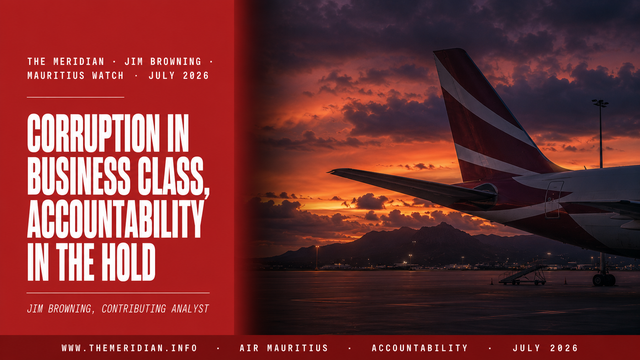
A national airline, a political playground and the Mauritian taxpayer’s most expensive frequent flyer programme.
“Nou pou conbat corruption.” There it is again. The national prayer of every Mauritian politician who suddenly discovers morality three months before an election and the amnesia of the Mauritian people who have for over half a century learned to swallow their spit while spitting in the air. They say it on platforms. They print it in manifestos. They repeat it on television with the grave expression of someone who has just discovered corruption hiding behind the curtains. “Nou pou gouverne autrement.” “Nou pou nettoye system.” “Nou pou mette lord, nou pou, nou pou, nou pou…”
Then the election finishes, the microphones are packed away, the posters are removed, and corruption receives another boarding pass. Briani all around, thanking the Briani starved voters, because that is precisely why they voted their parliamentary representatives, not because of drug problems in the country, not because of water issues, but because a minister thanking the population using the populations’ own money is what was voted. Destination: Air Mauritius.
Welcome aboard our national airline, where political influence may travel in Business Class, institutional silence receives a complimentary upgrade, and accountability is informed that the flight is indefinitely delayed. The ordinary passenger must arrive three hours early, respect the baggage allowance, produce identification, remove liquids from hand luggage and explain why there is an extra toothbrush in the suitcase. But when hundreds of millions of rupees may have been lost through questionable corporate decisions, everybody suddenly, once more, develops amnesia. Nobody remembers who signed. Nobody remembers who approved. Nobody remembers who advised. Nobody remembers who attended the Board meeting. Nobody remembers who raised objections. But somehow, everyone remembers where to submit the claim for travelling expenses.
On 29 June 2026, Air Mauritius officially confirmed that its Board had considered a forensic report prepared by Kroll. This was not an investigation into missing teaspoons from the airport lounge. According to the airline, the review concerned three major areas: the sale or disposal of five aircraft during the period of voluntary administration; the leasing of two Airbus A330-200 aircraft in 2022; and the decision to order an additional Airbus A350-900 aircraft in 2023.
Air Mauritius said it was considering referring matters arising from the report to the Financial Crimes Commission, the Police and other relevant authorities. It also mentioned the possibility of civil remedies and disciplinary proceedings. The airline did not publish the full Kroll report or identify the people whose conduct was being examined. Let us translate that from corporate language into ordinary Mauritian. A highly specialised international investigation firm examined decisions involving aircraft worth enormous sums of money. The findings were serious enough for the Board to consider calling the Police and the FCC. Yet the public is still expected to behave as though someone merely forgot to staple an invoice.
“Pa presse.” “Laisse institutions travailler.” “Bizin respecte procedure.” Of course, procedures must be respected. But procedures should not become a luxury retirement home for inconvenient truths. Seven senior managers were subsequently reported to have been suspended in connection with the inquiry. The suspensions were precautionary measures and do not, by themselves, establish guilt. That distinction matters. Suspension is not conviction. An allegation is not proof. A forensic report is not a court judgement. But neither is the reported suspension of seven managers after a forensic investigation the administrative equivalent of someone forgetting to switch off the office fan. Something serious happened. The public deserves to know what.
In April 2025, Prime Minister Navin Ramgoolam stated that Air Mauritius had suffered approximately Rs 1.22 billion in losses through aircraft sales conducted between 2017 and 2021. That is about Rs 1,220 million. To put that into perspective, Rs 1.22 billion is not petty cash. It is not an unfortunate rounding error. It is not the price of a few sandwiches at an Air Mauritius Board meeting. It is Rs 122,000 each for 10,000 people, Rs 1 million each for 1,220 families, Rs 10 million for 122 major public projects, or enough money to fund a very impressive collection of investigations, committees, advisers and press conferences explaining why nobody is responsible.
The Prime Minister publicly characterised what happened as theft and promised investigation and prosecution. That was a political allegation, not a judicial finding, and responsibility remains to be established through evidence and legal proceedings. Still, Rs 1.22 billion does not simply evaporate like aircraft fuel. If aircraft were sold below reasonable market value, who determined the price? Who obtained the valuations? How many independent valuations were commissioned? Who selected the buyers? Was there competitive bidding? Were conflicts of interest declared? Who advised the administrators? Who advised the Board? Were political offices informed? Did anyone object in writing? And, most importantly, did anyone at the meeting pause between the pizza slices and ask whether Mauritius was receiving proper value for its nowadays insignificant Rupee? These are not defamatory questions. They are the minimum questions that should be asked whenever a national asset may have lost more than one billion rupees.
The five aircraft examined by Kroll reportedly consisted of two Airbus A340-300s, two Airbus A319-100s and one Airbus A330-200, disposed of during 2020 and 2021. The investigation also examined the later leasing of two A330-200 aircraft and the additional A350-900 order. That sequence deserves particular attention. Aircraft leave the fleet. Other aircraft are later leased. Another aircraft is ordered. And now investigators are examining whether these decisions served the commercial interests of the airline.
Perhaps there is a perfectly reasonable explanation. Perhaps there were market conditions, maintenance considerations, financing limitations and operational requirements that justified every decision. Then publish the explanation. Show the valuations. Show the procurement process. Show the financial model. Show the Board papers. Show the declared interests. Show the professional advice. Because “trust us” is not an acceptable accounting standard. The public has already trusted enough, to the point where the word trust is no longer trustworthy.
Air Mauritius entered voluntary administration on 22 April 2020 after concluding that it could not meet its financial obligations in the foreseeable future. The pandemic was an immediate trigger, but the airline had already faced longstanding financial and governance problems. In September 2021, the Government supported a financing arrangement of Rs 12 billion, then approximately USD 280 million, to allow Air Mauritius to emerge from voluntary administration and provide what was described as long-term stability. Rs 12 billion. Twelve thousand million rupees. That is an extraordinary amount of public-backed financial support.
At that level, the taxpayer should not merely receive an annual report. The taxpayer should receive a seat at the Board meeting, a calculator, a magnifying glass and perhaps access to the executive lounge to chill out after a heavily laden, headache-conjuring meeting. The rescue was justified because Air Mauritius is a strategic national asset. Mauritius is an island economy dependent on international connectivity, tourism, trade and cargo services. But being strategically important cannot become permanent immunity from scrutiny. On the contrary, the more important the company, the greater the obligation to protect it from political interference, incompetent appointments and questionable transactions. Air Mauritius cannot be described as the nation’s strategic lifeline when it needs money, but treated like a private family-and-friends picnic when appointments and decisions are made.
There is some good news. Air Mauritius reported a net profit of Rs 252.7 million for the first quarter of the 2025-2026 financial year. It later reported an unaudited profit of Rs 1.1 billion, equivalent to EUR 22.03 million, for the six months from April to September 2025. That improvement should be recognised. The airline is not simply a story of failure. Its employees continue to operate flights, serve passengers and maintain a vital national connection under difficult circumstances. It would be unfair to blame thousands of ordinary workers for decisions made in executive offices and political corridors.
The problem is that a profitable semester does not erase historic governance failures. A patient may have a good blood pressure reading in the morning and still require treatment for a serious disease. Similarly, Rs 1.1 billion in profit does not make questions surrounding Rs 1.22 billion in alleged losses disappear. One figure cannot be used as holy water to wash away prior sins.
Long before Kroll, voluntary administration and aircraft leasing controversies, Air Mauritius had the infamous Caisse Noire affair. An investigation revealed the existence of a system involving special commissions and concealed funds. Proceedings implicated former senior figures from Air Mauritius and Rogers, including Gérard Tyack, Sir Harry Tirvengadum, Robert Rivalland, Derek Taylor and Joseph Yip Tong. Reports placed the amount involved at approximately Rs 85 million, in money from an earlier period when Rs 85 million could buy considerably more than it can today.
Gérard Tyack, the former finance director, was convicted and imprisoned. Robert Rivalland was initially convicted but was acquitted on appeal in 2015. Proceedings involving others ended, were dismissed, or could not continue, including proceedings against Sir Harry Tirvengadum that were halted because of his medical condition. Air Mauritius also pursued a civil claim seeking approximately Rs 97 million from several parties connected with the affair. This history must be stated accurately. Not everyone accused was convicted. Some were acquitted. Some proceedings were discontinued. Some allegations were never judicially established. But the scandal itself was real, and the existence of concealed funds was not invented by social media.
What is extraordinary is not only that the Caisse Noire happened. It is that, decades later, Air Mauritius is still appearing in national discussions about secrecy, political influence, questionable transactions and a lack of accountability. At some point, we must stop calling these matters isolated incidents. When the same institution repeatedly develops the same symptoms, perhaps the disease is structural.
Then came the fuel hedging catastrophe. Air Mauritius entered into arrangements that reportedly fixed a substantial portion of its fuel requirements at approximately USD 105 per barrel, covering between 80 and 90 per cent of its fuel needs until 2010. The strategy became disastrous when international oil prices collapsed. By 31 December 2008, the airline had reportedly suffered realised hedging losses of approximately EUR 20.5 million, while unrealised losses on contracts that had not yet expired stood at approximately EUR 129.5 million. This was financial innovation, Mauritian style. The rest of the world saw falling oil prices. Air Mauritius apparently saw an opportunity to continue paying yesterday’s premium price for tomorrow’s cheaper fuel. It was like watching the supermarket reduce the price of rice, then proudly announcing that you had signed a contract to buy it at three times the price for the next two years.
But please do not call it a disaster. They call it a “strategic risk management position affected by adverse market movements.” That sounds much better in a Board paper. By June 2009, unrealised losses on remaining hedge contracts were still reported at EUR 32.6 million, although they had reduced from EUR 72.2 million at the end of March 2009. The airline suffered. The accounts suffered. The country suffered. But did the culture of political and corporate responsibility change? Apparently, accountability also had a hedge contract. It was permanently protected against delivery.
Air Mauritius Board membership has often attracted public scrutiny because national companies have traditionally been used by governments to reward allies, loyalists, advisers, familiar faces, friends, family or mistresses. This is where Mauritius becomes wonderfully creative. A person may have limited aviation experience, but immense experience in knowing the right minister and most importantly possess a tongue longer than a tie to clean orifices and nether regions of ministers and CEOs that even a dog would not sniff. Someone may know little about fleet planning, but know exactly where to sit during a political dinner. Another may not understand aircraft financing, but has advanced qualifications in nodding at the appropriate moment or a PhD in levé pavillion.
And, of course, there is always that remarkable Mauritian species: the professional Board member. Change the government, he remains. Change the chairman, he remains. Change the company, he appears on another Board. Change the scandal, he changes his expression. Change the government, he will surely change his garments, both inner and outer, to match the colours of the ruling government. La sauce dan tou carri. You begin to wonder whether these people possess rare national expertise or merely a collection of photographs nobody wants published.
But the serious question remains: how are Board members selected? What specific aviation, finance, procurement, legal, risk management or corporate governance expertise does each member bring? How are conflicts of interest handled? How often did the Board challenge management? Which members voted for the transactions now under examination? Were dissenting opinions recorded? The public does not need another Board filled with prestigious surnames, political survivors and people described as “seasoned professionals” because they have spent thirty years moving between government committees. Many are screaming out of the political arena, namely those who were once asked if the microphone was switched off; these people are now revered on radio for their political prowess of going against their own party because their own interest was not met. We need competence. Real competence. Not political loyalty wearing a necktie and then changing it under a different banner.
The names of several managers have circulated widely through online articles, commentary and social media posts. But Air Mauritius did not identify the seven individuals in its Kroll communiqué. Nor did the company publish allegations against each suspended employee. That creates a dangerous vacuum. Rumours become facts. Social media becomes the charge sheet. Political commentators become prosecutors. And everyone begins writing prison sentences from their living rooms. Everyone is now a savant thanks to their preferred A.I.
The company should therefore clarify, within legal and employment constraints, which positions were affected; whether all seven suspensions were directly linked to the same transactions; whether the suspensions were precautionary; whether formal disciplinary charges were issued; whether any individuals were interviewed by Kroll; whether any findings were referred to the FCC or Police; and whether other executives, former administrators, directors or advisers are under examination. It would be irresponsible to declare those individuals guilty merely because their names are circulating. It would be equally irresponsible for Air Mauritius to hide behind silence while reputations are destroyed through speculation. Transparency protects the innocent as much as it exposes wrongdoing.
Representation by a lawyer does not prove membership of a criminal network. Serving on a Board does not automatically make someone responsible for every operational decision. Being related to a politician does not prove corruption. Being suspended does not prove theft. And being unpopular on Facebook is not yet a criminal offence, although at the rate Mauritius is going, someone may soon propose it and tax it if it sounds sweet enough. However, political proximity creates a legitimate need for additional transparency. When people appointed by political leaders oversee a public asset, the appointing authorities cannot behave like shocked tourists when problems emerge.
They cannot say: “Mo pa ti kone.” “Board ti autonome.” “Management ti prend decision.” This is the great political magic trick. When the company succeeds, the minister cuts the ribbon. When the company fails, the Board was independent. When profits rise, the government’s strategy worked. When losses appear, operational matters are outside political control. When appointments are made, political leaders praise the appointee’s exceptional competence. When investigations begin, nobody remembers who recommended him. Ala gouvernance autrement.
Pravind Jugnauth and members of the previous government are entitled to comment on the current Air Mauritius controversy. But they cannot pretend that the airline materialised on 12 November 2024. Major transactions now being examined occurred during the previous administration, including aircraft disposals during voluntary administration, aircraft leasing in 2022 and the additional A350 order in 2023. That does not establish personal criminal responsibility on the part of any minister or political leader. But it does establish political responsibility to explain the governance environment. Who appointed the administrators? Who approved the restructuring framework? Who supervised Airport Holdings Limited? What information reached the Cabinet? What was the role of the relevant ministers? What reports were submitted? What warnings were raised? Were parliamentary questions answered fully?
The previous government cannot now stand beside the wreckage with binoculars and ask who was driving. It was in government. It appointed people. It controlled policy. It celebrated the restructuring. It presented decisions as achievements. Political responsibility is not a coat that can be removed at the departure gate.
The current administration must also resist the temptation to use the Kroll report as an extended political television series. Episode One: dramatic announcement. Episode Two: seven suspensions. Episode Three: names leak through social media. Episode Four: politicians shout. Episode Five: committee established. Episode Six: everyone becomes busy with the Budget. Season Two: cancelled due to national amnesia. The report cannot be used only to embarrass former office holders. If there is evidence of criminal conduct, refer it. If there is evidence of civil liability, recover the money. If there is evidence of professional negligence, take disciplinary action. If decisions were commercially justified, publish the explanation and clear the people involved. Justice must not become political content.
Then we come to the press. Our fearless guardians of democracy. Our brave defenders of transparency. Our courageous investigators, individuals whose narcotic consumption is also their brand name, and whose idiocracy of simply holding a microscope metamorphoses them into journalists; or a trainee journalist sharing a bed with a minister and later calling him various amorous pet names turns the trainee into chief editor seeouplai, particularly when the target does not own a newspaper, control advertising or distribute free airline tickets.
The Caisse Noire affair historically raised disturbing questions about payments involving political and media interests. That history explains why public suspicions about airline benefits, upgrades and privileged access cannot simply be dismissed. This does not prove that present-day journalists have been bribed with tickets. But media organisations should publish clear policies concerning free travel, complimentary upgrades, sponsored trips, airline hospitality, gifts offered to journalists and conflicts involving advertisers. If a journalist receives a free ticket or an upgrade from an organisation being covered, disclose it. Very simple. The public can then decide whether the watchdog is barking or merely enjoying the lounge. Some journalists become ferocious when writing about a clerk who misplaced Rs 5,000. But when the subject involves aircraft, political networks and hundreds of millions, their vocabulary suddenly becomes delicate. “Questions arise.” “Concerns have emerged.” “Certain transactions may require clarification.” Mauritian journalism sometimes handles powerful people the way cabin crew handle turbulence. Please remain seated. Keep your seatbelt fastened. Do not ask what is happening. Everything is under control.
Air Mauritius has several organised employee interests and trade unions. Workers have every right to organise and defend their jobs. But unions must also explain what they knew about the airline’s governance problems. Well, unions are another specimen altogether. We do have one in our National Assembly who does not believe in grooming, let alone procedures. Anywho, I digress. Were concerns raised about fleet decisions? Were suspicious practices reported? Were whistleblowers supported? Did unions ask for greater transparency? Or did some representatives concentrate mainly on protecting privileges, promotions, travel benefits and particular groups? There is no point shouting “socialism” from the ground while queuing for an upgrade at the gate. True trade unionism protects the institution as well as employees. If the company collapses, the Board member moves to another Board. The political appointee returns to consultancy. The adviser sends another invoice. The ordinary worker loses the job.
Mauritius has developed a remarkable system. When Rs 500 disappears from an office cashbox, everyone is investigated. When Rs 500 million disappears through a strategic decision, everyone is invited to a workshop. The junior officer is suspended immediately. The senior executive receives legal advice. The cleaner is questioned. The director is unavailable. The clerk’s name appears in the newspaper. The powerful person is referred to as “a senior figure.” The small employee faces disciplinary action before lunch. The major decision maker enjoys the presumption of innocence until retirement, illness, death or the disappearance of the file. This is not justice. It is class privilege with official letterhead.
The full Kroll report may contain commercially sensitive, personal or legally privileged information. It may therefore be impossible to publish every page. But a detailed public summary should be released. It should include the transactions examined, the dates and values involved, the decision-making process, the valuation methods used, the advisers and entities involved, the governance failures identified, the estimated financial impact, the recommendations, the action already taken, and the matters referred to law enforcement. Parliament should also examine the affair through an appropriate committee with powers to call documents and question relevant witnesses. Former administrators, chairmen, directors, senior executives and government representatives should be invited to explain their roles, give account and take responsibilities where they are due. Not on Facebook. Not through anonymous sources. Not through carefully prepared political speeches. Under oath, where appropriate, and on the record.
Air Mauritius was established in 1967 and remains an essential connection between Mauritius and the world. That is precisely why this matters. Criticising Air Mauritius is not unpatriotic. Allowing it to be mismanaged is unpatriotic. Questioning its Board is not an attack on the country. Treating the airline as political property is an attack on the country. Demanding accountability does not weaken the airline. Silence weakens it. Air Mauritius does not belong to politicians. It does not belong to Board members. It does not belong to administrators. It does not belong to advisers. It does not belong to journalists expecting upgrades and it definitely does not belong to friends, family or mistresses. It belongs, ultimately, to the Mauritian nation whose resources have repeatedly supported it. The Kroll affair must not end with seven suspensions, three communiqués, five political speeches and one forgotten file.
We need answers. And we need them now. Who authorised the transactions? Who valued the aircraft? Who advised the decision makers? Who declared conflicts? Who benefited financially? Who failed in their duties? Who will reimburse the company? Who will face disciplinary action? Who will face prosecution if crimes are proven? And which political leaders will accept responsibility for the people they appointed? Until those questions are answered, all the slogans about fighting corruption remain exactly what they have always been: empty promises and only political slogans. In flight entertainment. At Air Mauritius, aircraft may come and go. Governments may rise and fall. Chairmen may change. Chief executives may be suspended. Reports may be commissioned. But one passenger is never removed from the flight. The Mauritian taxpayer. Li pena Business Class. Li pena upgrade. Li pena lounge. Li pena complimentary ticket. Li zis gagne facture. Corruption travels with extra luggage. Political responsibility claims its bag was lost. The press looks out of the window. The Board orders another coffee. And accountability? Ladies and gentlemen, we regret to inform you that accountability has missed its connecting flight.
PRIVILEGE SECOND.
PATRIOTISM DURING THE PRESS CONFERENCE.
ACCOUNTABILITY, PERHAPS, AFTER LANDING.
1. Air Mauritius. “Communiqué”, 29 June 2026. Official newsroom statement concerning the Kroll forensic report and possible referrals.
2. Air Mauritius. “News Release: Air Mauritius Posts First Quarter Profits”, reporting net profit of Rs 252.7 million for the first quarter of financial year 2025 to 2026.
3. Air Mauritius. Corporate “About Us” information concerning the airline’s establishment in 1967.
4. ch aviation. “Air Mauritius lost $27mn, prime minister alleges theft”, April 2025.
5. ch aviation. “Air Mauritius may refer Kroll findings to FCC, police”, 2026.
6. ch aviation. “Air Mauritius files for voluntary administration”, 22 April 2020.
7. MarketScreener. Air Mauritius financing announcement, September 2021, concerning the Rs 12 billion support package.
8. L’Express. Reports concerning the Air Mauritius Caisse Noire proceedings, the roles of accused persons, civil claims and subsequent judicial outcomes.
9. L’Express. Historical reporting concerning Air Mauritius fuel hedging losses and financial performance.
10. Le Défi Media. Report concerning the precautionary suspension of seven Air Mauritius managers following the Kroll review.
11. Institut des économies en développement, Japan External Trade Organization. Company information reporting historic Air Mauritius hedging exposures.
12. Air Journal. Historical report concerning the Air Mauritius Caisse Noire trial.
Add comment
Comments