The Generation That Stopped Waiting: Bobi Wine, Gen Z Africa and the Revolt Against Inherited Power
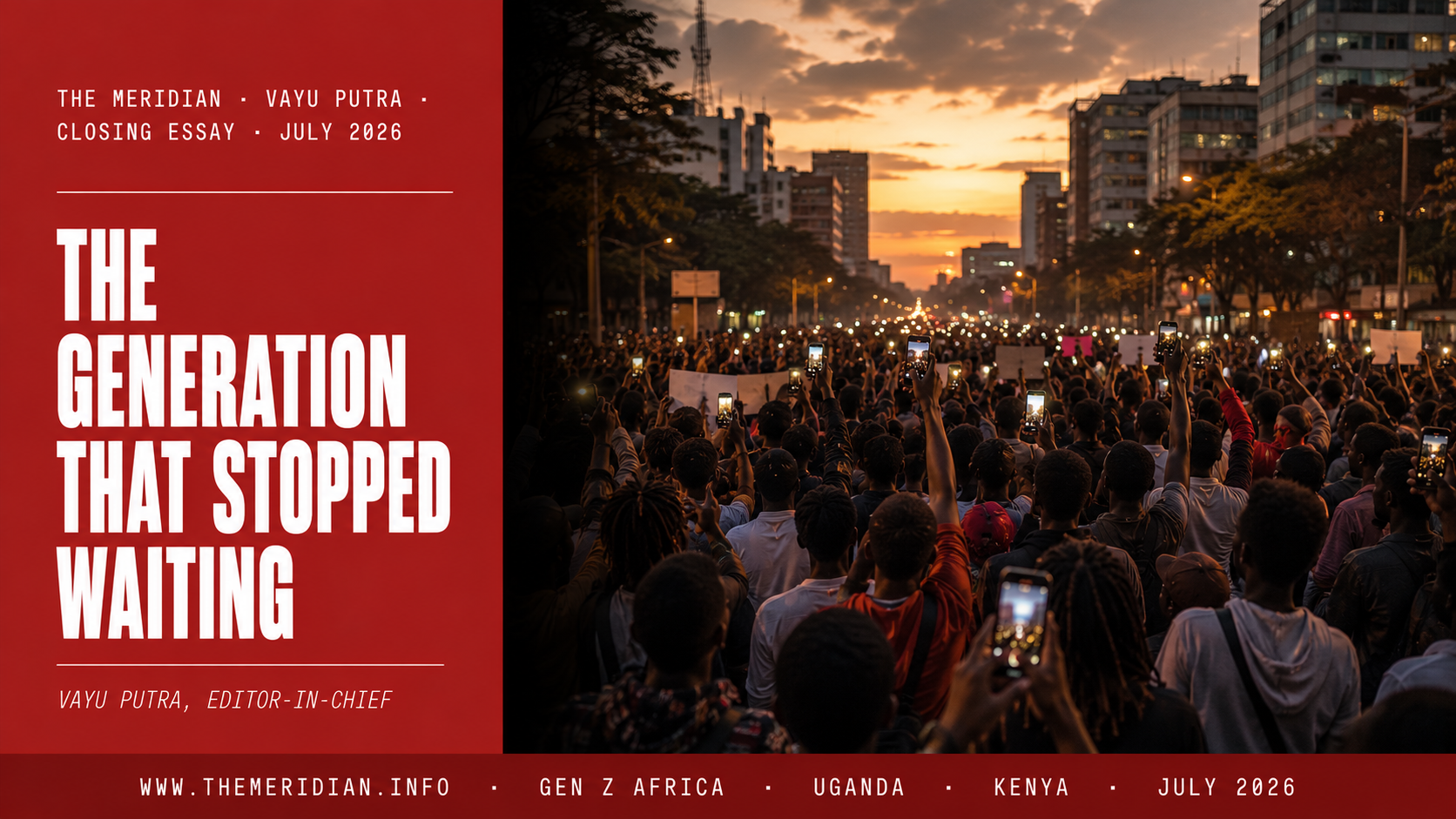
On 15 January 2026, Uganda held a presidential election. Yoweri Museveni, 81, who has ruled the country since 1986, was declared the winner with 71.6 per cent of the vote. Robert Kyagulanyi, known as Bobi Wine, 43, secured 25 per cent and rejected the result. Seven protesters were killed in the clashes that followed. Wine fled the country after a security raid on his home. The army chief, Museveni's own son, published a social media post calling for Wine's death. Uganda's median age is under 17. This is the world The Meridian has been documenting across 36 articles this July. This closing essay names what is being inherited, who is inheriting it, and why they have stopped waiting for someone else to change it.
There is a specific kind of absurdity that becomes visible only when you hold two numbers side by side. Yoweri Museveni is 81 years old. He has been president of Uganda since 1986. Uganda's median age is 16.9 years. The majority of Uganda's population was born, grew up, became adults, had children, and watched those children grow into adolescence, all within the reign of a single man who was already in power before most of them existed. When Bobi Wine ran against Museveni in January 2026, he was three years old when Museveni seized power. He is now 43, and he has spent his adult life campaigning in a political system that Museveni built, controls, and will not leave. Uganda is not an outlier. It is an illustration. Across Africa, the generation that is being asked to inherit the political economy of the Global South did not build it, was not consulted about it, does not benefit from it, and is increasingly unwilling to accept it as permanent.
Uganda has a population of approximately 49 million people. Seventy per cent are under 30. The youth unemployment rate is approximately 43 per cent. Three and a half million new voters entered the electoral roll ahead of the January 2026 election, the majority of them young, the majority of them urban, the majority of them connected to the global conversation through mobile phones that have made the distance between Kampala and Nairobi and Lagos and Port Louis and London a matter of seconds rather than continents. These young Ugandans did not vote in a vacuum. They voted with the memory of Kenya's June 2024 Finance Bill protests, in which their East African neighbours of the same generation broke into Parliament and forced a government to reverse itself. They voted with the knowledge that Gen Z movements had toppled governments in Madagascar and Nepal. They voted knowing, as Bobi Wine explicitly told them, that the election itself was a form of protest.
The result was declared as Museveni winning with 71.6 per cent. The UN said the vote was marred by widespread repression and intimidation. Wine's National Unity Platform, international observers, and two other presidential candidates rejected the outcome, citing ballot stuffing, intimidation, and the blocking of party agents. Protests erupted on 16 January. Seven people were killed in the initial clashes. The protests were crushed by 20 January. Wine fled the country following a security raid on his home. General Muhoozi Kainerugaba, commander of the Uganda People's Defence Force and Museveni's own son, published a post on social media stating that he wanted Wine dead. The army chief of a sitting government called publicly for the death of a man who had just received 25 per cent of the official vote count. The world took note briefly and moved on.
The July 2026 edition of The Meridian has documented, across 36 articles, the precise architecture of what this generation is being asked to inherit. It is worth naming it plainly as a single coherent structure before we discuss the generation rising against it.
They are inheriting dynastic capture: the four-pillar system through which political families monopolise the state through jobs as jerseys, procurement as kickbacks, welfare as conditional charity, and media as economic censorship. The Dynastic Capture essay published in this edition documented the mechanism. Uganda under Museveni and his son is the mechanism at its most undisguised: a president grooming his own child to command the army, then deploying that army against the opposition.
They are inheriting captured economies: fuel, electricity, water and telecommunications administered by state monopolies that serve political interests rather than competitive efficiency. The Captured Economy essay documented the Mauritius version. The principle scales: across the Global South, the commanding heights of the economy are administered in ways that concentrate benefits among the politically connected and distribute costs across the population that had no voice in the design.
They are inheriting the human capital trap: an education system that produces graduates at scale and an economic structure that cannot absorb them at the skill level their qualifications warrant, so that the ambitious leave and the rest stay in an economy that has no better use for their abilities than the minimum wage floor. Uganda's 43 per cent youth unemployment is the trap at its most extreme. Mauritius's graduate emigration to the United Kingdom and Canada is the same trap operating through a more sophisticated exit valve.
They are inheriting the brutality cycle: a police architecture designed during the colonial period for population control, maintained by post-colonial governments for political utility, staffed at poverty wages, and operating with zero accountability. Albert Ojwang was 31 years old. He was a teacher and a blogger. He was tortured to death in a Kenyan police station twelve hours after his arrest for a social media post. He was Gen Z. The institution that killed him was not. It was built for a different century and a different purpose and has never been fundamentally redesigned.
They are inheriting the trade deficit and the import dependency: the Tiger With No Claws economies that buy everything and produce too little, that administer prices through state monopolies and call it stability, that import cheap labour to suppress wages and export their graduates to serve wealthier economies, and that describe the resulting structural dependency as a development model.
This is the inheritance. Not a building or a bank account. A system. One that was designed by people who are still in power, maintained by institutions that answer to those people, and defended by a security apparatus willing to kill anyone who moves to change it. The question is what the generation being asked to accept this inheritance is actually prepared to do about it.
Kenya's June 2024 Finance Bill protests were the most instructive episode in recent African democratic history precisely because they succeeded by the one metric that matters: they produced a policy reversal by a government that had every institutional tool available to ignore them. President Ruto withdrew the Finance Bill. The protesters were young, mobile-native, leaderless in the traditional sense, organised through group chats and platform coordination rather than party structures, and motivated by a specific, legible grievance about specific taxes on specific essential goods. They were not calling for revolution. They were calling for a Finance Bill to be withdrawn. The specificity of the demand, combined with the scale of the mobilisation, produced the outcome.
Albert Ojwang's death in June 2025 brought the same generation back to the streets, this time with a different grievance: the same police architecture that the Brutality Cycle essay documents had killed one of their own, in custody, for a post on a social media platform, and the official account of his death was a lie that an independent autopsy immediately refuted. The 2025 protests were met with lethal force. Sixty-five people were killed. One thousand five hundred were arrested, many on terrorism charges for attending a demonstration. The government used the tools of the state against the same generation that had successfully used the streets against the state twelve months earlier. The outcome was different. The lesson was not lost.
A recent essay by a global investment strategist used the metaphor of two ice cream sellers on a crowded beach to explain the drift of political parties toward the extremes in the United States and Europe. The centre is underserved, the metaphor argues, and the market should fill the gap. The author conceded, in a single sentence, that much of the world still suffers a more basic democratic shortfall, before returning to the investment implications of European populism.
That single sentence is where the analysis of the Global South must begin, not where it ends. In Kampala, the barrier to political market entry is not tribalism or brand loyalty or the difficulty of building a new party structure. It is the security apparatus. Bobi Wine campaigned in a flak jacket and a helmet. He secured a quarter of the official vote count in an election the United Nations said was marred by widespread repression and intimidation. His reward was a security raid on his home, forced flight from the country, and a public death threat from the army chief. The ice cream metaphor requires a beach where the sellers are permitted to stand. In Uganda, one seller has occupied the beach for 40 years and deploys armed men to remove anyone who sets up a rival stall.
The Rothschild analysis also identifies what it calls an anti-establishment dimension in contemporary populism: the wish to stick it to The Man. In the Global South, that dimension is not a new axis of political psychology. It is the fundamental material condition of the majority of the population. The Man in Uganda is a specific 81-year-old man who has controlled the state for four decades. The Man in Kenya is the police officer who tortured Albert Ojwang to death and whose institution has never produced a single conviction. The Man in Mauritius is the political economy this edition has spent 36 articles documenting: the captured utilities, the foreign-owned shoreline, the graduate who had to leave, the pension the Finance Bill may take away. This is not populism in the European sense. It is the rational political consciousness of a generation that has studied the balance sheet of the system it is being asked to inherit and decided that the terms are unacceptable.
The Meridian does not advocate for any political outcome in Mauritius or anywhere else. What it observes is that Mauritius stands at a specific fork that Uganda, Kenya and the broader African Gen Z uprising has already passed through.
The constitutional route remains open in Mauritius in a way it is not in Kampala. The Finance Bill is a legislative instrument that can be read, debated, amended, and held to account. The pension march of 11 July was a constitutionally protected exercise of civic rights by a generation, or rather by the parents and grandparents of that generation, that still believes in the instrument. The Platform Komun Syndikal chose the route that Bobi Wine explicitly tried to choose in Uganda: lawful, constitutional, non-violent, specific in its demand.
Uganda's state answered with bullets and a death threat. Mauritius's state has not yet answered with the Finance Bill. The Alliance government that won a mandate in November 2024 on a platform of governing differently has one legislative instrument left in which to demonstrate whether that mandate was real or rhetorical.
The generation watching from Mauritius knows what happened in Kampala in January. It knows what happened in Nairobi in June 2024 and June 2025. It is watching the Finance Bill. And it is connected, through the same mobile phones that organised Kenya's protests and broadcast Uganda's crackdown, to every other young person in the Global South who has reached the same conclusion: that the political economy they are being asked to inherit was not designed for them, and that the generation that designed it is not going to reform it voluntarily.
The Gen Z revolt across Africa is consistently misread by international observers as a protest movement driven by social media and youthful energy. This reading is comfortable because it implies the movement is ephemeral, leaderless in a problematic sense, and likely to dissipate once the energy disperses. It is also wrong. What is driving the revolt is not social media. Social media is the logistics. What is driving it is a specific, legible, cross-border understanding of the political economy of the Global South that this generation has arrived at independently, through their lived experience of the system, and that is consistent with the analytical framework The Meridian has been building across 36 articles.
They understand dynastic capture because they live in its product: the jobs that go to the connected, the contracts that go to the family, the police that answers to the president, the army whose chief is the president's son. They understand the human capital trap because they are it: the educated young person for whom the economy has no appropriate use, who watches the ones with passports leave and considers leaving themselves. They understand the brutality cycle because they attend the funerals. They understand the trade deficit and the import dependency because they pay administered prices for fuel and electricity and food in economies that produce too little and consume too much, on wages that the NMW floor protects at the bottom but that the captured economy compresses at every other point.
They do not need The Meridian to explain this to them. They are living it. What they need, and what the best analytical journalism can provide, is the framework that connects the individual experience to the structural condition, that names the architecture rather than only the symptom, and that identifies who benefits from the system remaining as it is and therefore who resists the change that would end it.
The July 2026 edition of The Meridian opened with a question: who does the law actually protect? It closes with an observation: the generation that is being given the answer to that question in their daily lives, in their employment prospects, in their pension arrangements, in their fuel prices, in their police stations, and in their election results, is the generation that has stopped waiting for the people who designed the system to reform it.
Bobi Wine is 43. He ran in a flak jacket. He secured a quarter of the vote against a man who has ruled since 1986. He fled. The army chief called for his death. Kenya's generation buried Albert Ojwang and went back to the streets. Mauritius's generation marched to the Jardin de la Compagnie and gave the Finance Bill a deadline. Madagascar toppled a government. Nepal toppled a government. The route differs. The direction is the same.
The Rothschild essay worries about underserved centrists on a crowded beach. It is a legitimate concern in the economies it describes. In the Global South the concern is more elementary: whether the beach exists, whether the sellers are permitted to stand on it, whether the army chief is allowed to call publicly for the death of a man who stood on it anyway, and whether the generation watching all of this through a mobile phone screen will continue to accept the answer the current system keeps giving them.
The Meridian does not predict what happens next. It documents what is. Across 37 articles this July, what is has been named: the unfinished declaration of human rights, the captured economies, the dynastic families, the brutality cycles, the trade deficits, the stolen shorelines, the exported graduates, the imported labour, the pension marches, the constitutional tests. The generation inheriting all of it has read the balance sheet. They did not choose the terms. And they have stopped waiting for someone else to renegotiate them.
Add comment
Comments