The Price of the Plant: What Cannabis Would Cost If Treated Like Any Other Crop
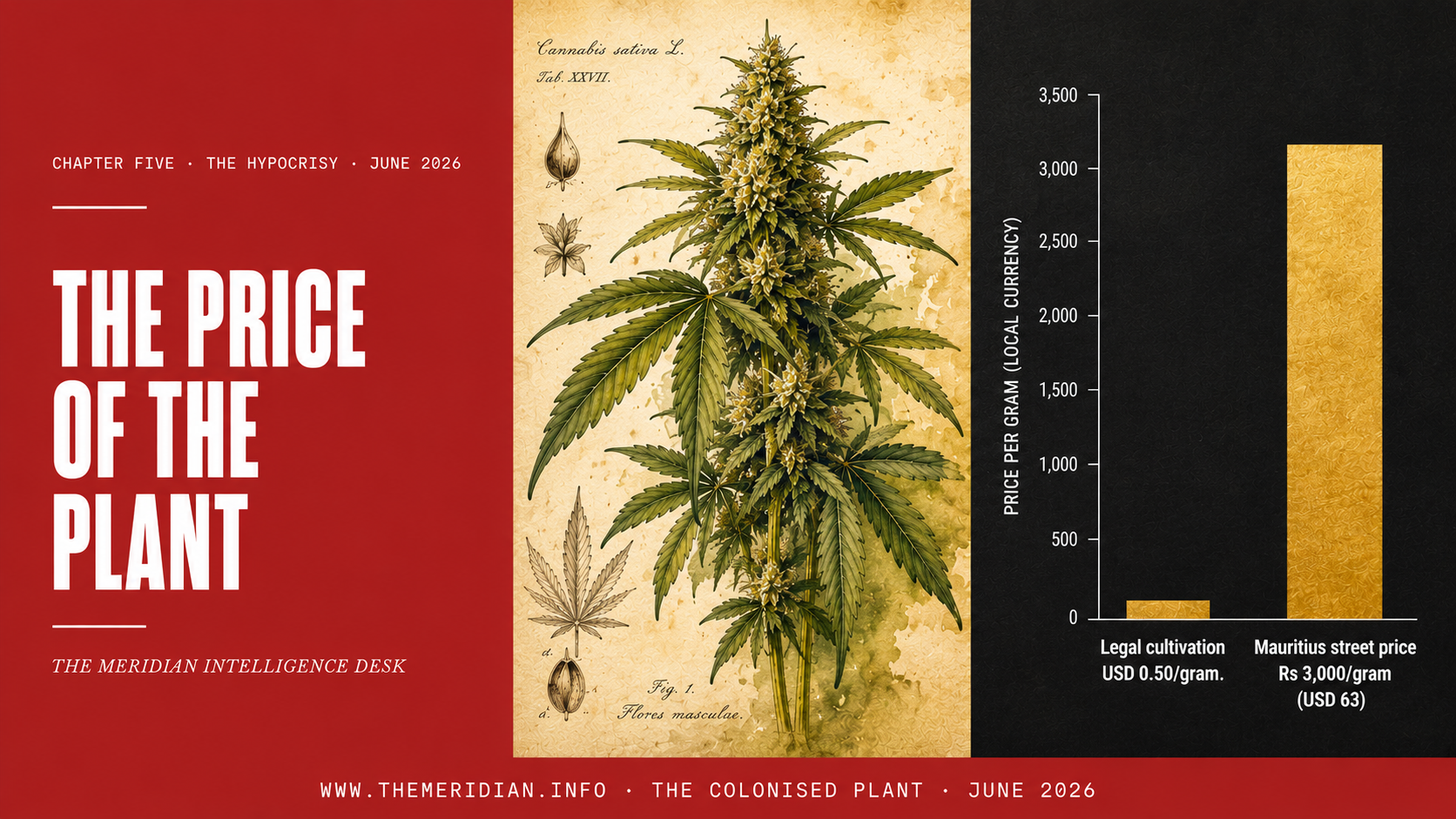
A kilogram of mint sells for approximately Rs 200 in Mauritius. A kilogram of cannabis sells for between Rs 1.2 million and Rs 3 million. The plants grow in the same soil, under the same sun, tended by the same hands. The difference in price is not botanical. It is legal. The Meridian Intelligence Desk models what cannabis would cost in a regulated Mauritian market, what the prohibition premium extracts from the citizens it claims to protect, and what the state foregoes by maintaining a law it inherited from the colonial era and has never seriously examined.
The Mauritian Revenue Authority values cannabis at Rs 1,200 per gram. That figure is not a market estimate or a journalistic approximation. It is the official valuation applied to cannabis seizures across multiple prosecutions between 2022 and 2025, used to calculate the monetary value of contraband for the purposes of criminal proceedings. It is what the state itself says the plant is worth. At the mid-tier of the market, ground intelligence places the price at Rs 1,500 to Rs 2,000 per gram. Premium hydroponic cannabis, confirmed by L'Express reporting, reaches Rs 3,000 per gram. At the Bank of Mauritius 2026 average exchange rate of Rs 47.4 per United States dollar, that premium gram costs the equivalent of USD 63.29. The same gram, legally cultivated in Colombia under that country's regulated cannabis framework, costs approximately USD 0.50 to produce. The arithmetic of prohibition is precise and brutal.
Cannabis price Mauritius prohibition premium Rs 1200 Rs 3000 per gram legal cultivation cost USD 0.50 Colombia regulated market
The Mauritian cannabis market operates across three documented price tiers, all of which have been independently verified through MRA seizure records, parliamentary testimony, and ground-level reporting.
| Grade | Price Per Gram | Source | Minimum Wage Equivalent |
|---|---|---|---|
| Baseline Standard domestic cultivation | Rs 1,200 | MRA seizure valuations, 2022 to 2025 | 6.8% of monthly minimum wage per gram |
| Mid-tier Imported or improved domestic | Rs 1,500 to Rs 2,000 | Ground intelligence, 2026 | 8.5% to 11.3% of monthly minimum wage per gram |
| Premium Hydroponic, skunk grade | Rs 3,000 | L'Express confirmed, 2025 to 2026 | 16.9% of monthly minimum wage per gram |
The national minimum wage in Mauritius stands at Rs 17,745 per month as of January 2026. A single gram of premium cannabis therefore costs a minimum-wage worker 16.9 per cent of their entire monthly income. The equivalent figure for a regulated product in a legal market would be approximately Rs 24 to Rs 40 per gram, based on the production cost benchmarks established in Colombia, the Netherlands, and Canada. At that price, the same gram would represent 0.14 per cent of the monthly minimum wage. The prohibition premium does not protect the poor. It taxes them at a rate that no legal commodity would survive.
The prohibition premium is not a market anomaly. It is the policy. Every Rs 2,800 above the cost of legal production that a Mauritian pays for a gram of cannabis is a transfer payment to the illegal distribution network that prohibition created and sustains.
The mint comparison is not rhetorical. Cannabis and mint are both aromatic plants grown in tropical soil under ambient light. Both can be cultivated in a household garden. Both can be harvested and dried with no industrial processing. Both have documented medicinal uses. The structural difference between a kilogram of mint at Rs 200 and a kilogram of cannabis at Rs 1.2 million to Rs 3 million is entirely and exclusively the Dangerous Drugs Act 2000. The plant itself creates no such differential.
In a regulated Mauritian cannabis market, the price to the consumer would be determined by four factors: the cost of cultivation, the cost of regulation compliance, the applicable tax rate, and the retail margin. The Meridian models the structure using the Lesotho and Colorado frameworks adapted to Mauritian agricultural and fiscal conditions.
Production cost: Rs 20 to Rs 35 per gram. Based on tropical outdoor cultivation benchmarks. Mauritius has year-round growing conditions, adequate rainfall in the northern districts, and an established smallholder agricultural sector. No greenhouse infrastructure required for standard grade.
Regulatory compliance and licensing: Rs 5 to Rs 10 per gram. Estimated from the Lesotho licensing model applied to a market of approximately 50,000 to 80,000 regular users (conservative estimate based on ADSU seizure volumes and regional consumption studies).
Excise tax: Rs 15 to Rs 25 per gram. Calibrated to suppress the illegal market rather than sustain it. Colorado set its initial excise tax at 15 per cent of average market rate. The principle: if the legal price exceeds the illegal price, legalisation fails.
Retail margin: Rs 10 to Rs 20 per gram.
Total consumer price: Rs 50 to Rs 90 per gram. At the midpoint of Rs 70, this represents 0.4 per cent of the monthly minimum wage per gram. The current black market premium grade represents 16.9 per cent of the same wage.
The Mauritian illegal cannabis market generates an estimated Rs 2.5 billion in annual turnover at current street prices. None of this revenue is taxed. None of it is quality-controlled. None of it funds the public services that the state deploys to suppress the market it has failed to eliminate. The entire Rs 2.5 billion passes through distribution networks that prohibition created, sustains, and has failed to dismantle in twenty-six years of operation.
The state simultaneously funds the enforcement operation through the national budget and forgoes the fiscal revenue that regulation would generate. The Mauritius Revenue Authority Cannabis Unit, the Anti-Drug and Smuggling Unit, the courts, the prisons, and the prosecutorial system all draw on public funds to manage a market whose existence is the direct consequence of a legislative choice. The cost of that enforcement has never been publicly audited. The revenue foregone has never been publicly modelled. The Meridian has done both.
Estimated excise tax revenue under regulation: Rs 750 million to Rs 1.2 billion per year. Based on a regulated consumer price of Rs 70 per gram, an excise rate of Rs 20 per gram, and a consumption volume equivalent to 60 per cent of current illegal market turnover migrating to the legal market in year three of operation. Colorado generated USD 423 million in cannabis tax revenue in its first full year of adult-use sales.
Estimated enforcement cost under current prohibition: Rs 280 million to Rs 420 million per year. Estimated from ADSU staffing costs, MRA Cannabis Unit operational budgets, prosecution and court time allocated to cannabis cases, and custodial costs for cannabis-related incarceration. This figure has not been officially published.
Net fiscal differential: Rs 1.0 billion to Rs 1.6 billion per year. This is the annual cost of maintaining prohibition over regulation, expressed as the sum of foregone tax revenue and current enforcement expenditure. Against a national budget deficit that requires structural management, this is not a minor consideration.
The Meridian has previously documented a 587 per cent retail markup on aubergine in the Mauritian agricultural supply chain. The mechanism is identical: a commodity produced at low cost by a producer is extracted from at every node between field and consumer, with each intermediary capturing a margin that bears no relationship to the value added. The difference between the cannabis market and the aubergine market is that the cannabis extraction is enforced by criminal statute. The law does not protect the consumer from the extraction. The law is the instrument through which the extraction is maintained.
If the plant were legal, a Mauritian citizen could cultivate it in their garden for personal use. The seed is available. The climate is suitable. The knowledge is traditional. The cost would be negligible. The therapeutic benefit, for the one in five Mauritians with diabetes whose neuropathic pain responds to cannabinoid treatment, would be available without a prescription, without a pharmacy visit, and without a Rs 3,000 transaction with an unregulated supplier. The law prevents this. The law costs this. That cost is the prohibition premium, and it falls entirely on the citizen.
There is no agricultural, pharmacological, or economic reason for cannabis to cost Rs 1,200 to Rs 3,000 per gram in Mauritius. The plant grows here. The climate supports it. The knowledge to cultivate it exists within the community that has been criminalised for doing so. The price is what it is because the Dangerous Drugs Act 2000 eliminated the legal supply while leaving the demand intact.
The prohibition premium is Rs 1,130 to Rs 2,930 per gram at current street prices. That is the cost of the law to every person who uses the plant for pain relief, for sleep, for anxiety, or for any of the therapeutic applications that the pharmacological literature has documented and that the Mauritian state has acknowledged by passing the 2022 amendment it has declined to proclaim.
The synthetic cannabinoid market that is hospitalising Mauritian adolescents at a rate of 652 cases over four years exists because chimique costs Rs 100 to Rs 200 per dose and cannabis costs Rs 1,200 per gram. The price differential is the market signal. The law created it. The law sustains it. The law is killing people with it.
This is the third article of Chapter Five: The Hypocrisy, in The Colonised Plant: The Cannabis Edition, June 2026. The next article examines the provisional charge mechanism: how the Dangerous Drugs Act 2000 destroys careers, restricts movement, and closes doors for years before any verdict is reached. The complete edition is published at themeridian.info/june-2026.
Add comment
Comments