Rs 220 Million in Uncirculated Bills: The Forensic Anatomy of the 2015 Cash Seizure and the FIAMLA Navin Ramgoolam Built to Detect It
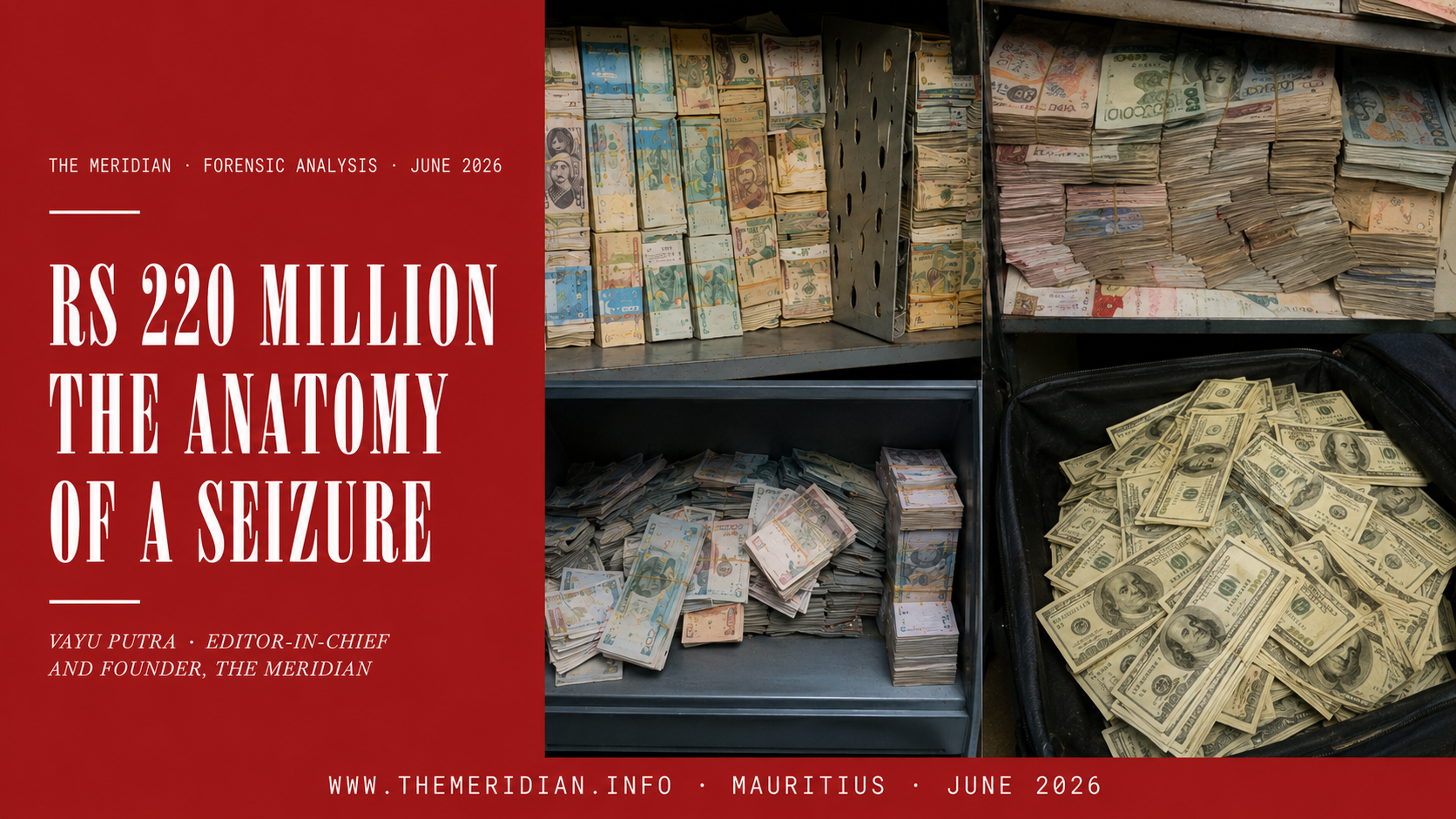
A verdict in the Rs 220 million case is expected before the Financial Crime Division of the Intermediate Court on 8 June 2026. This article is published six days before that verdict. On the morning of 6 February 2015, officers from the Criminal Investigation Division entered the residence of former Prime Minister Navin Ramgoolam at Riverwalk, Vacoas, and the separate address at Desforges Street, Port Louis. What they found has been reported in partial terms. What it means in full statutory, forensic, and institutional terms has not. Rs 220 million in various currencies. Uncirculated American hundred-dollar bills. A man who had spent nine years building the financial intelligence architecture designed to detect exactly this. And a legal architecture now confirmed to mean that even a conviction on 8 June may not result in the confiscation of those funds. The Meridian publishes the complete analysis.
Rs 220 million cash seizure Mauritius 2015 FIAMLA forensic analysis uncirculated bills Ramgoolam AML customs evasion statutory breakdown The Meridian
The Financial Intelligence and Anti-Money Laundering Act 2002 was not written for ambiguous situations. Its drafters, its parliamentary champions, and the international bodies that reviewed it understood precisely what category of conduct it was designed to capture: the accumulation of large quantities of physical cash outside the formal banking system, in private premises, in amounts that exceed the statutory ceiling, in currency that cannot be traced through declared channels. When police opened the safes at Riverwalk and Desforges Street in February 2015, what they found was not a grey area. It was a textbook example of the conduct that FIAMLA, in its original form and in each of its subsequent amendments, was built to detect, investigate, and prosecute.
The documented facts of the seizure, drawn from court proceedings, press records, and the formal charge sheets, are as follows. Police found approximately Rs 220 million in various currencies at two addresses associated with Navin Ramgoolam. The figure has been reported across multiple credible outlets including The Africa Report, Al Jazeera, Le Mauricien, and the Sunday Times Mauritius. Court records confirm 23 charges were subsequently filed, covering Rs 63.8 million in alleged illegal cash transactions across two currency categories.
The legal record confirms the bills were uncirculated. In anti-money laundering forensics, the condition of physical currency is not a trivial detail. It is an evidential category. Uncirculated currency -- meaning bills that have never passed through normal retail or commercial channels -- carries a specific forensic signature that has been recognised in AML guidance, banking regulation, and financial crime prosecution across multiple jurisdictions.
Circulated currency accumulates the marks of commerce: handling, folding, ATM processing, retail exchange, and banking transit. Uncirculated currency, by contrast, arrives directly from a primary source -- a central bank, a primary financial institution, or a wholesale currency dealer. It has not been used in ordinary transactions. In bulk quantities, its presence in a private residence rather than a licensed financial institution raises an immediate and statutory question: through what declared channel did it arrive?
Under the Bank of Mauritius Act and the Customs Act of Mauritius, any individual entering the territory carrying currency or monetary instruments exceeding Rs 500,000 (or its foreign currency equivalent) is required to make a customs declaration. The legal obligation is absolute. There is no exemption based on the identity of the carrier, the purpose of the funds, or the seniority of the individual concerned.
The uncirculated status of the American bills raises a further question that the 23 charges do not address. If the bills were not acquired through the Mauritian banking system -- which would have triggered Suspicious Transaction Reports under FIAMLA's reporting obligations -- they had to have entered the country through a non-banking channel. For bulk quantities of uncirculated US currency to bypass the Mauritian banking and customs infrastructure, the most probable mechanism is physical importation outside declared channels. Whether that occurred through diplomatic passage, VIP customs procedures, or some other route is not established by the public record. What is established is that the formal banking system did not process these funds in any documented way.
The deeper forensic fact of the 2015 seizure is not the quantity of the currency. It is the legislative authorship of the instruments invoked to investigate it. Between 2005 and 2014, the Ramgoolam government amended FIAMLA on six separate occasions. Each amendment tightened the compliance apparatus. Each strengthened the FIU's investigative powers. Each extended the Know Your Customer and Cash Transaction Reporting obligations that make the accumulation of undeclared physical cash a detectable and prosecutable act.
In 2009 -- the year the charges allege the illegal cash receipts began -- the government passed Act No. 14 of 2009, amending FIAMLA to extend compliance obligations. In 2011, the Asset Recovery Act gave the state the power to seize unexplained wealth without requiring a criminal conviction. In 2012, both FIAMLA and the Asset Recovery Act were simultaneously strengthened. By 2013, when the final pre-election FIAMLA amendment was enacted, the statutory framework that would be used to investigate and charge him was, on the prosecution's case, already being violated by the man who had spent eight years building it.
This is not legal irony in the rhetorical sense. It is a documented chronological fact: the charges allege offences began in January 2009. The FIAMLA amendments that tightened the framework continued in 2009, 2011, 2012, and 2013. The author of each amendment was, on the prosecution's case, simultaneously committing the offences each amendment was designed to prevent.
The state builds the machinery of financial surveillance to police the citizen. The question the 2015 seizure forces upon the Republic is the one that every captured state must eventually answer: who polices the architect of the machinery?
The most analytically significant fact in the 2015 case is not what was charged. It is the documented gap between the total amount found and the amount covered by the charges. Rs 220 million was found across two addresses and a bank safe. Rs 63.8 million was covered by the 23 FIAMLA Section 5 charges. The remaining amount -- approximately Rs 156 million on a conservative reading -- was not the subject of any of the 23 counts.
The prosecution chose the narrowest available instrument. Section 5 of FIAMLA -- the cash payment limitation provision -- is the least complex of the available charges. It requires proof only of receipt above the threshold. The more powerful instruments were not deployed: a Section 3 FIAMLA money laundering charge, which would have required proving the criminal origin of the funds but which carries substantially higher penalties; an unexplained wealth order under the Asset Recovery Act 2011, which required no criminal conviction and which Ramgoolam's own government had enacted; or a formal conspiracy charge connecting the cash to any of the parallel investigations then underway.
What structural conditions explained this prosecutorial restraint is a question the documentary record raises but does not answer. What is documented is that the full statutory arsenal -- the arsenal that Ramgoolam spent nine years constructing -- was not deployed against its own architect. The machinery was set in motion. Its highest settings were never engaged.
The case has been before the Financial Crime Division of the Intermediate Court for over eleven years. The verdict is now expected on 8 June 2026. But a development confirmed by court and parliamentary sources in early June 2026 has materially altered the legal landscape of that verdict: even if Navin Ramgoolam is convicted on all 23 counts, the Rs 220 million may not be confiscated.
In early 2026, Ramgoolam's legal team filed a motion to remove FIAMLA Article 8 -- the confiscation provision -- from the charges against their client. The court accepted the motion. The Director of Public Prosecutions could not oppose it. The reason: the former government -- the MSM administration under Pravind Jugnauth -- amended the Financial Crimes Commission Act in March 2024, removing the Intermediate Court's automatic power of confiscation and transferring it exclusively to the Financial Crimes Commission.
The effect, confirmed by former judicial officers familiar with the Mauritian confiscation framework, is as follows: even in the event of a conviction, the Rs 220 million will not be automatically seized. The FCC -- whose director is an executive appointee -- would need to initiate a separate and independent confiscation procedure before the Supreme Court via a Criminal Attachment Order or a Criminal Confiscation Order. Without that FCC action, the funds may be restituted to Ramgoolam. In the absence of a conviction, the DPP retains the right of appeal, and the Rs 220 million question remains open regardless of the June 8 outcome.
The March 2024 FCC Act amendment -- passed by the previous administration -- is the documented legal mechanism that removed Article 8 from the charges. Whether that amendment was designed with this outcome in mind is not established by the public record. What is established is its effect: the confiscation power that would have followed automatically from a conviction at the Intermediate Court no longer exists at that level. The instrument that would have made a conviction immediately consequential for the Rs 220 million was legislatively dismantled fourteen months before the verdict.
The contradiction that the 2015 seizure and the 2026 legislative agenda together expose is this: the same legal architecture can function as a sword against the citizen and a shield for the sovereign. Under FIAMLA Section 5, a Mauritian citizen who receives Rs 600,000 in cash is committing a criminal offence. Under the provisional charge mechanism of the Dangerous Drugs Act, a citizen found with a cannabis plant faces years of legal suspension without conviction. The law lands on the ordinary Mauritian with the full force of its statutory weight.
The same laws, built by the same hands, were invoked in their narrowest possible form against those hands. And now those same hands are proposing, through the Constitutional Review Commission Bill, the Anti-Money Laundering Bill of 2026, and the creation of a new Constitutional Court, to reconstruct the legal architecture so that it can never again reach the level of the executive.
The contradiction is not subtle. It is the documented structure of the captured state. The law exists to govern the Republic. When the Republic's governor engineers his own immunity from the law he built, the Republic requires the citizen to notice, and to say so on the record. This is The Meridian's record.
This article is the second in The Meridian's investigation into institutional capture in Mauritius. The first article examined the complete legislative record of the laws Ramgoolam passed while allegedly breaking them. Subsequent articles will examine the Constitutional Review Commission Bill (No. VI of 2026), the AML/CFT/CPF Bill (No. III of 2026), and the Triad of State Capture.
Add comment
Comments