Why the Strait of Hormuz Is Behind Your Cost of Living Crisis in 2026
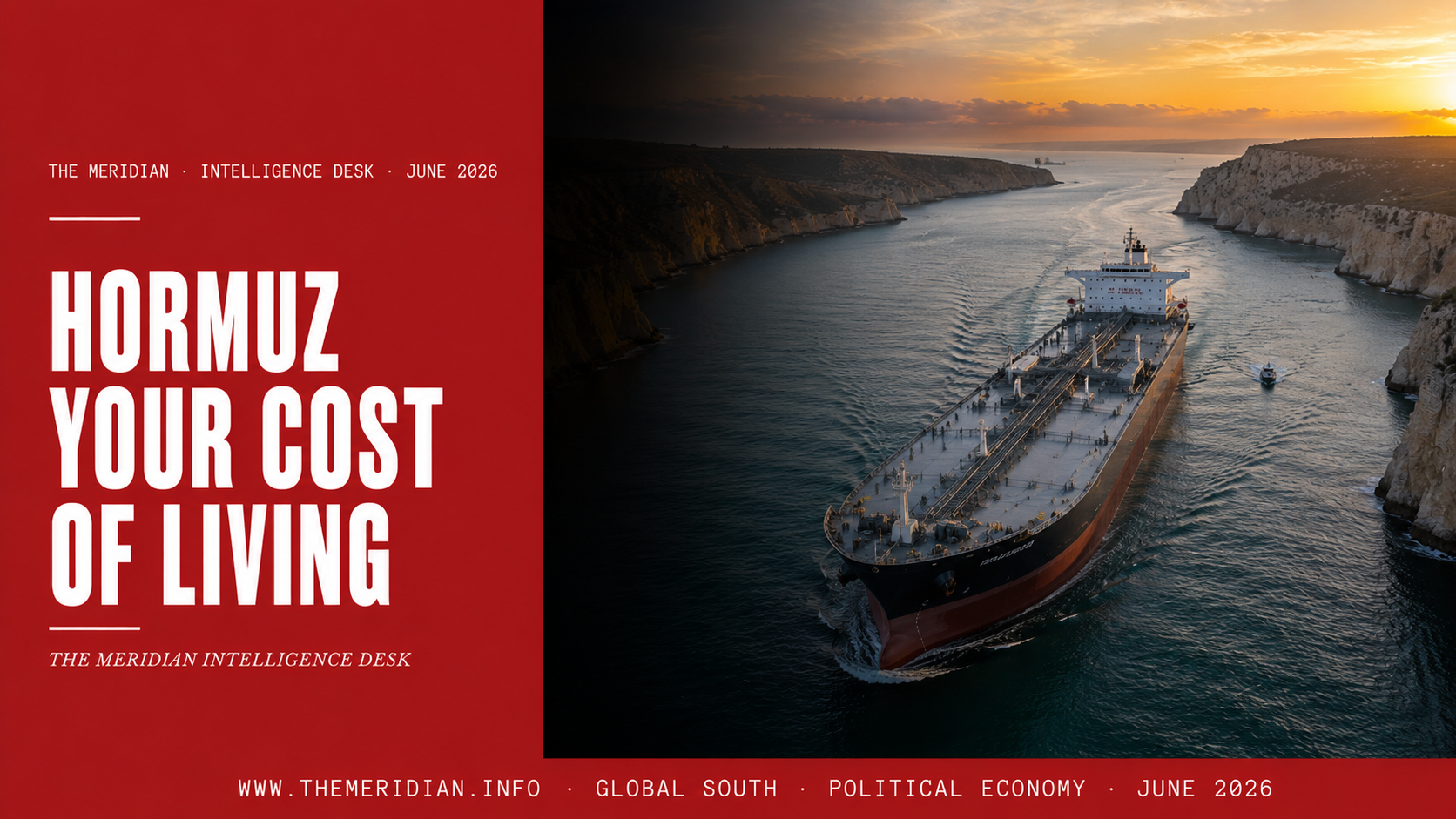
On 2 March 2026, following coordinated US-Israeli strikes on Iranian military infrastructure, the Islamic Revolutionary Guard Corps declared the Strait of Hormuz effectively closed to international commerce. Within hours, Brent crude surpassed $100 per barrel. Within weeks, the cost of living crisis you thought was easing came back. Your energy bill. Your fuel pump. The shortages at Glasgow and Edinburgh airports. The food prices that refuse to fall. The Mauritius government raising VAT. The African continent running 10.4% inflation. One chokepoint. Every economic pressure you are currently feeling. This is how it connects.
The Strait of Hormuz is 33 kilometres wide at its narrowest point. Through that 33-kilometre passage moves approximately 20 to 21 million barrels of oil every single day -- roughly 20 percent of global seaborne oil trade and 20 percent of the world's liquefied natural gas. It also carries around one third of global fertiliser supplies, including the urea and ammonia that feed the crops that become the food on your supermarket shelf. On 2 March 2026, Iran closed it. Not partially. Effectively. The cost of living crisis you thought was easing did not ease. It got structural.
The closure did not happen without warning. The escalation that produced it had been building since late February 2026, when US and Israeli forces launched Operation Roaring Lion -- a coordinated aerial campaign targeting Iranian military infrastructure. Iran's retaliation was swift and strategic. The IRGC deployed naval mines and drone swarms to deter commercial transit through the narrow strait and issued a formal declaration that the waterway was "no longer safe for international commerce."
The impact was instantaneous. Oil trading desks repriced crude within minutes. Shipping insurance premiums for tankers transiting the region skyrocketed. The limited storage capacity for oil and liquefied natural gas in the Gulf led to a near cessation of extraction, as producers had nowhere to send output they could not ship. Israel's bombing of the Iranian natural gas field on 18 March marked a further escalation. By mid-March, the International Energy Agency estimated that approximately 20 million barrels per day had been affected by the drop in shipping through the strait -- with oil production cut by at least 10 million barrels in Gulf countries, representing roughly 10 percent of global production.
Goldman Sachs put it precisely: every month the Strait of Hormuz remains closed adds $10 to the year-end oil price. European Commissioner Valdis Dombrovskis, speaking at the G7 finance ministers meeting in Paris on 18 May 2026, named it directly: "We are facing a stagflationary shock." Oil prices have settled firmly above $100 per barrel. The strait remains effectively closed.
The transmission mechanism from a narrow waterway in the Gulf to your household budget is not complicated. It operates through three simultaneous channels: energy, fertiliser, and freight. Understanding all three is what connects the news about a military escalation in the Middle East to the price you paid for petrol this morning and the food bill you paid last week.
The UK entered 2026 with inflation on a downward trajectory towards the Bank of England's 2 percent target. The Hormuz closure interrupted that trajectory. UK CPI inflation climbed from approximately 3 percent to 3.3 percent between March and April 2026, driven directly by the energy and transport price components. The energy price cap has absorbed some of the shock -- the April 2026 cap adjustment was already announced before the closure and does not fully reflect current wholesale prices. The next adjustment in July 2026 will. Households who believe their energy bills are manageable now should prepare for the July revision.
The UK is a net oil importer. North Sea reserves have depleted to a point where domestic production covers a diminishing share of national energy needs. This makes the UK systematically more exposed to external oil price shocks than economies with larger domestic reserves. Every $10 rise in the oil price is a direct transfer from UK households to oil-producing nations. At $100 per barrel sustained over six months, the macroeconomic drag is measurable in percentage points of household purchasing power.
The cost of living crisis did not begin with the Strait of Hormuz. But in 2026, it will not end without it. The strait is not a news story. It is a supply chain. And that supply chain runs through your energy bill.
The cost of living impact of the Hormuz closure is not evenly distributed. The African continent runs continental inflation at 10.4 percent in 2026, as confirmed by the African Development Bank's outlook released in Brazzaville on 26 May. The AfDB's own analysis identified the West Asia conflict as a primary driver -- noting that 13 percent of Africa's critical imports, primarily oil and fertiliser, pass through the Strait of Hormuz. For African governments that subsidise fuel or depend on imported fertiliser for food security, the Hormuz shock is not a percentage point of CPI. It is a fiscal emergency transmitted directly into state budgets that have almost no buffer.
For Mauritius -- a small island developing state that imports virtually all of its fuel, a substantial proportion of its food, and whose tourism sector depends on affordable international aviation -- the Hormuz closure is particularly acute. The government is considering raising VAT from 15 percent to 17 or 18 percent in the budget expected on 19 June 2026. That VAT increase is, in part, a fiscal response to the revenue pressure created by higher import costs flowing from energy market disruption. The Hormuz closure is present in that budget deliberation whether or not its name appears in the finance minister's speech.
UNCTAD has confirmed the broader picture with precision: 3.4 billion people live in countries already spending more on debt service than on health or education. For those populations, an energy shock of this magnitude is not a cost of living inconvenience. It is a development emergency. Global merchandise trade growth is projected to decelerate from 4.7 percent in 2025 to between 1.5 and 2.5 percent in 2026. Global growth slows from 2.9 percent to 2.6 percent. Every decimal point of that deceleration is a household budget, a cancelled investment, a delayed recovery.
The cost of living crisis of 2022 and 2023 was explained, extensively and correctly, as the product of pandemic supply chain disruption, energy market dysfunction following the Ukraine war, and the inflationary consequences of post-pandemic monetary policy. Those explanations were accurate and they were communicated. People understood, at least broadly, why their bills had risen.
The 2026 cost of living pressure has a cleaner, simpler, more precisely located cause. A 33-kilometre waterway in the Gulf is closed. Twenty percent of global oil and gas cannot move through it. One third of global fertiliser cannot move through it. Every product in your economy that uses energy to produce, transport, or refrigerate costs more because of that closure. Your energy bill. Your fuel. Your food. The airport fuel shortage in Scotland. The inflation running at 10.4 percent across Africa. The VAT increase being considered in Mauritius. All of it traces back to the same 33 kilometres.
The political question is not whether the closure affects you. It does. The political question is how long it remains closed, whether the 40-nation multinational military mission leads to a ceasefire agreement, and whether the July 2026 energy price cap adjustment reflects reality or delays the inevitable. Goldman Sachs has told you the arithmetic: every additional month adds $10 to the year-end oil price. The strait has been closed since 2 March. You are doing the mathematics.
Sources: NIESR (National Institute of Economic and Social Research, March 2026), UNCTAD Rapid Assessment (April 2026), House of Commons Library Research Briefing CBP-10601 (March 2026), African Development Bank African Economic Outlook 2026 (May 2026), Goldman Sachs Oil Research (Daan Struyven), European Commission Spring Forecast 2026. This article is part of The Meridian's coverage of the Strait of Hormuz and its consequences for the global economy and the Global South.
Add comment
Comments