The FX Death Spiral: Why the Global Franchise Model Is Collapsing in Mauritius
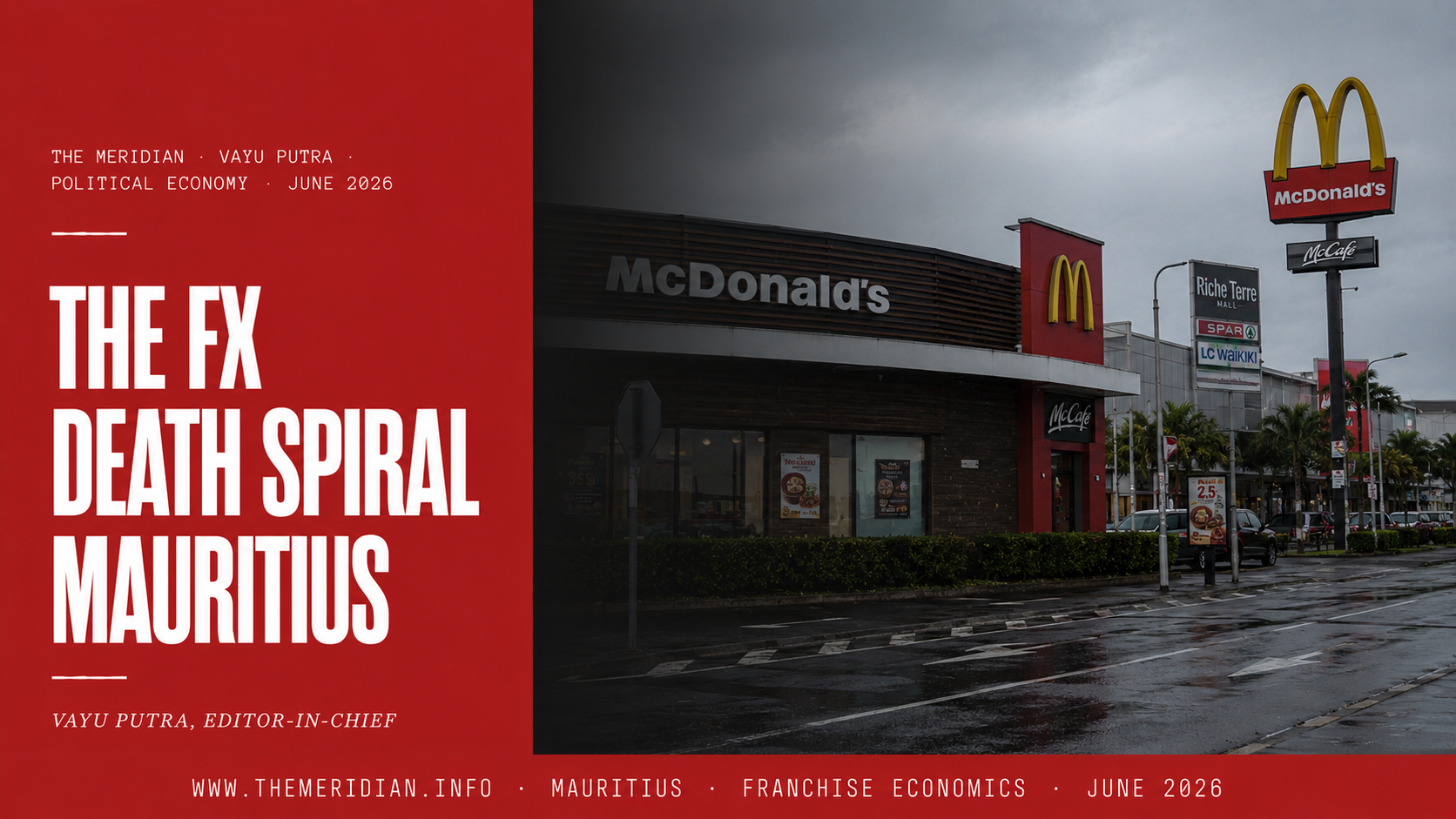
The FX Death Spiral: Why the Global Franchise Model Is Collapsing in Mauritius -- The Meridian Political Economy
Political Economy · Mauritius · Franchise Economics · 5 June 2026

The FX Death Spiral: Why the Global Franchise Model Is Collapsing in Mauritius

Mauritius franchises import their costs in US dollars and collect their revenue in a depreciating rupee. With VAT rising, the middle class tapped out, and royalties leaving the island every month regardless of profit, the global fast food model is no longer mathematically viable here. The Meridian investigates the structural trap.

In June 2026, a Mauritian worker earning Rs 20,000 per month faces a fast food combo meal priced between Rs 350 and Rs 450 at a global franchise outlet. That single meal represents roughly two percent of a monthly salary. At the equivalent franchise in London, the same meal represents less than 0.4 percent of median monthly earnings. The price is not the anomaly. The structural mechanism producing it is.

Global fast food franchises operating in Mauritius -- McDonald's, KFC, and their sector equivalents -- are caught in a compounding financial trap that macroeconomic analysts call the FX death spiral. Their costs are denominated in hard foreign currency. Their revenue is collected entirely in Mauritian rupees. And the rupee, under sustained pressure from imported inflation, the Strait of Hormuz disruption, and a widening current account deficit, has lost significant ground against the dollar over the past three years. The consequences are not abstract. They are felt in every combo meal price, every quietly shrunk chicken portion, and every franchise that retreats from inland communities toward tourist enclaves and Smart City malls.

The Currency Mismatch: Importing Inflation Through the Supply Chain

The fatal architecture of the franchise model in a small island economy is its demand for absolute product uniformity. A master franchise agreement legally binds the local Mauritian operator to global standards. A burger assembled in Grand Baie must be chemically and visually identical to one assembled in Glasgow. To enforce this, the franchisor prohibits local sourcing. Chicken portions, specific potato cuts, proprietary sauces and marinades, branded packaging materials -- all are imported from approved regional supply hubs, primarily Malaysia and South Africa, and all contracts are strictly priced in US dollars or equivalent hard currency.

The local operator generates one hundred percent of its revenue in Mauritian rupees. The rupee closed at approximately Rs 46 to the dollar in mid-2026, compared with Rs 40 in 2022 -- a devaluation of roughly 15 percent over three years. This means the operator's cost of goods sold has risen by the same margin even if global commodity prices had remained perfectly flat. They have not. The Strait of Hormuz crisis pushed shipping costs and energy prices sharply higher across all import corridors. The franchise operator in Mauritius is therefore absorbing a double inflation: currency devaluation and global commodity inflation, simultaneously, with no mechanism to escape either.

The Currency Trap in Numbers
Rupee per USD (2022)Rs 40
Rupee per USD (June 2026)Rs 46
Effective cost inflation on imported inputs+15%
Standard franchise royalty (% of gross sales)4--6%
Royalty currencyUSD -- non-negotiable
Revenue currencyMUR -- depreciating

The Repatriation Bleed: Capital Leaving the Island Every Month

The currency mismatch in the supply chain is only the first extraction layer. The second operates independently of it. Every global franchise agreement contains a non-negotiable royalty clause: between four and six percent of gross revenue must be remitted to the corporate headquarters -- in US dollars -- every month. This obligation does not depend on the restaurant's local profitability. A Mauritian McDonald's franchise that loses money in a given month still converts rupees into dollars and wires the royalty to Chicago. The mechanism is legally binding and cannot be renegotiated at the local level.

In an economy where the Bank of Mauritius manages its foreign exchange reserves carefully -- reserves estimated at roughly nine to ten months of import cover when broader service imports are factored in -- this royalty structure functions as a structural capital vacuum. Millions of rupees are converted into hard currency and permanently exit the Mauritian financial system every month, not because the business is generating value for the island, but because the logo on the building is owned by a corporation registered in the United States. The local operator carries the risk. The global entity collects the rent.

The global corporation carries zero risk. It collects its royalty in dollars until the local operator can no longer service the agreement. The capital flight has already occurred long before the restaurant closes.

The Consumer Wall: VAT, Inflation, and the Tapped-Out Middle Class

The standard franchise response to rising costs is price transmission: increase the retail price of the product and pass the margin pressure to the consumer. In a large, high-income market, a fifty-cent increase in a burger price is absorbed with mild complaint. In Mauritius in mid-2026, this option has effectively closed.

The National Budget for 2025-2026 raised the VAT rate and lowered the mandatory VAT registration threshold to Rs 3 million, pulling substantially more small businesses into the tax net and driving up the general cost of services across the island. The Strait of Hormuz crisis pushed fuel and food import costs sharply higher from March 2026 onwards. The IMF's 2026 Article IV consultation flagged Mauritius public debt at approximately 83 percent of GDP and recommended fiscal tightening. Real wages have stagnated. The Mauritian middle class is not price-resistant. It is price-exhausted.

There is a hard mathematical ceiling on what a local worker earning Rs 18,000 to Rs 25,000 per month will spend on a single fast food meal. When a franchise combo crosses Rs 400 to Rs 450, the consumer does not choose a cheaper item within the franchise. They exit the category entirely. A dholl puri vendor charges Rs 25 to Rs 40. A local chicken rotisserie charges Rs 80 to Rs 120. These businesses source locally, pay wages in rupees, carry no royalty obligations, and are entirely insulated from the dynamics that are breaking the franchise model. The consumer who walks away from the franchise is not returning.

The Endgame: Shrinkflation or the Enclave Retreat

Trapped between a cost structure they cannot reduce and a price ceiling they cannot breach, franchise operators in Mauritius are pursuing one or both of two survival strategies. The first is shrinkflation: portion sizes decrease quietly, chicken pieces are more heavily breaded, cheaper fillers replace imported proteins, and the headline menu price remains nominally unchanged while the value delivered to the consumer collapses. The consumer notices, but gradually, and the operator buys time.

The second strategy is the enclave retreat. As the broader island becomes mathematically unprofitable for the franchise model, operators concentrate their remaining investment in locations where the currency mismatch does not apply in practice: Smart City developments, luxury mall complexes at Bagatelle or Vivéa, and coastal tourist zones where European and Asian visitors pay with euros and pounds. A tourist on holiday in Mauritius will pay Rs 450 for a fast food meal without registering the price in local income terms. The franchise extracts its margin from foreign purchasing power rather than from the domestic consumer it originally claimed to serve. The working-class Mauritian who once used the franchise disappears from its customer base entirely, replaced by a transient foreign visitor who will never return to the island as a repeat customer.

The Sovereign Verdict: Who Wins

McDonald's Corporation and Yum! Brands are entirely insulated from the collapse playing out in their Mauritian outlets. Their asset-light franchise model means they hold no restaurant real estate, carry no inventory risk, and employ no kitchen staff in Mauritius. They collect their royalties and licensing fees in dollars until the local operator can no longer service the agreement, at which point the franchise changes hands or closes. The capital has already left. The extraction is already complete.

The future of Mauritian retail does not belong to the global franchise. It belongs to the business that sources in rupees, pays wages in rupees, keeps its margins on the island, and prices for the actual Mauritian consumer rather than for an algorithm optimised in Chicago. The dholl puri vendor, the local roti shop, the domestic chicken rotisserie, the family-run restaurant sourcing from Mauritian farms -- these are not the informal economy. They are the resilient economy. The FX death spiral does not touch them because they were never inside it.

Mauritius is not unusual in this respect. The same mathematical breakdown is playing out across the Global South wherever global franchise models have assumed that currency stability, consumer purchasing power, and royalty obligations would remain in comfortable alignment. They have not. The model was not designed for an era of rupee depreciation, imported inflation, and a middle class squeezed between rising VAT and stagnant wages. It was designed for growth. Growth has stopped. The spiral has begun.

The Meridian Analysis

The FX death spiral affecting Mauritian fast food franchises is not a retail story. It is a macroeconomic story about what happens when a business model built for currency stability meets an island economy facing imported inflation, rupee depreciation, and fiscal tightening simultaneously. The franchise model extracts in dollars and earns in rupees. In the current environment, that equation cannot balance. The operators who survive will be those who abandon the Mauritian working class for tourist enclaves. The ones who do not survive will leave behind a capital flight record and a closed storefront.

The businesses that will define the next decade of Mauritian retail are the ones that never left the rupee economy in the first place.

Add comment

Comments

There are no comments yet.