Fraude à la Constitution: Was the Law Lord Right?
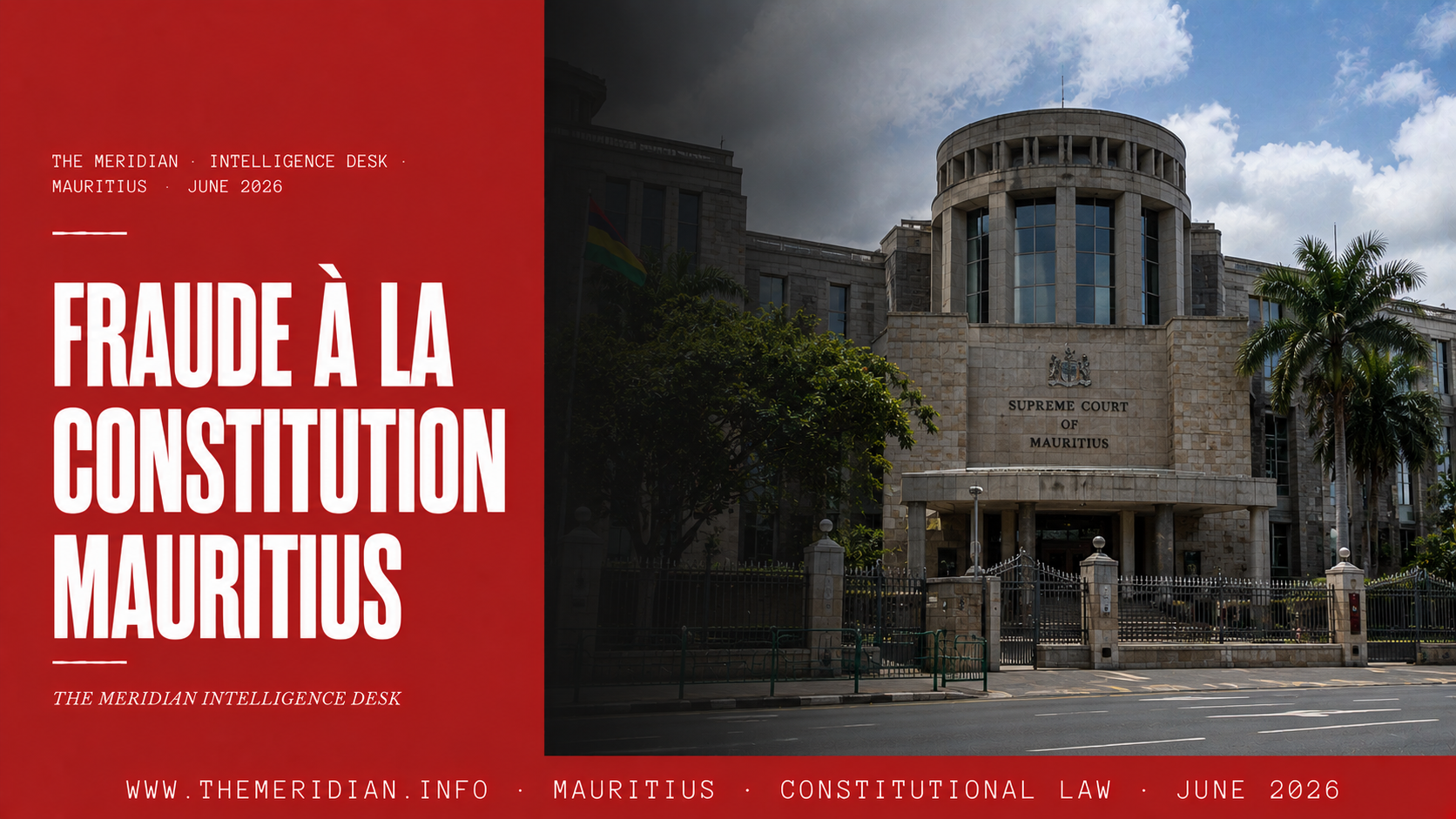
The Attorney General who designed the Constitutional Review Commission Bill was Navin Ramgoolam's legal counsel in his money laundering proceedings. The Financial Services Commission Director is appointed on the Prime Minister's advice. If FSC decisions are constitutionally insulated from judicial review, the sitting Prime Minister has engineered a constitutional shield for his own active prosecution. The Meridian places the bill against the exact text of the Mauritius Constitution and publishes the forensic autopsy.
The true collapse of a democracy is rarely announced. It arrives dressed in the language of modernisation, wearing the costume of progressive reform. It carries an environmental manifesto. It convenes an expert commission. It promises a Second Republic. And it is designed, at every level of its architecture, to solve a very specific problem: the legal exposure of the person who commissioned it. In Mauritius in 2026, that process is under way. The Mauritius Constitution, in its exact provisions, tells us precisely why the warning issued to The Meridian by an anonymous Law Lord is not alarmist. It is legally precise. And the conflicts of interest surrounding this bill are not theoretical. They are visible to anyone who reads the record.
"State capturing mechanisms are dangerously in play. Mauritius is a captured state. The constitution is supreme -- and nothing can overwrite it. Navin Ramgoolam has to understand that. If he wanted a constitutional court, one could be established under the Supreme Court as a division, like the Family Division. That is how it is done. This is state capture."
Identity withheld at source's request. Consulted exclusively by The Meridian.
Before dissecting the bill, we establish the legal ground on which it stands. The Mauritius Constitution is not ambiguous on its own supremacy.
"Mauritius shall be a sovereign democratic State which shall be known as the Republic of Mauritius."
Section 2 — Constitution is Supreme Law"This Constitution is the supreme law of Mauritius, and if any other law is inconsistent with this Constitution, that other law shall, to the extent of the inconsistency, be void."
Section 2 is the Law Lord's foundational point. Nothing overrides the constitution. But Section 2 also means that a constitutional amendment, once passed under the Section 47 three-quarters procedure, becomes part of the supreme law. The fraud is not in circumventing Section 2. It is in using Section 2 as the mechanism: amend the constitution to constitutionalise corporate and executive immunity, and those immunities become supreme law themselves -- beyond the reach of any statute, any future parliament, any court below the Privy Council.
The Constitutional Review Commission Bill was prepared under the authority and direction of the Attorney General. The Attorney General is the government's principal legal adviser and the architect of its constitutional framework. In Mauritius in 2026, this person is the same individual who previously served as legal counsel for Navin Ramgoolam in his money laundering proceedings -- the proceedings that are still active, whose verdict is expected on 8 June 2026, and whose outcome the constitutional reform being designed by the same person could directly influence.
This is not an analytical characterisation. It is a documented institutional fact. The lawyer who defended the accused has become the Attorney General who is designing the constitutional framework that would shield regulatory decisions affecting the accused from judicial review. There is no gap between these two roles that professional distance can fill. In any jurisdiction that takes the doctrine of conflict of interest seriously, this appointment would be challenged before a court. In Mauritius, it has been presented as normal.
The lawyer who defended the accused in the money laundering case is now the Attorney General designing the constitution that would shield the regulator overseeing that same case from judicial review. This is not ambiguous. It is the most visible conflict of interest in the current Mauritian institutional landscape.
The Financial Services Commission is the regulatory body responsible for overseeing Mauritius's financial sector, including the offshore industry and financial crime matters. The FSC Director is appointed by the President of the Republic acting on the advice of the Prime Minister. This means the sitting Prime Minister effectively controls who leads the body responsible for financial regulatory oversight.
Navin Ramgoolam is currently the subject of active money laundering proceedings. These proceedings involve questions of financial assets and the regulatory architecture that governs them. The Constitutional Review Commission Bill, through its "holistic mandate," opens the possibility of constitutionalising the independence of regulatory bodies such as the FSC from judicial review. If a future constitutional provision states that FSC decisions "shall not be subject to judicial review" -- a formulation that the commission's unlimited mandate permits it to recommend -- the following chain of consequences follows.
The sitting Prime Minister nominates the FSC Director. The FSC Director makes regulatory determinations regarding financial assets in cases of financial crime. If the FSC rules that no asset seizure is warranted, or declines to take enforcement action, that ruling becomes unchallengeable in any Mauritian court. The constitutional reform designed by the Prime Minister's former lawyer, passed under a constitutional commission appointed by the President on the Prime Minister's advice, shields the regulator appointed on the Prime Minister's advice from any judicial scrutiny of decisions that may directly benefit the Prime Minister.
"Provision is made by a law applicable to that taking... securing to any person having an interest in or right over the property a right of access to the Supreme Court, whether direct or on appeal from any other authority, for the determination of his interest or right, the legality of the taking of possession or acquisition of the property, interest or right, and the amount of any compensation to which he is entitled."
Section 8(4A) — The Three-Quarters Ouster Mechanism"Notwithstanding subsection (1)(c), section 17 or any other provision of the Constitution, no law relating to the compulsory acquisition or taking of possession of any property shall be called in question in any court if it has been supported at the final voting in the Assembly by the votes of not less than three quarters of all the members of the Assembly."
Section 8(1) guarantees every citizen access to the Supreme Court to challenge property-related decisions. Section 8(4A) removes that access if a 3/4 majority supports the relevant law. Applied to FSC regulatory decisions: once constitutionalised under a 3/4 majority provision, FSC enforcement decisions regarding financial assets become unchallengeable in any Mauritian court. Section 8(4A) is the loaded legal instrument. The constitutional commission is being designed to recommend pointing it at exactly the regulatory architecture that currently governs the PM's own prosecution.
This is not a conspiracy theory. It is a constitutional mechanism, documented in the text of the Mauritius Constitution, whose application to the current political situation is direct and demonstrable. The Law Lord who spoke to The Meridian did not need to know the details of the Rs 220 million case to identify state capture. He identified it in the structure of the bill itself. The details of the FSC and the Attorney General's prior role confirm that the structure was not accidental.
"It is hereby recognised and declared that in Mauritius there have existed and shall continue to exist without discrimination by reason of race, place of origin, political opinions, colour, creed or sex... each and all of the following human rights and fundamental freedoms: the right of the individual to life, liberty, security of the person and the protection of the law; freedom of conscience, of expression, of assembly and association; and the right of the individual to protection for the privacy of his home and other property and from deprivation of property without compensation."
Section 3 guarantees the protection of the law as a fundamental right. Every Mauritian citizen, without discrimination, is entitled to it. But Résistance et Alternative, a Mauritian political coalition, did not go to the United Nations Human Rights Committee because Section 3 did not exist in Mauritius. They went to the UN because enforcing Section 3 in Mauritius required resources, legal representation, and years of proceedings that ordinary citizens cannot sustain -- and because even after years of proceedings, in a captured state, the outcome is not guaranteed. Section 3 does not fail as a text. It fails as a practice, because the access to it is priced beyond the reach of those it was designed to protect.
The electoral participation case demonstrates precisely the gap between constitutional text and constitutional reality that defines a captured state. The rights exist. They are written in the document. But asserting them costs money -- legal fees, court proceedings, appeals. Justice is not only delayed in Mauritius. It is priced. Navin Ramgoolam's own case has run for ten years. The same system that has stretched a former Prime Minister's prosecution across a decade is the system that an ordinary Mauritian worker must navigate to assert their Section 3 rights against an EDB rezoning decision or a Financial Services Commission ruling. The constitutional review does not address this gap. It widens it.
"There shall be a Supreme Court for Mauritius which shall have unlimited jurisdiction to hear and determine any civil or criminal proceedings under any law."
Section 83(1) — Original Jurisdiction in Constitutional Questions"Where any person alleges that any provision of this Constitution (other than Chapter II) has been contravened and that his interests are being or are likely to be affected by such contravention, then, without prejudice to any other action with respect to the same matter which is lawfully available, that person may apply to the Supreme Court for a declaration and for relief under this section."
The Law Lord's point is constitutionally precise. Section 83 already grants original jurisdiction in constitutional questions to the Supreme Court. A Constitutional Division, as the Law Lord proposed, would formalise this existing jurisdiction without requiring a single constitutional amendment. The government's choice to create an external, presidentially-appointed commission instead removes the drafting of constitutional amendments from independent judicial oversight and places it in the hands of experts whose selection is controlled by the executive -- and in this case, by the same executive facing active money laundering proceedings.
Beyond the FSC, the second major instrument of constitutional capture concerns land. The Economic Development Board, established under the EDB Act of 2017, administers the Smart City Scheme under which legacy conglomerates convert former sugar estate agricultural land into tax-exempt commercial and residential real estate. Section 8(1) guarantees citizens the right to challenge land acquisition before the Supreme Court. Section 8(4A) is the mechanism to remove that right permanently, with a 3/4 majority.
Once the EDB's Smart City powers are constitutionalised under a 3/4 majority provision -- which the commission's holistic mandate permits it to recommend -- no Mauritian citizen living adjacent to a designated Smart City project will ever be able to challenge the conversion of neighbouring land before any Mauritian court. The commission does not repeal Section 8. It uses Section 8(4A) to hollow it out. The agricultural land of Mauritius passes from public contestation into permanent corporate control -- legally, constitutionally, and irreversibly.
Mauritius has existing constitutional mechanisms for political accountability. The inclusion of a formal Right to Recall in the commission's agenda adds a layer of complexity to the existing framework without meaningfully strengthening it. In a state where media is concentrated in the hands of legacy conglomerates, where legal proceedings cost years and hundreds of thousands of rupees to bring, and where the same families have governed since 1968, the Right to Recall does not empower the citizen. It empowers capital.
"Mauritius shall be a sovereign democratic State."
Under Basic Structure doctrine as applied through the Privy Council, Section 1 is unamendable in substance. Even a 3/4 majority cannot alter the democratic character of the state. A Right to Recall mechanism that is structurally only accessible to well-funded actors does not strengthen democracy under Section 1. It corrupts it. A Privy Council Law Lord would ask a single question: if only capital can afford to trigger this constitutional right effectively, how does its inclusion advance the "sovereign democratic" character guaranteed by Section 1? The answer is that it does not. It converts a democratic mechanism into a financial veto, and in doing so, violates the unamendable foundation of the Mauritius Constitution.
The Hansard of 7 October 2025 is explicit: the commission will examine the constitution "in a holistic manner together with constitutional amendments." The Rights of Nature provide the moral cover. The Electoral College discussion provides the democratic camouflage. And the 3/4 majority procedure under Section 47 provides the constitutional legitimacy. Members of the National Assembly who vote for the Rights of Nature and a reformed Electoral College will vote simultaneously for the constitutionalisation of FSC immunity, EDB land powers, and the ouster of Supreme Court jurisdiction over regulatory decisions. They may not know this when they vote. That is what holistic means in this context. It means bundled.
First: the Attorney General who is architecting this constitutional reform was Navin Ramgoolam's legal counsel in his money laundering proceedings. The same hands that defended him in court are now designing the constitution that will govern the regulatory architecture of his prosecution.
Second: the FSC Director is appointed on the Prime Minister's advice. If FSC decisions are constitutionally insulated from judicial review under Section 8(4A), then the Prime Minister appoints the person whose decisions cannot be challenged in any court. In a case involving financial assets and regulatory oversight, this is not an abstract risk. It is a concrete mechanism for constitutional self-protection.
Third: Section 3 of the Mauritius Constitution guarantees the protection of the law to every citizen without discrimination. But Résistance et Alternative went to the United Nations to assert rights that exist in Section 3, because asserting them domestically was too costly, too slow, and not guaranteed in a state where justice is captured. The constitutional reform does not address this gap. It deepens it by constitutionalising the advantage of those who can already afford to navigate the system.
The Law Lord was right. The constitution is supreme. But Section 2's supremacy cuts both ways. Once these immunities are embedded in the constitution by a 3/4 majority, they become supreme law themselves. The FSC's decisions become unchallengeable. The EDB's land conversions become permanent. The Right to Recall becomes a corporate veto. And the Mauritian citizen, whose Section 3 rights were already practically inaccessible, loses the last institutional avenue that currently, in theory, remains open to them.
This is not a Second Republic. It is a constitutional annexation of the state by those who are already being prosecuted by it -- using the very document that was designed to hold them accountable as the instrument of their permanent immunity.
Add comment
Comments