The Rupee Since January: What the Data Shows and What It Does Not Explain
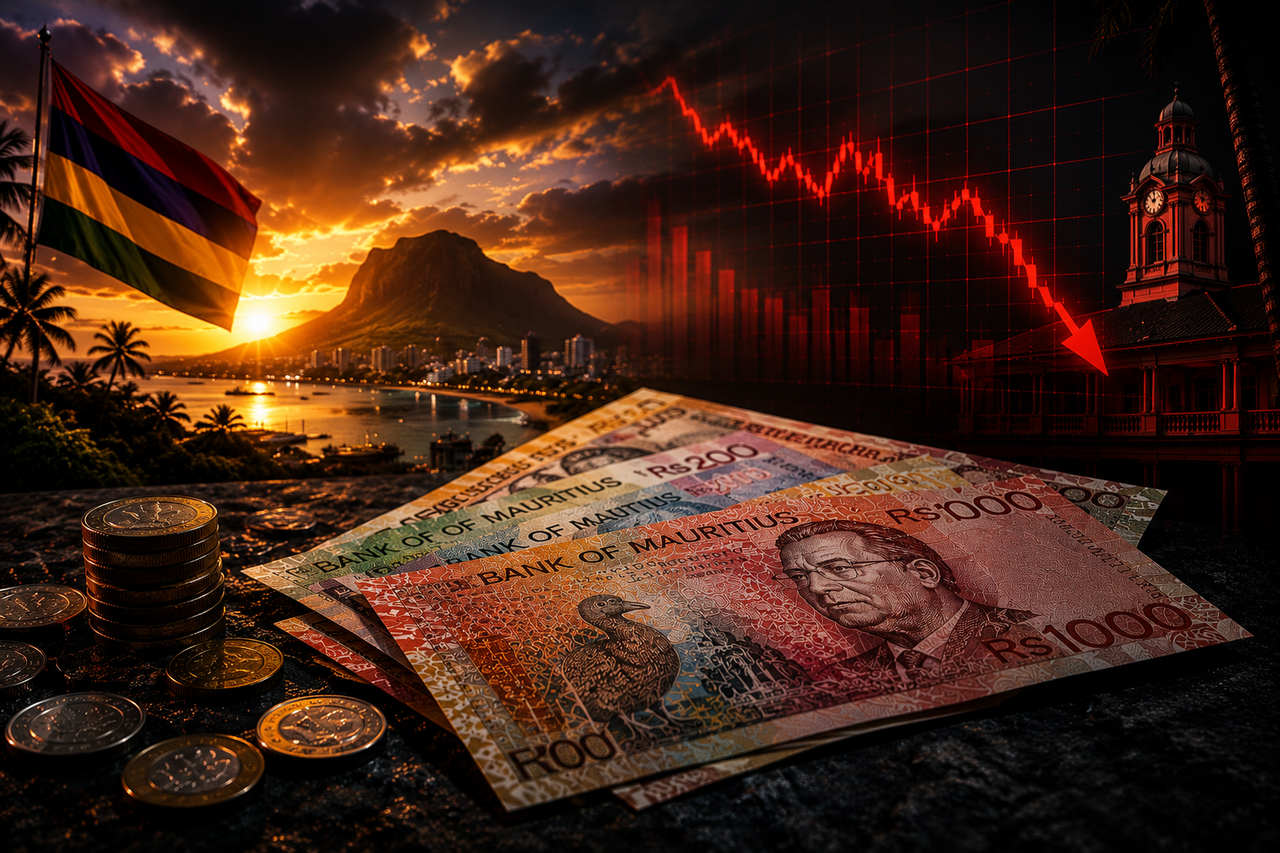
The Mauritius rupee has lost 23 per cent of its value against the US dollar over a decade. The official inflation rate reads 2.7 per cent. Supermarket prices tell a different story. The Bank of Mauritius intervenes constantly in a foreign exchange market that operates simultaneously at three different rates. The money supply expanded by Rs455 billion over six years. Every number in this article comes from the Bank of Mauritius's own published data. The Meridian Intelligence Desk lays them out and asks what they mean.
There is a standard way to discuss the Mauritian rupee and a more uncomfortable way. The standard way involves the official exchange rate, the Bank of Mauritius's inflation projections, the key repo rate and the statement that monetary policy remains appropriate given the outlook. The more uncomfortable way involves the exchange rate that Mauritians actually encounter when they try to obtain US dollars outside the official banking channel, the supermarket receipt after a weekly shop, and the consistent gap between what the official data says and what the daily experience of living in Mauritius suggests. This analysis attempts the more uncomfortable approach. Every number cited is drawn from the Bank of Mauritius's own Monthly Statistical Bulletin, from the MPC minutes published on the BOM website, or from named international data sources. No claim is made that cannot be sourced. But the questions those numbers raise are legitimate, they have not been adequately answered in the public domain, and The Meridian Intelligence Desk believes the Mauritian public is entitled to read them laid out plainly.
Mauritius rupee exchange rate 2026 dollar depreciation official data
The rupee opened 2026 at its weakest point in years. On 13 January 2026, 1 MUR was worth 0.02141 USD, equivalent to approximately 46.7 rupees per dollar, according to Exchange-Rates.org. It weakened further to its 2026 low of 0.02088 USD per rupee on 9 March 2026, equivalent to approximately 47.9 rupees per dollar. It has since recovered partially, trading at approximately 46.78 rupees per dollar as of May 2026, following a 0.51 per cent strengthening over the past month. The year-to-date performance shows the rupee down 1.24 per cent against the dollar in 2026.
These movements need to be placed in their longer-term context. Over the past ten years, the Mauritius rupee has declined 23.14 per cent against the US dollar. A decade ago, one dollar bought approximately 36 rupees. Today it buys approximately 47. The purchasing power of the rupee against the world's reserve currency has contracted by nearly a quarter over that period. For a country that imports approximately 80 per cent of its consumption, including all petroleum products and a significant share of its food, in US dollars, and that pays for those imports with rupees earned domestically, this long-run depreciation is not an abstract financial statistic. It is the explanation for why the cost of living in Mauritius has risen faster than the official inflation figures suggest to many households.
Exchange-Rates.org
Exchange-Rates.org
Statistics Mauritius via BOM
Bank of Mauritius MPC
Mauritius FX market three exchange rates official offshore money changer
The official USD/MUR rate published by the Bank of Mauritius is not the rate that many Mauritians pay when they need US dollars. This is the most important structural fact about the Mauritian foreign exchange market that official communications consistently understate. Analysis of the Mauritian monetary system published in 2026 drawing on the BOM's own MPC minutes identified three rates operating simultaneously in the Mauritian FX market: the official rate, the offshore rate available to global business companies and sophisticated financial actors, and the money changer rate available to ordinary citizens and small businesses. The offshore rate was identified as trading at 48 to 49 rupees per dollar at points in 2025 and early 2026, compared with the official rate of approximately 46 to 47. That gap of 2 to 3 rupees per dollar represents a premium of between 4 and 6 per cent above the official rate.
For the Bank of Mauritius to describe the rupee as stable in this environment, as its communications have at times suggested, requires accepting the official rate as the relevant measure. For the Mauritian importer, the small business owner, the household trying to remit funds abroad or to convert savings, the relevant rate is the one they can actually obtain. The three-rate structure is not a black market phenomenon. It is the predictable outcome of a structural trade deficit in which dollar demand chronically exceeds dollar supply and the BOM must intervene repeatedly to bridge the gap between what the market would clear at and what the official rate says it should.
A currency can only be described as stable if the rate at which it trades reflects genuine supply and demand equilibrium. When three rates coexist simultaneously, stability is a claim about one of the three rates, not about the currency's actual purchasing power in the economy.
Mauritius broad money supply BOM 2020 2024 2025 expansion MIC
The most important monetary data for understanding the structural pressures on the rupee is not the exchange rate itself but the money supply figures that the Bank of Mauritius publishes monthly in its Statistical Bulletin. The Meridian Intelligence Desk has extracted the Broad Money Liabilities figures from Table 1 of the BOM's February 2026 Monthly Statistical Bulletin, the most recent edition available. These are the BOM's own numbers, published by the BOM, sourced from the BOM. The pattern they reveal is significant.
The pattern requires careful interpretation. Broad money supply expansion is not inherently evidence of inappropriate monetary policy. In a growing economy, money supply growth is expected and necessary. The BOM projects GDP growth of 3.3 to 3.5 per cent for 2026. At that growth rate, some money supply expansion is structurally appropriate. The 2020 expansion of Rs101.7 billion coincided with the creation of the Mauritius Investment Corporation and the drawing of approximately $2 billion from the BOM's foreign exchange reserves to capitalise it, a fact confirmed by the US State Department's 2025 Investment Climate Statement for Mauritius. That expansion has a documented explanation.
What requires a documented explanation is the 2024 expansion of Rs109.5 billion, the largest single-year expansion since the Covid crisis, and the 2025 expansion of Rs83.6 billion. The BOM's MPC minutes for February 2026 note that between the last MPC meeting of 2025 and the end of January 2026, the BOM issued Rs26 billion in BOM Bills and Rs4 billion in 2-Year BOM Notes for liquidity management purposes, and that commercial banks held an average of Rs58 billion in the BOM's overnight deposit facility. These liquidity management operations are consistent with a money supply that is larger than monetary policy transmission requires, and the BOM's explicit use of bills and notes to absorb excess liquidity confirms that the system contains more rupees than the policy rate alone can manage.
The BOM's own published data confirms that Broad Money Liabilities expanded by Rs83.6 billion in 2025, the first full year of the current government. It also confirms that the 2024 expansion of Rs109.5 billion was the largest since the Covid-era MIC creation in 2020. These are facts published by the BOM itself.
What the publicly available data does not confirm is the cause of these expansions. Whether they reflect new MIC disbursements, normal credit growth, FX reserve accumulation reflected in money supply, or some combination of these factors cannot be determined from the Broad Money Liabilities aggregate alone. Determining the cause requires the specific line items from the BOM's Central Bank Survey, specifically the claims on the MIC as a percentage of total assets, compared across October 2024 and December 2025. The Meridian Intelligence Desk has not been able to obtain these specific line items from the BOM's published bulletins in sufficient detail to make a definitive finding.
The BOM has denied, in a public communiqué, that claims of additional MIC disbursements under the current government are accurate. The Meridian notes that denial and publishes the aggregate money supply data alongside it, leaving the reconciliation of these two facts to the BOM's own transparency mechanisms and to the independent oversight institutions whose mandate includes this question.
Mauritius import dependency dollar structural trade deficit FX BOM intervention
Understanding the rupee's long-run depreciation requires understanding the structural position of the Mauritius economy in the global trading system. Mauritius imports approximately Rs318.9 billion of goods per year in calendar year 2025, according to the BOM's own Table 1. It exports approximately Rs107.7 billion. The trade deficit is approximately Rs211 billion per year, meaning the country spends roughly three times as much on imports as it earns from exports of goods. This deficit is partially offset by services exports, primarily tourism at Rs103 billion per year and financial services, but the underlying structural position is one in which dollar demand is chronic and dollar supply is concentrated in two sectors, tourism and financial services, both of which are subject to external shocks.
The Iran war and the Hormuz crisis have added a new dimension to this structural vulnerability. Mauritius imports 100 per cent of its petroleum requirements in dollars. Every dollar increase in the Brent crude price adds directly to the import bill in a currency that must be obtained from a market where supply is already structurally insufficient. The BOM's February 2026 MPC minutes explicitly noted that 2026 current account deficit improvement is partly expected because of lower imports of petroleum products, an improvement that was projected before the Iran war pushed Brent above $100 per barrel. That projection has since been overtaken by events.
The BOM's response to this structural imbalance is foreign exchange market intervention. Table 49a of the Monthly Statistical Bulletin tracks BOM interventions on the domestic FX market. The BOM intervenes to sell dollars from its reserves when rupee weakness becomes disorderly, and to buy dollars when inflows from tourism or financial services create temporary surplus. The fact that these interventions are regular and frequent is not a sign of dysfunction — it is the expected behaviour of a central bank managing a small open economy with a structural current account deficit. But it does mean that the rupee's apparent stability at the official rate is partly a managed phenomenon rather than a market equilibrium, and that the stability of the Gross Official International Reserves, which grew from Rs321 billion in 2023 to Rs478 billion in 2025, is the buffer that makes that management possible.
Mauritius buys the world in dollars and sells itself in rupees. Sugar, tourism and financial services are the bridges between those two worlds. When oil prices rise, when tourism falters or when financial services face reputational headwinds, those bridges narrow and the BOM must spend its reserves to keep the crossing passable.
Mauritius inflation 2026 supermarket prices CPI official statistics gap
The official headline inflation rate in Mauritius fell to 2.7 per cent in March 2026, the lowest in a year, according to Statistics Mauritius data published in the BOM's bulletin. This is within the BOM's 2 to 5 per cent medium-term target range. The Bank of Mauritius projects 3.6 per cent inflation for the full year 2026. These are the numbers that monetary policy is set against, that Moody's uses in its sovereign assessment and that appear in international comparisons of Mauritius's economic performance.
The gap between this official figure and the experience of Mauritian households doing their weekly shopping is a persistent feature of public discourse about the economy that official communications have not adequately addressed. The CPI basket is a weighted average across a broad range of goods and services, calibrated to a household budget survey conducted in 2023. It includes items whose prices have fallen or remained stable alongside items whose prices have risen sharply. The restaurant and hotel category, which carries significant weight, showed inflation of 9.2 per cent in March 2026. Health services showed 6.7 per cent. Education showed 5.3 per cent in February. These are the categories that Mauritian households with children, with health needs and with aspirations for quality of life feel most acutely, and their inflation rates are substantially above the headline figure.
Furthermore the official CPI is calculated at the official exchange rate. If a significant portion of imported goods actually costs more in rupee terms because importers are obtaining dollars at the offshore or money changer rate rather than the official rate, that additional cost is not captured in the official CPI calculation. The three-rate FX market therefore creates a systematic downward bias in the official inflation measure relative to the actual cost of living for households and businesses that cannot access the official rate for their dollar requirements.
Bank of Mauritius governor Sithanen resignation credibility institutional independence 2025
The monetary analysis cannot be separated from the institutional context in which monetary policy is made. The Bank of Mauritius has had two governors since the new government took office in November 2024. The first, Rama Sithanen, resigned in September 2025 after the Second Deputy Governor, Gérard Sanspeur, publicly alleged political interference in regulatory decisions, conflicts of interest in banking licence processes and pressure to commit fraudulent acts. Sanspeur named the Governor's son as an external actor seeking to influence decisions. The Governor denied the allegations. The Prime Minister declared the Governor's position untenable. Sithanen resigned. Ten months in office. A governance crisis with no modern precedent in Mauritian central banking history, as subsequent analysis in the Mauritian press described it.
The current Governor, the second under the present government, has pledged to investigate the MIC for corruption and wind down the institution, according to the US State Department's 2025 Investment Climate Statement for Mauritius. The Governor is appointed by the Prime Minister. The Prime Minister is Navin Ramgoolam, who has himself faced criminal charges. These are matters of public record, not matters of opinion, and they are relevant to any assessment of the independence and credibility of the monetary policy framework within which the rupee's value is managed.
Central bank credibility is not merely a reputational asset. It is a functional prerequisite for monetary policy effectiveness. When the market does not fully trust that the central bank is acting in the interest of price stability and currency stability rather than in response to political direction, the policy rate has less power to anchor inflation expectations, the exchange rate is more vulnerable to sentiment shocks, and the interventions required to maintain stability are more frequent and more costly in reserve terms. The BOM's own MPC minutes note that excess liquidity management and yield alignment are crucial to avoid negative yield differentials with currencies such as the US dollar, which may contribute towards weakening the rupee and rekindling inflation. That is an acknowledgement that the monetary transmission mechanism is under strain.
Mauritius rupee stability structural reform financial services trade deficit 2026
The rupee's long-run weakness is not primarily a monetary phenomenon. It is a structural one. No interest rate decision and no FX intervention can permanently strengthen a currency whose weakness reflects a chronic imbalance between what a country produces and what it consumes from the rest of the world. The sustainable path to rupee stability runs through three structural changes that have been discussed in Mauritius for decades and implemented only partially.
The first is export diversification. Mauritius earns foreign exchange primarily through tourism and financial services. Both are subject to external shocks that Mauritius cannot control. A broader export base, including higher value-added manufacturing, digital services exports and blue economy products, would reduce the concentration risk in the FX earnings base and reduce the structural dependence on BOM intervention to bridge the gap between dollar earnings and dollar needs.
The second is financial sector quality over volume. The offshore financial sector's contribution to foreign exchange earnings is real and important, but it is also exposed to reputational risks that can evaporate rapidly, as the 2020 FATF grey-listing demonstrated. A financial sector positioned as the most transparent and institutionally robust in the region, rather than the most permissive, generates more durable FX earnings with less reputational volatility. Morocco's challenge to Mauritius's position in the Global Financial Centres Index, analysed in an earlier Meridian article this month, makes this strategic choice more urgent, not less.
The third is fiscal discipline that reduces the government's need to borrow and the consequent pressure on monetary policy to accommodate fiscal expansion. The government domestic debt has grown from Rs165 billion in 2014 to Rs499.9 billion in 2025, according to the BOM's own Table 1, an increase of 203 per cent over eleven years. Government debt at this level, and growing at this pace, creates a structural demand for rupees that puts upward pressure on both interest rates and money supply, and downward pressure on the rupee's external value. The budget that The Meridian analysed at the beginning of this month's daily articles series must address this trajectory. The rupee's performance since January is one of the clearest measures of whether it does.
Add comment
Comments