Silenced No More: What the Civil Commission's Report Documents and Why It Matters
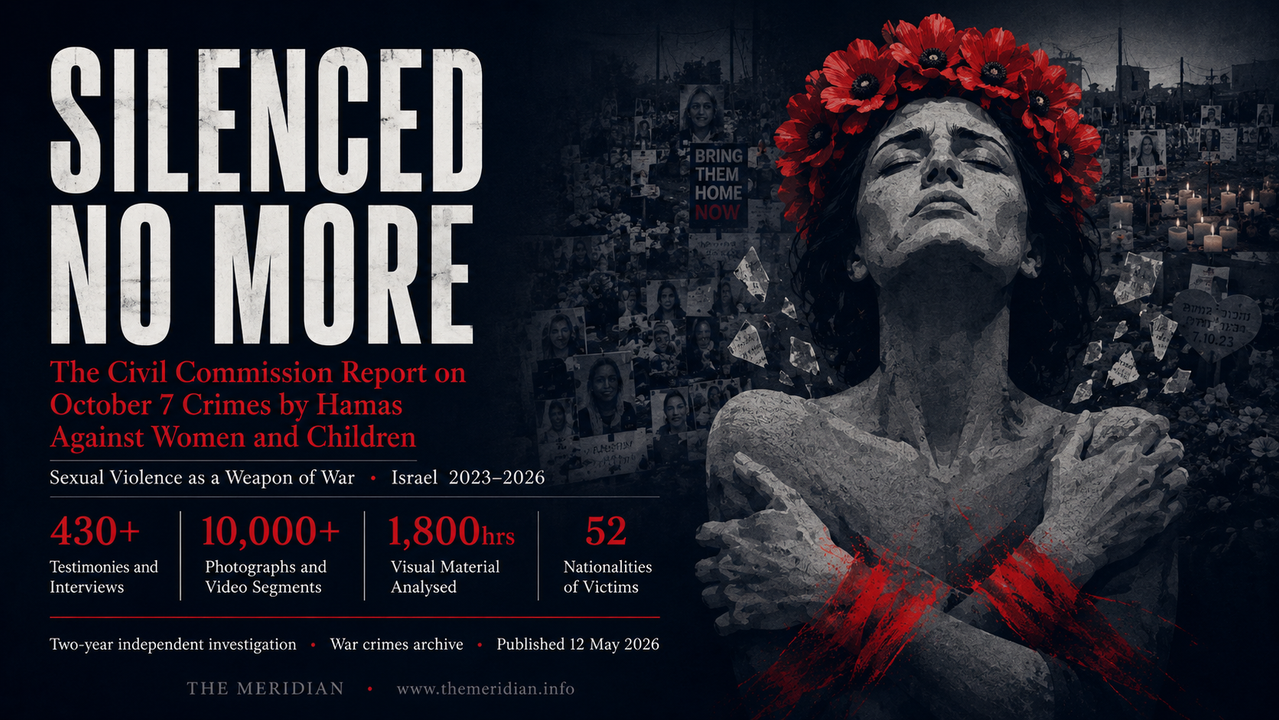
On 12 May 2026, the Civil Commission on October 7 Crimes by Hamas Against Women and Children published Silenced No More: Sexual Terror Unveiled. The 300-page report is the product of two years of independent investigation, 430 testimonies, 10,000 photographs, 1,800 hours of visual material, victims from 52 nationalities. Its central conclusion is unambiguous: sexual and gender-based violence was systematic, widespread and integral to the October 7 attacks and subsequent hostage captivity. The Meridian Intelligence Desk reports what the evidence shows, what international law says about it, and what accountability requires next.
There is a principle in international humanitarian law that documentation is the foundation of accountability. Crimes that are not recorded cannot be prosecuted. Evidence that is not preserved cannot be presented. Survivors who are not heard cannot receive justice. The Civil Commission on October 7 Crimes by Hamas Against Women and Children was established precisely in response to that principle, in the recognition that the sexual atrocities committed during and after the October 7, 2023 attacks on southern Israel required a dedicated, independent, rigorous evidentiary process if they were to be preserved in a form that international law could act upon. The report published on 12 May 2026 is the culmination of that process. It is not a political document. It is an evidentiary archive, a legal analysis and a call to accountability that The Meridian Intelligence Desk reports in the register of fact rather than opinion, because the facts are the argument.
Survivors, witnesses, hostages, first responders
Independently secured war crimes archive
Cross-referenced and geolocated
In addition to Israeli victims
Civil Commission October 7 Cochav Elkayam-Levy two year investigation war crimes archive Hamas
The Civil Commission on October 7 Crimes by Hamas Against Women and Children was founded by Dr Cochav Elkayam-Levy, a legal scholar, human rights researcher and 2024 Israel Prize laureate, widely considered Israel's highest civilian honour. The commission was established in the weeks following the October 7 attacks in response to what its founders characterised as an absence of immediate engagement by international institutions on the subject of sexual violence and other crimes against women and children committed during the attacks.
The commission's investigation team comprised approximately 25 experts and contributors including lawyers, researchers, archivists, trauma experts and human rights specialists. The report was produced in formal collaboration with the Raoul Wallenberg Centre for Human Rights, whose former director the Honourable Irwin Cotler, former Canadian Justice Minister and one of the most respected international human rights lawyers in the world, contributed the foreword. The report was endorsed by former US Secretary of State Hillary Clinton, former UN Special Adviser on the Prevention of Genocide Alice Wairimu Nderitu, former Chief Prosecutor of the UN Special Court for Sierra Leone Professor David Crane, and former Israeli Supreme Court President Aharon Barak.
The investigation's evidentiary approach was designed to meet the standards required for prosecutorial use. Every piece of evidence included in the report was carefully cross-referenced and fact-checked. Each case cited was corroborated by witnesses including first responders who attended the scene. The team worked with researchers who geolocated photographs and videos from the scene, pinpointing the location of each victim and cross-referencing it with other evidence. The commission began collecting evidence immediately after the attacks, preserving materials that are no longer publicly available including original footage and testimony recorded before dissemination and deletion cycles reduced the available evidentiary base.
Silenced No More report findings October 7 sexual violence systematic Hamas Nova music festival kibbutz
The report's central factual conclusion is stated with precision in the executive summary published by the Civil Commission: sexual and gender-based violence was systematic, widespread and integral to the October 7 attacks and their aftermath. Across multiple locations and phases of the assault, including during abduction, transfer and captivity, Hamas and its collaborators deployed recurring tactics of sexual abuse and torture against victims. The violence was not incidental. It was not chaotic. It followed patterns that were consistent across separate sites and separate perpetrators, which the commission's investigation identified as evidence of organised, coordinated conduct rather than spontaneous individual acts.
The sites documented include private homes in kibbutzim across the Gaza border area, public spaces, the Nova music festival grounds and adjacent areas, roadsides, shelters, military bases, and locations during abduction routes into Gaza and during prolonged captivity within Gaza itself. The commission's investigation traced the violence across what it describes as the full continuum of events, from the attacks themselves through abduction and transfer to prolonged captivity and the deliberate filming and digital dissemination of abuse as a means of amplifying terror. Nova music festival survivor Darin Komarov testified to the commission: you hear the screams, and then you hear silence.
The digital dimension of the documented conduct is a distinct and significant element of the report's findings. The commission found that Hamas and its collaborators systematically staged, produced and disseminated videos of hostages during captivity. Videos and images filmed during captivity show hostages being taunted, abused or humiliated on camera. Hamas in some cases posted this material directly to victims' own social media accounts. The commission described this conduct as turning visibility itself into a weapon, using the public dissemination of abuse to prolong and compound the harm inflicted on victims and their families beyond the physical acts themselves, exacerbating emotional distress and trauma far beyond the initial events and creating what the commission describes as multigenerational trauma.
These were not isolated incidents. They followed recurring, organised patterns across multiple locations and phases of the attack. The commission's conclusion is that sexual violence was a deliberate strategy, not a consequence of chaos but a component of the architecture of terror.
October 7 war crimes crimes against humanity genocidal acts international law ICC Hamas prosecution
The Civil Commission's report is explicitly designed as a prosecution-oriented document. Its legal analysis translates the documented factual record into a framework of specific charges under international humanitarian law. The commission concluded that the documented acts constitute war crimes, crimes against humanity, genocidal acts, torture, persecution and terrorism-linked sexual and gender-based violence under international law.
These conclusions align with and add to earlier findings by named international institutions. The United Nations found reasonable grounds to believe that sexual violence including rape and gang rape occurred during the October 7 attacks. The International Criminal Court prosecutor Karim Khan stated he had reason to believe that three key Hamas leaders bore responsibility for rape and other acts of sexual violence as crimes against humanity. Human Rights Watch and Amnesty International have both documented war crimes in the October 7 context. The Civil Commission's report adds to this body of evidence the most comprehensive site-by-site, case-by-case evidentiary record assembled to date, translating pattern analysis and corroborated testimony into the specific prosecutorial framework that domestic and international courts require.
The report explicitly recommends that Israeli authorities prosecute perpetrators specifically for acts of sexual and gender-based violence and outlines concrete pathways for investigation and prosecution. It also addresses the international community's responsibility, recommending engagement by the UN Security Council, the International Criminal Court and member state governments with the evidentiary record the commission has assembled. Former Canadian Justice Minister Irwin Cotler wrote in the report's foreword: atrocities do not begin with the machinery of killing. They begin with the machinery of indifference, denial and impunity. They begin with a failure to believe victims.
October 7 sexual violence denial documentation war crimes archive accountability international community
The Civil Commission's report addresses directly one of the most disturbing features of the aftermath of October 7, the rapid emergence of denial and minimisation of the sexual violence that occurred. Dr Elkayam-Levy stated publicly that she encountered silence and denial almost immediately after the attacks, and that the speed and scale of that denial made the creation of a rigorous, independently verified evidentiary archive urgent. She said that such denials have helped to fuel antisemitism globally and that she believes exposing these crimes will aid in supporting victims of rape everywhere who, even in 2026, are not automatically believed.
The political context in which the report was published, encompassing an ongoing war in Gaza, intense international debate about Israeli military operations, and deep divisions about the broader conflict, has made the sexual violence of October 7 a heavily contested terrain. The Civil Commission's response to that contestation is evidentiary rather than rhetorical. By constructing an independently secured war crimes archive under stringent international standards, cross-referencing testimony with geolocation data, and engaging the formal endorsement of leading international law experts and institutions, the commission has produced a record that is designed to withstand precisely the scrutiny that denial requires. Le Monde described the report as the most comprehensive investigation to date into sexual violence committed during the attacks.
The broader significance of the Silenced No More report extends beyond the specific context of October 7. Sexual violence as a weapon of war has been documented in conflicts from Bosnia to the Yazidi genocide to the Democratic Republic of Congo to Sudan. In each case, documentation has been the foundation of accountability, and the absence of documentation has been the foundation of impunity. The commission's founding chair noted this connection explicitly: from Iran to Bosnia to Yazidi communities and beyond, women's bodies have too often been battlegrounds. This report ensures that these crimes are seen, named and cannot be denied.
October 7 accountability international law prosecution ICC UN Security Council sexual violence war crimes
The Civil Commission's report is not the end of a process. It is the beginning of one. The evidentiary archive has been assembled. The legal framework has been constructed. The pathways for prosecution have been identified. What follows depends on the institutions and governments that the report explicitly calls upon to act.
The International Criminal Court, whose prosecutor has already alleged Hamas leadership responsibility for rape and other acts of sexual violence as crimes against humanity, now has access to the most comprehensive evidentiary record assembled on this subject. Whether that record is incorporated into active ICC proceedings is a question of prosecutorial and political will rather than evidentiary sufficiency. The UN Security Council, which has a formal responsibility under international humanitarian law to respond to systematic sexual violence in conflict, has yet to act in a manner proportionate to the findings documented in this report and in the earlier UN investigations that preceded it.
Member state governments that have endorsed the principle that sexual violence as a weapon of war constitutes an international crime requiring international accountability, a principle affirmed in UN Security Council Resolution 1820 of 2008 and subsequent resolutions, have a specific obligation to engage with the evidentiary record the commission has assembled. The commission CEO Merav Israeli-Amarant stated that institutional international recognition creates the beginning of justice. Recognition is the necessary precondition. Prosecution is the destination. The distance between them is measured in institutional will.
The Meridian Intelligence Desk publishes this report on the findings of the Civil Commission because The Meridian's commitment to human rights, to the protection of civilian populations in conflict, and to the accountability of those who use sexual violence as an instrument of political and military strategy is not conditional on the identity of the perpetrator or the identity of the victim. Sexual violence as a weapon of war is a violation of international humanitarian law. When it is systematic and deliberate, it is a crime against humanity. The Civil Commission has documented it. The law defines it. The world must act on it.
Add comment
Comments